

How I tracked down a retired fighter pilot of the Pakistan Air Force who wrote a viral piece on a fallen Indian counterpart, and how the iconic poet Gulzar and singer Mehdi Hasan figure in the story behind his article published recently in Sapan News
PERSONAL POLITICAL
Last November, I read an article titled “Salute Across the Skies” by a retired Pakistan Air Force officer in tribute to an Indian Air Force pilot who had died in a Tejas fighter jet crash during an air show in Dubai. I received the piece several times via email, WhatsApp and Facebook messages and groups, as well as on various social media sites. I also saw it being widely reported on, particularly by the Indian media.
A further search revealed Pervez Akhtar Khan listed as a writer at The Friday Times, so I emailed him to ask if he was the writer of the piece in question. I also messaged him via Facebook, as the person with that name had a private profile.
Some time later, I finally got a reply. He was indeed the writer, had originally posted it on his Facebook page – in English, later translated to Urdu (not the other way around as some reports had claimed).
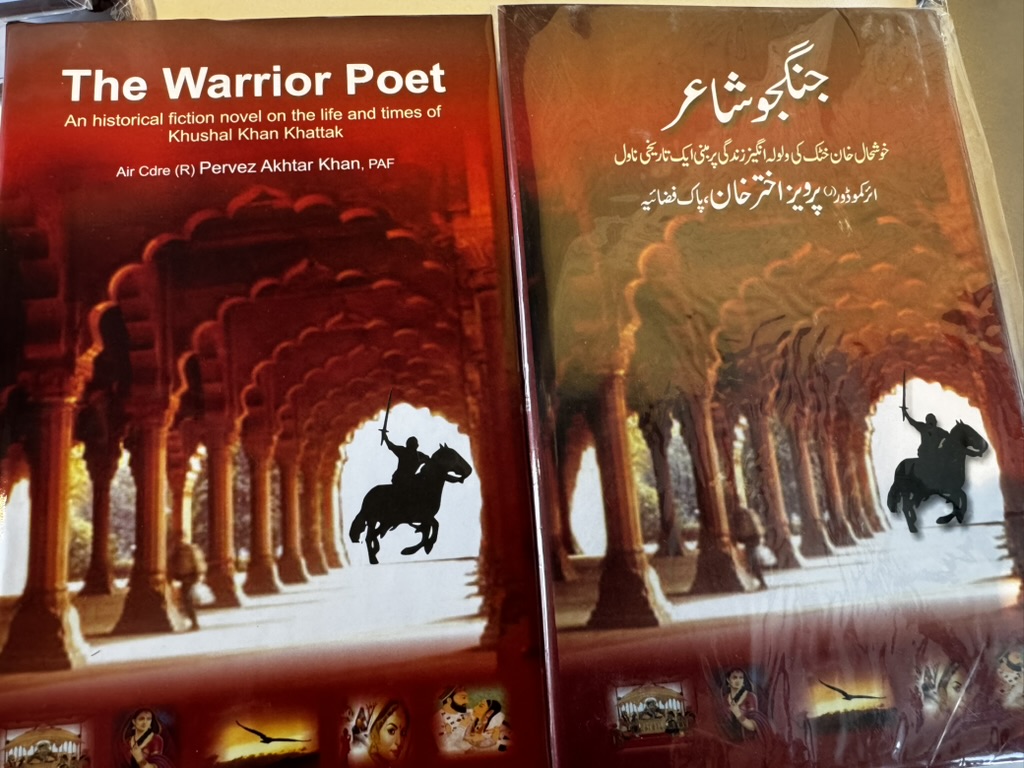
It was great to meet him in Islamabad for coffee the following month. Akhtar Bhai, as I call him, has served as Pakistan’s Defence Attache in Paris, and is a prolific writer, posting mostly on his Facebook page and on WhatsApp. His focus areas are defence policy, strategy, and social issues. He also authored a historical fiction on the legendary 17th-century Afghan Pashtun poet, chief, and warrior Khushal Khan Khattak, which he later translated into Urdu — a labour of love which he generously gifted me.
I enjoy reading his pieces and appreciate his wisdom, empathy, open-mindedness and openheartedness. And humour, as in a piece he wrote about being outwitted by a pair of mynahs building a nest in a kitchen pipe. This was not a fair competition; his wife was on the birds’ side.

While chatting some days ago, he shared a short post about identity, which got me thinking, where we spend our early childhood and where we grow up, remain seared in our memories and occupies a disproportionate place in our emotions, especially the older we grow. There is also an emotional tie to the land of our ancestors.
I was reminded of when Gulzar visited Pakistan in 2013 and went to his village Dina for the first time, he was so overcome with emotion that he had to return to India without being able to attend the literary event in Karachi he had come for. He talked about this in an interview with the Lahore-based writer Sehyr Mirza published in Aman Ki Asha (April 2013).
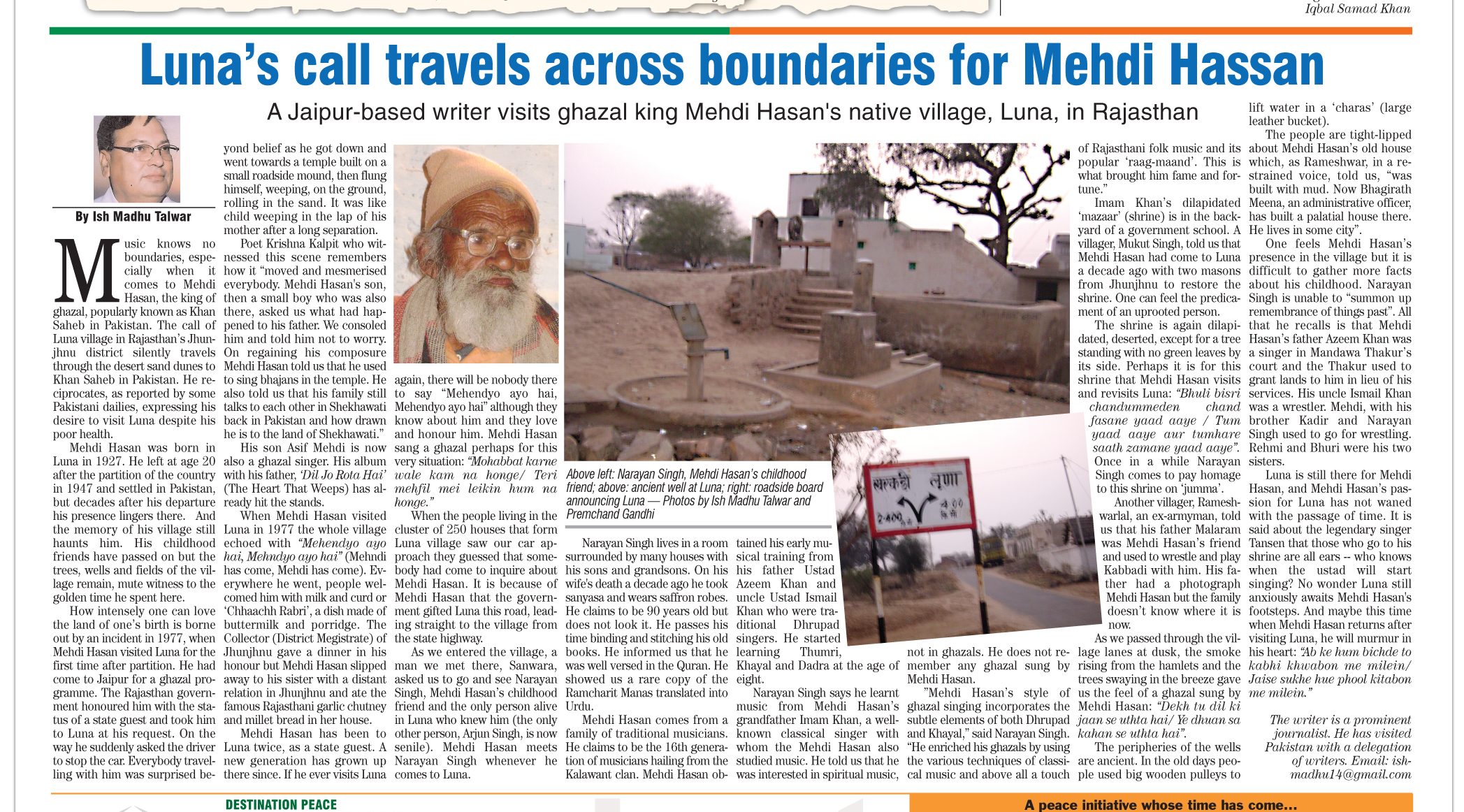
When Mehdi Hassan returned to India for the first time and was being driven through the Rajasthan desert, he asked the driver to stop the car, got out began rolling on the ground, as the late journalist Ish Madhu Talwar documented in another article I edited for Aman Ki Asha (April 2010), which appears to be no longer online. I have a PDF of the page, and the article text.
Talwar ji wrote that Mehdi Hasan was born in Luna in 1927.
He left at age 20 after the partition of the country in 1947 and settled in Pakistan, but decades after his departure his presence lingers there. And the memory of his village still haunts him. His childhood friends have passed on but the trees, wells and fields of the village remain, mute witness to the golden time he spent here.
How intensely one can love the land of one’s birth is borne out by an incident in 1977, when Mehdi Hasan visited Luna for the first time after partition. He had come to Jaipur for a ghazal programme. The Rajasthan government had honoured him with the status of a state guest and took him to Luna at his request.
On the way he suddenly asked the driver to stop the car. Everybody travelling with him was surprised beyond belief as he got down and went towards a temple built on a small roadside mound, then flung himself, weeping, on the ground, rolling in the sand. It was like child weeping in the lap of his mother after a long separation.
Poet Krishna Kalpit who witnessed this scene remembers how it “moved and mesmerised everybody. Mehdi Hasan’s son, then a small boy who was also there, asked us what had happened to his father. We consoled him and told him not to worry. On regaining his composure Mehdi Hasan told us that he used to sing bhajans in the temple. He also told us that his family still talks to each other in Shekhawati back in Pakistan and how drawn he is to the land of Shekhawati.”
His son Asif Mehdi is now also a ghazal singer. His album with his father, ‘Dil Jo Rota Hai’ (The Heart That Weeps) has already hit the stands.
I shared these thoughts with Akhtar Bhai, and also how emotional it was for me to visit my father‘s hometown Allahabad as an adult and see the house he had grown up in, although it meant nothing to me as a child.
In response he shared an article with me that he had been working on. I loved his vision of identity and a homeland at peace with its neighbours, reflecting on a future for Southasia defined not by divisions, but by regional cooperation and shared opportunities — a vision articulated by the Founding Charter of the Southasia Peace Action Network, which some of us launched in March 2021.
Read Pervez Akhtar Khan’s poetic and thoughtful piece in Sapan News: Many rivers, one dream: Reflections of a wanderer, a syndicated feature available for republication with due credit to https://www.sapannews.com.
And follow Sapan News on Instagram – instagram.com/sapan_news
Filed under: Afghanistan, Culture, Freedom of expression, History, Literature, Pakistan, Pakistan northern areas, Pakistan-India, Peace, Personal, Progressive politics, Southasia | Tagged: art, books, music, Travel | Leave a comment »


