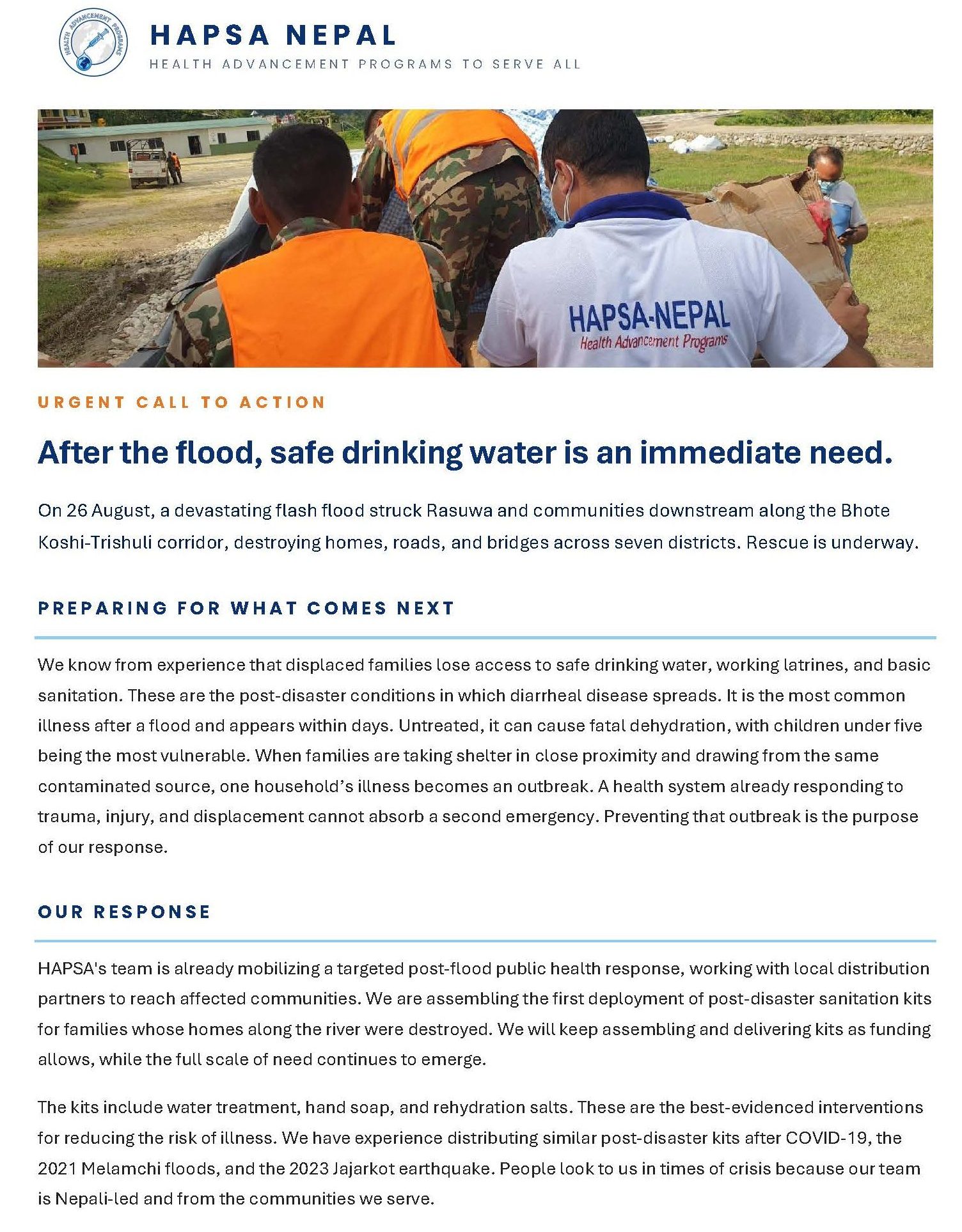
Sharing an email below from my friend and fellow peacemonger Dr. Ramu Kharel, an emergency physician at Brown University who loves Urdu poetry, and founded Health Advancement Programs to Serve All (HAPSA), Nepal, after the 2015 earthquake:
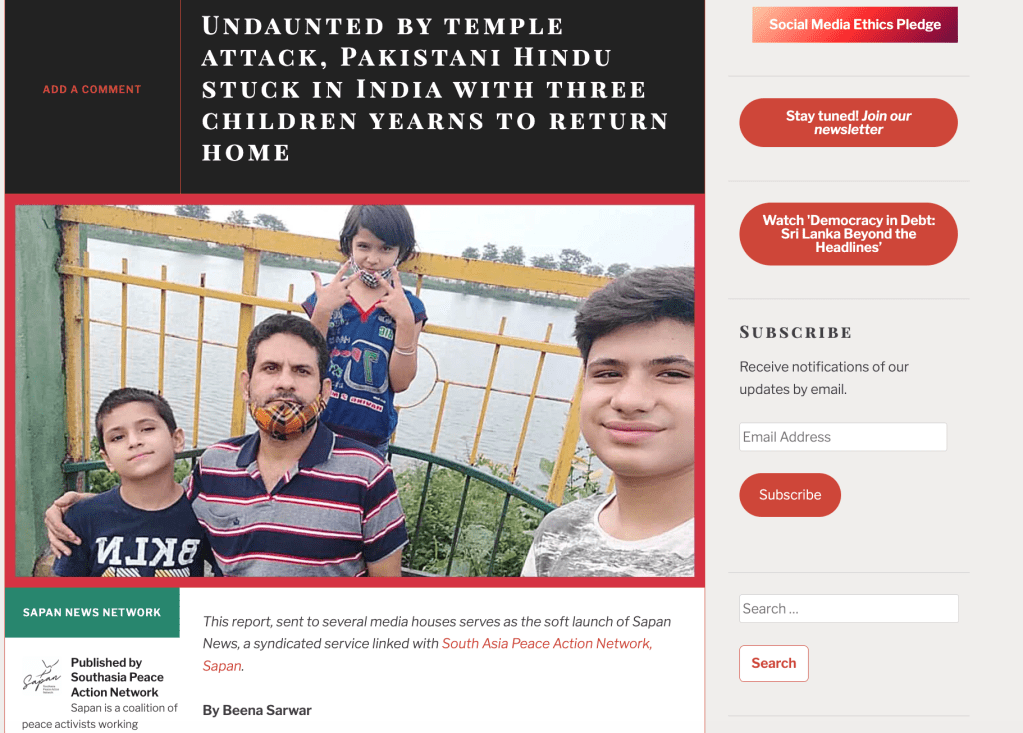
A Pakistani Hindu stuck in India with three children after his wife died in April is pleading with the authorities to let him return to Pakistan before Independence Day, August 14.
Screenshot from the southasiapeace.com site where this story was first published.
I had been in touch with the family for weeks, following the story since the man’s nephew Kapeel Kumar in Pakistan reached out for help via social media.
On 12 August 2021, we posted the article to the website of the Southasia Peace Action Network (Sapan; we write it like a word, not all caps) with this note:
This report, sent to several media houses serves as the soft launch of Sapan News, a syndicated service linked with Southasiapeace.com.
Several media outlets to whom we’d been sending press releases about Sapan events since launching in March 2021, published the story – listed below the piece.
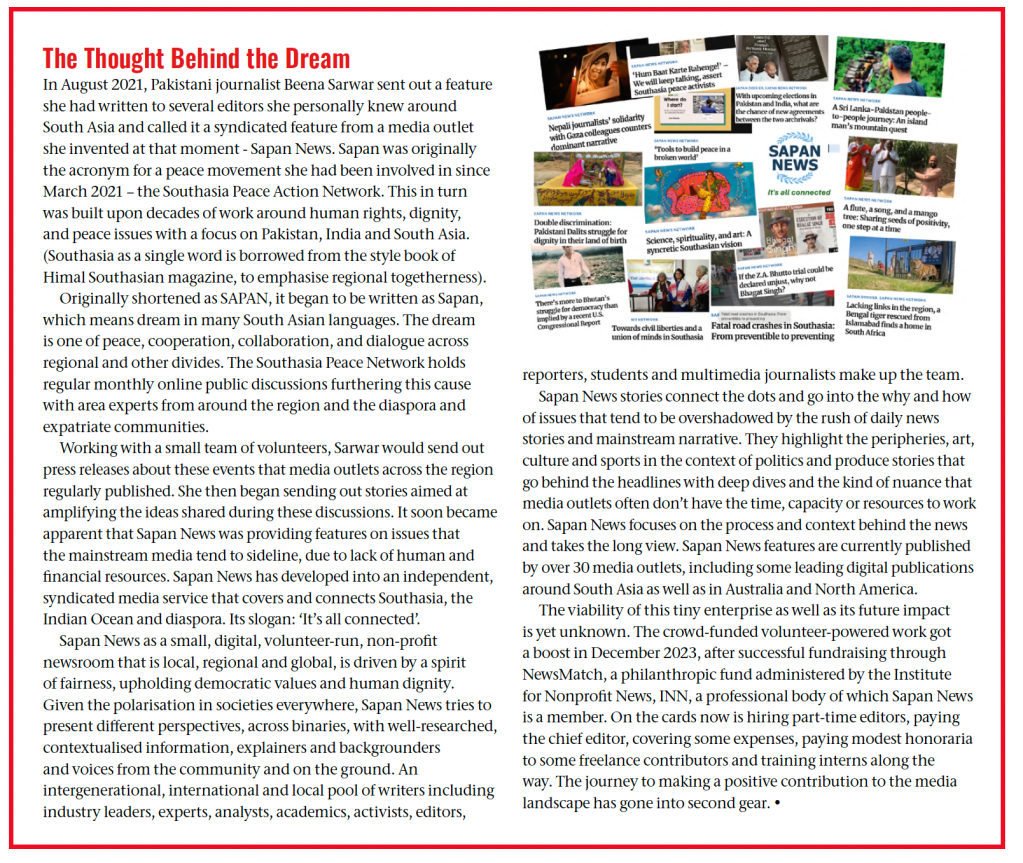
That is how Sapan News started, with the aim of ampifying the narrative of dialogue, empathy and collaboration in the region — see the Sapan Founding Charter, that has now been endorsed by more than 150 organisations and several hundred individuals. This is not a mass signature campaign but the slow, steady, building of a community with a minimum common agenda – peace, dialogue, empanty and collaborion in the region and beyond (Is your name on it?).
Two years later, in March 2023, at the Sapan second anniversary, we launched Sapan News as an independent media outlet. One of our amazing volunteers, the ace editor Aekta Kapoor in Delhi built the brand new Sapan News website literally overnight – http://sapannews.com
Sapan News could now apply for membership to the Institute for Nonprofit News (INN) about which I learnt during my Media Transformation Challenge fellowship at the Poynter Institute — thanks to fellow NiemanCharlie Sennott, founder of GroundTruth for nudging me to apply. Much gratitude to my wonderful community for help with the funding, especially Swati Sharan, then in Canada, and Siraj Khan, then President of the Pakistani Association of Greater Boston. And not least, thanks to MTC for the partial scholarship, and to my MTC colleagues for their support, especially Jonathan Kealing – we later remembered we had first connected when I wrote about our slain comrade Sabeen Mahmud for PRI where he then worked.
Box item in the International Federation of Journalists’ 22nd annual South Asia Press Freedom Report report, featuring Sapan News.
As we quietly celebrate the milestone of our fifth anniversary, we are in the process of transitioning to a new name: Global Southasia. Beyond the Headlines — thanks to our wonderfully creative associate editor Pragyan Srivastava for suggesting this name.
Much gratitude to each individual who supported and encouraged us, volunteered and worked with us, shared ideas, time and skills to help us be where we are. We are still a long way from where we’d like to be but we couldn’t have come this far without you.
(The update on Ajeet Kumar Nagdev is that back home in Pakistan, the family has got him remarried, and he has two more children. His nephew Kapeel who I met earlier this year, has fascinating insights on Pakistan’s Hindu community. More on that another time).
Appeal to India, Pakistan to release, repatriate incarcerated cross-border fisherpeople
Article 5 of the 2008 Consular Access Agreement requires repatriation within one month after nationality confirmation and sentence completion, yet 178 Indians remain imprisoned in Pakistan.
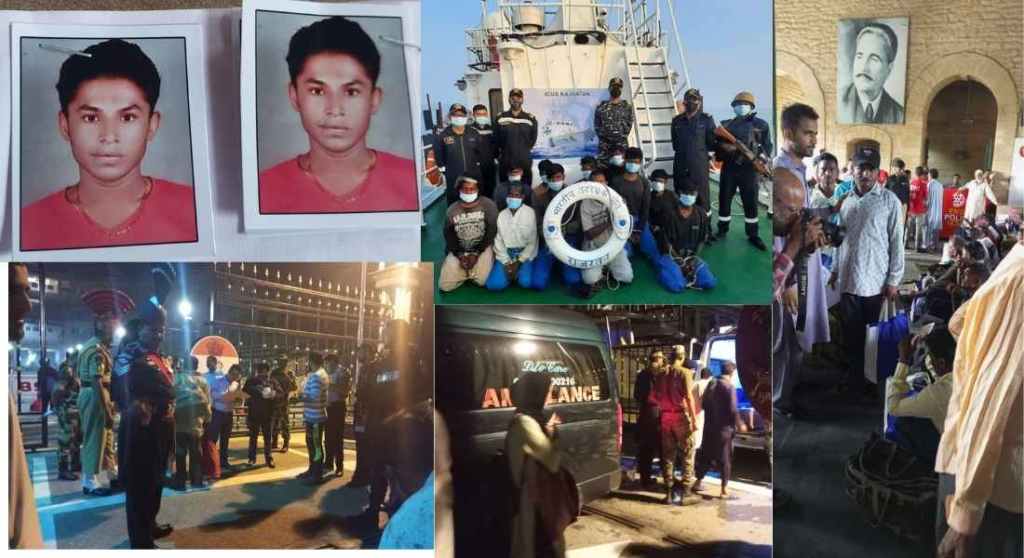
Fisherfolk suffer while governments bicker: (Clockwise from top left): Indian fisherman Jagdish Mangal died in Pakistani prison, 6 Aug. 2023; Pakistani fisherfolk arrested by Indian coastguard, Sept. 2021; Indian fisherfolk waiting to be repatriated at Lahore railway station, 2023; body of Pakistani fisherman Amir Hamza who died in Indian prison repatriated via Wagah border, 14 Sept. 2021; Indian fisherfolk being repatriated at Wagah, 15 Nov. 2012. Beena Sarwar archive photos.
ByBeena Sarwar/ Sapan News
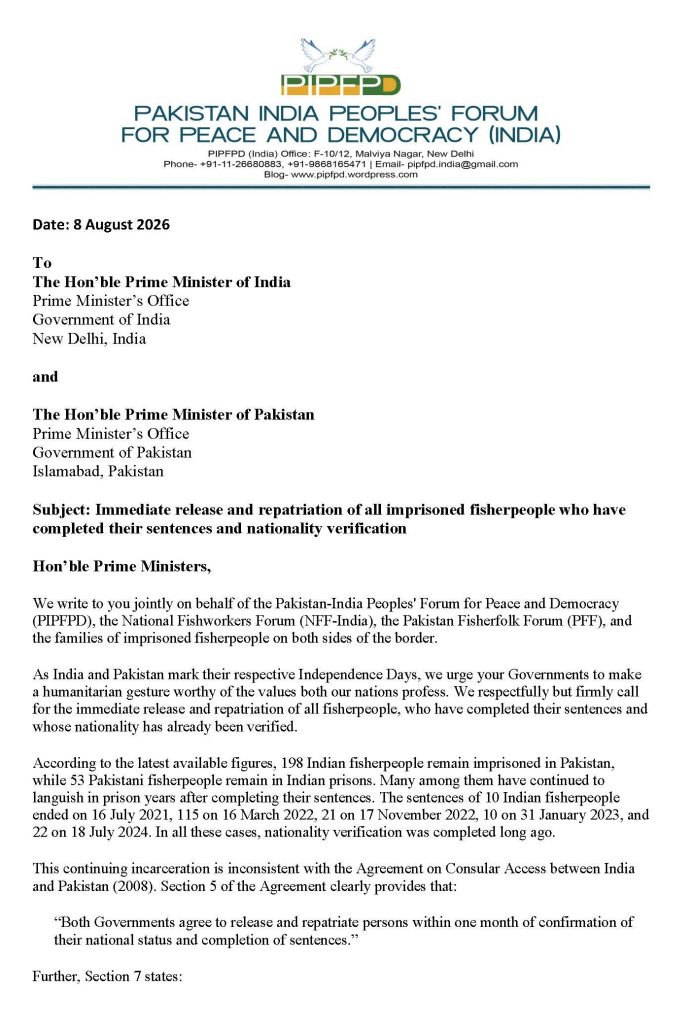
BOSTON: As India and Pakistan get ready to mark their respective Independence Days, the families of imprisoned fisherpeople on either side of the border along with various organisations have jointly written to the Prime Ministers of India and Pakistan demanding “the immediate release and repatriation of all imprisoned fisherpeople who have completed their sentences and nationality verification” as a goodwill and humanitarian gesture.
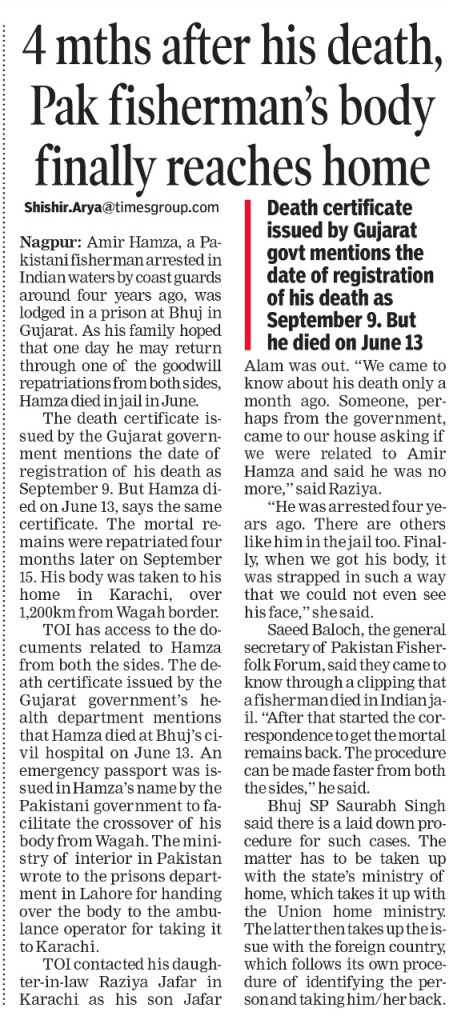
Report about Pakistani prisoner Amir Hamza’s death in Indian prison, by Shishir Arya, Times of India, 17 September 2021.
The letter also calls for accountability for continued detentions despite completion of prison sentences, which is in violation of the bilateral Agreement on Consular Access, 2008.
Section 5 of the Agreement categorically states: “Both Governments agree to release and repatriate persons within one month of confirmation of their national status and completion of sentences.”
“Unfortunately, this provision has not been implemented in letter and spirit,” says a press statement issued jointly on Friday by the Pakistan-India Peoples’ Forum for Peace and Democracy (PIPFPD), the National Fishworkers Forum, the Pakistan Fisherfolk Forum and families of Imprisoned Fisherpeople.
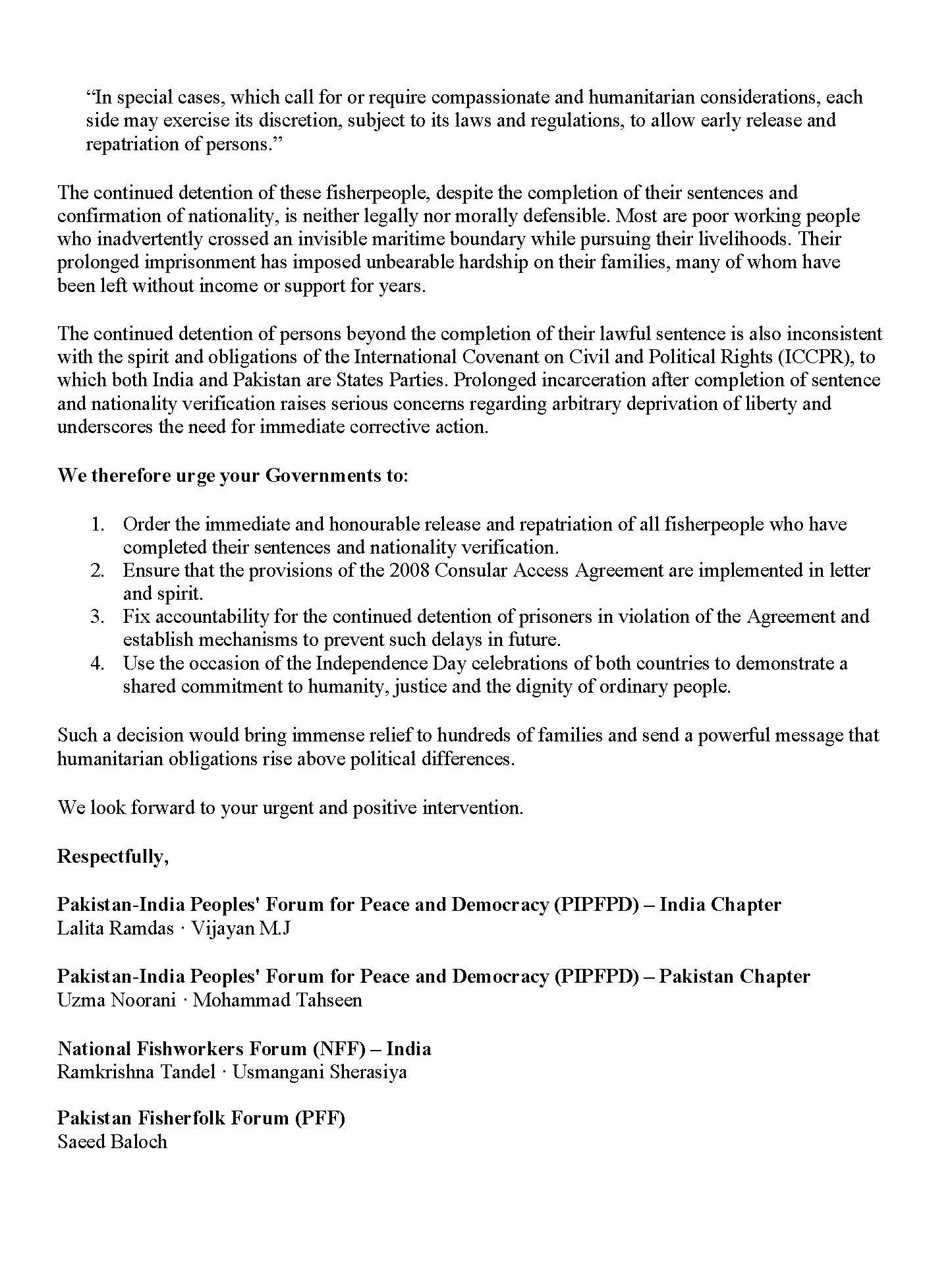
The letter urges both governments to implement mechanisms to prevent such delays in the future, and to pursue a ‘No Arrest Policy’ for fisherpeople who inadvertently cross the maritime boundary while pursuing their livelihoods. This is something that activists have long been calling for.
The number of arrests have declined significantly over the past couple of years — nearly 750 fisherfolk were imprisoned in jails across Pakistan and India in April 2023.
The statement suggests that this is because “fisherpeople avoid going towards the International Maritime Boundary Line to catch fish”.
According to the press statement there are “shocking” stories about Indian fisherpeople arrested by Pakistan and vice versa.
“Their prolonged incarceration deprives them and their family members of basic human rights and causes severe hardship to their families,” subjecting them to ” economic and emotional distress,” says the statement, urging that the arrest and detention of fisherpeople be viewed from a humanitarian perspective.
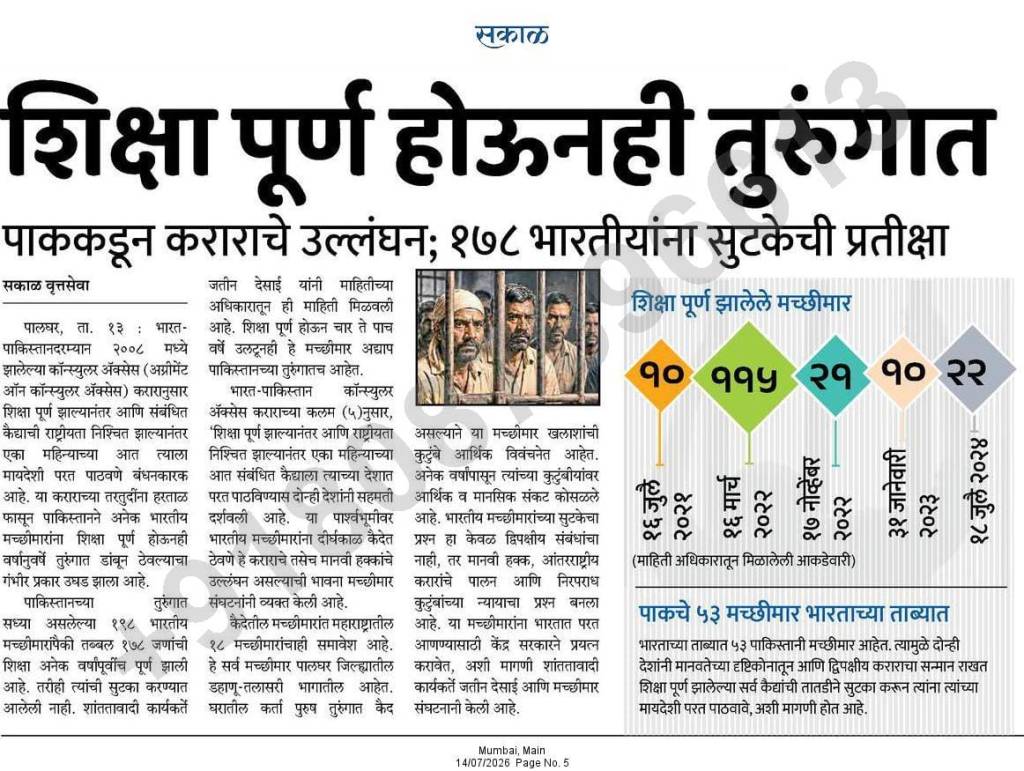
As many as 198 Indian fisherpeople are currently imprisoned in Pakistan, including 178 who have completed their sentences but continue to remain in custody, according to the data released in the statement.
Number of incarcerated Indian fisherpeople in Pakistan who have completed their sentences
Sentence completed on
Time spent in prison after having completed sentence
10
16 July 2021
5 years, 22 days
115
16 March 2022
4 years, 4 months, 22 days
21
17 November 2022
3 years, 8 months, 21 days
10
31 January 2023
3 years, 6 months, 7 days
22
18 July 2024
2 years, 20 days
Table compiled with data provided by the joint press release, 07 August 2026.
“Every year, an estimated four to five Indian fisherpeople die while imprisoned in Pakistan. In March last year, an Indian fisherperson also died by suicide in prison,” says the statement.
According to the latest prisoner exchange list released on 1 July this year, Pakistan holds 250 prisoners (52 civilian prisoners and 198 fishermen) “who are Indian or believed-to-be-Indian” as India’s Ministry of External Affairs put it in a media release.
Meanwhile, India holds 439 Pakistani “or believed-to-be-Pakistani prisoners, including 386 civilian prisoners and 53 fishermen,” to quote Pakistan’s Ministry of Foreign Affairs.
Clipping from Marathi paper ‘Sakal’ headlined: “In prison even after completion of sentences”, 14 July 2026
This language of ‘believed-to-be’ used by the bureaucracies on either side is a reflection of the need to verify identity before proceeding with repatriation or even consular access. The detained fisherfolk rarely carry identity documents while out fishing. Once arrested, verifying their identity is a cumbersome process that typically takes far longer than necessary, especially in this digital age..
Yet, despite their ongoing tensions, both countries have regularly exchanged prisoner lists twice a year, in January and July, since the practice began in 2008, following the constitution of a Joint Judicial Commission on Prisoners in 2007.
Comprising four retired justices from either side, the committee met twice a year and worked on expediting the release of cross-border prisoners.
However, it has not met since its last convention in October 2013 in India.
A heartfelt appeal: Joint letter to the Prime Ministers of India and Pakistan from the Pakistan-India Peoples’ Forum for Peace and Democracy (PIPFPD), National Fishworkers Forum (NFF) India, and Pakistan Fisherfolk Forum (PFF)
A Sapan News syndicated report available for republication with due credit tosapannews.com