

Five years ago, I wrote an article that I would normally have sent to one or two media outlets, perhaps in Pakistan and across the border in India. I headlined it: Undaunted by temple attack, ‘Pakistani Hindu stuck in India with three children yearns to return home (I’m not a fan of highlighting religious identity, but in this case, it was important).
This is the lede/ lead:
A Pakistani Hindu stuck in India with three children after his wife died in April is pleading with the authorities to let him return to Pakistan before Independence Day, August 14.
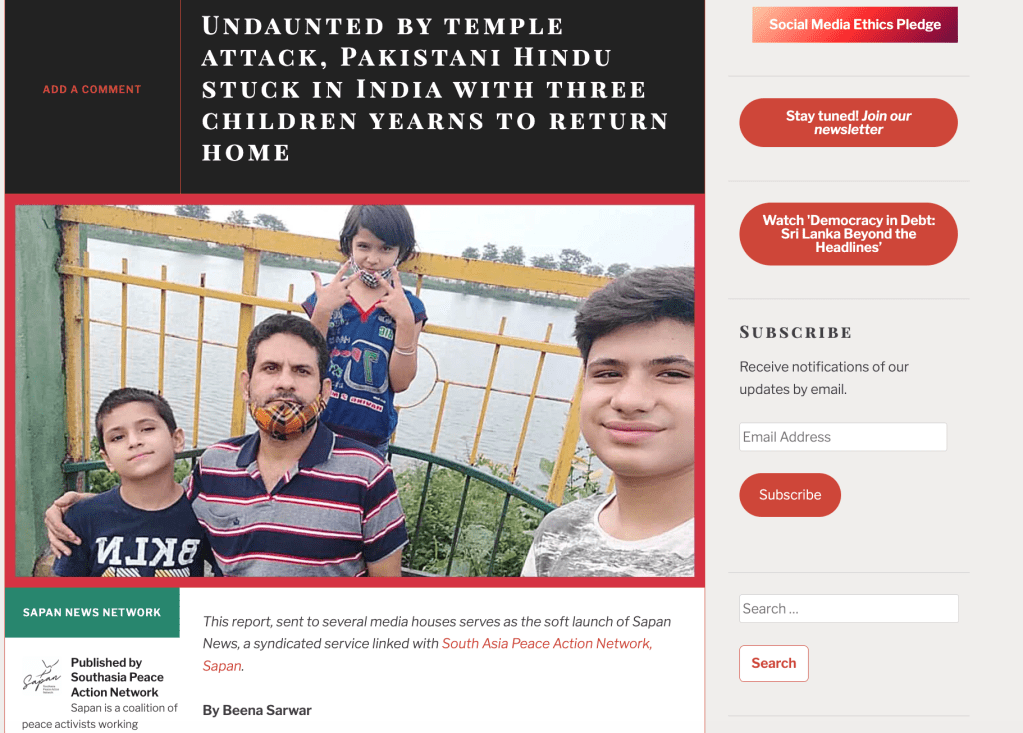
I had been in touch with the family for weeks, following the story since the man’s nephew Kapeel Kumar in Pakistan reached out for help via social media.
On 12 August 2021, we posted the article to the website of the Southasia Peace Action Network (Sapan; we write it like a word, not all caps) with this note:
This report, sent to several media houses serves as the soft launch of Sapan News, a syndicated service linked with Southasiapeace.com.
Several media outlets to whom we’d been sending press releases about Sapan events since launching in March 2021, published the story – listed below the piece.
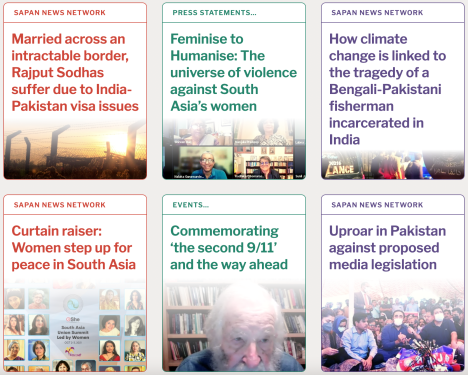
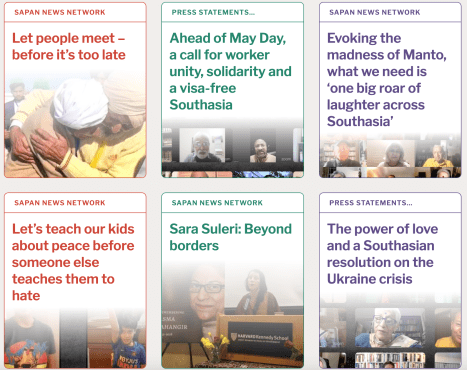
That is how Sapan News started, with the aim of ampifying the narrative of dialogue, empathy and collaboration in the region — see the Sapan Founding Charter, that has now been endorsed by more than 150 organisations and several hundred individuals. This is not a mass signature campaign but the slow, steady, building of a community with a minimum common agenda – peace, dialogue, empanty and collaborion in the region and beyond (Is your name on it?).
Two years later, in March 2023, at the Sapan second anniversary, we launched Sapan News as an independent media outlet. One of our amazing volunteers, the ace editor Aekta Kapoor in Delhi built the brand new Sapan News website literally overnight – http://sapannews.com
Sapan News could now apply for membership to the Institute for Nonprofit News (INN) about which I learnt during my Media Transformation Challenge fellowship at the Poynter Institute — thanks to fellow Nieman Charlie Sennott, founder of GroundTruth for nudging me to apply. Much gratitude to my wonderful community for help with the funding, especially Swati Sharan, then in Canada, and Siraj Khan, then President of the Pakistani Association of Greater Boston. And not least, thanks to MTC for the partial scholarship, and to my MTC colleagues for their support, especially Jonathan Kealing – we later remembered we had first connected when I wrote about our slain comrade Sabeen Mahmud for PRI where he then worked.
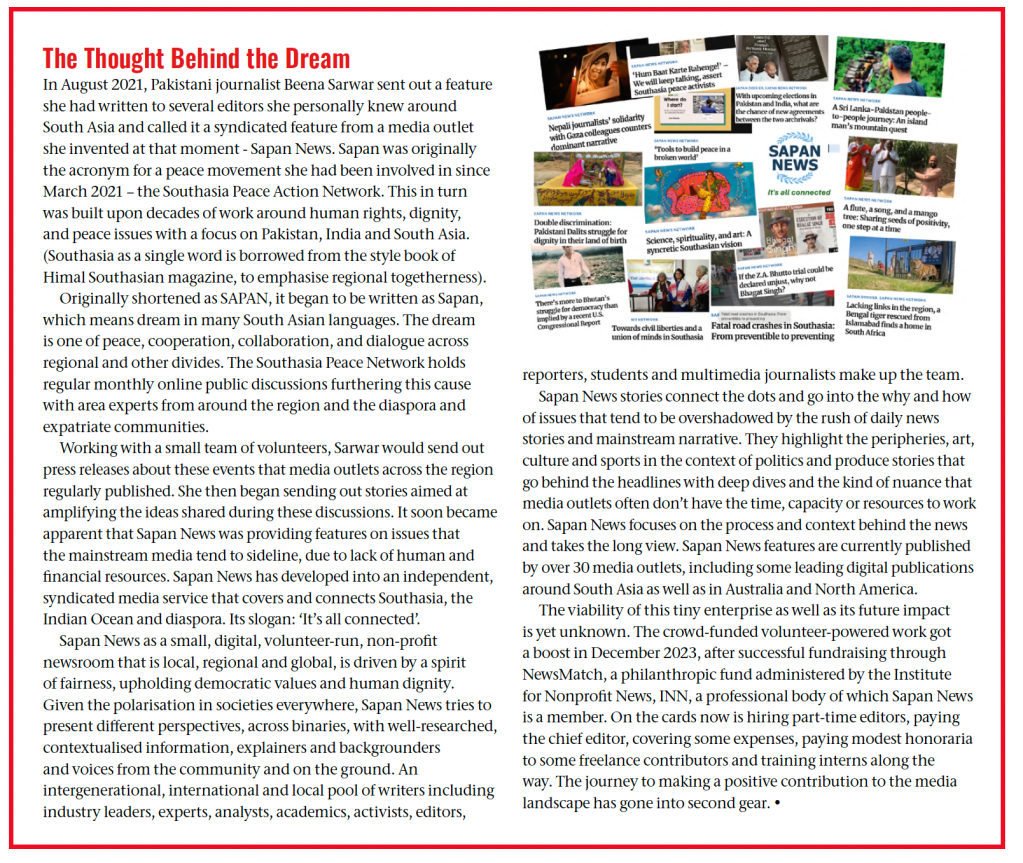
I later changed the initial tagline for Sapan News, ‘It’s all connected’ (it is, right?) to ‘Beyond the Headlines’ (after making our Pulitzer Center-supported documentary ‘Democracy in Debt: Sri Lanka Beyond the Headlines’, 2024).

As we quietly celebrate the milestone of our fifth anniversary, we are in the process of transitioning to a new name: Global Southasia. Beyond the Headlines — thanks to our wonderfully creative associate editor Pragyan Srivastava for suggesting this name.
Much gratitude to each individual who supported and encouraged us, volunteered and worked with us, shared ideas, time and skills to help us be where we are. We are still a long way from where we’d like to be but we couldn’t have come this far without you.
(The update on Ajeet Kumar Nagdev is that back home in Pakistan, the family has got him remarried, and he has two more children. His nephew Kapeel who I met earlier this year, has fascinating insights on Pakistan’s Hindu community. More on that another time).

Filed under: Freedom of expression, journalism, Media, Progressive politics, Southasia | Tagged: being hindu in pakistan, building bridges, covid, creating spaces for empathy, dialogue, India, Pakistan, Pakistani Hindus, pandemic, Peace, sapan news, Southasia Peace |


Leave a Reply