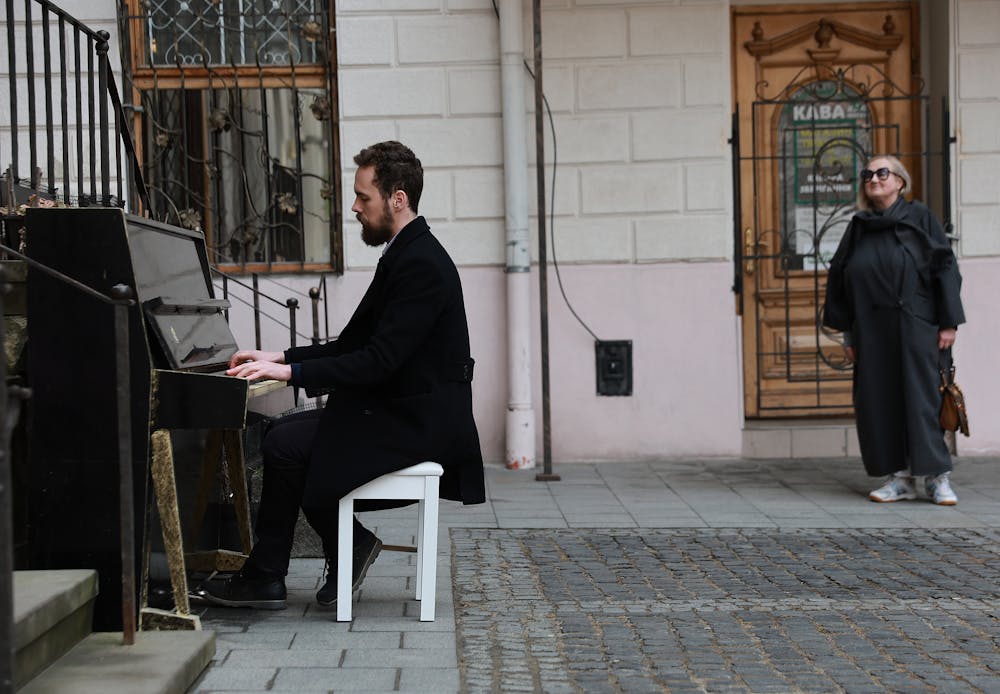
The “piano man,” a war refugee, became one of the symbols of resistance emerging from conflict. Photo by Joe Raedle/Getty Images, Lviv, Ukraine, March 29, 2022.
It’s a dream, and aspiration. To quote Gulzar’s beautiful poem, “Ankhon ko visa nahi lagta, sapnoN ke sarhad koi nahiN” (Eyes don’t need a visa, dreams don’t have frontiers)
So there’s this dream: Southasia is a region with soft borders, like the European Union, or like the Southasia region itself was, prior to 1965.
We’ve long been calling for dialogue to be uninterrupted and uninterruptible. The call for soft borders and allowing people-to-people contact takes this further. Letting people meet, travel, and trade will benefit the region economically, as well as reduce misunderstandings and violent extremism.
Check out the list of demands – we know it’s a long shot, but we desis are used to bargaining – sign and share this online petition, coordinated by the Southasia Peace Action Network or Sapan. As of today, over 36,000 signatures and counting. Help us reach 50,000.
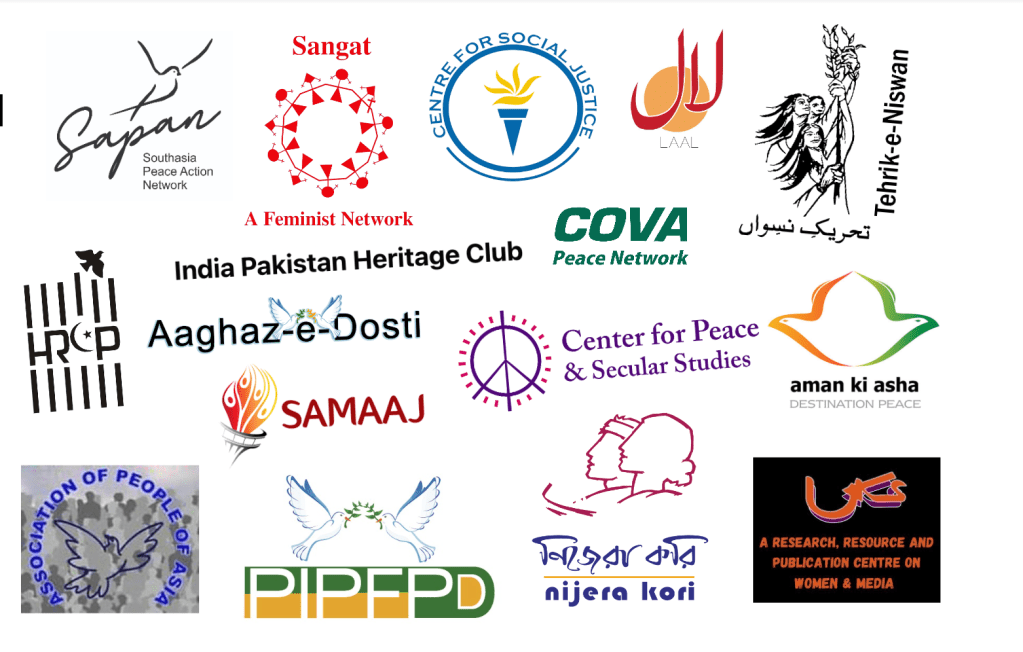
Here’s a compilation of the organisations collaborating on this so far. More are joining. Each person counts, like the drops that make up the ocean.
We may not attain the dream in our lifetime but let’s not let that stop us from trying.
Logos of participating organisations. Being updated on the petition site as more join.
The petition is addressed to the prime ministers and foreign offices of India, Pakistan and Bangladesh. Nepal and Sri Lanka allow visa-on-arrival. This is how it starts:
“This August marks 75 years since India gained independence from the British colonists and was simultaneously partitioned as the new country of Pakistan was born. In 1971, there was further independence and partition as East Pakistan became Bangladesh. These momentous events are marked with much blood and pain.
“It is time to heal the pain. Let people meet, “milne do”. Let us ‘reclaim Southasia’, to quote the late journalist I.A. Rehman.
“It is essential to allow people-to-people contact in order to fulfil the objectives of SAARC, the South Asian Association for Regional Cooperation which aims to “promote the welfare of the peoples of South Asia” in all ways possible and to enable the peoples of the region to “live in dignity and to realise their full potential”.
Over 30 organizations around Southasia and beyond have endorsed a joint statement about cross-border prisoners initiated and coordinated by Sapan, the Southasia Peace Action Network, calling for the humane treatment of cross-border prisoners and to decriminalise inadvertent illegal border crossings.
All three had served their sentences but remained in custody on ‘the other side’. Compounding the tragedy, there are terrible delays in the repatriation of the bodies of such fisherfolk, notes the statement.
The statement also draws attention to some teenagers who remain incarcerated in juvenile centers in India, mostly without any contact with their families. One has already served his sentence but remains incarcerated. Details below – Statement text and endorsements:
Arrested fisherfolk in custody across the border, far from home, no consular access until after sentence is over, often kept in custody even after serving their sentences. File photo. Getty images
Rajdeep Sardesai: A stable Pakistan is in India’s interests. Screenshot by Tej Kaul from yesterday’s show.
Thanks to the Pakistan Supreme Court for the unanimous judgement upholding the opposition’s right to a no-confidence motion and declaring as void the ruling party’s attempt to dissolve the assembly and hold fresh elections. The situation had many of us on tenterhooks given its potential to disrupt the democratic political process that has only just begun taking hold in the country.
Since 2008, only two cycles of elected governments have completed their term and handed over power to the next one without the assemblies being dissolved. Imran Khan was the third political leader to grasp the baton of this relay. If he passed the baton on to the next elected government that would be a historic hat-trick in Pakistan’s history and hopefully strengthen the process and pave the way for it to continue. He can still redeem himself by doing that after losing the no-confidence move on Saturday and stepping into the opposition.
Of course elections aren’t the be-all and end-all of a democratic political process. But as the wise know, the process is crucial. As a sportsman, Imran Khan should know that the game is only an event that needs an ongoing, continuous process of rigorous, consistent training.
Unfortunately the former captain of the Pakistan cricket team has turned out to be a sore loser. My commiserations to his supporters, many of whom had placed their hopes in him to improve the system. They need to recognise that an individual can’t do this alone. He has to work with others, and needs to pick the right people for his team. And stay in the game.
Sharing personal memories of the brilliant Sara Suleri whose genre-defying book Meatless Days inspired generations of writers, feminists, memoirists and dislocated Southasians. Thanks Ailia Zehra at The Friday Times for asking me to write this piece.Published as a Sapan syndicated feature in TFT, The Wire, Geo TV blog, South Asia Monitor and The Print – shared here with additional pix and links.
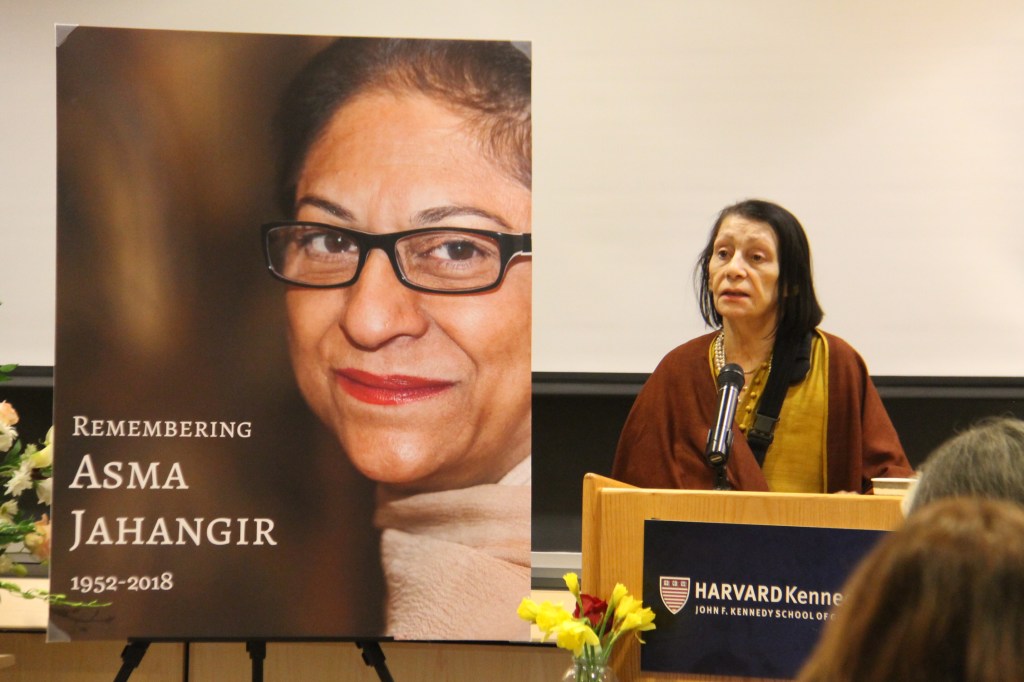
February 2018: Sara Suleri pays tribute to Asma Jahangir. Photo: Beena Sarwar.
PERSONAL-POLITICAL
By Beena Sarwar
March 25, 2022, Sapan News Service:
“Aur bataiye” – tell me more, a polite invitation to keep talking. I can hear her voice, perhaps naturally husky, made deeper with years of cigarette smoking and perhaps more recently with pain and other medications.
She’d send her love to Pakistan whenever I’d call before flying out from Boston, where we had both ended up around ten years ago – she after retiring as Professor Emeritus of English from Yale University. I had transplanted myself from my home city Karachi where I was editing Aman Ki Asha, hope for peace – between India and Pakistan.
“Dream on!” I hear Sara say. And yet, she agrees, it’s important to keep going. She’s also a hundred percent supportive of our push for a regional approach – the South Asia Peace Action Network, or Sapan, the more recent endeavour, launched last year with a wonderful group of inter-generational, cross-border peacemongers.
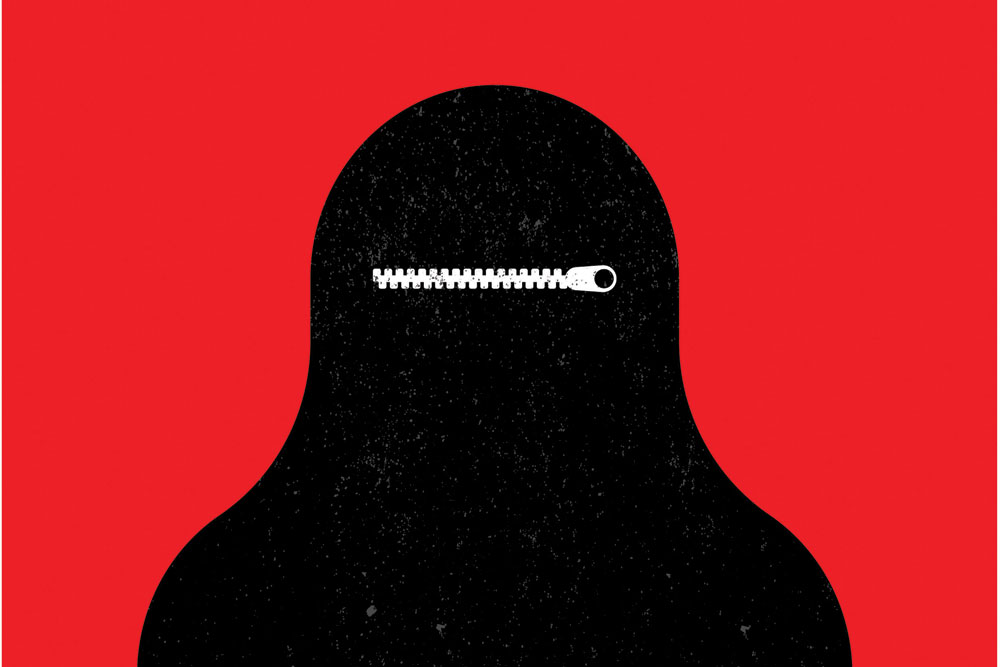
I was initially hesitant to add my two bits to the ‘hijab row’ in India about which so much has already been written. But I’m glad I did – gained a lot of insights and info that I tried to share with a wider audience. Thanks to Ullekh NP, Executive Editor at Open Magazine in India for prodding me. Published 25 Feb with the headline Hijab Row in India: Just Like Us, with a powchaerful illustration copied below. I’m thrilled that my SAWM sisters, the South Asian Women in Journalism, liked it enough to share it on their website under Article of the Day category.Posting the essay below with materials not used in the Open article, including my 1983(or was it ’82?)piece in The Star with my own illustrations, HUNDRED AND ONE USES OF A CHADDAR, and link to Fahmida Riaz reciting her poem.
Illustration by Saurabh Singh for Open Magazine
WOMEN ACROSS SOUTH Asia and beyond have for centuries loosely covered their heads and bosoms, regardless of religion, shielding themselves from unrelated men as well as from the hot sun.
Those entering the work force in urban areas have been quicker to shed traditional attire. Those who find these changes threatening sometimes find ways to keep women in their place. Religion offers a convenient pretext.
The more conservative Muslim women in South Asia also traditionally wore a burqa, more all-enveloping than a chaddar or dupatta. My grandmother in Allahabad, U.P., used to wear a brown burqa that she discarded eventually in Karachi.
Growing up in Pakistan under the military dictatorship of Gen. Ziaul Haq, 1977-88, women like me have first-hand experience of such tactics. We watch in horror as shadows of the ZIa dark years seem to spread across the border into India.
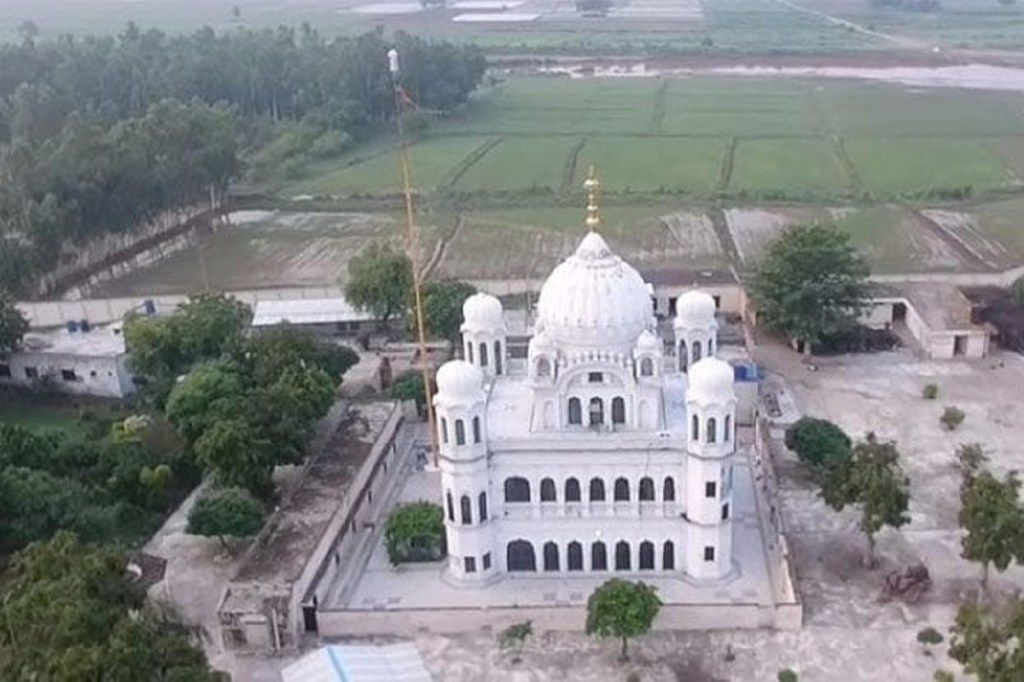
Gurdwara Darbar Sahib Kartarpur: Bringing people together. Image credit: Facebook/@syed.alli
Dozens of Indians and Pakistanis with ancestral roots in Chakwal will meet up mid-week at Kartarpur Darbar Sahib in Pakistan, taking advantage of the visa-free corridor inaugurated in November 2019 by Prime Minister Imran Khan for Baba Guru Nanak Dev’s 550th birthday celebrations.
Delhi-based Rotarian Anil Ghai, whose own family has strong connections to Chakwal since before Partition in 1947, will lead the Indian delegation.
The family had to flee with whatever belongings they could take, in a Dakota aircraft, remember area natives. Ghai’s visit to Pakistan in 1996 had led to rekindling those ties.
The establishment of Chakwal International Group about six months gave momentum to the upcoming ground-breaking meeting planned for Wednesday, 23 February.
“Everyone is welcome, they do not have to be Rotarians,” says Mohammed “Mo” Ayyaz, a Rotarian in London who is also from Chakwal and one of the driving forces behind the initiative.
Something I wrote based on a tip by an officer with a humanitarian conscience who came across Ganpat Singh Sodha’s story and wanted to help him reunite with his family. I subsequently connected Ganpat to a reporter colleague in India who wrote a great report about the issue, cited in my feature piece for which I did additional interviews and research. #MilneNo
This is the story of Ganpat Singh from Pakistan’s Sodha Rajput community of less than half a million. Like him, each member of this community has matrimonial linkages across the border in neighbouring Rajasthan, India. This is the only way they can keep their community alive, as they are barred from marrying within their own ‘gotra’. A special dispensation over a decade ago provided them relief with six-month visa extensions – but now those who apply for such extensions are being blacklisted, leading to painful and preventable human tragedies
By Beena Sarwar
Ganpat Singh Sodha couldn’t go to his mother as she lay dying of cancer at his brother’s house in Jodhpur, India, a little over 300 km from Umerkot, Pakistan, where he lives. Three of his children are in Jodhpur too. He has been apart from them for five years.
A former government schoolteacher of Sindhi in Umerkot —…
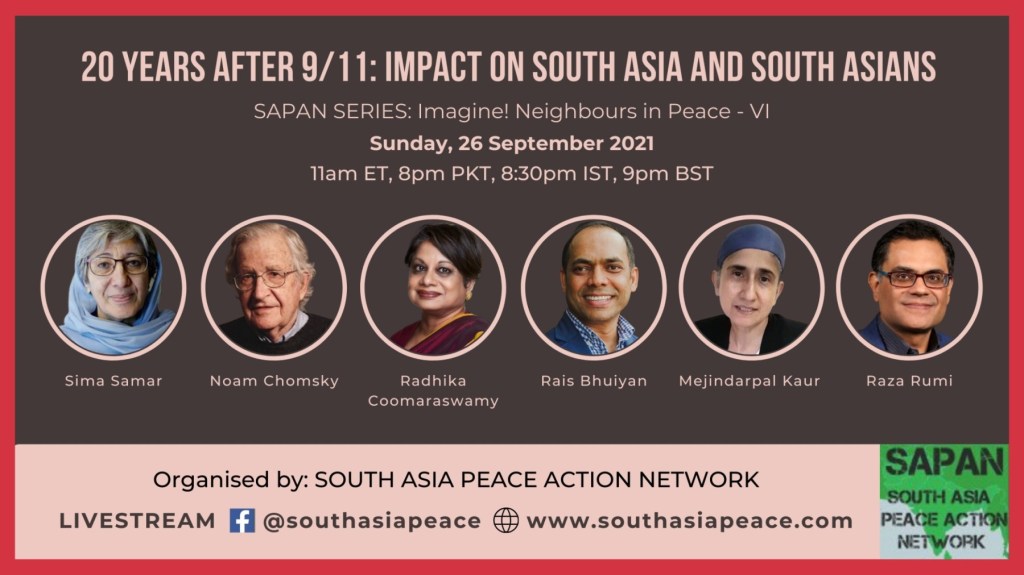
Marking two decades of the September 2001 attacks on New York City, global thought leaders and activists from across South Asia and the diaspora will meet across time zones this Sunday to discuss the impact of “9/11” on the region and its people.
The online event also commemorates the global International Peace Day, September 21.