In humanity’s name

Appeal to India, Pakistan to release, repatriate incarcerated cross-border fisherpeople

Article 5 of the 2008 Consular Access Agreement requires repatriation within one month after nationality confirmation and sentence completion, yet 178 Indians remain imprisoned in Pakistan.
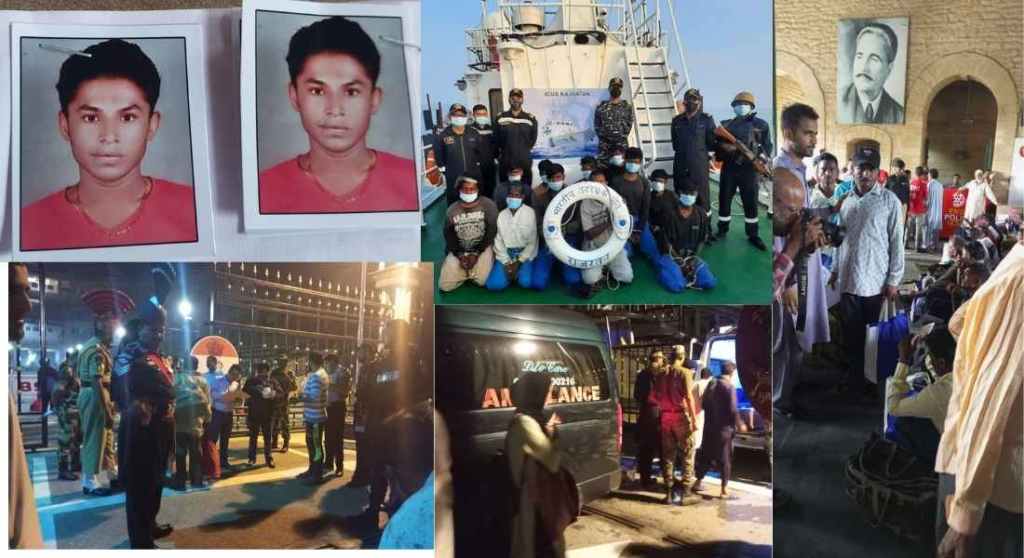
Fisherfolk suffer while governments bicker:  (Clockwise from top left): Indian fisherman Jagdish Mangal died in Pakistani prison, 6 Aug. 2023; Pakistani fisherfolk arrested by Indian coastguard, Sept. 2021; Indian fisherfolk waiting to be repatriated at Lahore railway station, 2023; body of Pakistani fisherman Amir Hamza who died in Indian prison repatriated via Wagah border, 14 Sept. 2021; Indian fisherfolk being repatriated at Wagah, 15 Nov. 2012. Beena Sarwar archive photos.

By Beena Sarwar / Sapan News

BOSTON: As India and Pakistan get ready to mark their respective Independence Days, the families of imprisoned fisherpeople on either side of the border along with various organisations have jointly written to the Prime Ministers of India and Pakistan demanding “the immediate release and repatriation of all imprisoned fisherpeople who have completed their sentences and nationality verification” as a goodwill and humanitarian gesture.
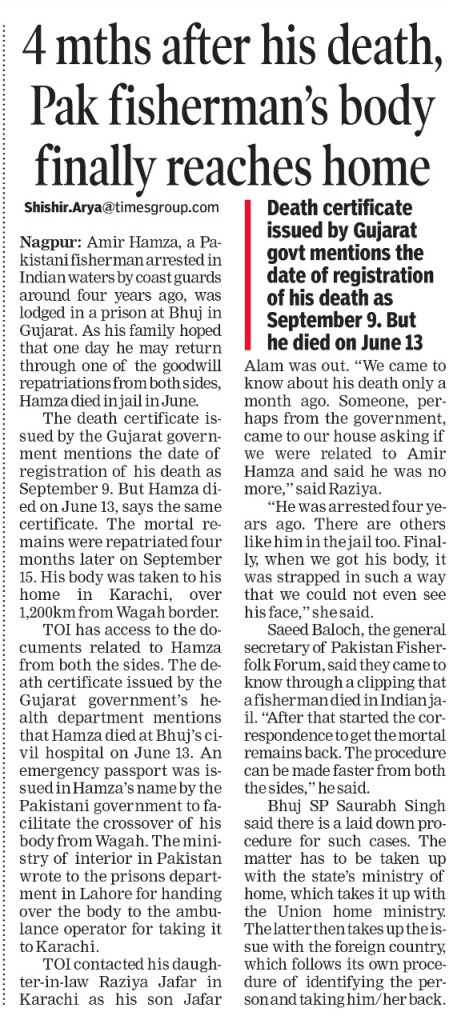
Report about Pakistani prisoner Amir Hamza’s death in Indian prison, by Shishir Arya, Times of India, 17 September 2021.  

The letter also calls for accountability for continued detentions despite completion of prison sentences, which is in violation of the bilateral Agreement on Consular Access, 2008. 

Section 5 of the Agreement categorically states: “Both Governments agree to release and repatriate persons within one month of confirmation of their national status and completion of sentences.”

“Unfortunately, this provision has not been implemented in letter and spirit,” says a press statement issued jointly on Friday by the Pakistan-India Peoples’ Forum for Peace and Democracy (PIPFPD), the National Fishworkers Forum, the Pakistan Fisherfolk Forum and families of Imprisoned Fisherpeople. 

The letter urges both governments to implement mechanisms to prevent such delays in the future, and to pursue a ‘No Arrest Policy’ for fisherpeople who inadvertently cross the maritime boundary while pursuing their livelihoods. This is something that activists have long been calling for.

The number of arrests have declined significantly over the past couple of years — nearly 750 fisherfolk were imprisoned in jails across Pakistan and India in April 2023. 

The statement suggests that this is because “fisherpeople avoid going towards the International Maritime Boundary Line to catch fish”. 

According to the press statement there are “shocking” stories about Indian fisherpeople arrested by Pakistan and vice versa. 

“Their prolonged incarceration deprives them and their family members of basic human rights and causes severe hardship to their families,” subjecting them to ” economic and emotional distress,” says the statement, urging that the arrest and detention of fisherpeople be viewed from a humanitarian perspective.

As many as 198 Indian fisherpeople are currently imprisoned in Pakistan, including 178 who have completed their sentences but continue to remain in custody, according to the data released in the statement. 

Number of incarcerated Indian fisherpeople in Pakistan who have completed their sentencesSentence completed onTime spent in prison after having completed sentence
1016 July 20215 years, 22 days
11516 March 20224 years, 4 months, 22 days
2117 November 20223 years, 8 months, 21 days
1031 January 20233 years, 6 months, 7 days
2218 July 20242 years, 20 days

Table compiled with data provided by the joint press release, 07 August 2026.

“Every year, an estimated four to five Indian fisherpeople die while imprisoned in Pakistan. In March last year, an Indian fisherperson also died by suicide in prison,” says the statement.

According to the latest prisoner exchange list released on 1 July this year, Pakistan holds 250 prisoners  (52 civilian prisoners and 198 fishermen) “who are Indian or believed-to-be-Indian”  as India’s Ministry of External Affairs put it in a media release. 

Meanwhile, India holds  439 Pakistani “or believed-to-be-Pakistani prisoners, including 386 civilian prisoners and 53 fishermen,” to quote Pakistan’s Ministry of Foreign Affairs.
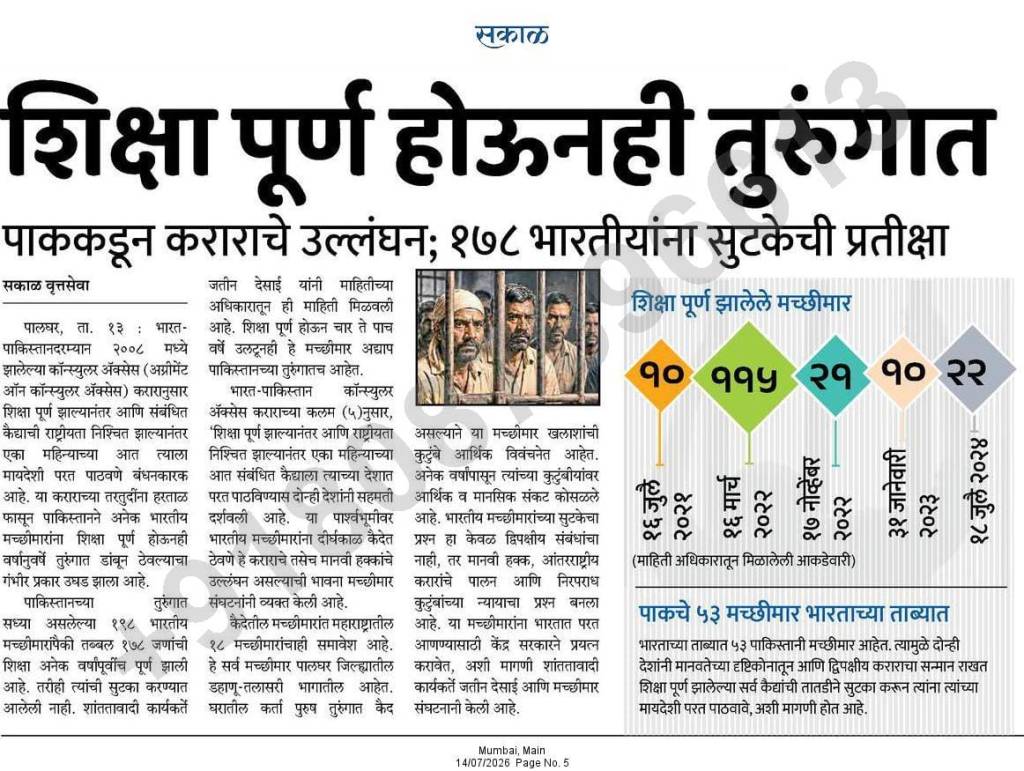
Clipping from Marathi paper ‘Sakal’ headlined: “In prison even after completion of sentences”, 14 July 2026

This language of ‘believed-to-be’ used by the bureaucracies on either side is a reflection of the need to verify identity before proceeding with repatriation or even consular access. The detained fisherfolk rarely carry identity documents while out fishing. Once arrested, verifying their identity is a cumbersome process that typically takes far longer than necessary, especially in this digital age.. 

Yet, despite their ongoing tensions, both countries have regularly exchanged prisoner lists twice a year, in January and July, since the practice began in 2008, following the constitution of a Joint Judicial Commission on Prisoners in 2007.

Comprising four retired justices from either side, the committee met twice a year and worked on expediting the release of cross-border prisoners.

However, it has not met since its last convention in October 2013 in India.
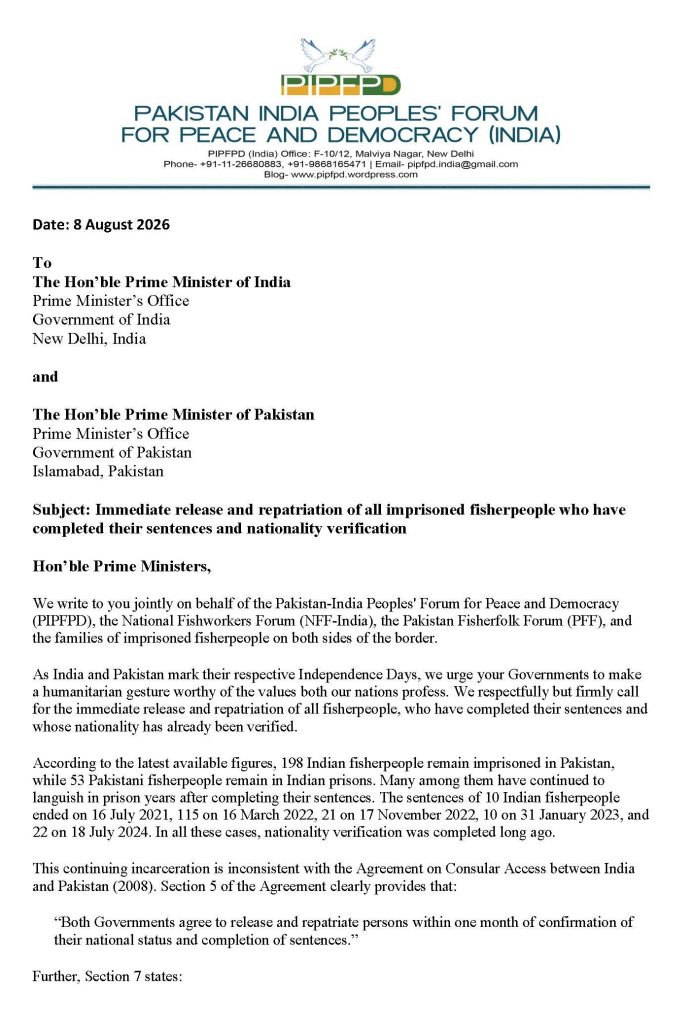
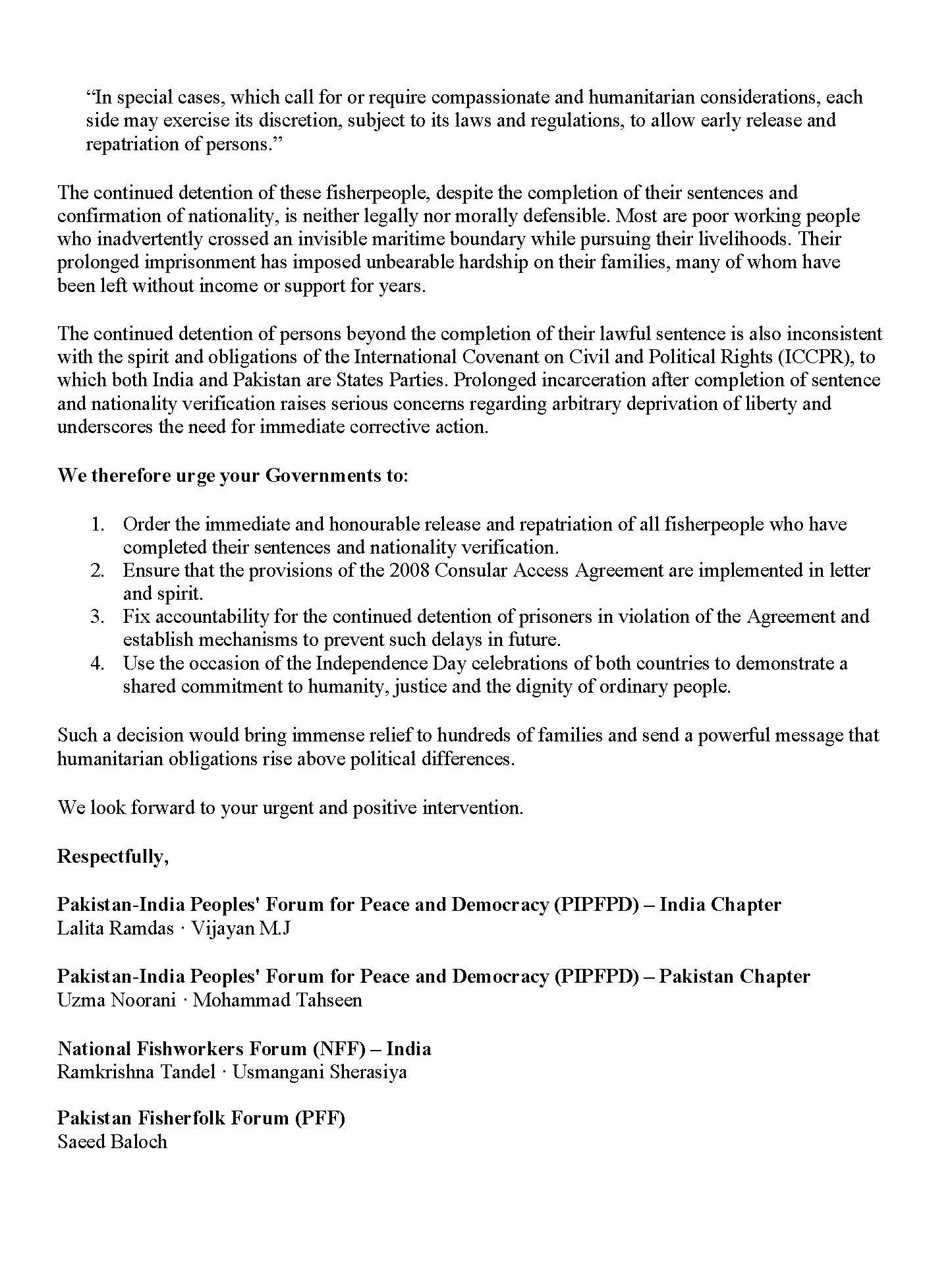
A heartfelt appeal: Joint letter to the Prime Ministers of India and Pakistan from the Pakistan-India Peoples’ Forum for Peace and Democracy (PIPFPD), National Fishworkers Forum (NFF)  India, and Pakistan Fisherfolk Forum (PFF)

A Sapan News syndicated report available for republication with due credit to sapannews.com

ChanukahForCeasefire; a Jewel in Ivory in Berlin; #SapanforSAARC this Sunday; and the NewsMatch challenge for Sapan News

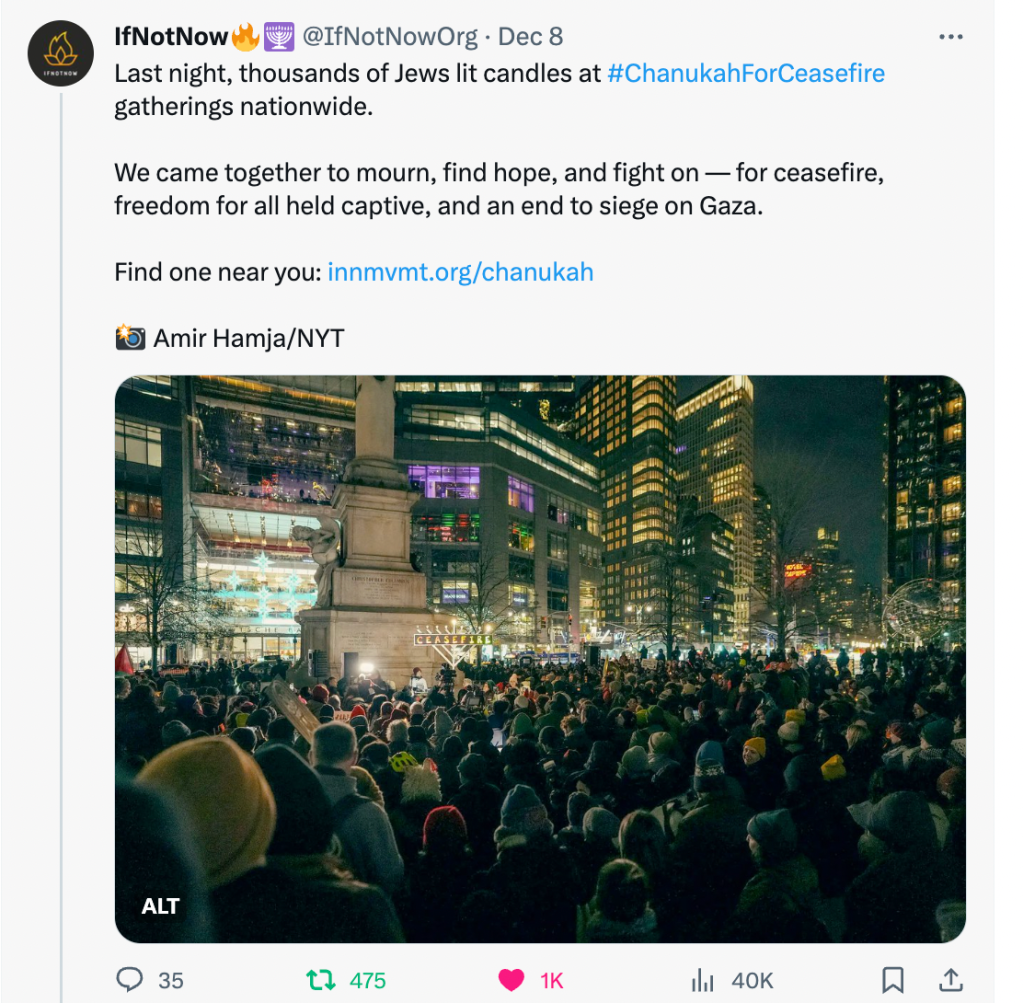
Greetings to those observing Hanukah and salute to those participating in #ChanukahForCeasefire demonstrations around the United States. Thousands of Jews have been lighting candles at #ChanukahForCeasefire gatherings, coming together “to mourn, find hope, and fight on — for ceasefire, freedom for all held captive, and an end to siege on Gaza,” says IfNotNow, a movement of American Jews “organizing for equality, justice, and a thriving future for all: our neighbors, ourselves, Palestinians, and Israelis.” To find one near you, go to: https://innmvmt.org/chanukah.

Such actions, and those of thousands including high school students marching around the world to call for #ceasefirenow, provide hope in a world that feels heavy. It is unbearable to think of the thousands killed, maimed and displaced in conflict areas, especially children.

Public opinion worldwide is clearly for #CeasefireNow, calls being ignored by those who could stop the bombing that continues to claim lives. What can we do? Hold on to ourselves and do what we can, where we can, when we can. Inform ourselves, share information – double-check before sharing so we don’t pass on #fakenews — donate to causes, participate in public actions.

Continue reading

Why arrest fisherfolk who cross an invisible maritime boundary, then hold them for years across the border?

Last month, another Indian fisherman incarcerated in Pakistan died while waiting to be repatriated. A young man in his thirties. Why he was held in the first place makes no sense to me, and to a lot of other people. India and Pakistan routinely detain each others fisherfolk. In doing so, they defy international law, deny the incarcerated men consular access in violation of their own laws, hold them in prison for months if not years (a costly enterprise), then take months to verify the identities of those who have served their terms, so that they remain imprisoned even after completing their sentences. I asked my friend Jatin Desai in Mumbai to write about this for Sapan News, the syndicated features I started a couple of years ago. We ended up doing the piece together. I’m sharing our article below, published in Sapan News, as well as in several other publications. Still relevant, and urgent for the authorities to take up. Please share widely.

The suffering continues: No relief in sight for Indian, Pakistani fishermen 

Another Indian fisherman died while in detention in Pakistan. Such deaths in custody routinely take place on either side. Pakistan and India routinely arrest and imprison each others’ fisherfolk for crossing an invisible maritime border. This should not be happening. Meanwhile, both countries must urgently at least revive the Joint Judicial Committee for cross-border prisoners

By Jatin Desai and Beena Sarwar

Passport photo of Jagdish Mangal, who died while waiting to be repatriated. Photo: Courtesy Edhi Foundation

If 99 Indian fishermen incarcerated in Pakistani prisons had been repatriated last month as agreed, Jagdish Mangal might still be alive.

Mangal was among the several Indian fishermen arrested by Pakistan’s Maritime Security Agency in February 2020 and detained in Malir prison, Karachi. He was 35 years old from Nana Vada, Gujarat.

Pakistan was to repatriate 99 Indian fishermen on 3 July, but this never happened for unexplained reasons. Mangal died on August 6 of ‘natural causes’ according to the medical certificate.

Continue reading

India-Pakistan @ 75 and graphic images from Ukraine: Two articles and some context

Sharing two recent pieces, this time not part of the Sapan News Network syndicate. One commissioned by The Wire, and the by The Conversation.

Below – some context and what the editors wanted.

The “piano man,” a war refugee, became one of the symbols of resistance emerging from conflict. Photo by Joe Raedle/Getty Images, Lviv, Ukraine, March 29, 2022.
Continue reading

Need to promptly repatriate cross-border prisoners, especially if they die…

Over 30 organizations around Southasia and beyond have endorsed a joint statement about cross-border prisoners initiated and coordinated by Sapan, the Southasia Peace Action Network, calling for the humane treatment of cross-border prisoners and to decriminalise inadvertent illegal border crossings.

Titled ‘Release prisoners on completion of jail term, decriminalise inadvertent border crossings, especially for fisherfolk and minors‘, the statement draws attention to the death of two Indian fisherfolk in Pakistani custody this year, and the death of a Pakistani fisherman of Bengali origin in India’s custody last year.

All three had served their sentences but remained in custody on ‘the other side’. Compounding the tragedy, there are terrible delays in the repatriation of the bodies of such fisherfolk, notes the statement.

The statement also draws attention to some teenagers who remain incarcerated in juvenile centers in India, mostly without any contact with their families. One has already served his sentence but remains incarcerated. Details below – Statement text and endorsements:

Arrested fisherfolk in custody across the border, far from home, no consular access until after sentence is over, often kept in custody even after serving their sentences. File photo. Getty images
Continue reading

So much human suffering – and for what?

Sharing here a piece I wrote published in The Wire and later in Aman Ki Asha about a poor man from a tiny village on the India-Pakistan border who went missing in 2008. For nine years his family didn’t know where he was. But his government knew for four years before the family learnt from another released prisoner that their loved one was in a prison across the border.

Under-trial for three years, he then served a five-year conviction – but remained imprisoned for three more years while the government dawdled over verifying his nationality.

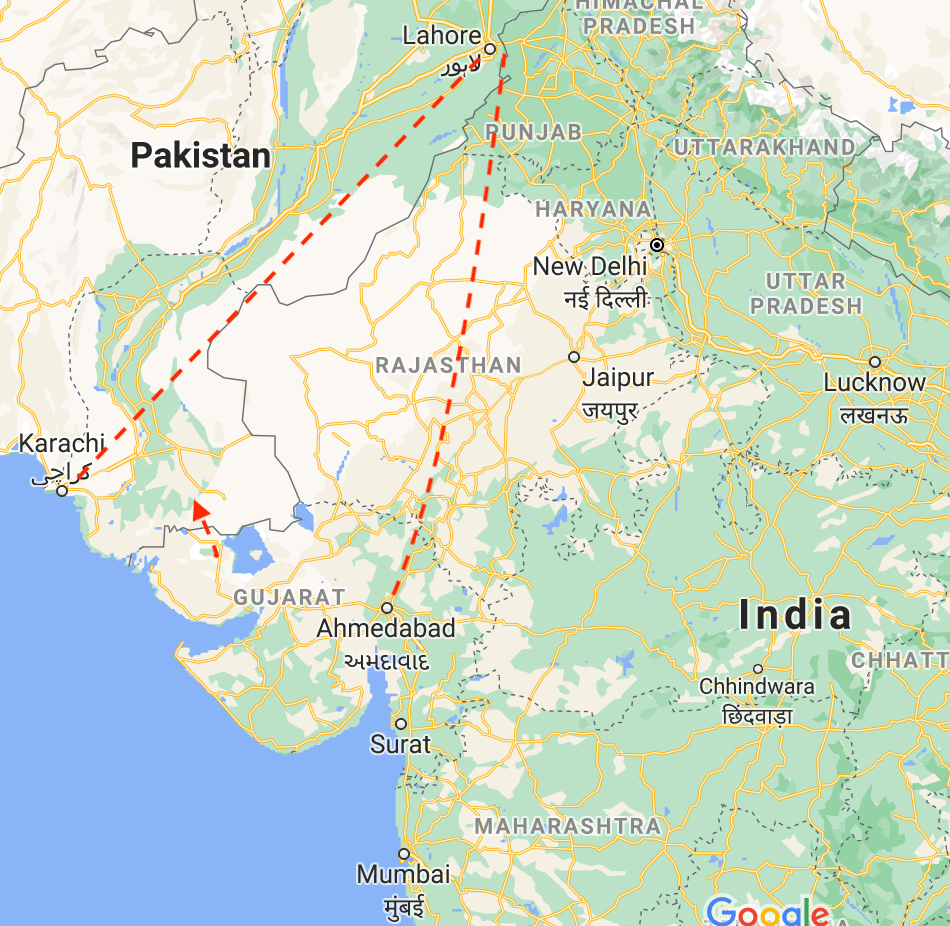
When they finally repatriated him at the end of January this year following court orders, he was made to travel 1000 km upcountry, then wait for three more days at a border town until police from his home state went to bring him back, another 1000 km downcountry. Here’s a map I made about his enforced travels:

Ismail Sama’s short journey across the border (small arrow) – and his long journey home. Fisherfolk caught violating the maritime border also have to endure this when imprisoned on the other side.

Read the full story at The Wire: India-Pakistan Relations: What the Kafkaesque Case of a Repatriated Cattle-Herder Tells Us, or at the Aman Ki Asha (hope for peace) website that I edit.

Here’s a follow up story by Gopal B. Kateshiya, ‘Coming back is second birth for me’: Kutch man returns home after 13 years in Pakistan jail, The Indian Express. Extract: “A scorpion stung me and I felt giddy. I lost my direction. Next morning, around 10.30 am, Pakistan rangers caught me, telling me I had intruded into their country. They took me to hospital and after my condition improved, they handed me over to Inter Services Intelligence (ISI),” said Ismail, son of a farmer.

Ismail Sama with his family: Reunited and it feels so good. Photo: Courtesy Indian Express.

Thirteen years is a long time. The story would be remarkable if it was a one-off but sadly, such incidents are not rare.

<p value="<amp-fit-text layout="fixed-height" min-font-size="6" max-font-size="72" height="80">Here's a report published some years ago which outlines some of the main problems (PDF). Here’s a report published some years ago which outlines some of the main problems (PDF).

Detained fisherfolk: Denial of consular access is denial of justice

It is beyond belief that Pakistan has STILL not nominated members to the joint Judicial Committee on Prisoners, which India did in 2018. I have personally sent notes to several members of the ruling party through various contacts. They say they care but there are obviously more important matters to worry about than poor imprisoned fishermen. The Judicial committee, instituted in 2007, has been virtually defunct since the end of 2013. Cross-border prisoners completing their sentences continue to languish in prisons across the border because of lack of consular access. This wouldn’t happen if they were rich and powerful.

Arrested Indian fishermen in Pakistan lockup. File photo. Getty images
Continue reading

India, Pakistan: For a better future, build on prisoner exchange agreement

Maier-tikka

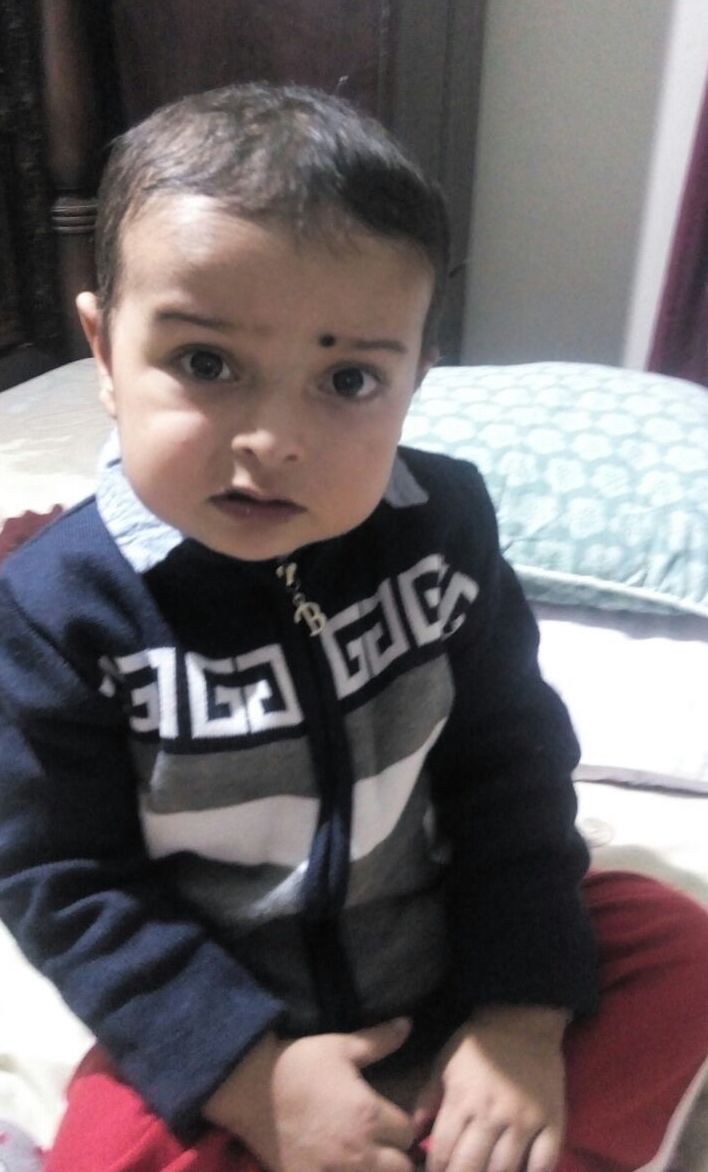
Two-year old Maier Jawwad needs urgent heart surgery in India.

Wrote a piece on a glimmer of hope regarding India Pakistan relations that needs to be built upon. Published in The News and in The Wire; original text below.

The best news in some time is that India and Pakistan are rising above their differences and joining hands for a humanitarian cause – they have agreed to exchange vulnerable prisoners (women, the elderly over 70 years, and those with special needs), as well as revive the Joint Judicial Committee on Prisoners that has not met since 2013. They will also allow medical experts from both sides to meet and examine mentally challenged prisoners in preparation for their repatriation.  Continue reading

Returning inadvertent border-crossers and more: Glimpses of humanity

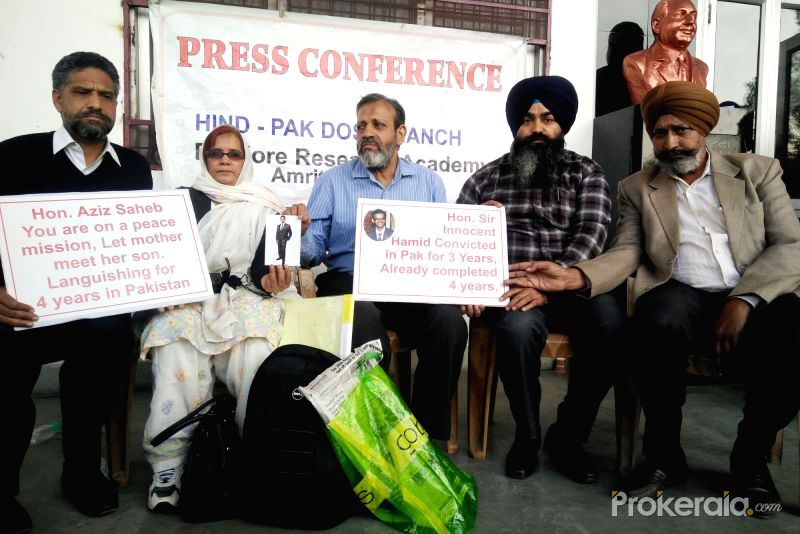
fauzia-ansari-and-nehal-ansari-parents-of-hamidLast week I wrote this short piece below for Aman ki Asha (hope for peace) after the Indian border security forces returned a young, inadvertent border-crosser to Pakistan. Today, there’s news that the Pakistan government will allow the wife of the Indian national and alleged spy Kulbushan Yadav to meet him “on humanitarian grounds”.

This raises hopes that the parents of another Indian prisoner Hamid Ansari will finally also be allowed to meet him. In fact, as the Pakistan-India People’s Forum for Peace and Democracy has said, the families of all cross-border prisoners should be given access to their loved ones in prison across the border.  Continue reading

Hope for young Ateeq, a real life ‘Ramchand Pakistani’

Below, a report I wrote on Feb 23, published in The News aman ki asha page of Feb 24 (see accompanying report ‘Prisoners of archaic laws‘ by Rabia Ali), shortly before 12-year old Ateeq’s hearing in Amritsar on Feb 26 – which Asma Jahangir and I.A. Rehman of the Human Rights Commission of Pakistan managed to attend.

12-year old Ateeq from Lahore, currently in the Juvenile Jail in Hoshiarpur, India

Here is an update from Asad Jamal in Lahore on Feb 26:
Release orders were passed for the 12 years old Pakistani boy in Indian Juvenile (Hoshiarpur) Prison after Asma Jahangir appeared in the Juvenile Court in Amritsar today. Now the Pakistan authorities have to complete procedural matters and bring the boy back home. Asma Jahangir met the boy in Amritsar and found him traumatised. She had taken video film of the boy’s father as well some clothes for him. Local lawyers/activists arranged and distributed sweets after the court order. Continue reading