The keynote speaker at TCF Boston fundraiser this year was Indian – and it wasn’t ‘bad news’. On the contrary. Check out Shashi Buluswar‘s cricket documentary that I’ve included in the article. Plus a discussion with ‘peacemongers’ hosted by a center in Kolkata the same day.Why can’t our political leaders take a leaf from Mani Shankar Aiyar’s relationship with his old friend Javed Jabbar, a self-proclaimed “chauvinist and narrow-minded Pakistani” — they disagree on almost everything yet are “the closest of friends”.(Note: for more photos, go to the piece published on Sapan News)
“By now you will have got the bad news,” said the keynote speaker after being introduced. “I’m Indian”.
There was laughter and warm applause from the largely Pakistani or Pakistani-origin audience.
Not only was it not ‘bad news’, but the speaker’s support for the cause he was advocating for, beyond borders and boundaries, was even more appreciated because of his Indian origin.
Going by the media – and social media – you’d think we all hate each other. Not true.
Boats on Dututwewa at sunset. Photo by Ben Samarasinghe
The lakes, paddy fields and forests of the ancient village of Dutuwewa are a world away from Colombo’s high-rises and colonial buildings. As elsewhere, decisions taken by ‘old men’ in the corridors of power impact life here, just as these rural voters will impact politics nationally
PERSONAL POLITICAL FROM DUTUWEWA WITH LOVE
By Beena Sarwar
Times are tough and it’s hard to make ends meet. A refrain heard from just about anyone in my home country Pakistan where the rupee has dropped to around 300 to the dollar. This is now comparable to the rupee in Sri Lanka, recovering from the biggest economic crash in its history.
Stories of hardship echo from the island nation’s largest city Colombo to the farming heartlands around Anuradhapura district, a little over 200 km to the north-east. At the core of Anuradhapura lies the irrigation tank called Dutuwewa which sustains several villages.
Sri Lanka’s rural landscape is dotted with as many as 14,000 such large and small irrigation lakes, known as wewas, built by kings thousands of years ago.
A nearly five-hour drive on surprisingly good roads – testament to the rural infrastructure built after the end of the 26-year long civil war 15 years ago – brings us to the serene lakes, lush paddy fields and dense forests of Dutuwewa. A world away from the corridors of power and the glittering, air conditioned, high-rises of Colombo and its historic colonial buildings left behind by 500 years of colonizers – the Dutch, the Portuguese and the British.
A village school in a forest
The din of crickets from the surrounding forest forms the backdrop to everything in Dutuwewa. The headmistress of the Palugollagama government school, who gives only her initials and last name, I. R. Ekanayake, is an ‘old girl’ who taught at schools around the district for 26 years and was posted to her alma mater as principal four years ago. There are two vice principals, 36 teachers and 506 students.
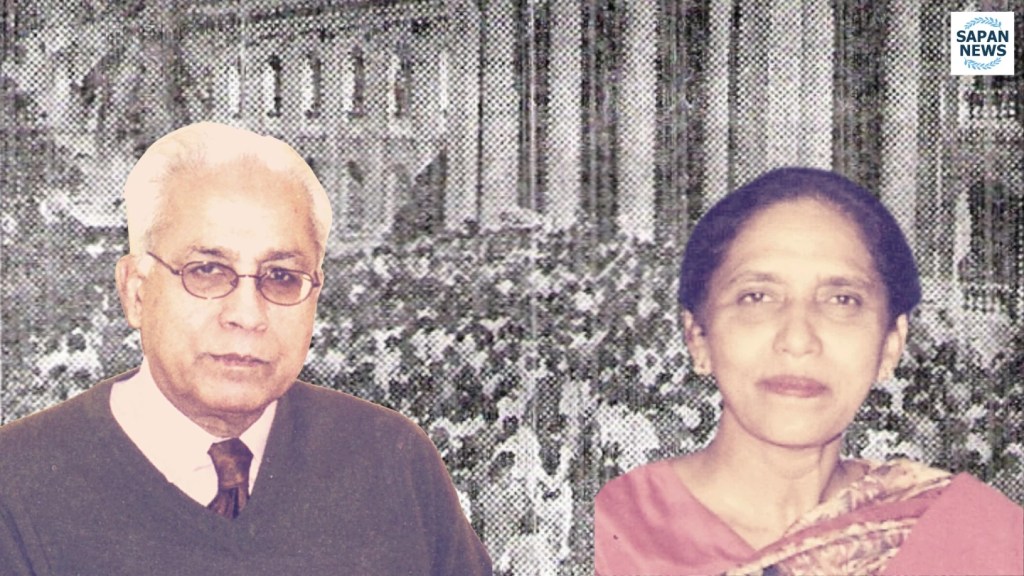
OBITUARY: The legacy of a decades-old connection between social worker Shahida Haroon (1937-2023) and economist Eric Rahim (1928-2023) endures through the ongoing struggle for student rights, economic justice and democracy in Pakistan
Demands Day at D.H. Science College, 07 Jan. 1953, Eric Rahim, Shahida Haroon Saad. Collage by Aekta Kapoor/Sapan News
It was while trying to reach Eric Rahim in Glasgow this week to inform him of my aunt Shahida Haroon’s passing in Karachi that I learnt he too was no more.
A respected journalist and economist, Uncle Eric as I called him, had passed away peacefully at home on 2 May 2023, aged 94. He was a mentor to my father Dr M. Sarwar (1929-2009), and Shahida, who departed this earth on 25 June, at 87.
Shahida did her Master’s in economics from Karachi University in 1958, a subject she didn’t enjoy or do well in. When she went to Punjab University for a second Master’s in social work, encouraged by her brothers Akhtar, 11 years older, and Sarwar, eight years older, Akhtar asked his friend Eric Rahim to look after her. It was Eric, then a columnist at The Pakistan Times, who met Shahida at the train station after her overnight journey.
Exploring a way of looking inwards, confronting my own demons, and competing with my own best self
My keynote commencementspeech at the first AAPIDA – Asian Pacific Islander Desi-American – affinity graduation, Harvard University, 23 May 2022
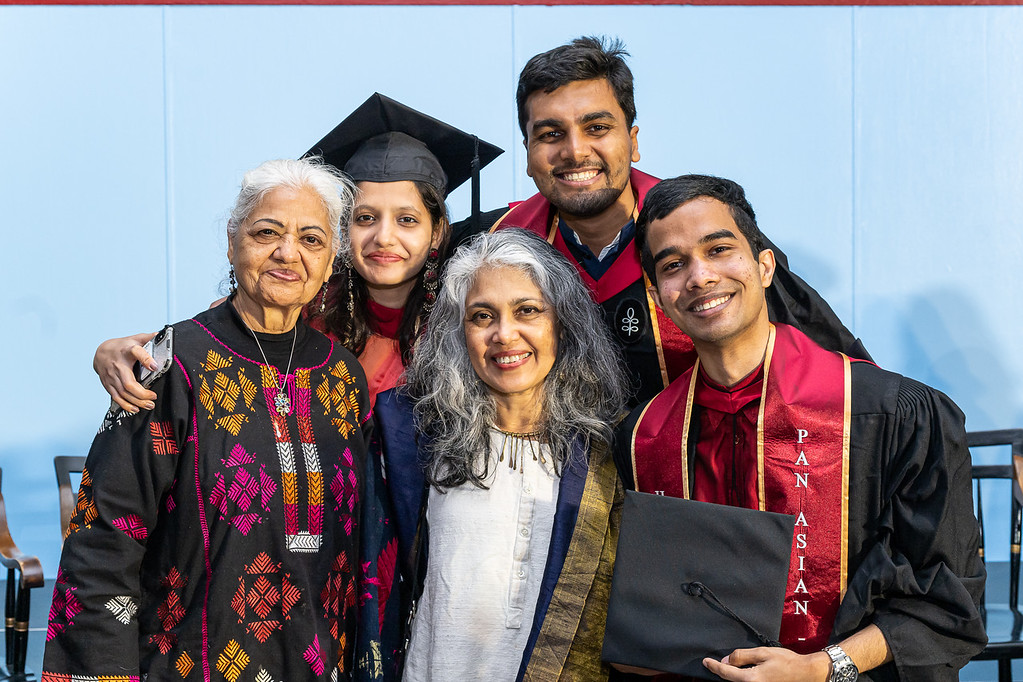
With my mother Prof. Zakia Sarwar, plus Harvard School of Education graduatesafter the ceremony: Najwa Maqbool and Nishant Singh from India, and Nigel Gray from Sri Lanka.Their families couldn’t make it so we were glad to be there for them. Photo: Lipofskyphoto.com
Beena Sarwar, video and text of speech below. Also published in Sapan News Network
The Covid-19 pandemic is real and dangerous. Yesterday it likely snatched another beloved relative from us. My beautiful, youthful 83-year-old cousin Geti’s husband Ismail Saad, 90, passed away in the early hours of Monday morning. He was frail and not keeping very well, but was mentally all there. Had just finished yet another book – in Urdu. A comparison between educational systems in different countries, it will now be published posthumously.
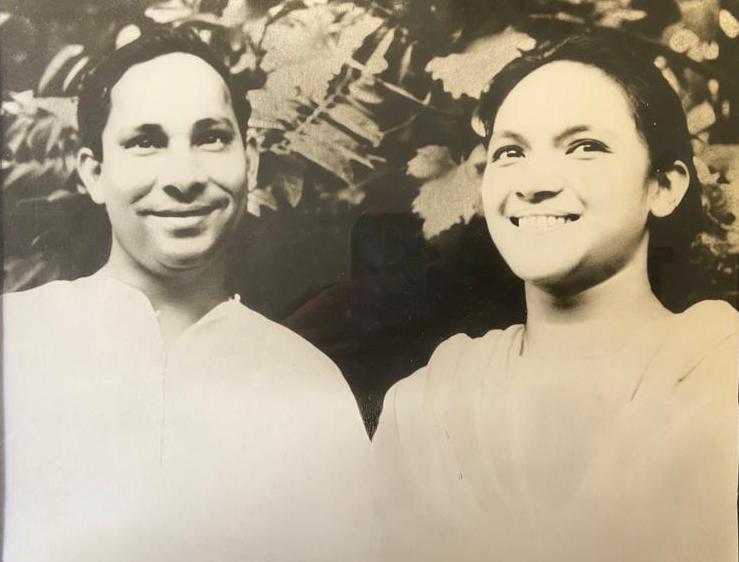
Ismail Saad and Geti Waheeduddin a week before their wedding, 1967.
He wasn’t tested but the positivity rate in Karachi is currently estimated at 40%. Like others, many of our family members tested positive over the past weeks – most with mild or no symptoms, probably the Omicron variant, including my mother Zakia Sarwar, 82, and many overseas guests visiting for a family wedding. But it’s not mild or asymptomatic for everyone. The day before Ismail Saad’s passing, the virus killed a senior pediatrician at Aga Khan Hospital.
Education isn’t just about bricks and mortar… I hadn’t planned to write this report but the story I heard was so inspirational, and the overall event so well done, that I just had to. Shoutout to TCF Boston, The Citizens Foundation and all the wonderful volunteers. My report in The News on Sunday, Dec. 9 2018 on TCF Boston’s fundraising gala last weekend that will contribute towards more schools in Pakistan. This may be just a drop in the ocean, but each drop contributes to the ocean.
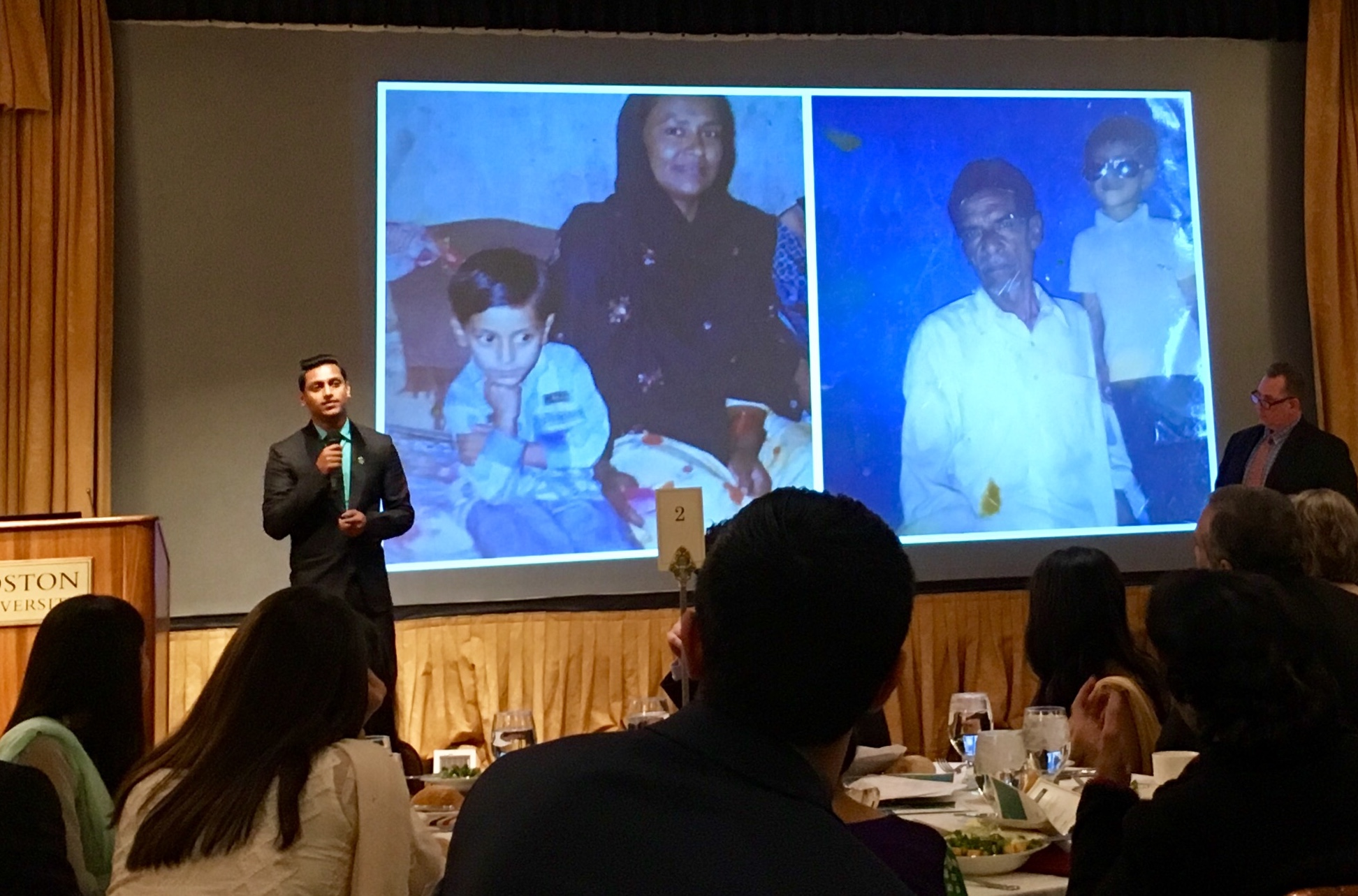
Both Noman’s parents died when he was little. The school saved him. Photo: Beena Sarwar
For Muhammad Noman, growing up in poverty with invalid parents in a low-income locality in Karachi, being forced by gentrification to relocate to another locality with no gas, electricity or running water, was the easy part.
It was in 2010, just after family moved to Khuda Ki Basti, the sprawling housing society on the outskirts of the city, that tragedy struck. Noman’s mother died of kidney failure. In 2011, his father, who had severe asthma, passed away.
“When you are poor in Pakistan, you don’t have access to the best medical care,” as Noman understatedly put it. Continue reading →
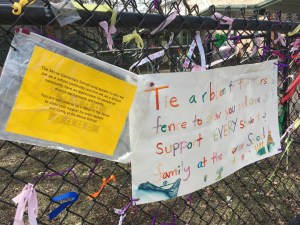
Morse School students use ribbons to express their support for immigrant families.
I wrote this piece after a discussion with fourth and fifth graders at a public school in Cambridge MA; slightly different versions published in the Cambridge Chronicle and The News on Sunday. The students’ desire to be “in the news” reflects what I believe is one of journalism’s key roles – to ensure that the voices of the under-represented get heard. The selfie-culture sweeping the world isn’t just about narcissism. It speaks to the human need to be affirmed and remembered. I was here. See me. Hear me.
PERSONAL POLITICAL
By Beena Sarwar
“Did you see our ribbons? They are for immigrant families,” says Emma, one of half a dozen 9 and 10-year olds I’m talking to about journalism on a bitterly cold weekend in March.
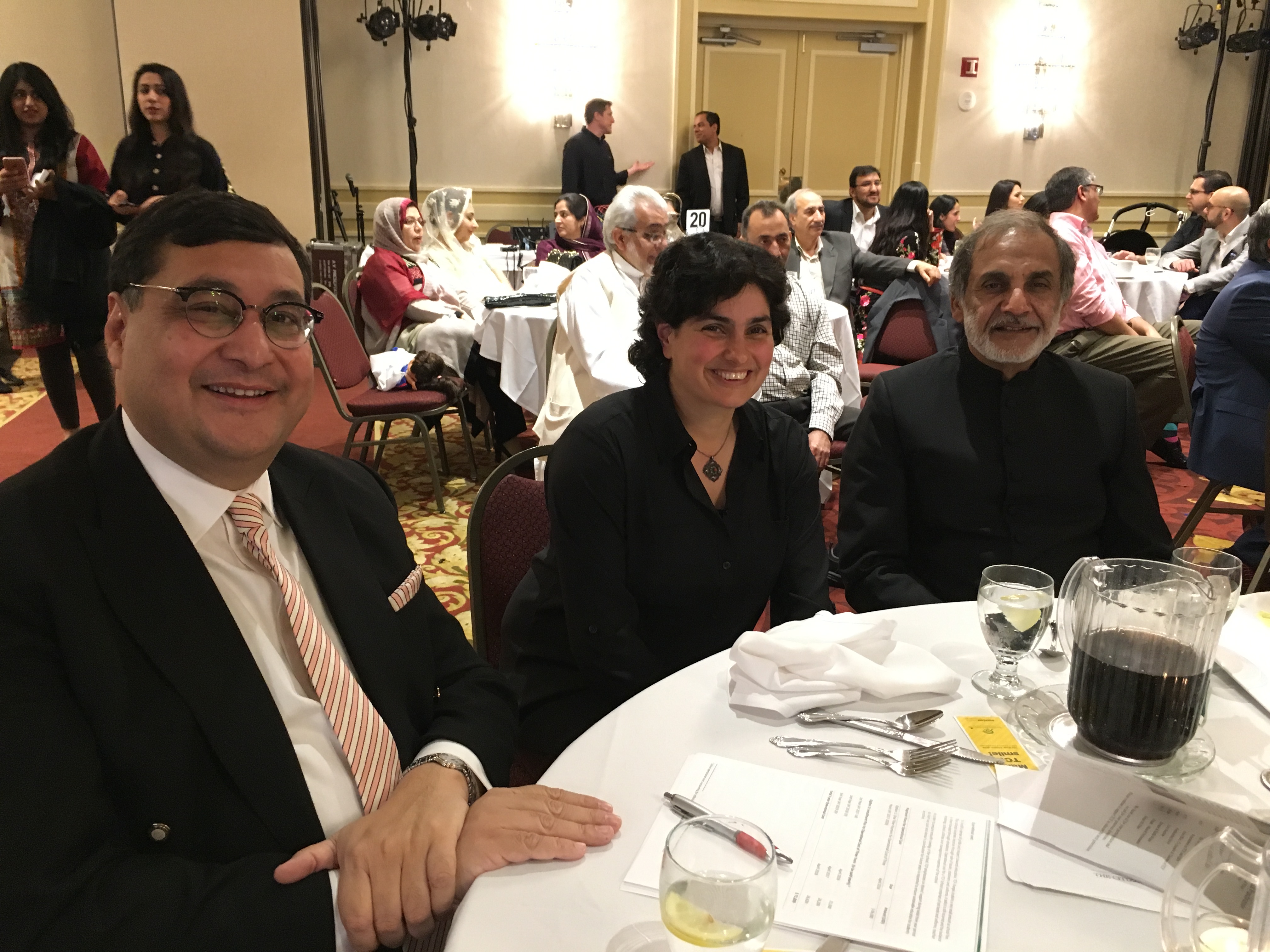
Adil Najam, Nargis Mavalvala, Ateed Riaz at the speakers table. Photo: Beena Sarwar
Pitching in for education in Pakistan from Boston and beyond
Beena Sarwar
“The Citizens’ Foundation is doing an amazing job, and I’m honoured to be here,” said Nergis Mavalvala, giving the keynote address at the sold-out Third Annual The Citizen’s Foundation (TCF) Boston Fundraiser on Saturday, 7 May, 2016.
Propelled to celebrity status by her role in the recent breakthrough on gravitational waves predicted by Einstein, the Pakistani-American astrophysicist at MIT added, “TCF is fantastic – give generously”. Continue reading →
Calling all filmmakers: video contest organized by the Eqbal Ahmad Centre for Public Education: Produce and submit 8-minute videos on the theme: “Pakistan: How To Make A Better Future?” Details at this link (text below). Also check out these 8-min videos – impressive compilation.
The competition seeks to raise awareness and encourage activism on important social issues, and encourage the use of new media in Pakistan.
Submissions for 2014 may deal with any of the following:
Citizenship: What are the rights and responsibilities of being a citizen of Pakistan?
Minority Rights: Issues of Pakistan’s religious and ethnic minorities.
Terrorism: Why is Pakistan afflicted and what’s to be done?
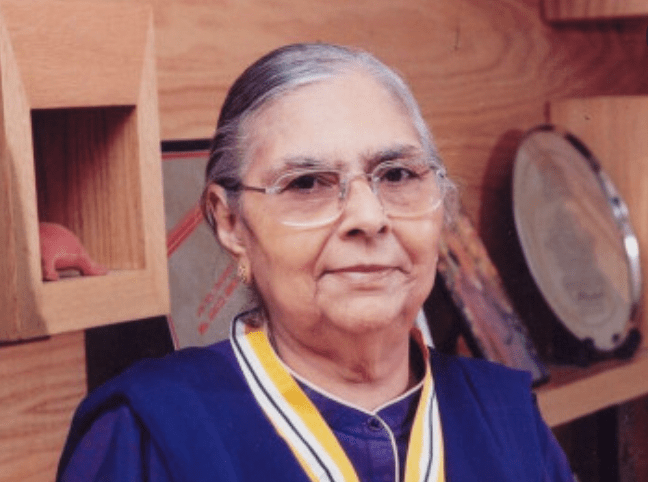
She leaves a void that will be hard to fill, but her legacy will live on through the institutions she was associated with, and the people she mentored over the decades, particularly in the field of education. Although Anita Ghulam Ali had no children of her own, many of these individuals were as dear to her as if they were her own. She took a keen interest in their work and personal wellbeing, in the most non-interfering way, encouraging, questioning, supporting, and motivating. She would ask affectionately, with genuine concern, after their children and grandchildren, whom she’d seen grow from babies to “young ladies” or gentlemen, as she would put it.
It didn’t matter if you were a chaprasi or a CEO. With Anita Ghulam Ali, you could be assured of the same treatment, rooted in egalitarianism and respect for human dignity.
I can’t remember a time when she was not part of our lives. Heading the West Pakistan Teachers College Association (WPTCA), she had led the massive teachers’ strike in the late 1960s that my mother Zakia Sarwar participated in as a young lecturer at Sir Syed Girls College in Nazimabad, Karachi. They were demanding that private colleges, which had proliferated during the military regime of Ayub Khan, pay due wages to their teachers.
As many as 72 private colleges ungoverned by rules or regulations had cropped up in Karachi alone, compared to ten government colleges. The exploitative owners would make teachers sign for salaries listed as double of their actual pay, or make them perform menial tasks at their homes. Insults and harassment were common. The last straw was when anti-Ayub agitations closed down educational institutes for nearly five months, and private college owners stopped paying their teachers salaries. Some teachers resorted to operating pushcarts on the streets, vending clothes and other items to feed their families.
I visualise Anita Ghulam Ali as she must have been then, a short, stocky figure, hair pulled back severely from her broad forehead, intensely bright,
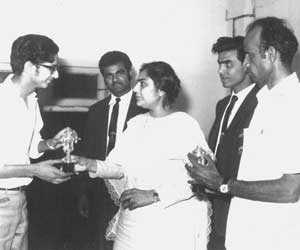
.Distributing prizes at a debate competition at Islamia College. File photo.
dark, slightly slanted eyes over wide, high cheekbones – the Slavic beauty inherited from her equally formidable and regal Georgian mother Shirin, a respected social worker.
The authorities, wanting the teachers to end their agitation, tried to get Anita’s father Justice Feroz Nana Ghulam Ali, to step in. A police officer went to tell him that his daughter was creating trouble and could be arrested.
“If she is breaking the law, by all means arrest her,” Justice Nana is reported to have replied calmly.
Anita Ghulam Ali remained true to her parents’ legacy, uncompromisingly honest and committed to humanitarian values all her life. A prominent leader in the field of education, she served as Sindh’s Education Minister in October 1996 and as a caretaker minister in November 1999. Some criticised her for having accepted a position under the military dictator Gen. Pervez Musharraf.
“I don’t care who appoints me, a dictator or a democrat. I just want to get the job done,” she told me.
A trailblazer in the field of education, leadership, and social activism, her courage, biting wit and will of steel, will remain an inspiration – not to mention her refusal to suffer fools. For over two decades she headed the pioneering Sindh Education Foundation, fending off corrupt ministers and bureaucrats who felt entitled to a share of the funds she raised. She would share stories of how she got the better of them, although there were setbacks too.
One minister had even eyed her paintings and ingratiatingly, but blatantly, asked her for them. She recalled the incident sardonically, relating how she had refused the man, telling him off in her own unique way – low-key, direct, firm, yet with a touch of irony and wry humour. She had nothing but contempt for such parasites, but she knew how to work with them, earning their respect, and getting what she needed.
Her pioneering adopt-a-school programme is now replicated in all provinces. A vocal opponent of child labour, she also initiated community-supported schools for underprivileged, working children in Karachi. These are places where working children can come in, be mentored, given education, get cleaned up, and receive medical care including vaccinations. As always, she had a pragmatic approach to the issue, recognising that these children work because they must, either as sole breadwinners for their families or to supplement the family income significantly.
A recklessly driven car crashed into her as she stood by the roadside many years ago, leaving her with long-term injuries that eventually confined her to a wheelchair. Additionally, she also suffered from debilitating arthritis. But Anita Ghulam Ali refused to let anything get in the way of her work. She obtained permission from her apartment authorities to get a small lift installed for her top-floor apartment. Later she courageously stood firm against the land developers who wanted to raze the building and build a multi-storey (illegal) structure there. Had it not been for her, the builders would have had their way long ago.
Anita Ghulam Ali received several awards, from the government – including the President’s Pride of Performance medal and the Sitara-e-Imtiaz – as well as from various private organisations. But the down-to-earth, unpretentious, totally unmaterialistic person that she was, for her, the real recognition came from the genuine love and respect she received from those whose lives she touched.





 Journeys to democracy