‘My years with WAF’ – Zohra Yusuf on the Pakistani women’s movement

Guest post: Zohra Yusuf, my first editor at The Star Weekend 1981-82, outlines the birth of the women’s movement in Pakistan
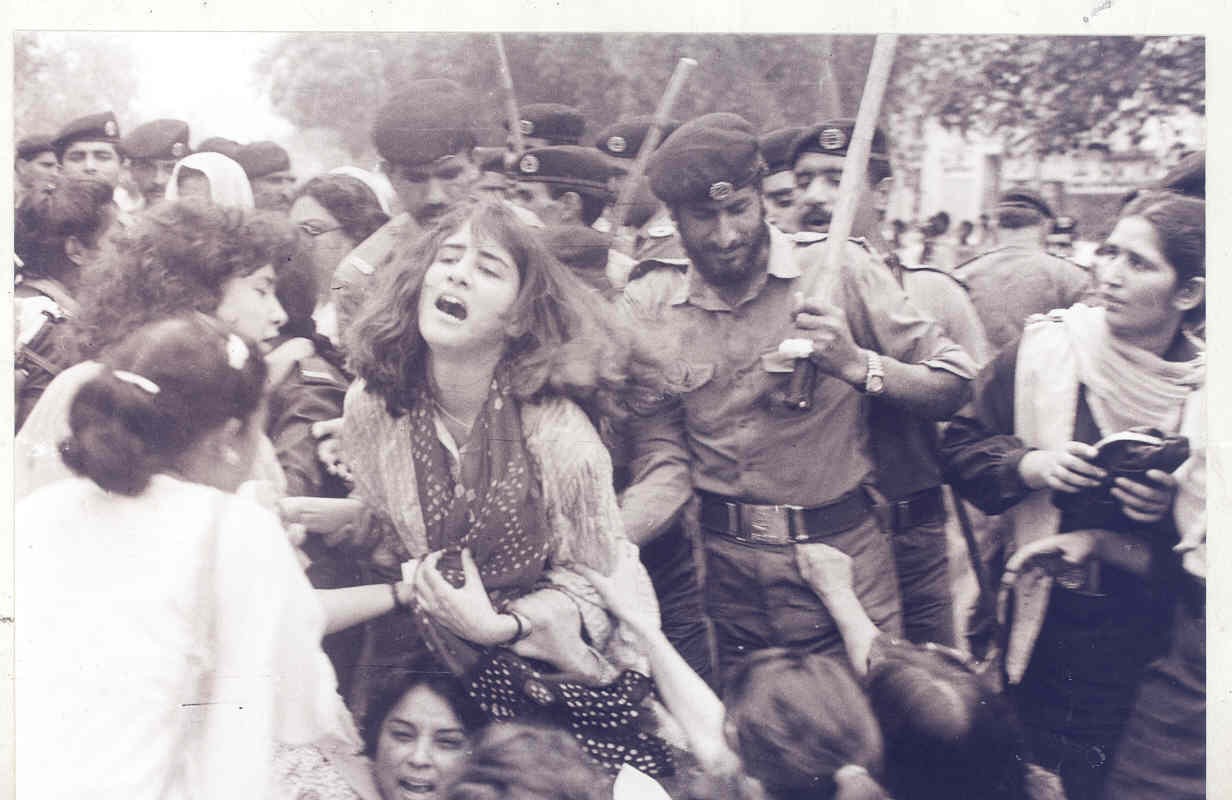
Lahore, Feb 12, 1983: Police brutality on the women's demonstration against the 'Law of Evidence' catapulted the nascent women's movement into the limelight. Photo: Rahat Ali Dar
Lahore, Feb 12, 1983: Police brutality on the women’s demonstration against the ‘Law of Evidence’ catapulted the nascent women’s movement into the limelight. Photo: Rahat Ali Dar

“My years with WAF” 

By Zohra Yusuf | Article written for a souvenir on WAF’s 25th anniversary, Oct 2006
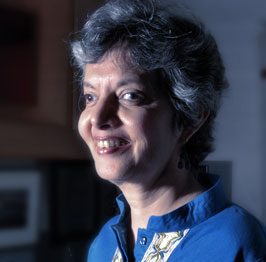
Zohra Yusuf-Newsline
Zohra Yusuf, Newsline photo 2012

Certain memories are etched on the mind. The birth of Women’s Action Forum is, for me, surely among them. It was on an afternoon in September 1981 that Aban Marker (Shirkatgah) called. She told me about the distressed call she had just received from Najma Sadeque (another SG founding member) regarding the case of Fehmida-Allah Bux. Pakistan’s first sentence of death by stoning and public whipping handed down to a couple under the Zina Ordinance of 1979. We had all read about the sentence and in our individual capacities felt deeply disturbed. After a bit of discussion, we decided to call a meeting of all women’s organizations at Aban’s place. The rest, as they say, is history.

The women’s movement was at a nascent stage. Shirkatgah itself was born in 1975, the year the UN dedicated the decade to the cause of women. All Pakistan Women’s Association (APWA), after successfully campaigning for the Family Laws Ordinance 1962, had returned to charitable work. Pakistan Women Lawyers’ Association was also fairly new, as was Tehrik-e-Niswan. The only organization with experience of political work was Pakistan Jamhooriat-Pasand Khwateen (Pakistan Women’s Democratic Front).

I remember to this day the faces of the women around the table that evening when we met at Aban’s. Distressed yet determined. Shirkatgah took the lead in conducting the meeting as it did in the creation of a dynamic platform for Pakistani women to come together in solidarity to challenge the military regime’s anti-women policies. Apart from Aban and Najma, there was Najma Babar, journalist and my colleague at The Star, the Rahman sisters (Ghazala and Humaira) from Tehrik-e-Niswan, Sheema Kirmani – among others from Shirkatgah and other women’s groups. If my memory serves me right, the name Women’s Action Forum was proposed by Humaira and adopted after much debate.
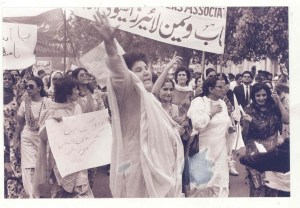
Women's rights demonstration in Lahore, Feb 12, 1983. Photo: Rahat Ali Dar
Women’s rights demonstration in Lahore, Feb 12, 1983. Photo: Rahat Ali Dar

The Star Weekend, where I worked in the eighties, became the voice of the women’s movement. Indeed, I must confess that the birth of WAF was partly responsible for my decision to continue working at The Star which, till then, had been primarily an entertainment weekly.

In fact, over a brief period of time, I was accused of making The Star a feminist newspaper. Of course, many WAF members were regular contributors. Najma Sadeque had already been contributing (believe it or not) a weekly television review. She happily gave up the ordeal of watching PTV to write on issues of women’s rights and status. Kausar S.K. passionately wrote on the setback faced by women’s sports as a result of retrogressive policies. Najma Babar frequently reported on women’s political status and Hilda Saeed on violence against women.

Fortunately, the entry of WAFers in journalism coincided with the lifting of direct censorship in January 1982. While self-censorship remained in force, we were able to pull the wool over some eyes by writing between the lines, stepping back when absolutely necessary and returning for more effective assaults. Political journalism was also introduced in The Star at the same time. Several of the columnists who began to write for the newspaper were committed supporters of women’s rights. Among them were Ahmed Bashir and Hussain Naqi. At The Star itself, we found a staunch supporter in the editor, the late G. N. Mansuri.
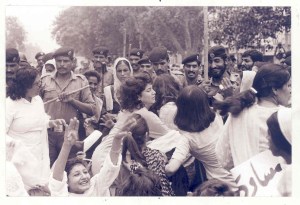
Feb 12, 1983: Many women's rights demonstrators were injured and arrested, heavily outnumbered by police. Photo: Rahat Ali Dar
Feb 12, 1983: Many women’s rights demonstrators were injured and arrested, heavily outnumbered by police. Photo: Rahat Ali Dar

In the eighties, WAF was struggling not only against the discriminatory policies of the Zia regime but for understanding from the society at large, including the media that was, by and large, dismissive of the women’s movement. Even Dawn, which now editorially supports women’s causes, refused to publish reports of and statements by WAF, viewing the organization as an insignificant entity. Often, it was also the butt of sexist jokes. However, it had fairly staunch support from journalists, lawyers and other members of civil society who never hesitated to march with WAF when it took out protest demonstrations on some of the busiest streets of Karachi.

WAF’s strategies in the early years worked. If they did not lead to the repeal of the Hudood Ordinances, they succeeded in watering down the proposed Law of Evidence. Moreover, WAF was quickly gaining world media attention. I remember how elated I felt when the BBC World Service Radio described WAF as the first challenge to the military regime (a highly exaggerated assessment, in retrospect). In fact, WAF put the issue of the status of Pakistani women on the agenda of the global media. Scores of western journalists sought out WAF members to get an insight into the discriminatory laws and their response.
2steps forward 1 step back

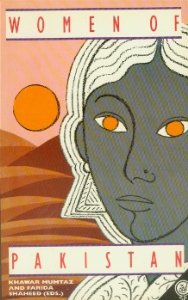
Apart from newspaper articles, the struggle of the eighties spearheaded by WAF, led to the first recorded history of the women’s movement. It inspired (I believe) Farida Shaheed and Khawar Mumtaz to write their seminal book One Step Forward, Two Steps Back.

To a great extent, the struggle for women’s emancipation that WAF embodied released a fair amount of creative energy. Plays related to women’s and other political issues were frequently staged. Leading artistes, including the late Zarina Baloch, showed their support by performing from WAF’s platform. Poets such as Fehmida Riaz, Saeeda Gazdar, Zahida Hina and Attiya Dawood wrote and recited poetry on the theme of the status of women in Pakistan.

The death of General Zia in an air crash brought back Benazir Bhutto from exile. The hopes she instilled in the women of Pakistan (more as a symbol, rather than in substance) were soon dashed shortly after she took over as the first woman Prime Minister of a Muslim country. Perhaps unable to realize their hopes, most of the women associated with WAF formed – or joined – non-governmental organizations. The street-fighting days were over.

Awareness of rights apart, women’s social and legal status has continued to be eroded. So 25 years after the formation of Women’s Action Forum, where is the Pakistani woman today? To borrow from the title of Farida’s and Khawar’s book: “one step forward, two steps back”.

– Zohra Yusuf
Oct 2006

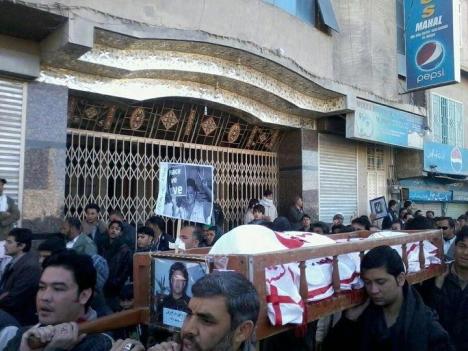
Finally. Victims of Quetta blasts laid to rest.

From @ChaiSabz (Hadi Zaher), 5.55pm Pakistan time: 'Victims of Quetta blasts laid to rest. @KhudiAli among them: "Peace we love". #WEAllAreHazara #RIPKhudiAli'

From @ChaiSabz (Hadi Zaher), 5.55pm Pakistan time: ‘Victims of Quetta blasts laid to rest. @KhudiAli among them: “Peace we love”. #WEAllAreHazara #RIPKhudiAli’

Update to the ‘coffin protest’ in Pakistan

Photo tweeted by Haider Changezi @Aushpaz: Dear #Pakistan U all came in protest but Gov is deaf, hasn't announced #ActionAgainstLeJ #WeAreAllHazara

Photo tweeted by Haider Changezi @Aushpaz: Dear #Pakistan U all came in protest but Gov is deaf, hasn’t announced #ActionAgainstLeJ #WeAreAllHazara

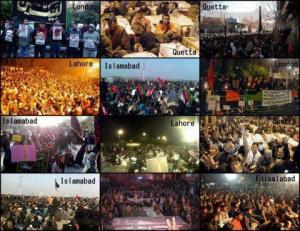
A quick note on the current situation: The past two days and nights have seen inspiring massive, ongoing peaceful protests all across Pakistan in solidarity with the ‘coffin protesters’ at Alamdar Road in Quetta who are refusing to bury their dead until their demands for security are met. The protests finally pushed the PPP government to action – the Balochistan provincial government has been dismissed and Governor Rule imposed in the province, one of the demands of the protestors. Continue reading →

Ongoing protest in Quetta; mourners refuse to bury their dead until action is promised

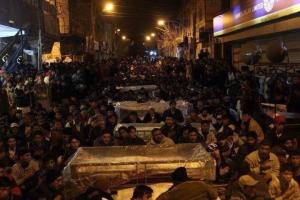
Haunting photo of grieving protestors sitting with coffins in the freezing cold in Quetta

Haunting photo of vigil by thousands of protestors gathered around the shrouded bodies of the blast victims; they’ve been there for 15 hours now, braving freezing cold and rain.

In a powerful statement of grief, rage and protest, demonstrators, including women and children are sitting in the freezing cold and rain holding vigil over 86 shrouded bodies at Alamdar Road, the site of the bomb blasts in Quetta. No one from the government has yet met the mourners who are refusing to bury their dead until the army promises them protection. See video footage of the dharna, ongoing for 15 hours now, broadcast online by Such TV. In solidarity, protestors began gathering at the Karachi Press Club starting at about 3.00 am, galvanised into action by Syed Ali Raza Abidi‘s tweets. By 5 am , some protestors also started gathering in Islamabad. A protest called by the Institute of Peace and Secular Studies is already scheduled from 5-7 pm at the Liberty Roundabout in Lahore today, Jan 12. (UPDATE: Karachi protest Sat, Jan 12, 2.30 pm at Karachi Press Club) Continue reading →

Bomb blasts in Quetta target Hazaras, claim over 100 lives #RIPKhudiAli

There was devastating news today about the triple bomb blasts today in Quetta, one of them at a snooker club, all targeting Hazara Shia areas. Over 100 killed, including three media men who rushed to cover the blasts. It is hard for the human mind to taken in the mind-numbing numbers, but when someone you know is among the dead it really hits home. Our young friend and comrade Irfan Ali lost his life while helping others when the second blast took place. Continue reading →

Iqbal Haider, we’ll miss your ‘groove’

Iqbal Haider: A firm believer in secular values.

 My article for The News on Sunday, Nov 18, 2012 – in which I forgot to mention the resolution Iqbal Haider tried to get the Senate to pass against the cold-blooded murder of young Saima Sarwar in the office of Hina Jillani at the behest of her own parents, simply because she wanted a divorce from her abusive husband. Some senators from FATA physically attacked him for it (See my article ‘There is no ‘honour’ in killing).

 Beena Sarwar

The protests outside Karachi Press Club will be all the poorer without Senator Syed Iqbal Haider’s energising presence. Activists promoting any good cause could count on him to be there — whether it was justice for Mukhtaran Mai, protest against Shia killings, or a call for peace between India and Pakistan. Continue reading →

One Billion Rising: Global campaign against violence against women

Eve Ensler, founder of the One Billion Rising movement. Photograph: Martin Argles for the Guardian.

The well known feminist activist, playwright and actor Eve Ensler has given a call for One Billion Rising campaign that aims to mobilise and bring out one billion people on streets across the world on February 14th, 2013 against violence against women, and in celebration of women’s power (One Billion Rising on Facebook).

Noted women activists from all over South Asia, including Kamla Bhasin of Sangat, OBR’s South Asian coordinator, were at the launch in Nepal. (Photo: WFS)

This, writes Ensler, “is a call to the billion women who have been violated and the men who love them, to the women who have been beaten and raped and mutilated and burned and sold and who know the destruction of the female species heralds the end of human kind. A call to walk out of your homes, your jobs, your schools and find your friends, your group, your place and music and dance” (‘One Billion Rising: Together we can end violence against women’, op-ed in The Guardian). Continue reading →

Malala Yousufzai – Some updates

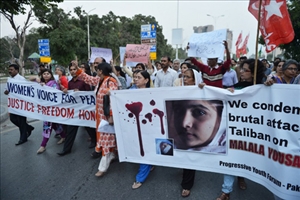
Demo for Malala in Mumbai earlier this week

Adapted from the post I sent to my Yahoogroup a little while ago:

No point repeating what happened a week ago in Swat, when Taliban shot Malala Yusufzai, the 14-year old school girl who has been speaking out courageously for the right of girls to be educated, supported by her equally brave father, Ziauddin Yusufzai, principal of the school she was studying at.

Malala was already a hero to many. Now she has become a worldwide symbol of the right of girls to education, as well as of resistance to the Taliban. In this, she represents millions of Pakistanis – and world citizens. Her friend Kainat who was also injured, told CNN from her hospital bed that she hoped to continue her education and that Malala would come back and join her schoolmates soon. “I want to tell all the girls to continue their mission to get an education,” she said. Continue reading →

IN SOLIDARITY: Charlestown families honour Malala Yusufzai at Bunker Hill, Boston

Joanne Samuelson lights a candle for Malala

“Families in Charlestown are gathering on Bunker Hill monument on Sunday October 14 at 5:30 pm to hold a vigil for Malala Yousafzai. Please try to attend and spread the word, all welcome,” read the email circulated by the Pakistani Association of Greater Boston on behalf of Joanne Samuelson, a Boston resident who works at M.I.T.

The drizzly weather cleared away allowing the sun to come out in time to endorse the gathering at this historic spot in Charlestown, Boston, the site of a major battle between the revolutionaries and the British colonists. Continue reading →

Pakistan artists – challenging dictators and contemporary thought

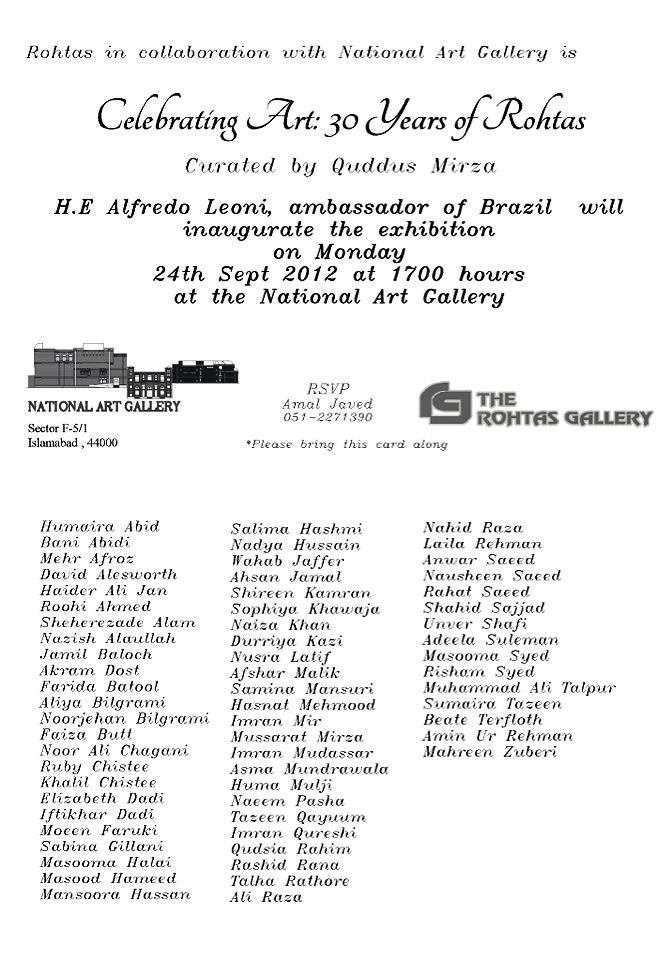
Largest exhibition of Pakistani contemporary art on display Sept. 24 at National Art Gallery, Islamabad at 5 p.m. to celebrate 30 years of Rohtas Gallery. Sixty five artists will exhibit more than 165 works in a testimony to Pakistan’s contemporary artists and an amazing journey through their growth and contribution to art over three decades. Rohtas Gallery opened in 1981 when a repressive military dictator ruled Pakistan. Rohtas Gallery defied constraints and offered space and inspiration to Pakistan’s artists who wanted to challenge contemporary thought and encourage others to do the same through their work. This exhibition on Sept. 24 celebrates Rohtas Gallery and Pakistan’s artists and their amazing journey together.