Following up from my earlier post, here’s the video recording of the Razia Bhatti Memorial Lecture 2023 I delivered online recently for the Center of Excellence in Journalism at IBA, Karachi.
Saleem Asmi: Portrait by Sharjil Baloch, 2014-2015.
By Beena Sarwar
His old friend S. M. Shahid termed Saleem Asmi a ‘Marxist Sufi’ in his compilation of biographical essays, ‘Living Souls: Memories’. Asmi Sahib would typically brush aside the accolades that came his way, not because he didn’t appreciate himself but because he had no false pride, false humility, or a shred of hypocrisy.
I can imagine his chuckle at the couplet by his favourite poet initially chosen by family and friends to inscribe on his gravestone:
Ye masaail-e-tassawuf, ye tera byan Ghalib Tujhey hum vali samajhtalay jo na baada khwar hota
The way you talk of philosophy Ghalib, the mystical way you explain it You would have been considered a saint yourself, had your drinking been less.
Guest post:Zohra Yusuf, my first editor at The Star Weekend 1981-82, outlines the birth of the women’s movement in Pakistan
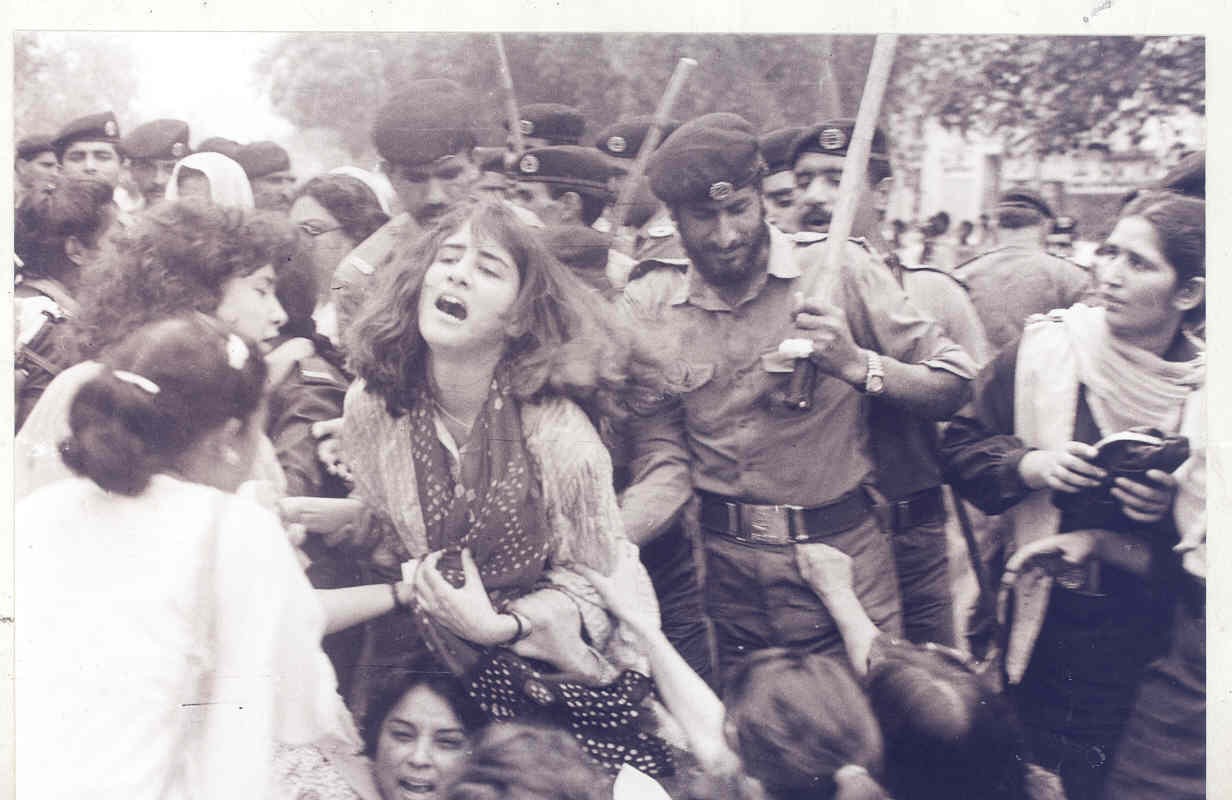
Lahore, Feb 12, 1983: Police brutality on the women’s demonstration against the ‘Law of Evidence’ catapulted the nascent women’s movement into the limelight. Photo: Rahat Ali Dar
“My years with WAF”
By Zohra Yusuf | Article written for a souvenir on WAF’s 25th anniversary, Oct 2006
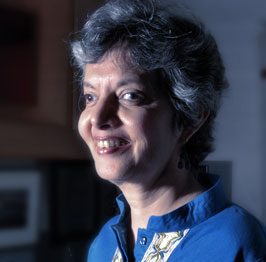
Zohra Yusuf, Newsline photo 2012
Certain memories are etched on the mind. The birth of Women’s Action Forum is, for me, surely among them. It was on an afternoon in September 1981 that Aban Marker (Shirkatgah) called. She told me about the distressed call she had just received from Najma Sadeque (another SG founding member) regarding the case of Fehmida-Allah Bux. Pakistan’s first sentence of death by stoning and public whipping handed down to a couple under the Zina Ordinance of 1979. We had all read about the sentence and in our individual capacities felt deeply disturbed. After a bit of discussion, we decided to call a meeting of all women’s organizations at Aban’s place. The rest, as they say, is history.
The women’s movement was at a nascent stage. Shirkatgah itself was born in 1975, the year the UN dedicated the decade to the cause of women. All Pakistan Women’s Association (APWA), after successfully campaigning for the Family Laws Ordinance 1962, had returned to charitable work. Pakistan Women Lawyers’ Association was also fairly new, as was Tehrik-e-Niswan. The only organization with experience of political work was Pakistan Jamhooriat-Pasand Khwateen (Pakistan Women’s Democratic Front).
I remember to this day the faces of the women around the table that evening when we met at Aban’s. Distressed yet determined. Shirkatgah took the lead in conducting the meeting as it did in the creation of a dynamic platform for Pakistani women to come together in solidarity to challenge the military regime’s anti-women policies. Apart from Aban and Najma, there was Najma Babar, journalist and my colleague at The Star, the Rahman sisters (Ghazala and Humaira) from Tehrik-e-Niswan, Sheema Kirmani – among others from Shirkatgah and other women’s groups. If my memory serves me right, the name Women’s Action Forum was proposed by Humaira and adopted after much debate.
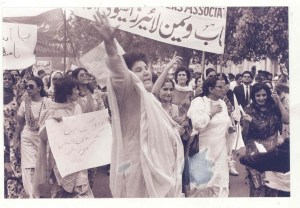
Women’s rights demonstration in Lahore, Feb 12, 1983. Photo: Rahat Ali Dar
The Star Weekend, where I worked in the eighties, became the voice of the women’s movement. Indeed, I must confess that the birth of WAF was partly responsible for my decision to continue working at The Star which, till then, had been primarily an entertainment weekly.
In fact, over a brief period of time, I was accused of making The Star a feminist newspaper. Of course, many WAF members were regular contributors. Najma Sadeque had already been contributing (believe it or not) a weekly television review. She happily gave up the ordeal of watching PTV to write on issues of women’s rights and status. Kausar S.K. passionately wrote on the setback faced by women’s sports as a result of retrogressive policies. Najma Babar frequently reported on women’s political status and Hilda Saeed on violence against women.
Fortunately, the entry of WAFers in journalism coincided with the lifting of direct censorship in January 1982. While self-censorship remained in force, we were able to pull the wool over some eyes by writing between the lines, stepping back when absolutely necessary and returning for more effective assaults. Political journalism was also introduced in The Star at the same time. Several of the columnists who began to write for the newspaper were committed supporters of women’s rights. Among them were Ahmed Bashir and Hussain Naqi. At The Star itself, we found a staunch supporter in the editor, the late G. N. Mansuri.
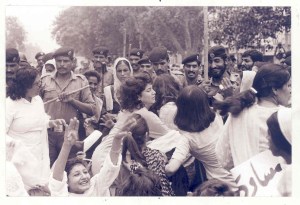
Feb 12, 1983: Many women’s rights demonstrators were injured and arrested, heavily outnumbered by police. Photo: Rahat Ali Dar
In the eighties, WAF was struggling not only against the discriminatory policies of the Zia regime but for understanding from the society at large, including the media that was, by and large, dismissive of the women’s movement. Even Dawn, which now editorially supports women’s causes, refused to publish reports of and statements by WAF, viewing the organization as an insignificant entity. Often, it was also the butt of sexist jokes. However, it had fairly staunch support from journalists, lawyers and other members of civil society who never hesitated to march with WAF when it took out protest demonstrations on some of the busiest streets of Karachi.
WAF’s strategies in the early years worked. If they did not lead to the repeal of the Hudood Ordinances, they succeeded in watering down the proposed Law of Evidence. Moreover, WAF was quickly gaining world media attention. I remember how elated I felt when the BBC World Service Radio described WAF as the first challenge to the military regime (a highly exaggerated assessment, in retrospect). In fact, WAF put the issue of the status of Pakistani women on the agenda of the global media. Scores of western journalists sought out WAF members to get an insight into the discriminatory laws and their response.
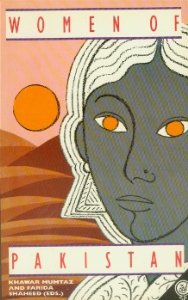
Apart from newspaper articles, the struggle of the eighties spearheaded by WAF, led to the first recorded history of the women’s movement. It inspired (I believe) Farida Shaheed and Khawar Mumtaz to write their seminal book One Step Forward, Two Steps Back.
To a great extent, the struggle for women’s emancipation that WAF embodied released a fair amount of creative energy. Plays related to women’s and other political issues were frequently staged. Leading artistes, including the late Zarina Baloch, showed their support by performing from WAF’s platform. Poets such as Fehmida Riaz, Saeeda Gazdar, Zahida Hina and Attiya Dawood wrote and recited poetry on the theme of the status of women in Pakistan.
The death of General Zia in an air crash brought back Benazir Bhutto from exile. The hopes she instilled in the women of Pakistan (more as a symbol, rather than in substance) were soon dashed shortly after she took over as the first woman Prime Minister of a Muslim country. Perhaps unable to realize their hopes, most of the women associated with WAF formed – or joined – non-governmental organizations. The street-fighting days were over.
Awareness of rights apart, women’s social and legal status has continued to be eroded. So 25 years after the formation of Women’s Action Forum, where is the Pakistani woman today? To borrow from the title of Farida’s and Khawar’s book: “one step forward, two steps back”.
Zohra Yusuf’s tribute to Saneeya in ‘The Herald’ – one of dozens of articles about this extraordinary activist, journalist and wonderful human being
Hard to believe it’s five years already since we lost Saneeya to asthma and a traffic jam in Sao Paulo, Brazil. Our mutual friend in Sri Lanka, Nalaka Gunawardene remembers her in a blog post today titled “Remembering Saneeya Hussain of Absurdistan, five years on…”.
“Absurdistan” is the delightfully whimsical word Saneeya coined, in her email to me in March 2005 in response to news of the attack on women participating in a ‘mixed’ (non-segregated) marathon in Gujranwala. Just two days later, we learnt that she had gone into a coma, from which she never recovered. I used “Absurdistan” as the headline of another article after she’d passed away.
Saneeya, we will always miss you. Thanks to all those who are supporting the Saneeya Hussain Trust run by her family and friends to provide educational scholarships to deserving women and girls.