Boston area screening of ‘Democracy in Debt’ documentary, Sunday 24 November

COMMUNITY INVITE: If you are in the Boston area, you are invited to a screening of my documentary film ‘Democracy in Debt: Sri Lanka Beyond the Headlines’ (25 min), followed by a discussion, at the Cambridge Public Library on Sunday 24 November, 2-4 pm. If you are not here or unable to join, please tell people you know who might like to:

‘Democracy in Debt: Sri Lanka Beyond the Headlines’ 
A film by Beena Sarwar
Sunday 24 November, 2-4 pm
At Cambridge Public Library.

 Trailer: ‘Democracy in Debt: Sri Lanka Beyond the Headlines’ 

The film will be followed by a discussion moderated by Pratyush Bharati of the Boston South Asian Coalition. Discussants include Bangladesh origin activist Hayat Imam of the Massachusetts Peace Action, Sri Lankan human rights lawyer Thyagi Ruwapathirana, a fellow at the Harvard Law School, and the filmmaker Beena Sarwar, a journalist and peace activist from Pakistan.

The film, supported by the Pulitzer Center, has been screened in over 60 locations in some 16 countries across 5 continents so far, followed by engaged discussions on the issues it raises. More information here. 

The event is free and open to the public. RSVP here.

Hosted by the Southasia Peace Action Network and Sapan News Network in collaboration with the Boston South Asian Coalition and South Asia Center, Boston

Those wishing to watch the film through the Global Community Screenings series are welcome to participate by filling in the form at this link

Local votes to regional destiny? The future of democracy in South Asia

I meant to share this when it was first published on Sapan News recently, my article co-authored with Dr Serena Hussain and Vishal Sharma, but was caught up with the Colombo screening of my Sri Lanka documentary. Thought I’d post now – the piece is still relevant especially given a recent article in an influential foreign policy magazine debunking the idea of Southasia

Images from various SAARC summits sourced from copyright-free photos. Collage by Pragayan Srivastava

Why the regimes ushered in through the democratic political process need to collaborate for a better future for the peoples of the region

By Dr Serena Hussain, Vishal Sharma and Beena Sarwar

The recent elections in Britain, France, and India are a reminder of the power of the people – and also of the importance of regional cooperation.

Pakistani PM Benazir Bhutto with her Indian counterpart Rajiv Gandhi at 1988 SAARC Summit in Islamabad. Source: Dawn

The Indian elections were the third electoral exercise in South Asia this year, after Bangladesh in January  and Pakistan in February. Sri Lanka is also required to hold presidential elections before October.

As part of the democratic political process, elections determine the leadership that will shape not only a nation’s destiny, but also in closely connected regions.

The governments may choose to be isolationist, or follow the will of foreign powers, or cooperate and collaborate with neighbouring nations. Can and will South Asia’s regimes cooperate to promote regional peace, prosperity and progress as they have done in previous decades such as, during the 1950s, 1980s, and 2000s?

Such collaboration is essential for the sake of the peoples of the region.

Continue reading

Hope, wisdom and cynicism: Voices from rural Sri Lanka (and an owl rescue)

Boats on Dututwewa at sunset. Photo by Ben Samarasinghe

The lakes, paddy fields and forests of the ancient village of Dutuwewa are a world away from Colombo’s high-rises and colonial buildings. As elsewhere, decisions taken by ‘old men’ in the corridors of power impact life here, just as these rural voters will impact politics nationally


PERSONAL POLITICAL
FROM DUTUWEWA WITH LOVE

By Beena Sarwar

Times are tough and it’s hard to make ends meet. A refrain heard from just about anyone in my home country Pakistan where the rupee has dropped to around 300 to the dollar. This is now comparable to the rupee in Sri Lanka, recovering from the biggest economic crash in its history. 

Stories of hardship echo from the island nation’s largest city Colombo to the farming heartlands around Anuradhapura district, a little over 200 km to the north-east. At the core of Anuradhapura lies the irrigation tank called Dutuwewa which sustains several villages. 

Sri Lanka’s rural landscape is dotted with as many as 14,000 such large and small irrigation lakes, known as wewas, built by kings thousands of years ago. 

A nearly five-hour drive on surprisingly good roads – testament to the rural infrastructure built after the end of the 26-year long civil war 15 years ago – brings us to the serene lakes, lush paddy fields and dense forests of Dutuwewa. A world away from the corridors of power and the glittering, air conditioned, high-rises of Colombo and its historic colonial buildings left behind by 500 years of colonizers – the Dutch, the Portuguese and the British.

A village school in a forest

The din of crickets from the surrounding forest forms the backdrop to everything  in Dutuwewa. The headmistress of the Palugollagama government school, who gives only her initials and last name, I. R. Ekanayake, is an ‘old girl’ who taught at schools around the district for 26 years and was posted to her alma mater as principal four years ago. There are two vice principals, 36 teachers and 506 students.

Continue reading

Sarmad Khoosat live; Celebrating love in Boston; Sapan News tribute to a harmonium soloist

A compilation of offerings from our Sapan network, including my latest venture Sapan News syndicated features. Together, we aim to further the narrative of regionalism, peace, and dialogue. What can you do? Read on

Visual: Aekta Kapoor/Sapan

Delighted to have acclaimed actor and director Sarmad Khoosat join us Sunday July 16 for Sapan’s first fundraiser, hosted by poet Dr Arvinder Chamak in Amritsar. Sarmad will be in conversation with the wonderful journalists Malinda Seneviratne in Colombo, Mandira Nayar in Delhi; and Lubna Jerar in Karachi.

Watch: Sarmad Khoosat LIVE |… on Facebook | … on YouTube

Continue reading

Opinion / India: A tale of two pardons

The latest Sapan News syndicated feature, by Ramon Magsaysay awardee Dr Sandeep Pandey on the difference between the release of convicts in Rajiv Gandhi’s assassination case and those convicted in the Bilkis Bano case. He argues that the premature release of one set of convicts cannot be used to justify another — one was set free by the courts, while administrative decree was behind the other. One poses no threat to the victim’s family, while the other has sent witnesses into hiding.

Read more at Sapan News Network.

Available for use with credit to Sapan News Network.

Need to promptly repatriate cross-border prisoners, especially if they die…

Over 30 organizations around Southasia and beyond have endorsed a joint statement about cross-border prisoners initiated and coordinated by Sapan, the Southasia Peace Action Network, calling for the humane treatment of cross-border prisoners and to decriminalise inadvertent illegal border crossings.

Titled ‘Release prisoners on completion of jail term, decriminalise inadvertent border crossings, especially for fisherfolk and minors‘, the statement draws attention to the death of two Indian fisherfolk in Pakistani custody this year, and the death of a Pakistani fisherman of Bengali origin in India’s custody last year.

All three had served their sentences but remained in custody on ‘the other side’. Compounding the tragedy, there are terrible delays in the repatriation of the bodies of such fisherfolk, notes the statement.

The statement also draws attention to some teenagers who remain incarcerated in juvenile centers in India, mostly without any contact with their families. One has already served his sentence but remains incarcerated. Details below – Statement text and endorsements:

Arrested fisherfolk in custody across the border, far from home, no consular access until after sentence is over, often kept in custody even after serving their sentences. File photo. Getty images
Continue reading

Solidarity with Sri Lanka

The situation in Sri Lanka is really dire. We at Sapan issued this statement 02 June – posted to website. Pls share widely: Southasians express solidarity with Sri Lanka, concern about economic and humanitarian crises.

Excerpt: “Amidst all the tension and uncertainty, it is important to note the undercurrent of hope enabled by the active engagement of individuals, organisations and civil society calling for accountability and good governance.” 

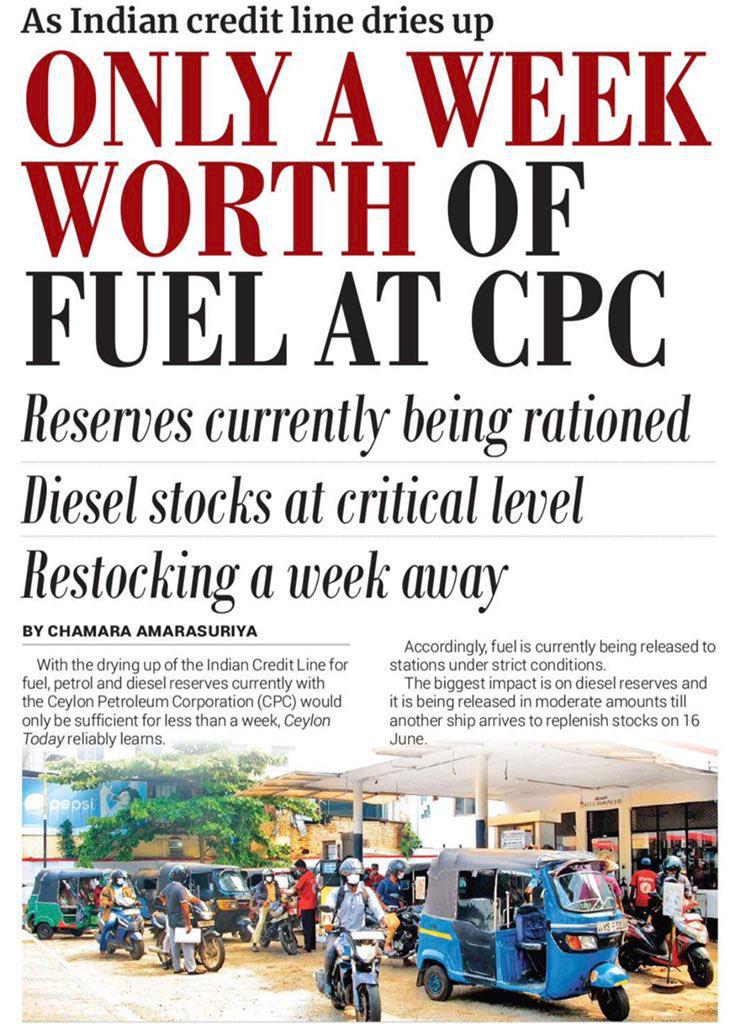
Here’s the scan of a report shared just now by a friend waiting in a petrol queue – the Ceylon Petroleum Corporation has only a week’s worth of fuel left:

She also shared a short piece from the Daily Mirror today. Excerpt:

“The people of Sri Lanka deserve to live their lives without these politically-triggered interruptions.  Towards that end, I implore international companies that Sri Lanka works with to not divert business from here when we need their support and partnership the most.  Hopefully tourists will return once the country finds stability.  The wonders of this country still remain as beautiful, unmarred by the constant disruption.”  – Paradise Disrupted

A 58-year old daily wage labourer who lives in a single room on the outskirts of Colombo with her husband shares how they’ve had to switch from cooking with gas, to kerosene, and now firewood. Her husband forages for vegetables and edible leaves on his way home from work. See her story at: Financial Pandemic: ‘Sri Lanka is not a country for poor people now’, The Fuller Project, 20 May, 2022.

Wanted: Adult behaviour in SouthAsia

The last Sapan – South Asia Peace Action Network – event of the year was titled “Growing up, growing together” with activists across the region resolving to continue working for a better tomorrow. It was wonderful to hear so many young people speak – most under 35 years old. Thanks to all those who worked so hard to make the event a success – including the poetry and music at the end. Sapan’s next monthly event on the last Sunday of January will have more music and culture.

The Facebook Live recording of the recent meeting is available at this link – video log online at this link. Here’s a feature report about the event.

Commemorating Human Rights Day, the founding of SAARC, and 50 years of Bangladesh’s independence, Sapan discussion highlights the commonality of human rights issues across the region

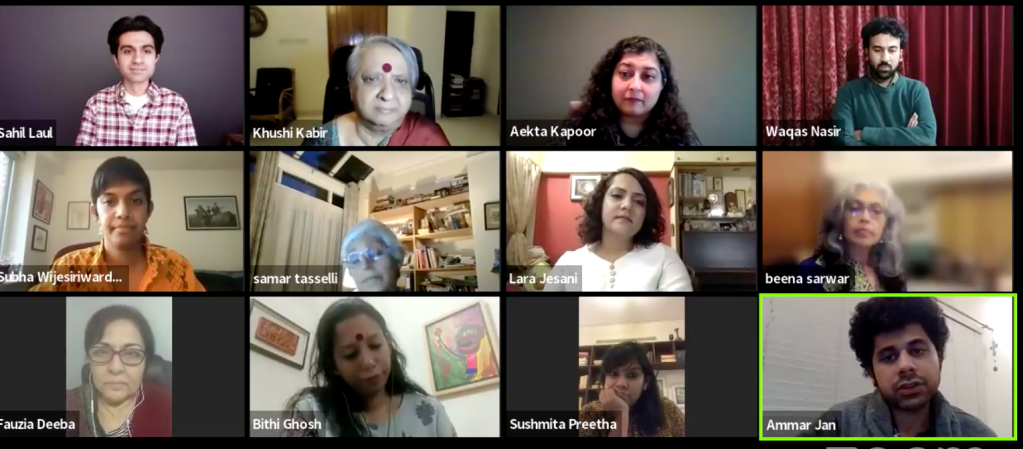
Some of the participants at the event – most speakers were under 35-years old. Screenshot.
Continue reading

South Asian activists, academics, journalists urge Sri Lanka not to violate fundamental rights in the name of combating terror


SriLanka statement-Wire-collage

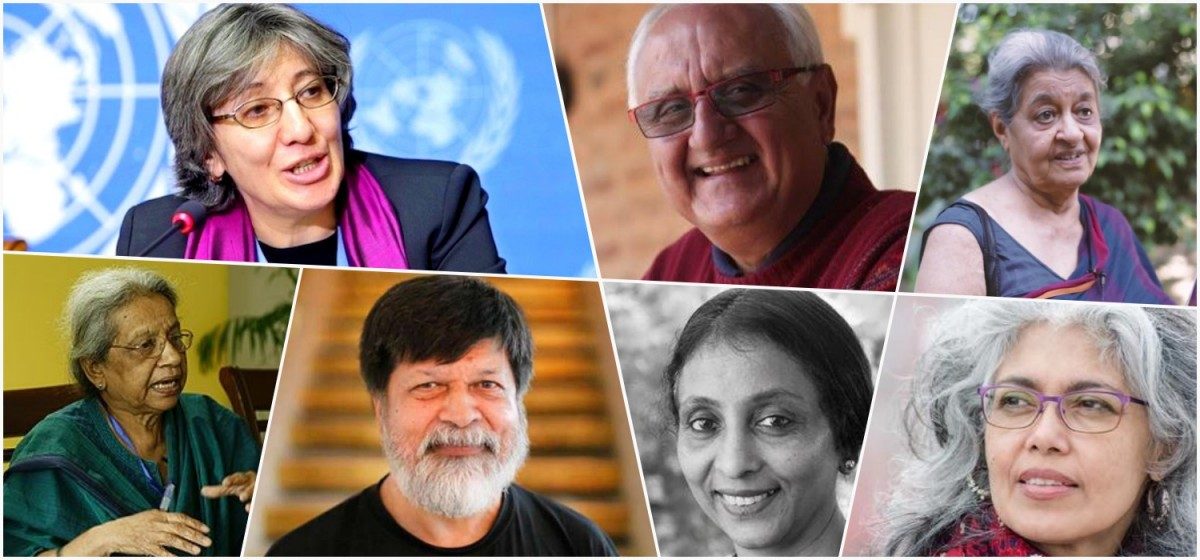
Top row (L-R): Sima Samar, Kanak Mani Dixit, Hamida Hossain. Bottom row (L-R): Uma Chakravarti, Shahidul Alam, Pamela Philipose, Beena Sarwar. Collage: TheWire.In

Thanks to friends who initiated this statement in solidarity with the artists, thinkers and people of Sri Lanka, that I have signed along with over 250 other activists, academics and journalists from across South Asia. Please feel free to endorse and share. Signatories include human rights activists from Afghanistan and Bangladesh, journalists from Nepal, Pakistan and India, and historians and feminists from India and Pakistan, among others who have been at the forefront of facing similar realities in their respective nation-states for decades. Full text below, updated from the version published earlier in TheWire.in.


May 2, 2019: Continue reading