The event in India this afternoon represents a significant moment for Southasian solidarity. It also underscores the challenges in the region, including visa restrictions between Pakistan and India
I feel deeply honoured to be among the wonderful women being conferred the Saahas-e-Azim (Most Fearless) award by WISCOMP in Delhi today – Women in Security, Conflict Management and Peace, celebrating its 25th anniversary.
Sapan founder member Dr Syeda Hameed
It is amazing that three of the awardees are from Pakistan – but sadly unable to be there at the ceremony, thanks to the visa issues between Pakistan and India.
The highest award, the Saahas Shresta (Great Courage), goes to the journalist and activist Patricia Mukhim, Editor of Shillong Times and a Sapan News advisory council member. The jury termed Mukhim a “tireless advocate for communal harmony and gender equality” with “ceaseless positive energy in countering violence”.
Further delighted that our dear mentor Dr Syeda Hameed is a guest of honour conferring the awards, and that our lovely friends Kavita Srivastava and Mandira Nayar will be there to receive the honour on behalf of Saeeda Diep and me.
The large Sapan presence and contingent in this event includes four of the awardees, a guest of honour, and two accepting the awards, as Pragyan Srivastava wrote today for Sapan News
The Pakistanis besides myself are Sapan founder member Saeeda Diep, “peace activist and human rights advocate from Pakistan, championing the rights of religious minorities, especially Hindus through a gender lens” and Mossarat Qadeem, a university professor turned activist, being honoured for her work through her Paiman Trust which “empowers women and radicalised youth in conflict zones to become agents of peace and reconciliation”.
The fourth Saahas-e-Azim awardee is Ruchira Gupta, “globally renowned journalist, filmmaker, and activist, dedicated to eradicating sex trafficking and empowering women”, a Sapan member from India.
Thanks also to our great friends and Sapaners Aekta Kapoor and Sagari Chhabra for the nominations.
Hello everyone! We are excited that Sapan News qualified for NewsMatch for the second year running. This is a collaborative fundraiser run by the Institute for Nonprofit News, a professional journalists’ body to which only half the media outlets that apply get accepted. The initiative supports 475 independent, nonprofit, nonpartisan newsrooms dedicated to public service like Sapan News.
Until December 31, 2024, NewsMatch will match every dollar donated to Sapan News, up to $15,000. That means all donations made by year end will go twice as far. ‘
This will enable us to continue the Sapan News mission of furthering the narrative of peace, dialogue, and regionalism, to provide nonpartisan journalism with context and nuance, with voices from the community and on the ground who go into the why and how beyond the headlines.
COMMUNITY INVITE: If you are in the Boston area, you are invited to a screening of my documentary film ‘Democracy in Debt: Sri Lanka Beyond the Headlines’ (25 min), followed by a discussion, at the Cambridge Public Library on Sunday 24 November, 2-4 pm. If you are not here or unable to join, please tell people you know who might like to:
‘Democracy in Debt: Sri Lanka Beyond the Headlines’ A film by Beena Sarwar Sunday 24 November, 2-4 pm At Cambridge Public Library.
Trailer: ‘Democracy in Debt: Sri Lanka Beyond the Headlines’
The film will be followed by a discussion moderated by Pratyush Bharati of the Boston South Asian Coalition. Discussants include Bangladesh origin activist Hayat Imam of the Massachusetts Peace Action, Sri Lankan human rights lawyer Thyagi Ruwapathirana, a fellow at the Harvard Law School, and the filmmaker Beena Sarwar, a journalist and peace activist from Pakistan.
Those wishing to watch the film through the Global Community Screenings series are welcome to participate by filling in the form at this link.
Support non-profit journalism. Help Sapan News meet its NewsMatch challenge and raise $15,000 by year end. All donations to Sapan News are tax-deductible.
The keynote speaker at TCF Boston fundraiser this year was Indian – and it wasn’t ‘bad news’. On the contrary. Check out Shashi Buluswar‘s cricket documentary that I’ve included in the article. Plus a discussion with ‘peacemongers’ hosted by a center in Kolkata the same day.Why can’t our political leaders take a leaf from Mani Shankar Aiyar’s relationship with his old friend Javed Jabbar, a self-proclaimed “chauvinist and narrow-minded Pakistani” — they disagree on almost everything yet are “the closest of friends”.(Note: for more photos, go to the piece published on Sapan News)
“By now you will have got the bad news,” said the keynote speaker after being introduced. “I’m Indian”.
There was laughter and warm applause from the largely Pakistani or Pakistani-origin audience.
Not only was it not ‘bad news’, but the speaker’s support for the cause he was advocating for, beyond borders and boundaries, was even more appreciated because of his Indian origin.
Going by the media – and social media – you’d think we all hate each other. Not true.
Film screenings byAnand Patwardhanin Cambridge MA TODAY and tomorrow. My documentary at Tufts on Wednesday. The sublime musical play ‘Madho’ at Wellesley next weekend. The latest Sapan Alliance newsletter has more events and info about other events, including in Colombo. Scroll below for my conversation with Mayank Chhaya on the Sri Lanka elections, plus pix from ‘Democracy in Debt’ Global Community Screenings – some 40 events in 14 countries across 5 continents – and my notes on recent Sapan News features.
Off-Kendrik started over 16 years ago, “committed to building a broad platform for South Asian theatre groups and the next generation of South Asian Americans through theatre and storytelling”.
PERSONAL POLITICAL By Beena Sarwar
I went to see ‘Madho’ last night with my mother at the Third South Asia Theatre festival, SAATh 2024, in the Boston area. A musical play set in Lahore, it is written and directed by Sarbpreet Singh, an engineer by profession whose passion is music and storytelling.
I meant to share this when it was first published on Sapan News recently, my article co-authored with Dr Serena Hussain and Vishal Sharma, but was caught up with the Colombo screening of my Sri Lanka documentary. Thought I’d post now – the piece is still relevant especially given a recent article in an influential foreign policy magazine debunking the idea of Southasia
Images from various SAARC summits sourced from copyright-free photos. Collage by Pragayan Srivastava
Why the regimes ushered in through the democratic political process need to collaborate for a better future for the peoples of the region
By Dr Serena Hussain, Vishal Sharma and Beena Sarwar
The recent elections in Britain, France, and India are a reminder of the power of the people – and also of the importance of regional cooperation.
Pakistani PM Benazir Bhutto with her Indian counterpart Rajiv Gandhi at 1988 SAARC Summit in Islamabad. Source: Dawn
The Indian elections were the third electoral exercise in South Asia this year, after Bangladesh in January and Pakistan in February. Sri Lanka is also required to hold presidential elections before October.
As part of the democratic political process, elections determine the leadership that will shape not only a nation’s destiny, but also in closely connected regions.
The governments may choose to be isolationist, or follow the will of foreign powers, or cooperate and collaborate with neighbouring nations. Can and will South Asia’s regimes cooperate to promote regional peace, prosperity and progress as they have done in previous decades such as, during the 1950s, 1980s, and 2000s?
Such collaboration is essential for the sake of the peoples of the region.
Guest post: A personal tribute to Karamat Ali (19 August 1945 – 20 June 2024) by Mandira Nayar in Delhi, for Sapan News
Karamat Ali was many things but for Mandira Nayar he was always the person who returned her grandfather Kuldip Nayar to Lahore, where he was born and which he considered home. The relationship between them defies labels but it has a bond that is deep and unbreakable, stronger than many relationships with names, she writes:
There are many words for friendship. Arabic has twelve. You can choose from friendships of different shades — the intense saqeeb, a true friend; sameer, someone who you like to have a conversation with, or the casual zameel, an acquaintance.
Announcement from Pakistan India People’s Forum for Peace and Democracy for an online memorial
Memorial meeting at Arts Council of Pakistan, Karachi, for Karamat Ali
Comrades at the Human Rights Commission of Pakistan in Lahore remember Karamat Ali
English has just the one — a bland ‘friend’. The short dost (friend) in Hindustani encompasses in its tiny frame a sort of bro-code for the intense relationship that Hindi film songs refer to, between Maana Dey’s ‘Yaari hai Imaan’ (My friend is my faith) to Sholay’s anthem ‘Yeh Dosti Hum Nahi toRe.nge‘ (This friendship we will never abandon).
‘Dost’
So I struggle to find a word to describe the relationship between Karamat Ali, labour leader, peace activist, revolutionary, lover of music, and my grandfather Kuldip Nayar, journalist, peace-activist and fellow dreamer. And by extension, my relationship with Karamat Sahib.
This relationship without a name has a bond that is deep and unbreakable, stronger than many relationships with names.
Karamat Ali was many things but for me he was always the person who returned my grandfather to the home he was born in.
As news of Noam Chomsky’s failing health makes the rounds, I share some learnings from my interactions with a trailblazing public intellectual whose moral compass has impacted the world
PERSONAL POLITICAL By Beena Sarwar
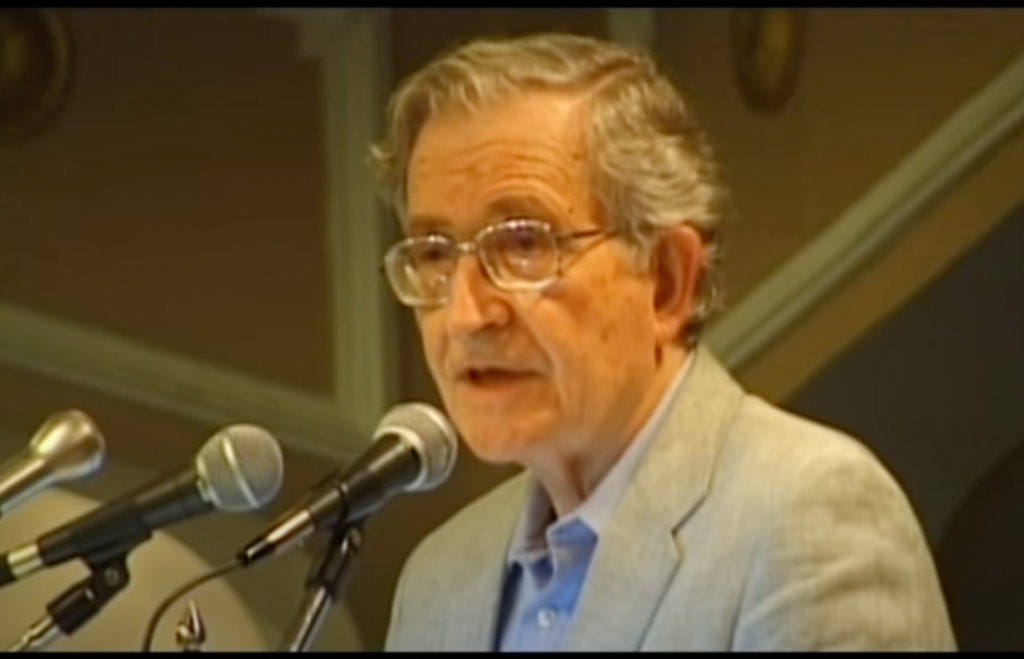
Noam Chomsky in Pakistan, 2001. Screenshot from VPRO news report by Beena Sarwar.
I once asked Noam Chomsky how he manages to remember so many facts and figures and hold audience attention. He replied that he didn’t convey any new information, that his talks are based on materials already in the public domain, and that he simply joins the dots – providing context – and repeats the information consistently and in different ways.
His response was typical of his humility as well as his courtesy towards a much younger person to whom he owed nothing.
Chomsky teaches us that it is not necessary to be loud and sensationalist in order to be heard. This, together with the clear and courageous moral compass he has provided over decades, is a most valuable lesson.
Noam Chomsky was already a legend when I first met him over two decades ago in December 2001 when he visited Pakistan for the inaugural Eqbal Ahmad Memorial lecture series.
Boats on Dututwewa at sunset. Photo by Ben Samarasinghe
The lakes, paddy fields and forests of the ancient village of Dutuwewa are a world away from Colombo’s high-rises and colonial buildings. As elsewhere, decisions taken by ‘old men’ in the corridors of power impact life here, just as these rural voters will impact politics nationally
PERSONAL POLITICAL FROM DUTUWEWA WITH LOVE
By Beena Sarwar
Times are tough and it’s hard to make ends meet. A refrain heard from just about anyone in my home country Pakistan where the rupee has dropped to around 300 to the dollar. This is now comparable to the rupee in Sri Lanka, recovering from the biggest economic crash in its history.
Stories of hardship echo from the island nation’s largest city Colombo to the farming heartlands around Anuradhapura district, a little over 200 km to the north-east. At the core of Anuradhapura lies the irrigation tank called Dutuwewa which sustains several villages.
Sri Lanka’s rural landscape is dotted with as many as 14,000 such large and small irrigation lakes, known as wewas, built by kings thousands of years ago.
A nearly five-hour drive on surprisingly good roads – testament to the rural infrastructure built after the end of the 26-year long civil war 15 years ago – brings us to the serene lakes, lush paddy fields and dense forests of Dutuwewa. A world away from the corridors of power and the glittering, air conditioned, high-rises of Colombo and its historic colonial buildings left behind by 500 years of colonizers – the Dutch, the Portuguese and the British.
A village school in a forest
The din of crickets from the surrounding forest forms the backdrop to everything in Dutuwewa. The headmistress of the Palugollagama government school, who gives only her initials and last name, I. R. Ekanayake, is an ‘old girl’ who taught at schools around the district for 26 years and was posted to her alma mater as principal four years ago. There are two vice principals, 36 teachers and 506 students.