The unfulfilled creative promise and potential of Southasia through art and film

Among the insights gained during the panel discussion after the exhibition walkthrough and documentary screening was the similarity between the creative arts and good journalism: Both involve masses of research, and are rooted in being exploratory, observational, and non-judgmental, rather than agenda-driven.

Personal Political

By Beena Sarwar / Sapan News
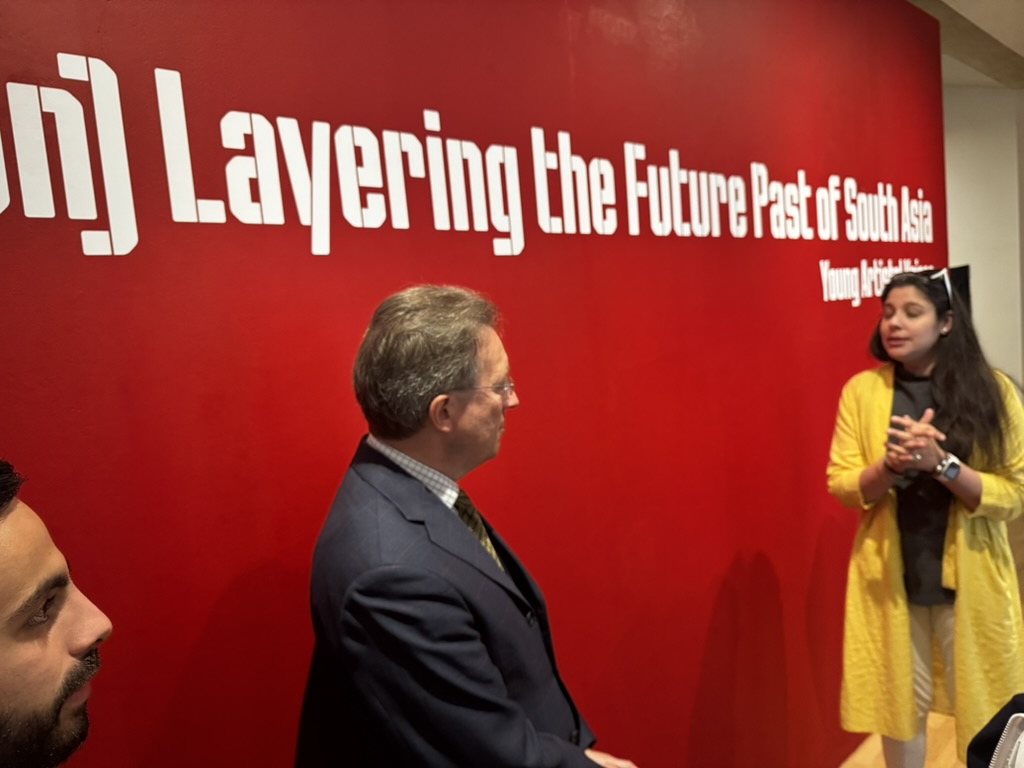
Manmeet K. Walia introducing the (Un)Layering the future past of South Asia: Young artists’ voices‘ exhibit as part of a special event organised by the Bloomsbury Institute London last week. Photo by Beena Sarwar.

The idea of a ‘Young Southasian Artists’ exhibition struck a chord when acclaimed Lahore-based artist and educator Salima Hashmi mentioned it some years ago, after writer and curator Manmeet K. Walia from New Delhi approached her about it.

Salima Hashmi, known for her creativity and longstanding commitment to peace, democracy and human rights, is also a founder member and advisor for the Southasia Peace Action Network which nearly 90 of us launched online in March 2021. Her lifetime of hard work, struggle, and consistency stand apart from the legacy she inherited from her illustrious father, the celebrated poet Faiz Ahmed Faiz.

When Prof. Hashmi and Ms. Walia presented their then under-production show at the Faiz Festival in Lahore, 2024, what stood out was the creativity and courage they were showcasing.

Continue reading

Beyond ‘Ceasefire’ – India and Pakistan must talk. For the sake of the people. Plus some good news

First, the good news.

Our Pulitzer Center-supported documentary ‘Democracy in Debt: SriLanka Beyond the Headlines’ has just been selected by the Pune Short Film Festival 2025, June 2. It has also been selected for the Asian Talent International Film Fest 2025, Oct. 5, in Ahmednagar, Maharashtra, and was earlier screened at the Fifth Kerala Short Film Festival 2025, held in March.

Here’s the trailer. To watch the film, fill in the Global Community Screening form linked here.

Trailer: ‘Democracy in Debt: Sri Lanka Beyond the Headlines’

More good news

Our peace appeal for India and Pakistan to Stop Hostilities posted by the Southasia Peace Action Network or Sapan just after the war broke out reached more than 5,000 signatures in the first 48 hours. It had reached nearly 7,500 signatories but the number inexplicably dropped so now we are just over 7,000. In this vitiated atmosphere where jingoism dominates the airwaves and social media, this is no small number. Let’s keep on the pressure for these two nuclear-powered neighbours to talk.

The sad news

Continue reading

As war drums beat, remembering three departed comrades who stood for peace

It has been a decade since we lost Sabeen Mahmud to a targeted attack in Karachi and since we lost Shayan “Poppy” Afzal Khan to cancer. It is also 20 years since the pioneering environmental journalist Saneeya Hussain died in Brazil. Their peacemongering legacies live on.

Personal Political
Beena Sarwar / Sapan News

On 24 April 2015, a valiant crusader for peace, social justice, creativity and human dignity was killed in Karachi. That tragedy ten years ago deprived a mother of her only child, and many of us of a dear friend.

Social entrepreneur Sabeen Mahmud, 40, was driving home with her mother Mahenaz next to her. A motorcyclist approached while they were stopped at a red light, and shot Sabeen at point blank range. She died on the spot. 

  • Sabeen. Photo by Zaheer Alam Kidvai.

I had known Sabeen since she was a teenager. We were comrades together in several peace initiatives – part of a large, cross-border tribe of ‘peacemongers’ as I call our community. 

Continue reading

A Sri Lankan’s Nepal odessey before heading to the ‘savage’ Mt. K2, Pakistan

Dimantha looking at the calm ocean that once took his “everything” as he puts it. Photo by Flavion Moses

The first time I met Dimantha D. Thenuwara was almost exactly two years ago, in 2023, when he caught a bus overnight across Sri Lanka to meet me and Aisha Gazdar at Ramani Corea‘s beach house in the north-west. He climbed up a tree branch and napped there in the mid-day heat, and offered to show us how he could eat bugs (no thanks, we said).

This man from the tropics had recently determined to climb K2 – the ‘savage mountain’ in northern Pakistan – and wanted to meet some Pakistanis. We’ve been in touch since. He has visited Pakistan and is even learning Urdu (search sapannews.com for ‘Dimantha’).

Next week, he’s headed to Nepal to summit the spectacular Mt. Ama Dablam, one of the world’s most challenging peaks. Sri Lankans have summitted Himalayan mountains before but Dimantha will also carry the Southasia Peace Action Network hashtag#Sapan logo on the flag he hoists, to highlight a mission he supports, to amplify the narrative of peace, dialogue, and regional cooperation and connectivity.

Continue reading

The urgency of ‘Southasia’: The answer to the region’s challenges lies in real federalism

“What’s in a name?” – veteran journalist, civic and political rights advocate Kanak Mani Dixit from Kathmandu Valley challenges diaspora scholars and academics to deeply study the issue of ‘Southasia’ in a way that has not yet been attempted 


Nepali journalist and founder of Himal Southasia, Kanak Mani Dixit speaking at the Annual Indu Bhatt Memorial Lecture on What’s in the Name ‘South Asia’? January 2025.jpg. Photo by Pragyan Srivastava.

By Pragyan Srivastava and Beena Sarwar / Sapan News

“Southasia,” declares Kanak Mani Dixit, “is about creating space for empathy and compassion.”

The well-known Nepali journalist, writer, civic and political rights activist based in Kathmandu believes that “to address the reality and challenges of a region containing a quarter of humanity, there must first be an agreed name for it”. 

The term Southasia serves the purpose — a neutral, inclusive term free of the colonial baggage carried by labels like Indian Subcontinent or Hindustan.

Continue reading

‘I want India and Pakistan to make peace in my lifetime’ – Zehra Nigah

Some thoughts emerging from a chance encounter with one of Pakistan’s most respected and iconic progressive poets.

Indian and Pakistani writers and a filmmaker at the Faiz Festival, Lahore: (l-r) Dr Saif Mahmood, Atul Tiwari, Dr Arfa Sayeda Zehra, Dr Arvinder Chaman, Nandita Das and Zehra Nigah. Photo by Zarminae Ansari / The Joy of Urdu

Personal Political
By Beena Sarwar / Sapan News

“It’s the girls that give me hope,” says the celebrated poet and writer Zehra Nigah.

She leads a quiet life at her home in Karachi, without a mobile phone or email. Yet those who seek her are able to find her. Besides the school and college students who look to her for guidance, there are advertising companies looking for classy jingles. And there are organisers of literary festivals wanting to invite her.

These include Jashn-e-Rekhta, the three-day annual festival that celebrates Urdu — subtly countering the rightwing narrative that Urdu is a ‘Muslim’ language while Hindi is for ‘Hindus’.

When it started in 2015, Rekhta invited several prominent Pakistani poets and writers to participate. Its third edition in 2017 was the first time that there was no Pakistani participation in its sessions – due to the “prevailing atmosphere” in India, the organisers took “a considered decision” to not invite Pakistanis as “participants” but only as “guests”, reported Anita Joshua in the Telegraph, India. 

“Some see in this an instance of self-censorship to avoid trouble of the sort that has recently beset Bollywood films starring Pakistani actors,” commented Joshua.

The only Pakistani who accepted the invitation was Kishwar Naheed, then 77, another iconic Pakistani poet, for whom being invited as a ‘guest’ meant that she would at least be able to recite at the ‘mushaira’, the poetry recital session addressed by several poets, as she told me later. 

Continue reading

Dictatorships come and go but the music continues

Wrote this piece a couple of weeks ago, on one of Pakistan’s most versatile composers who continues to produce a genre embedded in Southasian traditional music, to get the younger generation to appreciate classical poetry and music — and provide a platform for new talent. A Sapan News syndicated feature also published in other outlets.

Personal Political
By Beena Sarwar / Sapan News

Arshad Mahmud in Such Gup, PTV, 1970s. Screenshot.

Will there be singing
In dark times?
Yes, there will be singing
About dark times

— Bertolt Brecht,
Germany, 1939

Arshad Mahmud is one of Pakistan’s most prolific and talented composers, the man whose music launched singing sensations like Nayyar Noor and Tina Sani.

He made his debut with the children’s television show Akkar Bakkar, 1972, along with Nayyara Noor and the pioneering puppeteer Farooq Qaiser, produced by Shoaib Hashmi, then an economics professor at Government College (now University) Lahore.

Behind the ustad (teacher) Hashmi’s booming voice, gruff manner and handlebar moustache was a brilliant writer and satirist who went on to write and produce the groundbreaking, now legendary satirical television shows Such Gup and Tal Matol. We would use these as the titles of Shoaib Hashmi’s columns for The Frontier Post later and The News on Sunday that I edited in Lahore, starting in the 1990s. His daughter Mira Hashmi has uploaded many of the videos to her YouTube channel.

‘Lord Clive’

Continue reading

The dream that MLK articulated may seem distant, but we’re moving towards it

I began writing this piece some time ago, after watching Ava DuVernay’s ‘Origin’ at a friend’s place in Chicago – appropriate because that’s where Dr. King did a lot of his activism. Today seemed like a good time to finish it.

There is more awareness about systemic racism, caste oppression, and gender rights than ever before but we have a long way to go to achieve the dream of equality, justice and human dignity embodied by Dr. Martin Luther King. Those who fear change will continue to fight it. The struggle continues

Personal Political
By Beena Sarwar / Sapan News

The third Monday of January, which falls this year on the 20th,  is a federal holiday in the U.S., in honour of Dr. Martin Luther King Jr.’s birthday. Born on 15 January 1929, Dr King was assassinated on 4 April 1968. A bill passed by Congress led to his birthday being commemorated  as a federal holiday on the third Monday in January since 1986.

The U.S. Presidential Inauguration also takes place on 20 January. This will mark the third time ever for a president to take the oath of office on the holiday designated for Dr Martin Luther King – the earlier two were President Bill Clinton and President Barack Obama. 

Dr King’s children have urged supporters to hear what President Trump has to say, even if they do so later.

The ideals of equality, justice, human dignity, and peace that Dr King stood for remain relevant, opposed by those threatened by these concepts.

Martin Luther King, Jr.
A photo of a photo from the Martin Luther King, Jr. Memorial Center in Atlanta, Georgia, by Matt Lemmon.
Continue reading

Fact-checking starts with self-accountability

The recent disbanding of Facebook and Instagram’s third-party factchecking programme has raised fears about the kind of news and information that will shape public discourse. Whatever facts or non-facts get pushed out, it is up to us, citizens who are news producers and consumers through our social media apps, to be the change. The Social and Digital Media Ethics Code and Pledge, an initiative by Sapan News, is a step in this direction.

By Beena Sarwar / Sapan News

Mark Zuckerberg’s Meta disbanding of Facebook and Instagram’s third-party factchecking programme, following the lead of Elon Musk’s X, formerly Twitter, may well lead to strengthening a public narrative that further undermines values of humanity, inclusivity and democracy.  

This makes it all the more important for those of us who strive to uphold these principles and who value facts over opinion, to buckle down and do what we can to “hold the line,” to use the words of Filipina journalist Maria Ressa.

That is why we at Sapan News last year initiated a Social and Digital Media Ethics and Responsibility Pledge, which provides guidelines with resources to help social media and digital media users enhance their credibility. Endorse here

Continue reading

Sapan shines at the WISCOMP Saahas awards in Delhi – a video and a report

Hello friends – I’m still in Boston, waiting for permission to visit India. The WISCOMP Saahas (courage) awards ceremony I wanted to attend on 16 December is over, but I am still like to go and visit my friends and family, and show my Sri Lanka documentary at various places including the Bangalore International Center, the IIC, Delhi, and in Chennai – police in all three cities have given clearance as far as I know.

Sharing the edited version of the WISCOMP awards ceremony below – they had taken it offline to edit out the Afghan and Bangladeshi activists who were kept anonymous. Don’t miss the inspirational speeches by the awardees and thoughtprovoking documentary on the courageous journalist Patricia Mukhim from India’s North-East (I love her singing in it and now I know where her love for plants and nature comes from).

Here is a report about the event in The Wire – I’m delighted they used a photo of featuring the wonderful community of Southasia Peace Action Network (Sapan) Peacemongers who joined my dear friend and colleague, journalist Mandira Nayar on stage after she accepted the award on my behalf from Dr Syeda Hameed, a Sapan founder member and advisor. It was wonderful and moving to see Aekta Kapoor, Ruchira Gupta (also a Saahas awardee), Parshu Narayan, Reema Amin, and the veteran peace activist O.P. Shah from Kolkata come together – thank you WISCOMP for inviting them.

Other wonderful members of our community were present but remained seated, like the inspirational activist Harsh Mander of Carvan-e-Mohabbat, poet and writer Sagari Chhabra, and journalist and activist Rita Manchanda.

Mukta Lall, daughter of the poet Jagannath Azad, was also present but had to leave before my name was called. We’ve been been in communication with for years but never met. It was Mukta ji who provided me with a scan of her father’s Urdu poem that served as Pakistan’s first national anthem – well documented, although there is no official record.