#StandwithJNU… “But what about Pakistan?”

I wrote this piece a couple of days ago for Scroll.in on why I, as a Pakistani, am bothered about what’s happening in India – and also what people like me have to deal with from hyper-nationalists on both sides of the border. Also see this post from New Pakistan raising the question of whether the applause in Pakistan for political dissent in India means that such dissent is acceptable in Pakistan too – with reference to the young cricket enthusiast Umar Daraz in Pakistan, arrested for raising an Indian flag. Also see this excellent piece by Rubeena Mahato in Nepali Times raising alarm bells about South Asia’s constricted freedoms.
JNU crisis: But what about Pakistan?

JNU crisis: But what about Pakistan?


For the past few days, the row between those who stand for free speech and those who don’t has intensified in India. As a journalist from Pakistan, I stand unequivocally with the students and journalists in India who are being vilified and targeted by hyper-nationalists. In the process, I am getting more than my usual share of nasty comments from Indians – and Pakistanis – on social media. Continue reading

India/Pakistan: ‘Peace is a process, not an event’

My first monthly column for Himal Southasian (Feb 2016 issue), a Kathmandu-based magazine I’ve been associated with since its launch in 1997. The headline derives from something I remember a Naga woman from India saying at a conference I attended in Colombo, Sri Lanka many years ago. I focus my piece on what links the Pathankot and Bacha Khan University attacks, Modi’s Christmas Day visit to Pakistan and beyond – the issue may have died out from the headlines, but remains relevant. Article below with additional links and photos.vxtvfzk
By Beena Sarwar

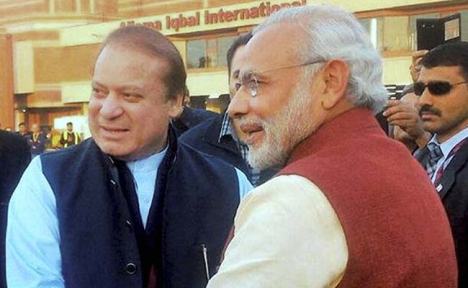
If Indian Prime Minister Narendra Modi’s stopover in Lahore to meet his Pakistani counterpart Nawaz Sharif on 25 December last year came as a surprise, the subsequent militant attack in India barely a week later on 2 January did not. Continue reading

Death of an activist: The courage survives and so does the message

pia-afp

Rangers personnel baton charge on PIA employees near Jinnah International Airport, Karachi, February 2, 2016. PHOTO: AFP

Three Pakistan International Airlines (PIA) employees protesting against the privatisation of the national carrier have died as the Singh Rangers countered their peaceful demonstration with water cannons, tear gas, baton charge, and bullets. The victims include PIA Assistant Manager Inayat Raza and engineer Saleem Akbar while a third victim, Zubair, succumbed to his wounds in hospital yesterday. The knee-jerk response of the administration to citizens exercising their right of peaceful assembly and protest is not new, and it has always backfired.

Instead of condoling with the families of those killed, Prime Minister Nawaz Sharif (who is believed to have a vested interest in privatising the airline), has suspended the PIA employees’ right to protest under the Essential Services Act, and threatened the them with loss of job and incarceration.

Killed by a bullet to the chest, Inayat Raza was a former student union leader with the National Students’ Federation (NSF) in Karachi in the 1980s. He is survived by his wife and three daughters. Below, a moving tribute to him by activist and researcher Mansoor Raza in Karachi:

Continue reading

Farewell, Aslam

Aslam-2013-photo beena

Aslam Azhar, Islamabad, 2013. Photo: Beena Sarwar

My personal tribute to a giant of progressive politics in Pakistan, published in The Friday Times on Jan 15, 2016, posted below with links that didn’t make it into the TFT copy. 

By Beena Sarwar

Aslam. That’s what everyone, junior or senior, in the theatre group Dastak called him. He insisted upon it. That was just one aspect of Aslam Azhar, the founding father of Pakistan Television and already a legendary figure in the late 1980s. That was when I joined the theatre group that he had started in 1982 with his close friend and comrade Mansoor Saeed – who also insisted on being called Mansoor. Continue reading

In wake of Pakistan university attack, the voices grow louder – stop glorifying the dead

Screen Shot Hamid Mir-Geo TV

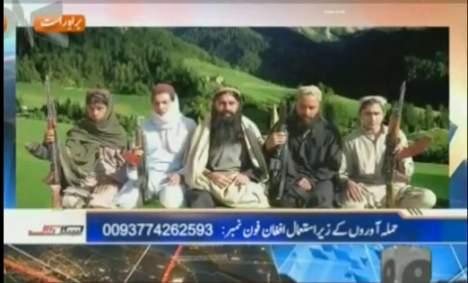
Screenshot from Hamid Mir’s Capital Talk, Geo TV, Jan 20, 2016

I wrote this piece on Jan 20, 2016 on the barbaric attack on Bacha Khan University in Charsadda. Published in Scroll.in on Jan 22, 2016.

As Pakistanis look for solutions, a consensus is emerging that people killed in such attacks should not be called ‘martyrs’ or ‘heroes’.

By Beena Sarwar

There is now a numbing familiarity to the kind of news that broke on Wednesday morning from Pakistan.

This time, heavily armed militants in suicide vests scaled the walls of a sprawling university campus near Charsadda, a picturesque town in Khyber Pakhtunkhwa (formerly known as North West Frontier) province near the Afghan border. Gunfire and explosions starting at about 9 am resounded through the dense fog enveloping Bacha Khan University, set idyllically amidst sugar cane fields some 13 km from Charsadda.

The four assailants killed at least 19 students and teachers before themselves being killed by the police and army in a three-hour long gun-battle.

The casualty rate was far lower than the attack on the Army Public School in nearby Peshawar just over a year ago on Dec 16, 2014 in which militants killed some 150 school children and teachers.

The relatively low casualties, pointed out Senator Rubina Khalid of the Pakistan People’s Party, is not a basis for self-congratulation.
Continue reading

‘Blood on the streets’

Part one of a series I am working on. NOTE: Post later updated to add the other parts below.

Student mtg 1951 or 52

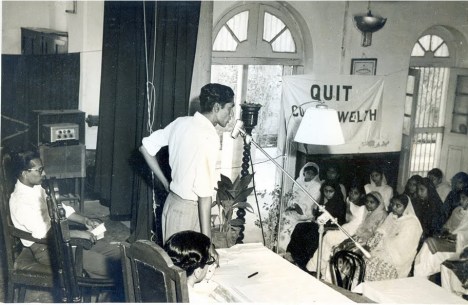
M. Sarwar addressing a meeting in Karachi, early 1950s, Khaliqdina Hall. Seated left: Rehman Ali Hashmi.

Looking back to look forward: The DSF-led movement of the 1950s eschewed party politics, was inclusive, and focused on student unity. Besides students from medical, engineering and and law colleges, it involved students from girls’ and boys’ high schools, and women’s colleges. 

Below, an extract from my forthcoming memoir on the struggle for democratic spaces in Pakistan. This is from the chapter about the student movement of 1953 that shook the country and laid the foundations for the University of Karachi, published in The Friday Times, Jan. 8, 2016. Thanks to Raza Rumi for pushing me to share this Continue reading

Remembering the historic January 7 student movement

Sharing a blogpost that’s so relevant today, about the 1950s student movement led by the Democratic Students Federation

beenasarwar's avatarDr M. Sarwar (1930-2009)

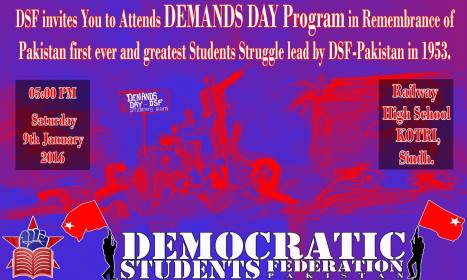
DSF poster Jan 2016Message from DSF: In memory of the great struggle and demands day led by the then Democratic Students Federation of 1950’s, the present cadre of Democratic Students Federation Sindh is holding a program to highlight the achievements of that struggle and movement. Please join us on 9th January 2016 5.00pm at Railway High School, Kotri, Hyderabad. The program will be marked with speeches from student activists, trade unionists and Political activists – DSF secretary.
Remembering the historic January 7 student movement – by Shahid Husain in The News, Jan 6, 2016. Text below:

View original post 978 more words

Travels though history with a rural archivist

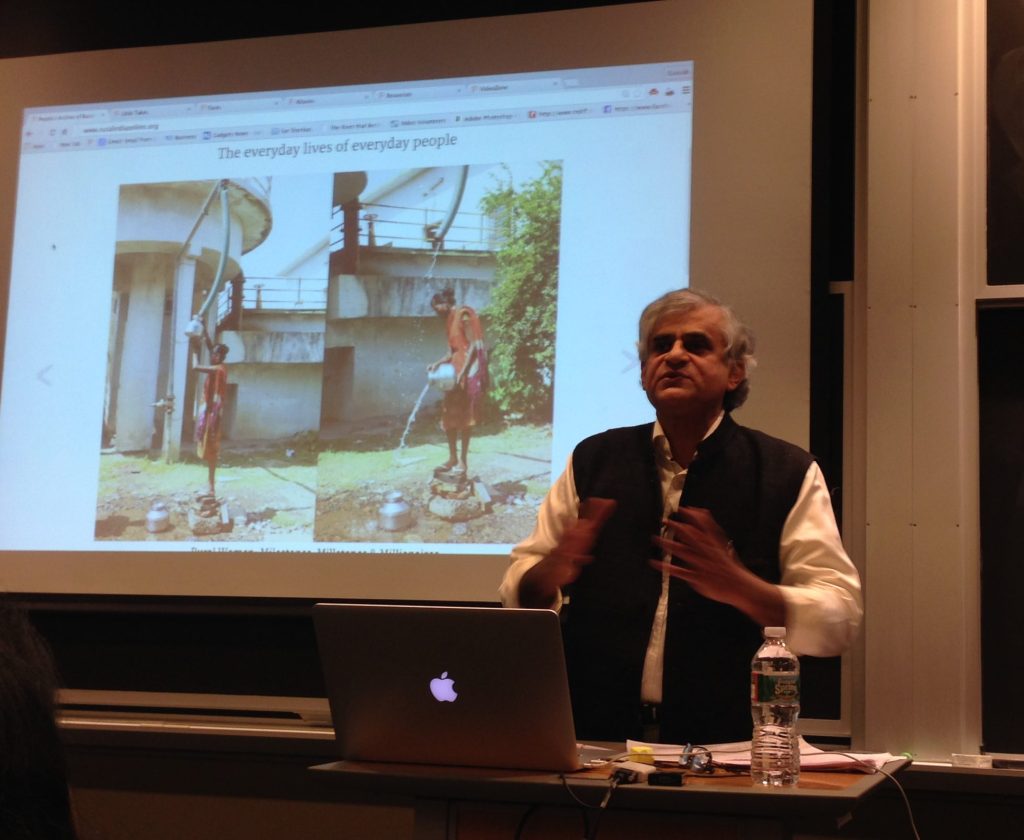
Sainath at MIT, explaining the concept behind PARI. Photo: Beena Sarwar

Tracing the footsteps of rebels like Kartar Singh and Sita Ramaraju with a rural archivist, the iconic P. Sainath… Wrote this piece to mark his groundbreaking initiative PARI’s first anniversary; published in The News on Sunday, Jan 3, 2016. Text below with links and additional photos.

Continue reading

A year after Peshawar APS massacre; Islamophobia and yes, Humanity Trumps All

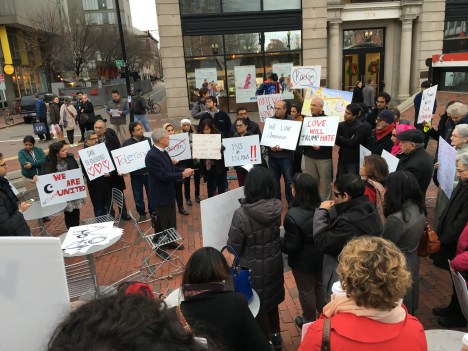
Rev Joe Robinson speaking at a protest in Boston against the APS massacre and Islamophobia. Dec. 21, 2015. Photo: Beena Sarwar

Last Sunday as we geared up to commemorate the Peshawar APS massacre of Dec 16, 2014, when Taliban killed 144 schoolchildren, a bomb blast in Shia-majority Parachinar at the lunda bazar (second-hand market) killed over 22 people, most of them poor.

We talked about that at our gathering that afternoon at Harvard Square where Reverend Joe Robinson and members of the Christ Church in Cambridge joined us in solidarity, as did many others from the local Pakistani and Indian communities. Rabbi Neal Gold of Temple Shir Tikvah couldn’t join us but we read out his letter of support and solidarity to the Islamic Center of Boston.

Many friends joined us from another rally in Providence, R.I., an hour away, attended by some 3-400 people of all faiths, including Muslim, Jewish, Christian and agnostics.

Here’s a link to a piece I wrote for Scroll.in on the issue: #NeverForget: A year after Peshawar school attack, voices rise in solidarity around the world

Continue reading

When information and awareness leads to change

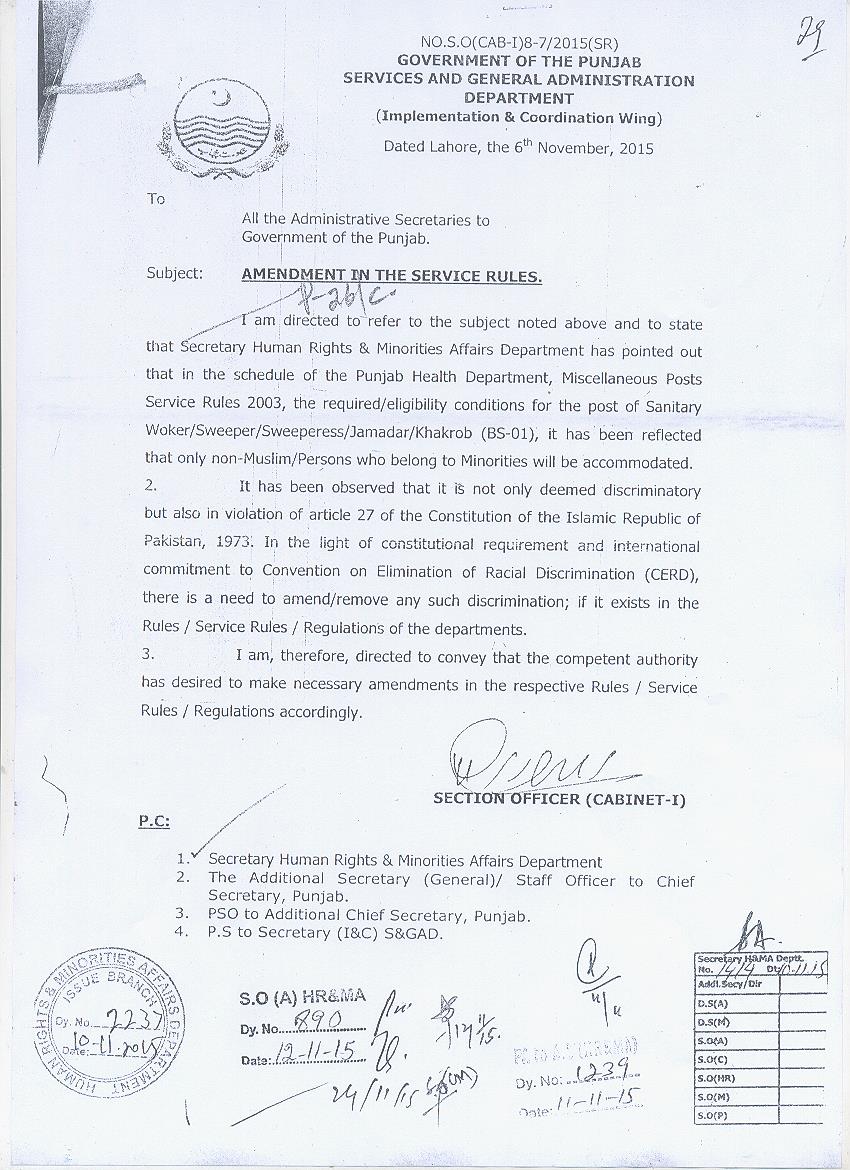
The Punjab government has directed the provincial Human Rights department to amend existing service rules (see scan of letter dated Nov 6, 2015) according to which “Only non-Muslims/ Persons who belong to Minorities” are eligible for the position of sanitary workers or sweepers (see attached scan of Service Rules below).

Punjab govt Order-Nov 6-2015Researcher and writer Asif Aqeel who emailed this update today thanks parliamentarian Mary Gill for bringing the issue to the notice of the government and pushing for the change. Continue reading