Film screenings byAnand Patwardhanin Cambridge MA TODAY and tomorrow. My documentary at Tufts on Wednesday. The sublime musical play ‘Madho’ at Wellesley next weekend. The latest Sapan Alliance newsletter has more events and info about other events, including in Colombo. Scroll below for my conversation with Mayank Chhaya on the Sri Lanka elections, plus pix from ‘Democracy in Debt’ Global Community Screenings – some 40 events in 14 countries across 5 continents – and my notes on recent Sapan News features.
I meant to share this when it was first published on Sapan News recently, my article co-authored with Dr Serena Hussain and Vishal Sharma, but was caught up with the Colombo screening of my Sri Lanka documentary. Thought I’d post now – the piece is still relevant especially given a recent article in an influential foreign policy magazine debunking the idea of Southasia
Images from various SAARC summits sourced from copyright-free photos. Collage by Pragayan Srivastava
Why the regimes ushered in through the democratic political process need to collaborate for a better future for the peoples of the region
By Dr Serena Hussain, Vishal Sharma and Beena Sarwar
The recent elections in Britain, France, and India are a reminder of the power of the people – and also of the importance of regional cooperation.
Pakistani PM Benazir Bhutto with her Indian counterpart Rajiv Gandhi at 1988 SAARC Summit in Islamabad. Source: Dawn
The Indian elections were the third electoral exercise in South Asia this year, after Bangladesh in January and Pakistan in February. Sri Lanka is also required to hold presidential elections before October.
As part of the democratic political process, elections determine the leadership that will shape not only a nation’s destiny, but also in closely connected regions.
The governments may choose to be isolationist, or follow the will of foreign powers, or cooperate and collaborate with neighbouring nations. Can and will South Asia’s regimes cooperate to promote regional peace, prosperity and progress as they have done in previous decades such as, during the 1950s, 1980s, and 2000s?
Such collaboration is essential for the sake of the peoples of the region.
Guest post: A personal tribute to Karamat Ali (19 August 1945 – 20 June 2024) by Mandira Nayar in Delhi, for Sapan News
Karamat Ali was many things but for Mandira Nayar he was always the person who returned her grandfather Kuldip Nayar to Lahore, where he was born and which he considered home. The relationship between them defies labels but it has a bond that is deep and unbreakable, stronger than many relationships with names, she writes:
There are many words for friendship. Arabic has twelve. You can choose from friendships of different shades — the intense saqeeb, a true friend; sameer, someone who you like to have a conversation with, or the casual zameel, an acquaintance.
Announcement from Pakistan India People’s Forum for Peace and Democracy for an online memorial
Memorial meeting at Arts Council of Pakistan, Karachi, for Karamat Ali
Comrades at the Human Rights Commission of Pakistan in Lahore remember Karamat Ali
English has just the one — a bland ‘friend’. The short dost (friend) in Hindustani encompasses in its tiny frame a sort of bro-code for the intense relationship that Hindi film songs refer to, between Maana Dey’s ‘Yaari hai Imaan’ (My friend is my faith) to Sholay’s anthem ‘Yeh Dosti Hum Nahi toRe.nge‘ (This friendship we will never abandon).
‘Dost’
So I struggle to find a word to describe the relationship between Karamat Ali, labour leader, peace activist, revolutionary, lover of music, and my grandfather Kuldip Nayar, journalist, peace-activist and fellow dreamer. And by extension, my relationship with Karamat Sahib.
This relationship without a name has a bond that is deep and unbreakable, stronger than many relationships with names.
Karamat Ali was many things but for me he was always the person who returned my grandfather to the home he was born in.
As news of Noam Chomsky’s failing health makes the rounds, I share some learnings from my interactions with a trailblazing public intellectual whose moral compass has impacted the world
PERSONAL POLITICAL By Beena Sarwar
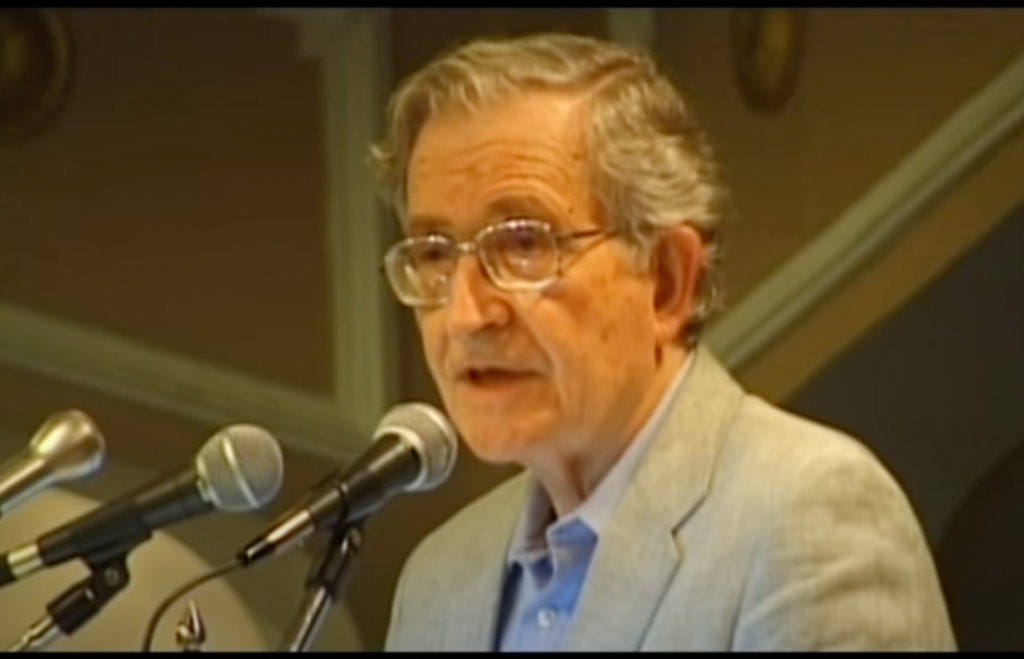
Noam Chomsky in Pakistan, 2001. Screenshot from VPRO news report by Beena Sarwar.
I once asked Noam Chomsky how he manages to remember so many facts and figures and hold audience attention. He replied that he didn’t convey any new information, that his talks are based on materials already in the public domain, and that he simply joins the dots – providing context – and repeats the information consistently and in different ways.
His response was typical of his humility as well as his courtesy towards a much younger person to whom he owed nothing.
Chomsky teaches us that it is not necessary to be loud and sensationalist in order to be heard. This, together with the clear and courageous moral compass he has provided over decades, is a most valuable lesson.
Noam Chomsky was already a legend when I first met him over two decades ago in December 2001 when he visited Pakistan for the inaugural Eqbal Ahmad Memorial lecture series.
Boats on Dututwewa at sunset. Photo by Ben Samarasinghe
The lakes, paddy fields and forests of the ancient village of Dutuwewa are a world away from Colombo’s high-rises and colonial buildings. As elsewhere, decisions taken by ‘old men’ in the corridors of power impact life here, just as these rural voters will impact politics nationally
PERSONAL POLITICAL FROM DUTUWEWA WITH LOVE
By Beena Sarwar
Times are tough and it’s hard to make ends meet. A refrain heard from just about anyone in my home country Pakistan where the rupee has dropped to around 300 to the dollar. This is now comparable to the rupee in Sri Lanka, recovering from the biggest economic crash in its history.
Stories of hardship echo from the island nation’s largest city Colombo to the farming heartlands around Anuradhapura district, a little over 200 km to the north-east. At the core of Anuradhapura lies the irrigation tank called Dutuwewa which sustains several villages.
Sri Lanka’s rural landscape is dotted with as many as 14,000 such large and small irrigation lakes, known as wewas, built by kings thousands of years ago.
A nearly five-hour drive on surprisingly good roads – testament to the rural infrastructure built after the end of the 26-year long civil war 15 years ago – brings us to the serene lakes, lush paddy fields and dense forests of Dutuwewa. A world away from the corridors of power and the glittering, air conditioned, high-rises of Colombo and its historic colonial buildings left behind by 500 years of colonizers – the Dutch, the Portuguese and the British.
A village school in a forest
The din of crickets from the surrounding forest forms the backdrop to everything in Dutuwewa. The headmistress of the Palugollagama government school, who gives only her initials and last name, I. R. Ekanayake, is an ‘old girl’ who taught at schools around the district for 26 years and was posted to her alma mater as principal four years ago. There are two vice principals, 36 teachers and 506 students.
Kathy Gannon shares an iconic photo by Anja Niedringhaus during a talk at Emerson College, Boston, 2022. Photo by Beena Sarwar
“If France and Germany can be part of the European Union, why can’t Pakistan and India be part of a Southasian Union?” asked Dr Mubashir Hasan, former finance minister of Pakistan, a hawk-turned-dove who co-founded the Pakistan-India People’s Forum for Peace and Democracy (PIPFPD). He had roped me into it when I was a young journalist in Lahore in the mid-1990s. When he said these words to me some years ago, and I replied that this was impossible, he responded, “Par hum baat toh kar sakte haiN” – but we can at least talk about it.
Years later, in 2021, during a time of renewed tensions between Pakistan and India, his words inspired the foundation of the Southasia Peace Action Network, Sapan, that we now write like a word, Sapan, rather than in all caps, conveys the meaning of a dream.
“This is a dream that connects millions, giving hope for solidarity, peace, and friendship in the region. The network, which encourages dialogue and connections amongst Southasians and across various issues, has managed to virtually overcome borders and build bridges between those who have historically been divided” writes young peacebuilder Mansi Chandna from Jaipur, who attended the event from her current base in Manchester.
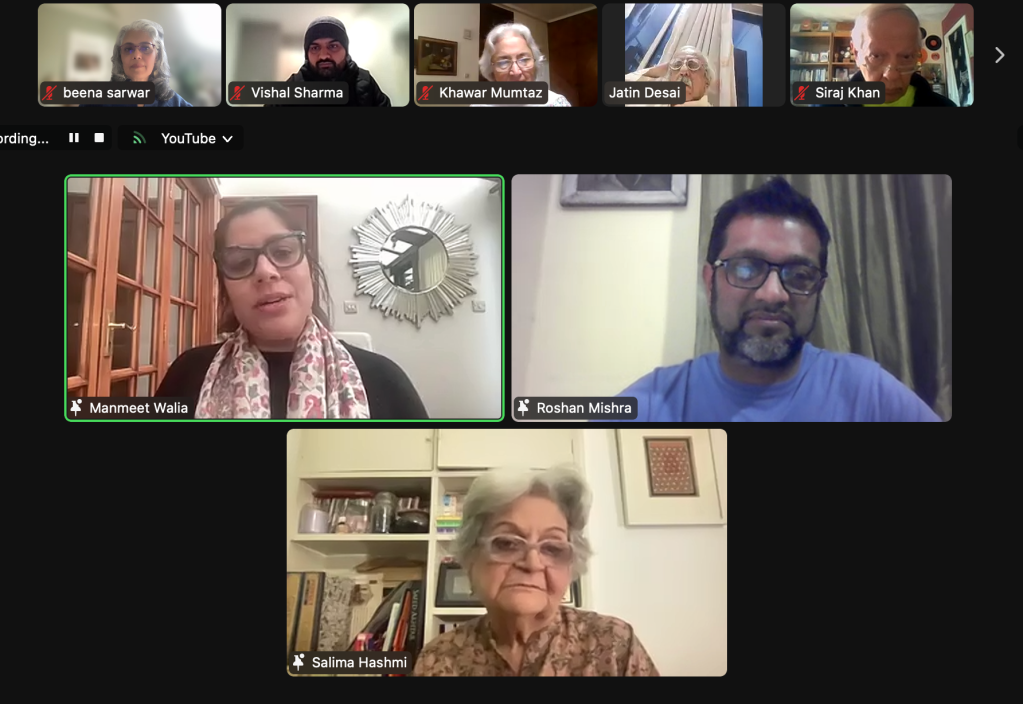
Art and Southasian Voices panel at the Sapan third anniversary event: Manmeet K. Walia, Roshan Mishra, Salima Hashmi. Screenshot from video recording.
Sharing my curtainraiser for Sapan News about a poignant photo exhibition opening at the Bronx Documentary Center in New York today, featuring the work of the acclaimed photojournalist Anja Niedringhaus. She covered Afghanistan and Pakistan at the height of the war between the Taliban and the USA, and was killed ten years ago, on 4 April 2014.
An Afghan police commander walked up to the car she sat in with Kathy Gannon outside a government compound in Khost, where they were covering the presidential election for the AP. Anja, 48, died instantly. Seven bullets shattered Kathy’s arms and shoulders. The Afghan doctor who initially operated on her saved her arm, using various ‘jugaRs‘ (improvisations). Doctors at the French military hospital in Kabul where she was later medi-evaced said they would have amputated it had she reached them first.
In all the years I’ve known Kathy, I’d never heard her complain or mention her injuries or trauma. When I hesitantly asked about it now, for this piece, she detailed the information matter-of-factly, even cheerfully, focuses more on Anja, her courage, and her spirit. All that applies to Kathy herself.
Kathy, who also on the Sapan News Advisory Council, has co-curated the show and its accompanying book.
Anja Niedringhaus’ photos showcased in a tribute posted by her colleagues at AP
The exhibition will travel to Cambridge MA, 9-10 May 2024, co-sponsored by the Nieman Foundation and the Shorenstein Center at Harvard University. Anja was a Nieman Fellow 2007.
Exhibition information: Bronx Documentary Center 614 Courtlandt Ave, Bronx, NY 10451 On View: April 4 – May 5, 2024 Gallery hours: Thurs-Fri 3-7PM, Sat-Sun 1-5PM
Book information: Anja Niedringhaus By Ami Beckmann, Kathy Gannon, and Muhammed Muheisen Hardcover, 80 pages, 44 images Release date: April 2024 Published by Fort Orange Press Price: USD 30
Note: We have been doing this work voluntarily for the past three years and need support of all kinds – like, share, encourage.
And donate – thank you to those who contributed to help Sapan News meet our NewsMatch goal by December 31. We made it!
We now need to raise $3,000 more in the next three weeks. Will you help? Here is the link to share with friends who might want to contribute – no amount is too small: www.sapannews.com/donate
Seasons greetings despite the sadness, and excerpts from a Sapan Alliance newsletter sent out a few days ago on Substack
Joy is also a form of defiance. Dancers: A greeting card I made some years ago (pastel and water colour), repurposed for Southasiapeace.com and Sapannews.com.
In times that can feel dark and dismal, some good news and exciting updates.
Meet Sapan News — a unique media outlet that aims to cover and connect Southasia, the Indian Ocean and diaspora. That goes behind the headlines, connects communities, academics, activists, and more. Creating space for understanding, empathy and nuance.
In November, Sapan News qualified for NewsMatch, a philanthropic fund helping nonprofit newsrooms like ours in the U.S. Contributions made by year-end will get matched up to $15,000. Gratitude to our community that has stepped up to meet this challenge.
Those wanting to chip in are welcome – here’s the donate link for tax-deductible contributions.
A 100 new donors will secure a $1,000 bonus, and monthly donations initiated this month will get matched x12!
Thank you for your support. It means so much – and together, we are stronger.
Collaborations: Hello, Central Desi!
Sapan News is proud to partner with Central Desi, a dynamic news portal that started as a newsletter to cover all things ‘desi’ (Southasian) in New Jersey. Kudos to journalist Ambreen Ali for growing her passion project into a news org that won a major grant, enabling them to hire reporting fellows. Sapan News has much to learn from this initiative.
A message from the journalist Amitabh Pal about a mutual friend, David Barsamian of Alternative Radio in Colorado reminded me of this piece originally published in The News on Sunday, 8 Oct. 2006, about an event with Noam Chomsky where I first met David. The article is still all-too relevant, but the link no longer works so I’m sharing the piece here without any changes; just added some hyperlinks and photos.
Essential reading – and doing: Eqbal Ahmad
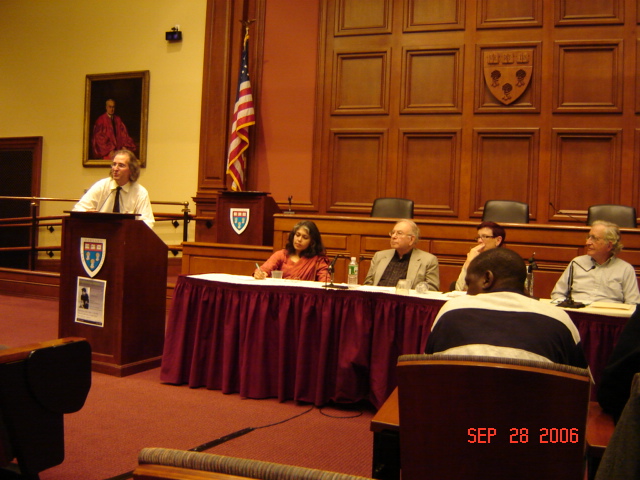
Book launch: The Selected Writings of Eqbal Ahmad, Cambridge, September 28, 2006.
Beena Sarwar
John Trumbour addressing the event. Panel: Beena Sarwar, Stuart Schaar, Margaret Cerullo, Noam Chomsky. Photo: Courtesy MAPA.
When Venezuelan president Hugo Chavez in his address to the UN on Sept 20, held up a copy of Noam Chomsky’s Hegemony or Survival: America’s Quest for Global Dominance (2003) and recommended it as essential reading to understand contemporary world politics, he could have been talking about The Selected Writings of Eqbal Ahmad, for which Chomsky, Eqbal’s long-time friend, wrote the foreword. Chavez identified “the hegemonic pretension of the North American imperialism” as “the greatest threat on this planet” to the survival of the human race.
The book that Jack launched (at HLS)
Chomsky also gave the main address for this collection of Eqbal Ahmad’s writings (Columbia University Press, 2006) at the book’s launch in Cambridge, USA, on September 28. John Trumpbour and Emran Qureshi of the Labor & Worklife Program at the Harvard Law School, who organised the event, didn’t publicise the event too aggressively because of the hype Chavez had generated for Chomsky.
The hall did get quite full, but they didn’t have to turn anyone away at the door. The venue may have had something to do with this. Chomsky, a linguistics professor now retired from the neighbouring MIT, is rarely invited to Harvard. Harvard Law School professor Alan Dershowtiz criticises Chomsky for being too “black and white” but often has to concede the basic truth of the points Chomsky makes.
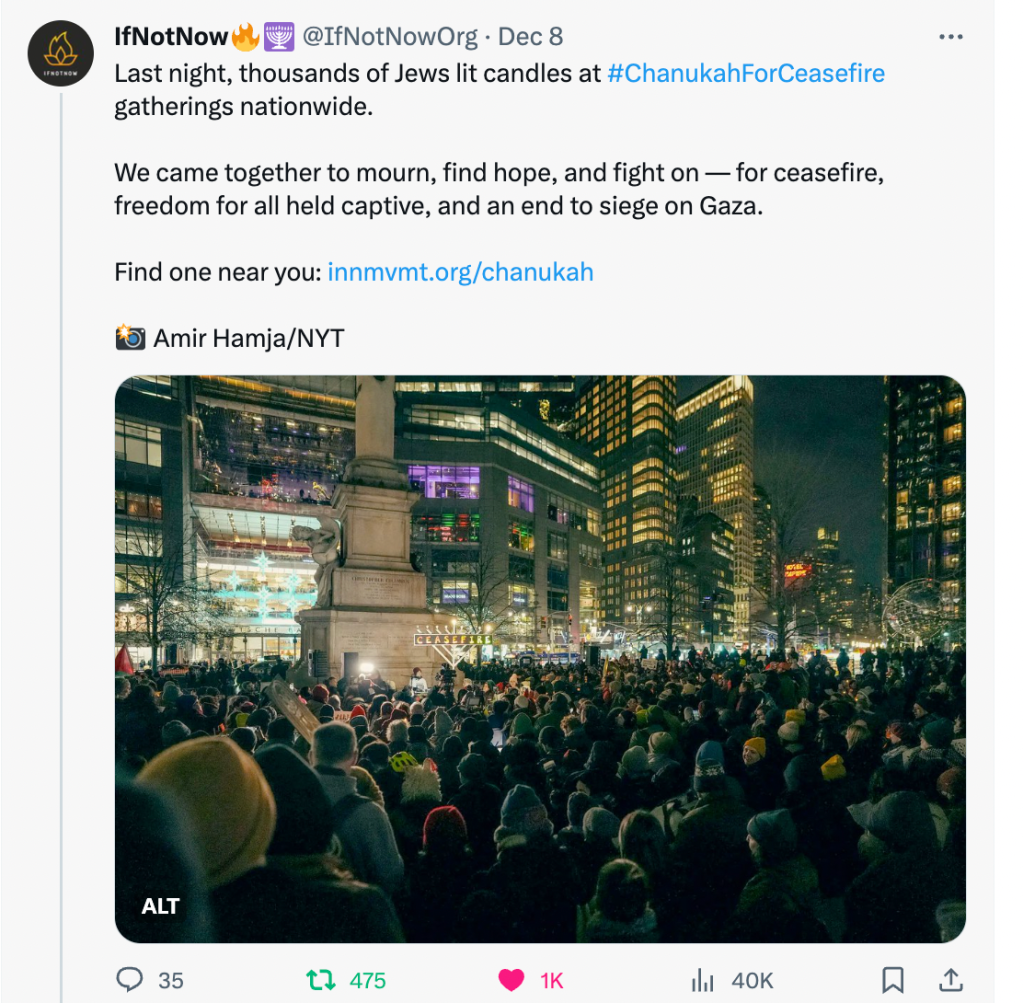
Greetings to those observing Hanukah and salute to those participating in #ChanukahForCeasefire demonstrations around the United States. Thousands of Jews have been lighting candles at #ChanukahForCeasefire gatherings, coming together “to mourn, find hope, and fight on — for ceasefire, freedom for all held captive, and an end to siege on Gaza,” says IfNotNow, a movement of American Jews “organizing for equality, justice, and a thriving future for all: our neighbors, ourselves, Palestinians, and Israelis.” To find one near you, go to: https://innmvmt.org/chanukah.
Such actions, and those of thousands including high school students marching around the world to call for #ceasefirenow, provide hope in a world that feels heavy. It is unbearable to think of the thousands killed, maimed and displaced in conflict areas, especially children.
Public opinion worldwide is clearly for #CeasefireNow, calls being ignored by those who could stop the bombing that continues to claim lives. What can we do? Hold on to ourselves and do what we can, where we can, when we can. Inform ourselves, share information – double-check before sharing so we don’t pass on #fakenews — donate to causes, participate in public actions.
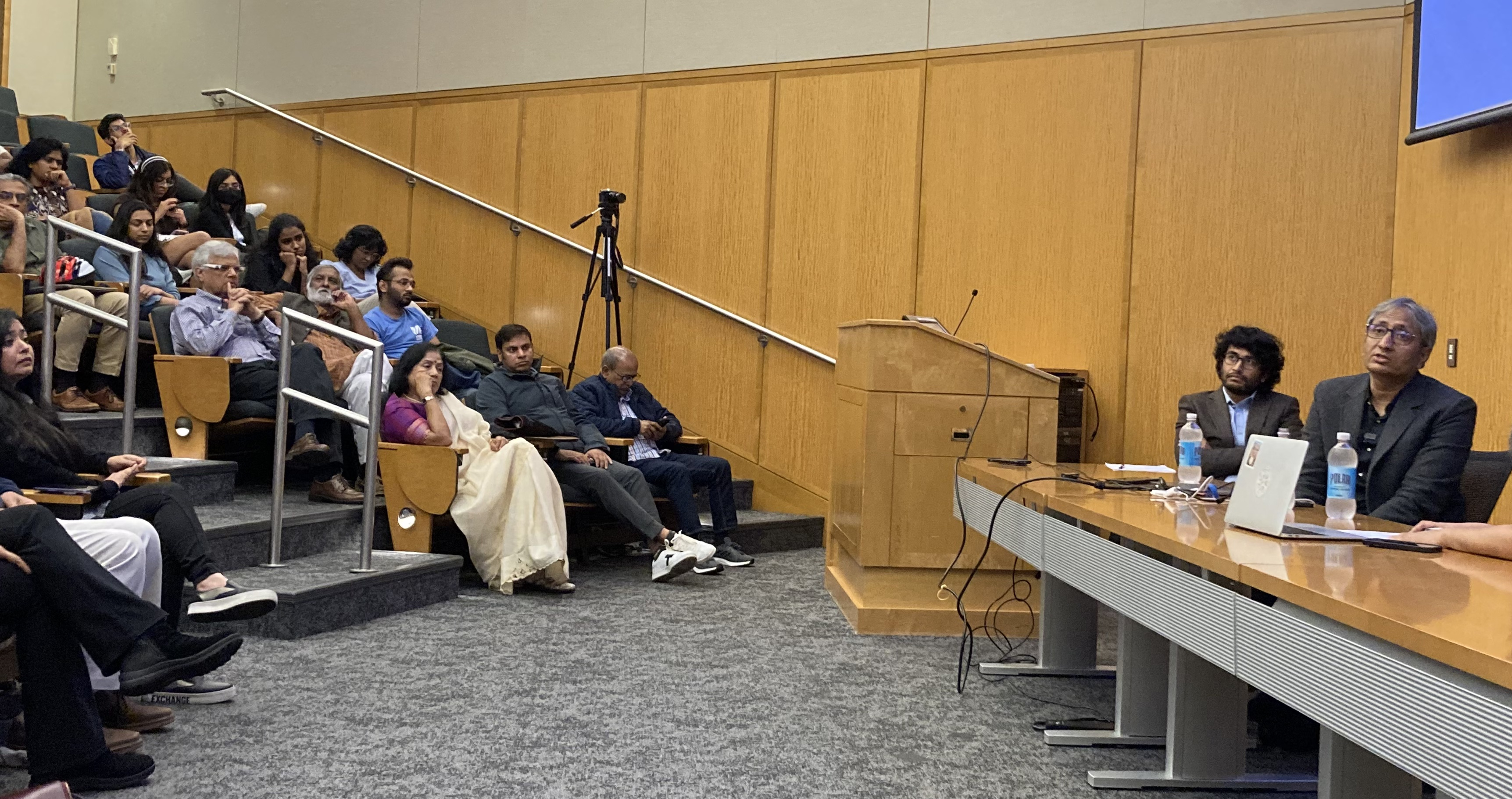
The day the popular Indian journalist Ravish Kumar spoke at Harvard, Oct. 2, happened to mark Gandhi Jayanti, Mahatama Gandhi’s birth anniversary. A day that social media users celebrated Gandhi-ji’s murder was and glorified his murderer on X, formerly Twitter, noted Kumar, talking in Hindi to students and community members filling the nearly 150-seater auditorium.
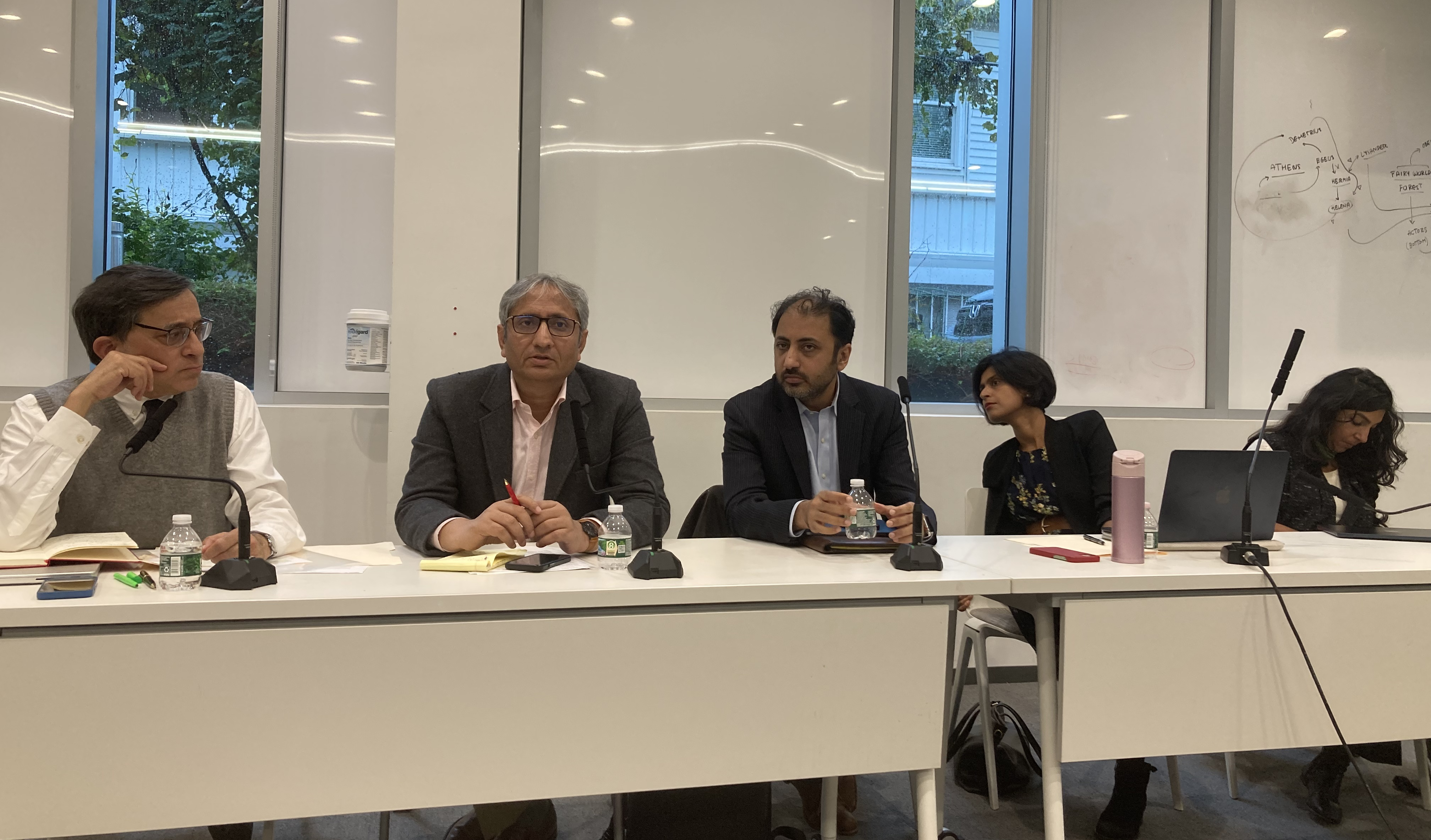
Ashutosh Varshney, Director of the Saxena Center for Contemporary South Asia at Brown University; Ravish Kumar; Wall Street Journal columnist Sadanand Dhume; Brown University faculty Poulami Roychowdhury and Prerna Singh. Photo: Beena Sarwar
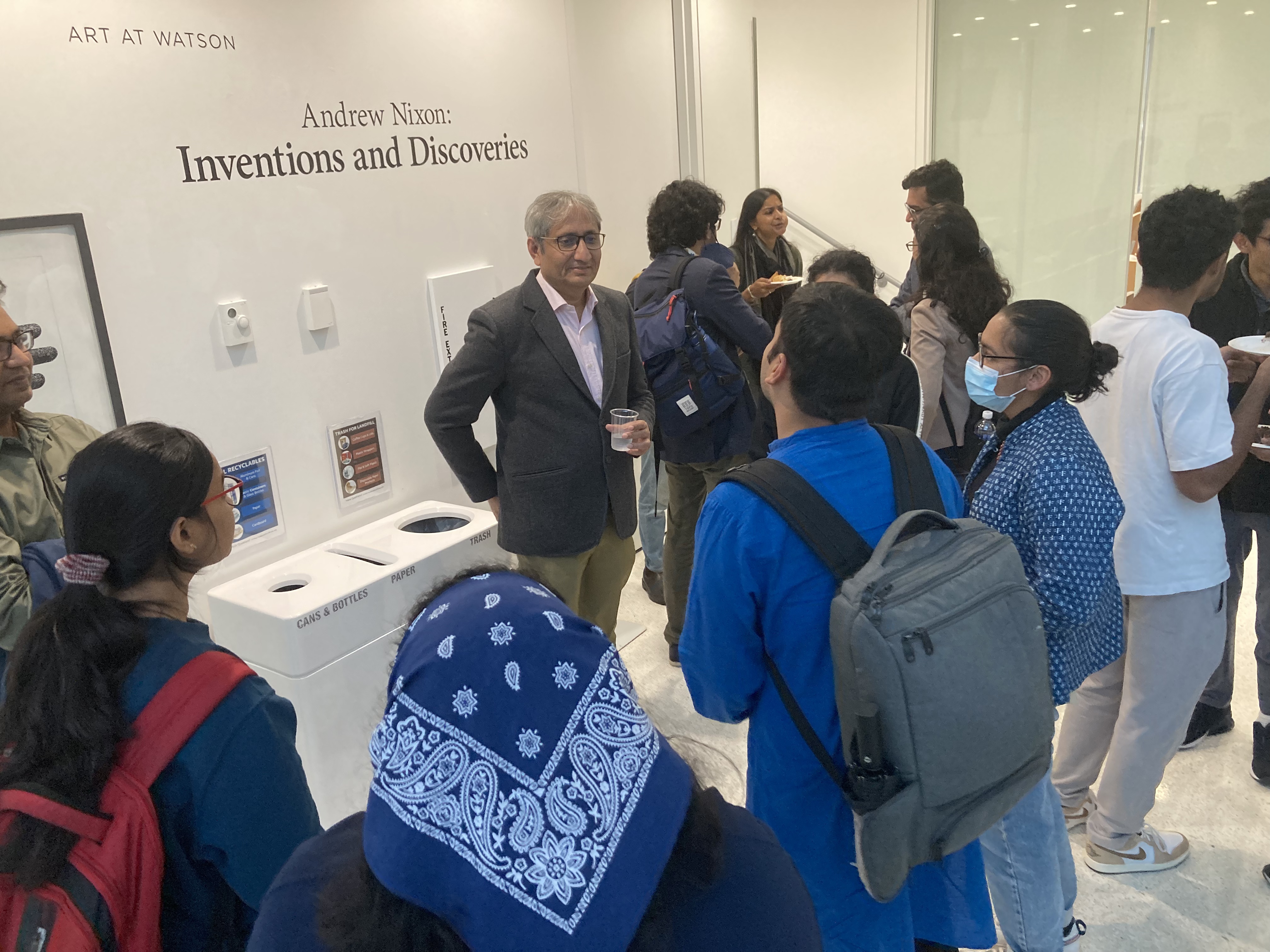
Students throng Ravish Kumar after his talk at Brown University.
Photo: Beena Sarwar
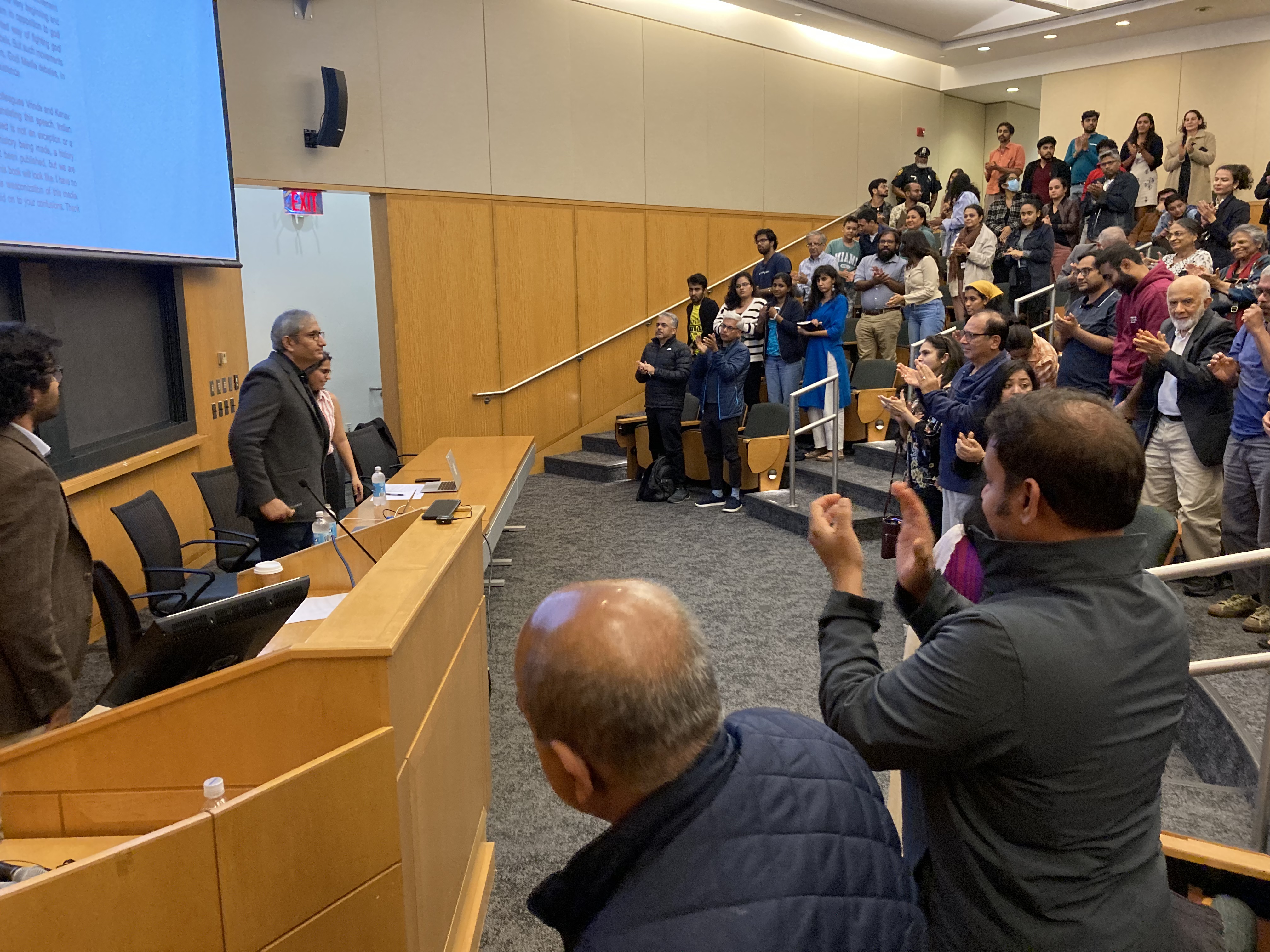
Standing ovation for Ravish Kumar after his talk at Harvard. Photo: Beena Sarwar
Discussion after the talk at Harvard. Not all questions were answered but as Ravish said, it’s important to ask them. Photo: Beena Sarwar
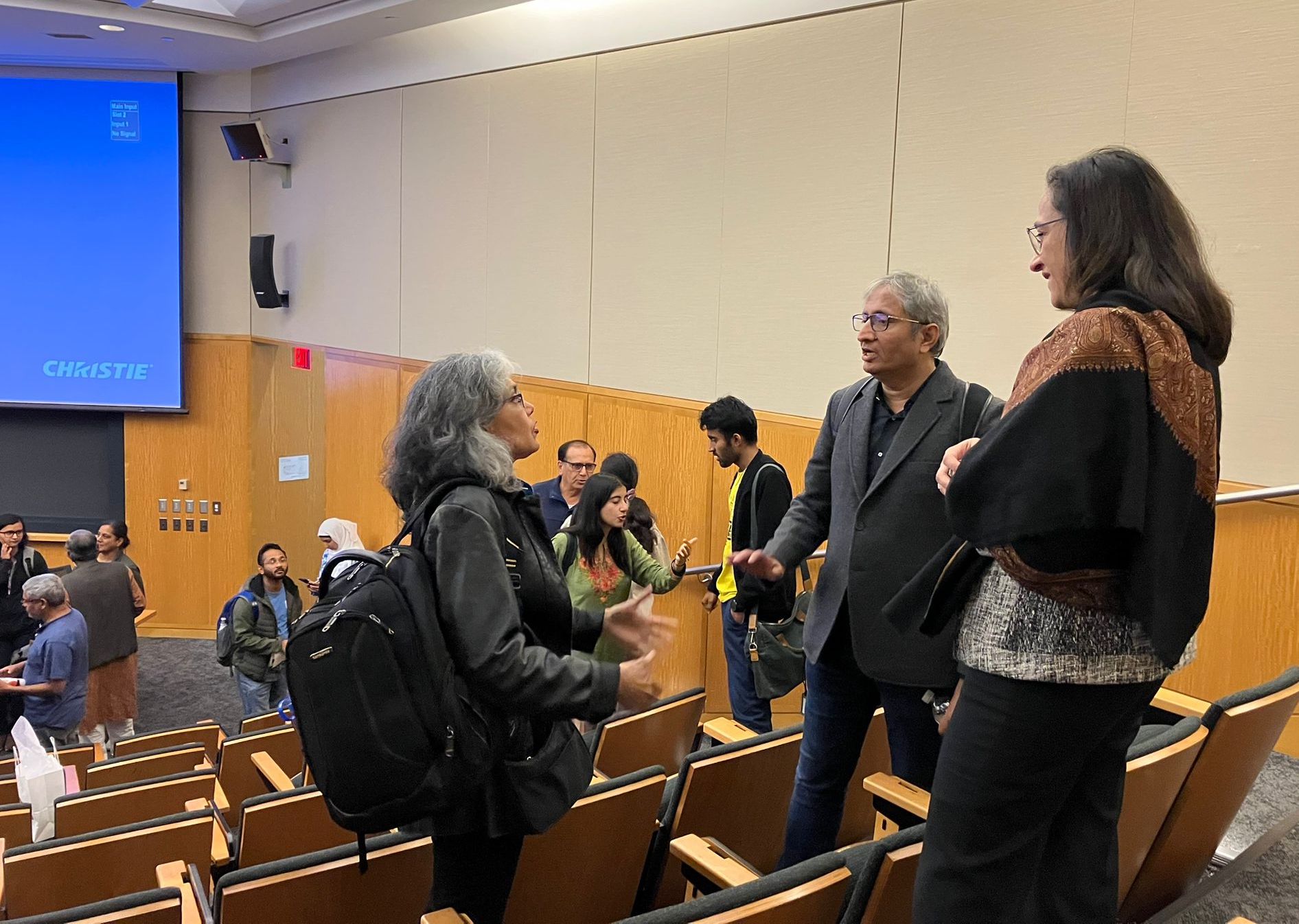
Talking to Ravish Kumar after the event, with Dr Deeba Husain from India. Photo: Rajeev Soneja
Ravish Kumar famously resigned from NDTV last November after its hostile takeover by Asia’s richest man Gautam Adani known to be close to Prime Minister Narendra Modi. While Kumar still has a huge viewership on YouTube – his channel has garnered over 7 million subscribers so far – it is an insecure platform, as he knows. The recently released documentary While We Watched (available on PBS) features Kumar, but as he also acknowledges, there are many others standing for journalistic values and ethics in India.
An FIR (first investigation report) was lodged against NewsClick in August, the day after a poorly-sourced New York Times report alleging that it had received funding from a network spreading “Chinese propaganda”.
The detained journalists included junior employees – and if they were being detained “simply because you believe that NewsClick is getting Chinese funds then a very wrong precedent is being set,” to quote prominent TV anchor Rajdeep Sardesai.
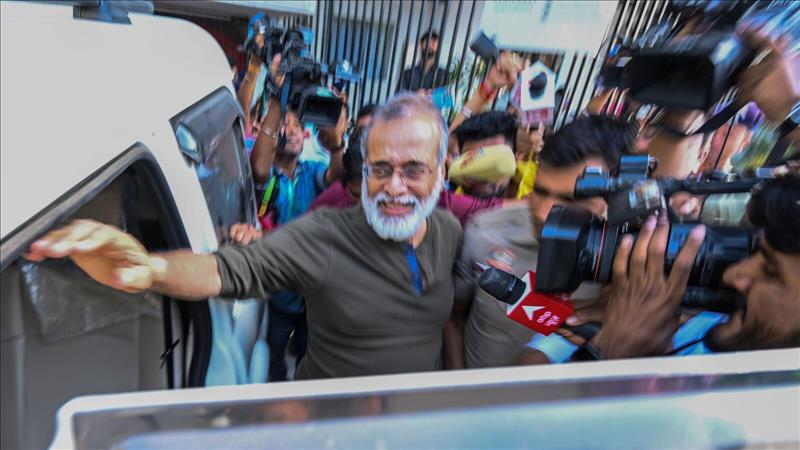
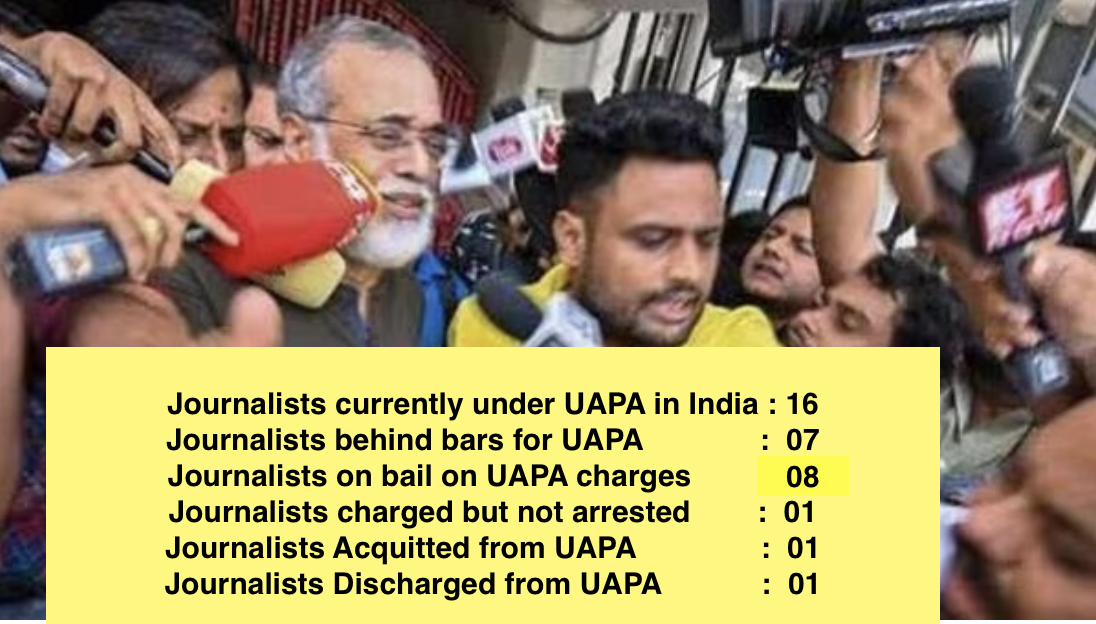
Newsclick founder and chief editor Prabir Purkayastha, and Amit Chakravarty, who heads the portal’s human resources section, were arrested under the draconian Unlawful Activities (Prevention) Act (UAPA). Since 2010, as many as 16 journalists have been charged under the UAPA, reports the Free Speech Collective, India, in a post that lists them, with details of those out on bail, the seven still behind bars, and others.
NewsClick founder and chief editor Prabir Purkayastha arrested. Photo credit: Raj K Raj/Hindustan Times via Getty Images, published by Amnesty International.
“In India, 16 journalists under UAPA ; seven behind bars” – image courtesy the Free Speech Collective, India
There is a huge pushback in India against these heavy handed tactics, which those in other countries are familiar with.
Below, the text of a joint letter by several journalists’ organisations to the Chief Justice of India:








 Journeys to democracy