Pakistan’s “three-headed monster” bows out. RIP Comrade Sobho Gianchandani.

Babba-Sobho-Jan4-08

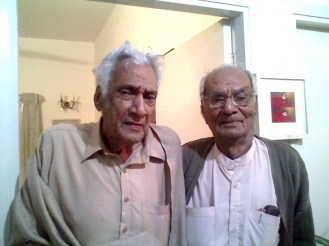
Dr Sarwar and Sobho Gianchandani at our house in Karachi, January 2008. It was a cold evening and both were reluctant to be photographed. Babba because he was unwell, and Sobho ji because he didn’t want to remove the muffler wrapped around his head and ears.

Sad to hear that Comrade Sobho Gianchandani is no more. He passed away in Larkana on Dec 8, nearly 95 years old. He lives on as an inspiration to all those seeking a better, more just, humane society. The last time we met was in July 2003, when he came over with his daughter and two of his grandsons to visit us as he often did when visiting Karachi. He made it a point to do so particularly after his close friend, my father Dr Sarwar passed away in 2009.

Below, my brief video profile of him for Geo TV (2003) in which he talks about his lifelong struggle for people’s rights. This, he said was his real struggle, the struggle for social justice by any name, rather than a fight against imperialism or extremism. And a 2002 feature I wrote about him (couldn’t find an online copy). Continue reading →

Musharraf or Zia… A dictator is a dictator

20130408 Mush Tamil UnrealTimes

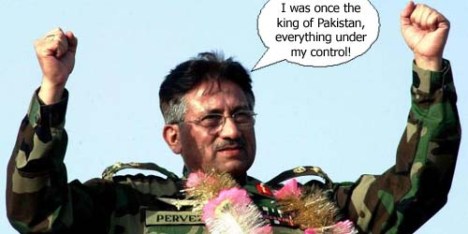
One-man rule is disastrous in the long term. Image courtesy: Tamil UnrealTimes

My opinion piece published in The News op-ed, and for Hard News, India

Former Pakistan army chief Pervez Musharraf ousted an elected civilian government from power, and usurped power illegally, holding on to it for over ten years, but there are those in India and in Pakistan who feel quite sympathetic towards him.

He had dash and bravado, they say. He nearly resolved the long-pending Kashmir issue with India. He encouraged the classical arts, liberalised the media, oversaw a telecommunications revolution, and partially revived the joint electorate system that the previous military dictator Gen. Ziaul Haq had divided by religion (Ahmadis still are not allowed to vote as Muslims). Musharraf also took the teeth out of the controversial Hudood Ordinances, making it more difficult for false charges of zina (adultery) to be brought against women on various pretexts. Continue reading →

‘This is not about Shia or Sunni but barbarians hijacking our religion and our country’

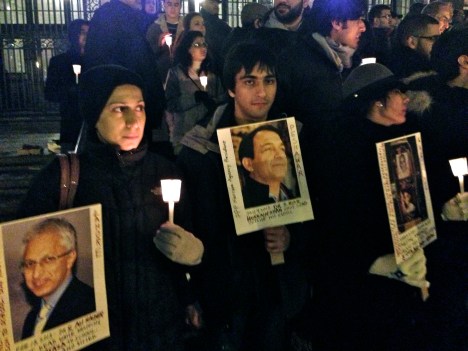
Syed Shehroz Hussain (centre) holds a picture of his father, Dr Riaz Hussain Shah who was killed in Peshawar recently.

Syed Shehroz Hussain (centre) holds a picture of his father, Dr Riaz Hussain Shah who was killed in Peshawar recently.

Students and professionals in the Boston area organised a well-attended vigil on Friday evening in solidarity with Pakistan’s Shia Muslims and in protest against the ongoing target killings. A heavy snowstorm cleared up hours before the candlelight vigil at picturesque Copley Square in downtown Boston that some participants travelled for hours to attend. Continue reading →

Accountability is key. Along with the democratic political process.

Admiral Fasih BokhariAt a time when Pakistan is reeling under all kinds of attacks, the continuation of the democratic political process and the accountability this process entails is critical. On Jan 28, 2013 a copy of a letter to the President of Pakistan from Admiral (rtd.) Fasih Bokhari, the widely respected Chairman of the National Accountability Bureau (NAB) was released to the media. Admiral Bokhari is known to be under pressure from various elements in the judiciary, media, and cartels, and has been threatened repeatedly. At age 71, he is fearless, believing he has nothing to lose. His words to a friend in a private email: Continue reading →

‘My years with WAF’ – Zohra Yusuf on the Pakistani women’s movement

Guest post: Zohra Yusuf, my first editor at The Star Weekend 1981-82, outlines the birth of the women’s movement in Pakistan

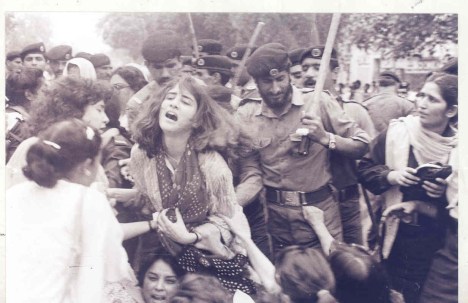
Lahore, Feb 12, 1983: Police brutality on the women's demonstration against the 'Law of Evidence' catapulted the nascent women's movement into the limelight. Photo: Rahat Ali Dar

Lahore, Feb 12, 1983: Police brutality on the women’s demonstration against the ‘Law of Evidence’ catapulted the nascent women’s movement into the limelight. Photo: Rahat Ali Dar

“My years with WAF” 

By Zohra Yusuf | Article written for a souvenir on WAF’s 25th anniversary, Oct 2006

Certain memories are etched on the mind. The birth of Women’s Action Forum is, for me, surely among them. It was on an afternoon in September 1981 that Aban Marker (Shirkatgah) called. She told me about the distressed call she had just received from Najma Sadeque (another SG founding member) regarding the case of Fehmida-Allah Bux. Pakistan’s first sentence of death by stoning and public whipping handed down to a couple under the Zina Ordinance of 1979. We had all read about the sentence and in our individual capacities felt deeply disturbed. After a bit of discussion, we decided to call a meeting of all women’s organizations at Aban’s place. The rest, as they say, is history. Continue reading →

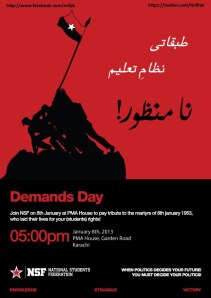
Commemorating Jan 8, 1953: 2013 events, Jan 6 and 8, by DSF and NSF

2012 Jan 8-NSF Demands Day

Re-blogged from Dr M. Sarwar:

As we remember Jan 8, 1953 Demands Day and those who gave their lives for the cause of students’ rights, it is good to see that progressive young people in Pakistan are organising and work for students’ rights, with the revival of Democratic Students Federation and the National Students Federation. In keeping with the rallying cry of the original movement – ‘Student Unity’ – activists of DSF and NSF must put up a united front, and attend and support each others’ events even if they don’t merge into one organisation. Demands should include lifting the ongoing ban on student unions. Below, information about several events being organised this year, some on Jan 6, in different cities of Sindh and Punjab by DSF, and NSF event on Jan 8:

Continue reading →

Five years on, same questions…

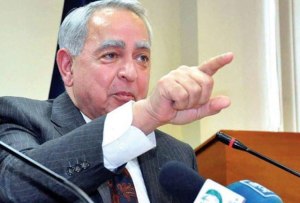
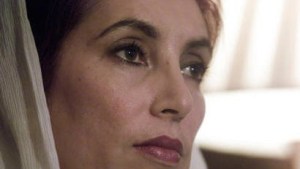
BB shaheed Bashir Ahmed Bilour Was her courage in vain, or do we still not know?

Text of editorial in Economic & Political Weekly, JANUARY 5, 2008:

Benazir’s Last Battle

Benazir Bhutto died battling the “state within the state”. Can Pakistan rid itself of the cancer?

The assassination of Benazir Bhutto, Pakistan’s former prime minister and opposition leader, on December 27 at the conclusion of an election rally in Rawalpindi has sent shockwaves across the world. Bhutto’s party, the Pakistan People’s Party (PPP), and the public at large held the government of president Pervez Musharraf responsible for the murder, while the government and its allies pointed the finger at Taliban and Al Qaida. The first reaction of US president George Bush also appeared to deflect blame from the Pakistan government and in the direction of Islamic militants. Continue reading →

Inspiring musical video tribute to Ahmed Faraz from his son Sarmad

The late great poet Ahmed Faraz’s son Sarmad Faraz pays tribute to his father, by releasing a music video titled “Shayar”, which features the poet reciting his verses in his inimitable manner.

Sarmad is a musician and is best-known for being in the band Corduroy. He chose this particular poem of his late father because it espouses resilience, individuality and change.

The poem “Shayar” is part of Ahmed Faraz’s first-ever published book Tanha Tanha (1954). (Read more below).

Continue reading →

Dr. Ghalib Khan Lodhi: A personal memoir, by Eric Rahim

Former journalist Eric Rahim’s thoughtful obituary of Dr Ghalib Khan Lodhi (1930-2012), one of the founding members of DSF, who passed away in Karachi recently… Solas Educational Trust, supporting schools in Chitral, remains Ghalib’s most important legacy

“Goodbye, generous friend, earnest and upright, seeker of knowledge”

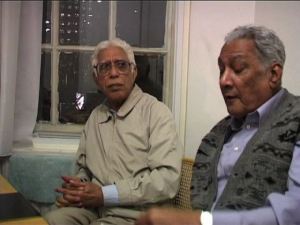
Dr Ghalib Lodhi, London, 2001. Still from video footage by Beena Sarwar

Ghalib, who has recently died of cancer, was a founding member of the Democratic Students Federation and, along with Mohammad Sarwar, Hashmi, Haroon, Ayub Mirza, Yousaf Ali, SM Naseem and others, a leading activist in the early 1950s student movement in Karachi. I remember him as one of the most serious minded among his cohort. While a medical student, in his early twenties, he was trying to grapple with Das Kapital.

Along with so many others – students, journalists, writers, and trade unionists – he was arrested in the general round-up that took place in West Pakistan in the wake of the triumph of the United Front in East Pakistan elections of 1954 and Pakistan government’s decision to sign military pacts with the United States. Before his arrest he was acting as general manager of the organ of the Democratic Student Federation, the Students’ Herald. Naseem, who was the editor of the Herald, in a recent communication described to me the occasion of the arrest in the following words..…

Read more at: Dr. Ghalib Khan Lodhi (1930-2012) – A personal memoir by Eric Rahim.

Former DSF activist Dr Ghalib Lodhi makes a quiet exit

Dr Ghalib Lodhi (left) with Dr M. Sarwar, London, 2001.

Karachi, Aug 3, 2012: Tahir Wasti in London emailed recently that Dr Ghalib Lodhi expired in Karachi. I contacted some of Dr Ghalib’s old comrades. None of them had heard of his demise…

Former DSF activist Dr Ghalib Lodhi makes a quiet exit.