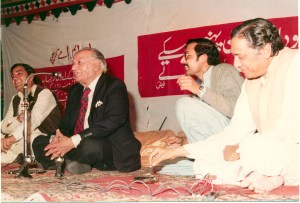
Target killing of doctors; my article of 2002; Dr Sarwar on censoring Jinnah, 1991

A press release from PMA condemning the ongoing target killing of doctors in Pakistan reminded me of a piece I had written in 2002, published in the Indian Express – googled the key words and found it. Ah, Internet.

There are also new uploads in the ‘Writings’ section of the blog Dr Sarwar blog – including ‘Censoring the Quaid’, a piece Dr M. Sarwar wrote in 1991 for his fortnightly column ‘Karachi calling’ in The Frontier Post, Lahore. Particularly relevant given the Jaswant Singh and Jinnah controversy.

In its press release of August 21, 2009, the Pakistan Medical Association, Karachi strongly condemns yet another murder of Dr.Sajjad Arain in Hyderabad, killed on his way to work at Civil Hospital, Hyderabad. A similar incident had also occurred a couple of days before in Quetta when Dr.Iqbal Zaidi was killed by unidentified miscreants. “By now this easy phenomena of killing doctors has become a routine, and right to life of those who are providing soles to humanity irrespective of sex, colors, religion or beliefs, is sadly no more available to them in the country,” says PMA, demanding the immediate arrest of culprits. If stern action is not taken with in 24 hrs the doctors community will be forced to stage country wide protest by calling total shut down of health services in the country.  http://health.groups.yahoo.com/group/pakistanmedicalassociation

Below, my article in Indian Express, April 2002: http://www.indianexpress.com/storyOld.php?storyId=1097

Targeted doctors ask what about us as Gen fights US war against terror

Apr 19, 2002

Beena Sarwar

For some days now, Karachi has thankfully not woken up to the news of yet another medical doctor shot dead in cold blood. But as an editorial in The News (April 16) cautions, ‘The current let-up in the assassinations does not mean that the issue should be allowed to quietly die down, or overshadowed by the controversial referendum. The question of who is behind the killings and why still begs to be answered, and must be answered sooner rather than later.’

Over the last decade, almost 90 doctors, mostly Shi’ite, have been assassinated, causing widespread fear and insecurity, and leading to a veritable exodus not just of medical practitioners but also their relatives in other professions. Dr Tipu Sultan, Karachi President of the nation-wide Pakistan Medical Association (PMA), knows of at least 28 doctors who left Karachi in one week in March.

Obviously, whoever is behind these murders wants to make an impact: a doctor killed demands media attention, and creates far-reaching ripples, given each doctor’s contact with hundreds of patients and their families; their very public dealing makes them vulnerable.

Assassins turn up at a targeted doctor’s clinic, and ask for him by name to identify him, as in the case of Dr Rashid Mehdi, 39 on February 12. He was shot dead, leaving behind a young wife, also a doctor, a little son, and a five-day-old daughter.

The pattern includes armed motorcyclists intercepting a doctor’s car and shooting him at point blank, as in the case of Kidney Centre nephrologist Dr Alay Safdar Zaidi, killed on his way to work on March 4. Dr Zaidi had returned to Pakistan a year and a half ago, leaving a thriving practice in the States to come back and make a difference here.

His daughter, aged six, and son, only three, are now among the dozens of other children whose fathers were similarly assassinated, despite not being affiliated with any religious or political party or even holding aggressively Shia views.

In one instance, the assailants used a car to force a doctor’s car to a stop. Dr Jafar Naqvi of the philanthropically run Kidney Centre was saved by his driver’s reflexes.

Dr Naqvi, saved by taking refuge in a private house, is now virtually confined to his own house, with round-the-clock police protection.

Most victims are Shi’ite, but they include some Sunnis too, like Dr Fayyaz Karim, 44, shot on Feb 4 as he left a mosque after offering his prayers. His wife, Dr Farahnaz Karim, says bitterly that it’s commendable that the Government is helping Americans wipe out terrorism. ‘‘But what of the terrorists in our midst who are killing our own countrymen?’’

The killings have forced an organised response from doctors, with the PMA calling several strikes (including a six-hour country-wide hunger strike) during which doctors at hospitals and clinics across the country provide only emergency cover. ‘‘This is not the answer,’’ concedes Dr Asghar Mirza, editor of the PMA’s Urdu journal Nabs. ‘‘But how else do we express our rage and fear?’’

When the PMA met the Sindh Governor last month, police officials suggested a ban on motorcycle pillion riding, and arms training and protection to threatened doctors. ‘‘This is not the answer either,’’ says prominent psychiatrist Dr Haroon Ahmed. ‘‘They are trying to use us to push through their own agenda.’’ He argues, like others, that administrative steps alone are not the answer.

‘‘The Government must restore civil and political liberties so that alternative opinions are given space, and tolerance and respect promoted,’’ demanded the Pakistan Peace Coalition (PPC) at a nation-wide protest on April 5 against violence in the name of religion. ‘‘This will likely provide a necessary challenge to extremism, as well as temper the urge for many frustrated elements to resort to reactionary violence.’’

Political parties in Karachi, including major players like the Pakistan People’s Party (PPP) and the Muttahida Qaumi Movement (MQM), joined the protest on the invitation of the Joint Action Committee for Peace Karachi (JAC), an umbrella group for activist groups, and also a PPC member. A March 20 meeting agreed that ‘‘The killings of doctors, lawyers, judges and other sections of society are aimed at instigating fear and retaliation’’ and that the root cause of the problem must be addressed. This includes ‘‘the forces of reaction and regression’’, including the intelligence agencies, which have gained strength since Pakistan’s involvement in the Afghan war.

The point is reiterated by PPC: ‘‘It is time that the intelligence agencies start protecting citizens from extremist violence rather than harass citizens and activists for their political activities and agitation. The revamping and reorientation of the intelligences agencies is yet another promise that the Government has made and is failing to keep.’’

Meanwhile, ‘‘it is individuals and groups who are fighting for their basic rights that are being targeted by the state, often under the anti-terrorist legislation’’.

Gen Musharraf’s actions against religious extremists since 9/11 are criticised as tokenism. ‘‘Some have been arrested, but why have cases not been registered against them?’’ questions PPP Central Information Secretary Taj Haider. ‘‘Because the Pakistan army’s and the agencies’ role in the matter will be exposed. This permanent axis is dangerous for democracy in Pakistan.’’

Even the police privately acknowledge this axis. ‘‘These extremists have been very useful to the Government, which might need their services again,’’ says an official, speaking on condition of anonymity.

He acknowledges that at least some elements of the powerful Inter-Services Intelligence (ISI) still protect the militants they nurtured, trained and armed over the years.

It is significant that while the doctors’ killings are labeled as sectarian because those targeted mostly belong to a particular sect, there is no sectarianism or religious intolerance at the grassroots level.

‘‘The incidents of apparently religiously-motivated violence, like the attack on the Islamabad church or the murder of Daniel Pearl, are planned and executed by individual miscreants with no popular support or public sanction,’’ says The News editorial.

‘Except for one incident in Rahim Yar Khan (instigated by economic reasons), Hindus in Pakistan have not been attacked in retaliation for the carnage of Muslims in Gujarat, as opposed to 1992, when the razing of the Babri Masjid was countered by attacks on Hindu temples in Pakistan (then too, the nexus of vested interests like property developers and ‘‘religious’’ leaders had teamed up to reap the benefits).

Religious parties have never gained more than 3 per cent of the assembly seats in Pakistan, unlike in next door India, where a religious party has actually been voted in, with disastrous results for an avowedly secular polity.’

Former mayor of Karachi and MQM leader Farooq Sattar argues against calling these killings sectarian: ‘‘Let’s not play into the hands of vested interests by calling them that.’’

Dr Sattar urges the easing of regional tensions as a step towards resolving national problems. ‘‘Sixty per cent of India’s trade is with Islamic countries, as compared to only 5 per cent of Pakistan’s, the remaining 95 per cent of our trade is with Western countries.’’

‘‘These issues (violence in the name of religion) are not Pakistan’s alone, they also exist in India and Bangladesh, all of South Asia,’’ argues Sabihudin Ghausi, the outspoken President of the Karachi Press Club and a senior economic reporter.

‘‘We can’t remain isolated from the region, we have to have ties with India, with Bangladesh, and the other South Asian countries.’’

(Beena Sarwar is a senior journalist working with The News)

Remembering Saneeya Hussain on her birthday

Here’s a note I sent out to the Saneeya Hussain yahoogroup yesterday, Aug 13th, her birthday – please do check out the link about the Saneeya Hussain Trust:Saneeya Homepage

Dear family and friends of Saneeya, scattered all over the world, this huge community of caring and committed people working in all kinds of ways to make the world a better place in their own ways

Here’s to Saneeya – we’ll always miss her. It is wonderful that the Saneeya Hussain Trust is up and running. Please do check it out at http://www.saneeyahussaintrust.com/ – The Trust has already done a lot of valuable work in terms of helping young girls obtain an education.

Several months ago I wrote a chapter for a forthcoming book on environmental journalism being published (eventually, we hope) by Sage, India. It focuses to some extent on Saneeya and Nazeeha had it posted to the SHT website for those who are interested
http://www.saneeyahussaintrust.com/PakistanChapterforSageIndiaAug08.pdf

I finally made a blog (on which I post my own articles and other material that I also send to my issues yahoogroup) – have linked the SHT to it also. I’d encourage all those of you who maintain blogs or websites to do the same.

That’s all for now from hot and muggy Karachi

beena

Neighbours in peace – or pieces?

My monthly column for Hardnews, India, August 2009 – http://www.hardnewsmedia.com/2009/07/3122. Also published in The News on Sunday, August 9, 2009

Karachi, July 26 2009

Personal Political

Neighbours in peace — or pieces?

Beena Sarwar

The auditorium was full of women from far-flung, poor localities of Karachi. One of them plonked herself next to me in the second row along with her daughters, a toddler and a six-year old. A gigantic banner featuring a photo of the late activist Nirmala Deshpande formed the backdrop to an array of speakers from India and Pakistan seated behind a long table on the platform. ‘PROMOTING PEACE IN SOUTH ASIA AND REMEMBERING NIRMALA DIDI DESHPANDE’ it read.

Mumtaz, the young Pahstun mother next to me, had studied up till the eighth grade, unlike most of the other women present. The toddler nuzzled against her to breastfeed from time to time.

The speakers included prominent Urdu writer Zahida Hina, peace activist and educationist from Lahore Syed Diep, parliamentarians from  the PPP and MQM and Indian activist Sandeep Pandey from Lucknow, journalist Jatin Desai from Mumbai, and Kavita Srivastava of the Peoples Union of Civil Liberties (PUCL) from Jaipur. Two other Indians weren’t given ‘clearance’ from Islamabad in time for the visit, meant to further the aims of a joint signature campaign for peace launched earlier this year.

Mumtaz and the other women, mostly wives of daily wage labourers, had been brought there by various ‘bajis’, women activists working in their areas. “I don’t understand everything they’re saying,” Mumtaz told me, “But I know they are talking about the need for peace between India and Pakistan. That is what we all want.”

Her immediate concern was to feed her family. “Maybe if these two countries stop fighting, our lot will improve,” she said optimistically.

“Let the people meet, all other matters will sort out,” a cyclist told Sandeep Pandey and other peace marchers who went from Delhi to Multan in 2005, demanding that the governments of India and Pakistan resolve all matters of dispute through dialogue.

Such basic wisdom is at odds with the justifications for continued animosity presented by ‘intellectuals’ on either side of the border. “India/Pakistan wants to destroy us”; “Stop appeasing India/Pakistan”; “There is no point in talking to them”.

If we listen to this babble of voices whose sole aim seems to be to present their own country’s case as better than the other’s, we’ll never get anywhere. There is an old saying in our part of the world, ‘Taali donoN haathoN se bajti hai’ – it takes two hands to clap.

Let’s stop these blame games and accept that there are problems on either side – of varying degrees and natures, and try and understand the complexities of the problems.

Those with access to the Internet have increased the potential for such understanding. But because we’re not used to talking to each other, the un-moderated exchanges posted on blogs are often crass and offensive. Direct interaction involving basic civility and an open mind is more meaningful.

Some time back, a Mumbaikar emailed saying, “Frankly, with Pakistan itself is in such a mess (Lal Masjid, Swat valley, Taliban, regular suicide attacks and of course the numerous Muslim organisations ranting about Jehad), do you really feel safe in your own country? And the most amusing thing is when Pakistan tells that India is its enemy number one. Wait for a few more years, am sure the Taliban will take over Pakistan. And what pains us, is what did we do to Pakistan. Kargil was Musharaf’s misadventure.”

I replied, yes, Pakistan is in a mess, due largely to the continual disruption of the political process, with no democratically elected government being allowed to complete its terms. “This is the biggest difference between India and us, and what I most envy about your country”.

Still, women do get around here too, carry on with their work and their lives. And at least elements within Pakistan’s establishment no longer consider India as enemy number one.

Kargil was indeed Musharraf’s misadventure. Many of us spoke out against it (were labelled as Indian agents). Pakistan’s military must be accountable and answerable to elected civilian governments. This will only happen if the political process is allowed to continue.

Rocky as politics in Pakistan currently are, with a floundering democratic process, it is only more democracy on a sustained and continuous level that will in the long run yield positive results.

(ends)

See also:

‘HRCP urges Pakistan, India to resume prisoner swap, stop arrests for minor violations’, Aug 5, 2009 – http://hrcpblog.wordpress.com/2009/08/06/hrcp-urges-pakistan-india-to-resume-prisoner-swap-stop-arrests-for-minor-violations/

Why not hang Sarabjit Singh, March 2008

http://www.chowk.com/articles/why-not-hang-surabjit-singh-Beena-Sarwar.htm

Simply repealing 295-C will not stop the rot

Since it was introduced by Gen. Zia, the ‘blasphemy law’ 295-C has been used to settle scores, including financial rivalries, as umpteen fact-finding missions have recorded (included several I have participated in), much as the Zina laws have been used for revenge.

Now, simply repealing 295-C will not stop the rot. That must be done, but along with it we have to demand strict enforcement of law and order.

Those who incite violence and murder (eg mullahs who used loudspeakers) must be held culpable as well, charged, tried and punished in accordance with the law.

Ditto those who desecrate a holy book or symbol, no matter of what religion.

Below, links to some reports that provide a perspective on the issue:

PAKISTANI CHRISTIANS-THE VICTIMS OF HALF LAW IN GOJRA, by Brigadier Samson Simon Sharaf (Retired), Aug 5, 2009

http://chowk.com/ilogs/73055/47736

An Eyewitness Account from Gojra – Faris Kasim.  August 7, 2009

http://www.chowk.com/articles/an-eyewitness-account-from-gojra-faris-kasim.htm

Edited version in The News Op-Ed, Aug 8, 2009

http://www.thenews.com.pk/daily_detail.asp?id=191978

HRCP press releases, Aug 4 & Aug 1
http://hrcpblog.wordpress.com/2009/08/06/gojra-admin-knew-about-pre-planned-attacks-hrcp/

http://hrcpblog.wordpress.com/2009/08/06/hrcp-press-release-on-gojra-and-korian-incident/

Lethal Law, Newsline Sept 2001
http://www.newsline.com.pk/NewsSept2001/newsbeat.htm

PAKISTAN-INDIA: The frog who reached the top

Photo: Nicolas Reu/Caters News Agency

Photo: Nicolas Reu

PAKISTAN-INDIA: The winning frog’s approach just might work…

The Indian media is gunning for Prime Minister Manmohan Singh for his stand regarding the need for dialogue with Pakistan, just as the Pakistani media is gunning for the Pakistani leadership for their insistence on dialogue with India (going against long years of conditioning).

Reminds me of the little frog who made it to the top in a pole-climbing competition amidst the din of the crowd below cat-calling and yelling nasty comments. 

Unlike the other frogs who kept dropping out, he couldn’t hear the people yelling that he would never make it.

He was deaf. 

Urgent appeal for potable water in monsoon-affected areas of coastal Sindh

Appeal from A Ercelan, Pakistan Labour Trust

People in monsoon affected areas of coastal Sindh urgently need potable water.

Their dire condition is the direct result of decades of deprivation of fresh water, drainage of upstream pollution, and destruction of mangroves — with consequent depletion and degradation of ground water reserves specially through sea water intrusion. State policies of which many if not all of us are beneficiaries.

Please help by donating for Musaffa (brand name for water-filter bags developed by the Pakistan Council of Scientific and Industrial Research (PCSIR)). Musaffa bags contain mostly sand with some silver as the active steriliser, which kills e-coli about an hour after immersion.

Direct purchase of Musaffa bags for delivery to Pakistan Fisherfolk Forum (PPF) would be appreciated. You can collect money and go to Musaffa supplier directly, or have a PPF representative pick up the contribution and deliver a sale invoice from Musaffa supplier. An a/c payee check is preferred to cash. Pakistan Labour Trust

(PLT) has donated Rs 50,000 to deliver Musaffa filter bags to the Pakistan Fisherfolk Forum. The Musaffa supplier has made an additional donation of about half this amount through a discount.

Please join this PLT-PFF effort to provide at least 1000 families in emergency need of potable drinking water.

Contacts:

Faiz Saheb at +92-21-4534356 (off Amir Khusro Road, Karachi) to purchase.

Pakistan Fisherfolk Forum M Ali Shah +92-21-5090543 in Ibrahim Hyderi, Karachi).

Zardari: two articles and a comment

Meant to do this earlier but didn’t get around to it – two interesting articles about Zardari and a comment

July 12, 2009 ‘The advent of Asif Zardari’ by Kunwar Idris – http://tinyurl.com/ksbydc

Shaheryar Azhar posted this to his group The Forum with the comment: “A very good article. This moderator to the dismay of some forum members has not focused on the ‘governance’ issue in Pakistan ever since the departure of the Musharraf government. This, of course, was by design.

“We must first decisively emerge victorious in our civil war – as long as Zardari’s government is doing a credible job on this front they deserve our full support. There will, however, come a time when we will shift our complete focus on ‘governance’, ‘corruption, ‘efficiency’ etc.-type make-or-break issues. Here we must acknowledge that what is different from the 90’s is not just more maturity being shown by the politicians or the existence of the Charter of Democracy or the working coalitions in all the four provinces or much greater consensus amongst politicians of consequence on key national issues – all of which individually and collectively is the big and surprise story of 2008 and 2009 but the existence of two empowered institutions, which were conspicuously missing then – independent judiciary and media. So rest assured, there will be time (soon inshalla) when our focus will shift laser-like to the bread-and-butter issues.

“There is one big caveat: as always military dictatorship, including military manipulation from the background will always be fought against. In Pakistan what is true is the following: Corrupt democracy anytime over any kind of military dictatorship.”

A follow up article at – http://tinyurl.com/m6zuva

July 15, 2009, ‘Meeting the president’, by Sayed Naseer Ahmad, Dawn:

“Never before had a head of state invited so many retired bureaucrats and asked them to speak their mind on national issues. The mere fact that several dozen retired bureaucrats, who could no longer influence decision-making, were invited to the presidency for a frank discussion showed that the incumbent valued good counsel.

“…Zardari said he thought that the militants and extremists had emerged on the national scene not because the civil bureaucracy was weak. In fact, they had been deliberately created and nurtured with the help of the international community as an instrument of policy in the 1980s. He then went on to advise the former bureaucrats to be “truthful to ourselves and make a candid admission of the realities”.”

DR SARWAR: New photos and articles

DR SARWAR: New updates and uploads www.drsarwar.wordpress.com

– ‘Hasan Nasir’s case should also be reopened’ – article by Shafqat Tanvir Mirza

– a couple of writings by Dr Sarwar (paper on democracy & letter to Editor)

– article by women’s rights and health activist and friend Hilda Saeed

– photos from Dr Sarwar’s student activist days & during his days as a PMA office bearer – also up at http://tinyurl.com/sarwar-pix

– poetic invite by Dr Farrukh Gulzar who is the driving force behind the Reference for Dr Sarwar on Aug 8 at HRCP Lahore (5-8 pm)

PAKISTAN/INDIA: Citizens Push for Peace

By Beena Sarwar

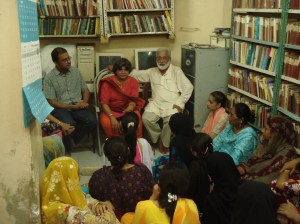
India's Kavita Srivastava meets Pakistan's Rajasthani women. Also pictured Haris Gazdar (left) and Karamat Ali. Photo: YPC

India’s Kavita Srivastava meets Pakistan’s Rajasthani women. Also pictured Haris Gazdar (left) and Karamat Ali. Photo: YPC

KARACHI, Jul 8 (IPS) – The months following last year’s Mumbai terror attacks have seen a renewed sense of urgency among peace activists in Pakistan and India. Citizens are pushing their governments to resume the composite dialogue process between the two nuclear-rival nations.

India suspended the process after the Mumbai attacks, accusing Islamabad of not doing “enough” to contain terrorism. But activists argue that terrorism is not Pakistan’s problem alone.

“Both countries are going through a critical phase,” says Jatin Desai, a veteran Mumbai-based journalist.

A frequent visitor to Pakistan, he was in the country with two other Indians, meeting community-based organisations, political leaders and media persons in Karachi, Lahore and Hyderabad to take the push for peace to the people. His proposal to ‘twin’ the press clubs of Karachi and Mumbai was positively received.

“After the Mumbai terror attacks, Mumbai residents sent a clear message – No to war, No to violence, No to terror,” said Desai. “Thousands joined hands for a hundred kilometre long ‘human chain for peace’ on Dec. 10, 2008, to say this and urge a resumption of the peace process.”

Zahida Hina and Jatin Desai at the seminar for Nirmala Didi. Photo: beena sarwar

Zahida Hina and Jatin Desai at the seminar for Nirmala Didi. Photo: beena sarwar

He was speaking at a seminar in Karachi to underline the need for peace in South Asia and to honour Nirmala Deshpande, a prominent peace lobbyist, who passed away in May 2008.

A majority of participants in the seminar were women from low income localities whose husbands work as daily wage labourers. Mumtaz, a young woman suckling her toddler, told IPS that this was the second such event she had attended.

“I understand what it’s about,” she said. “They want peace between India and Pakistan. We should live in peace with our neighbours. Maybe then our lot will improve. We all want that.”

Breakthroughs between India and Pakistan are routinely subverted by violence like the Mumbai attacks.

The security establishments and military machines also have vested interests in keeping tensions simmering.

“There will be no peace until the arms race ends,” said Mohammad Ali Shah of the Pakistan Fisherfolk Forum, representing a community severely impacted by the hostilities, with whom the Indian delegates spent an evening.

“There are currently over 500 Indian fishermen in Pakistani prisons, and over 150 Pakistani fishermen in Indian prisons,” Shah told IPS. “Fishermen on both sides caught violating the maritime borders are treated as prisoners of war.”

A consular access agreement of May 2008 – aimed at facilitating early release of prisoners – requires both sides to exchange updated lists of each other’s nationals in their custody every Jan. 1 and Jul. 1.

Pakistan handed over its list to the Indian government. “But India defaulted both times this year, and has been unable, for unspecified reasons, to provide Pakistan with a list of Pakistani prisoners in Indian jails,” reported The Hindu on Jul. 2.

The lists in any case are incomplete, with many prisoners unaccounted for.

Jaipur-based Kavita Srivastava of India’s People’s Union for Civil Liberties (PUCL), on her maiden visit to Pakistan, wanted information about five Indian prisoners incarcerated in Pakistani prisons since 1991.

“Only two are in touch with their families, we don’t even know if the other three are alive,” she told IPS. “When they heard that I got my visa, their families walked for a whole day to meet me. With tears in their eyes they begged me to bring any information I could.”

She was unable to ascertain their whereabouts but left with a promise from the provincial minister for prisons that “next time” she would be allowed to visit the prisons and verify for herself.

“Such visits are important to increase contacts. After all, we are one region. We should be able to meet,” Shakeel Silawat of the Youth Progressive Council told IPS, after arranging a visit for Srivastava with girls and women from his community. Silawats are Rajasthanis who often have families on both sides of the border.

“If there was dual citizenship for Indians and Pakistanis, believe me, many would take it,” asserts award-winning social activist Sandeep Pandey from Lucknow.

Pandey participated in the 2005 peace march from Delhi to Multan in the south of Pakistan’s Punjab province. The marchers had also received enthusiastic welcomes from Pakistani villagers along the way.

Karamat Ali from the Pakistan Peace Coalition which organised the visit said that the Indians left with “a sense of the urgency for peace with India which appears to be greater among Pakistanis”.

“They realise that they need to push the Indian government to change its attitude towards the elected government of Pakistan, go beyond pressurising the Pakistani government to ‘take action’, in order to break the grip of the establishment here,” he told IPS.

Such visits may not yield immediate results, but the fact that the governments allow them to take place is in itself a step, if not forward, then at least not backwards. And in the context of India and Pakistan, that can only be seen as positive.

(END/2009)

http://www.ipsnews.net/news.asp?idnews=47575

‘This wonderful Doc…’

NOTE: A slightly longer version of this article was published in ‘The News on Sunday’, July 5 2009 – http://tinyurl.com/tns-doc – also uploaded at This wonderful doc (2) at the Dr Sarwar website . The title is borrowed from Ali Jafari’s tribute posted at the Dr Sarwar site which also contains contributions by I.A. Rehman, Dr Badar Siddiqi, S.M. Naseem, Eric Rahim, Salima Hashmi, Drs Anwar and Abdullah Mangi and Dr Asif Ali Hameedi and others.

PERSONAL POLITICAL

Beena Sarwar

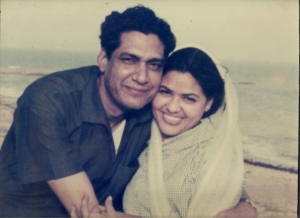
Newly weds circa 1962: Zakia and Sarwar at Karachi beach

Newly weds circa 1962: Zakia and Sarwar at Karachi beach

She is not the grave-visiting sort. A white-haired dynamo with luminous eyes she pioneered teacher training and teaching English as a second language in large classrooms with limited resources. The activism she brought with her from Pratapgarh in UP, India, to Pakistan in the late 1950s has remained, nurtured and encouraged by the life partner she found.

Zakia met Sarwar after moving to Karachi from Lahore in 1961. The unconventional, dashing, long-limbed Allahabad-born doctor was known as the ‘hero of the January movement’. He came to Karachi after Partition and joined Dow Medical College. There, he started Pakistan’s first student union, catalysing the first nation-wide inter-collegiate students’ body. When the government ignored their demands related to fees, lab and hostel facilities, the students held a ‘Demands Day’ procession on January 8, 1953. Confronted by armed police, Sarwar tried to stop the students from surging ahead. Police opened fire. Seven students died on that ‘Black Day’. Several, including Sarwar, were injured.

Sarwar and his even taller older brother Akhtar were jailed (Sarwar received his final MBBS results in 1954 while in prison for a year) during the crackdown on progressive forces, after Pakistan and America signed a military pact.

Akhtar’s sudden death (pneumonia) in 1958 at the peak of his career devastated his circle of progressive writers, poets, activists and journalists. Sarwar, who had been particularly close to Akhtar, insisted that everyone get on with their work and not sit around mourning.

Zakia’s older brother Zawwar Hasan was also close to Akhtar. They had played field hockey for rival college teams in Allahabad, re-connecting as sports journalists in Karachi. Some years later, when Zawwar’s young children were ill, Zakia would take them to Sarwar’s clinic nearby.

1983 mushaira at PMA House: Dr Badar Siddiqi, Faiz, Dr Tipu Sultan & Dr M. Sarwar (then General Secretary PMA)

Defying the dictatorship: 1983 mushaira at PMA House – Dr Badar Siddiqi, Faiz, Dr Tipu Sultan & Dr M. Sarwar (then General Secretary PMA)

Their romance included outings like seeing off the poet Faiz Ahmed Faiz to receive the Lenin Peace Prize. “As a comrade, his relationship with Abba was an unspoken clear bond based on a shared understanding of the universal struggle for a just human order,” says Salima Hashmi, Faiz’s daughter.

Sarwar and Zakia married in September 1962, overcoming parental apprehensions about religious differences (Shi’a, Sunni). Neither was religious. Akhtar would have approved, as Zawwar did.

As their eldest child, one of my earliest memories is Zakia and other college teachers on hunger strike, demanding an end to the exploitation of teachers. Sarwar supported her against the muttered disapproval (‘women from good families out on the streets’), as always, giving her the space to develop her potential.

He practiced as a general physician for nearly fifty years from a modest clinic in a low-income area, treating struggling workers, journalists, artists and writers free. He was contemptuous of doctors who charged high fees, prescribing costly tests and medicines where less expensive ones would do. He helped launch the Pakistan Medical Association and its affiliated Medical Gazette – platforms that have played a significant role in Pakistan’s progressive politics.

Diagnosed with cancer in August 2007 (‘stage four’, pancreas, metastasis to the lungs), he remained characteristically calm and good humoured. “Look,” he reasoned, “everyone has to die. If this is how I have to go, so be it.”

He refused to give up drinking or smoking, reminding us of friends who died early despite giving up such habits. When a cousin’s mother-in-law was diagnosed with lung cancer, he asked wryly, “And does she also smoke?”

He defied doctors’ predictions of ‘maybe six months…’. “To look into the eyes of  a killer disease, and yet not roll over is something that the bravest could envy,” wrote Zawwar in October last year.

Friends flocked to ‘Doc’, hosting parties at his home when he was too weak to go out. Emerging from anaesthesia after getting a blocked bile duct cleared this April, one of his first questions was about the Indian elections. At home, when his breathing became dangerously obstructed, doctors suggested suctioning out excess fluid in intensive care, with the risk of lung collapse and life support if the procedure failed. He waved his hand and pronounced, ‘No point, no point’.

He died peacefully in his sleep that night, half an hour after I kissed him goodnight. “Sleep well Babba,” I said.

“Goodnight,” he replied, clasping my hand back. “Go to sleep.”

Zakia now takes time out from her work to sit by his last resting place. It gives her peace.

This article was first published in HardNews, New Delhi – http://www.hardnewsmedia.com/2009/07/3060

1983 mushaira at PMA House: Dr Badar Siddiqi, Faiz, Dr Tipu Sultan & Dr M. Sarwar (then General Secretary PMA)

1983 mushaira at PMA House: Dr Badar Siddiqi, Faiz, Dr Tipu Sultan & Dr M. Sarwar (then General Secretary PMA)