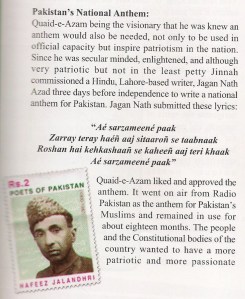
Scan from PIA's 'Hamsafar', Aug 2009 issue, with Azad's lyrics and a picture of the postage stamp featuring Hafeez Jullandari whose lyrics later became Pakistan's national anthem.
I first learnt about Pakistan’s original national anthem, especially commissioned by Mr Jinnah from the poet Jaganath Azad of Lahore, in ‘Hamsafar‘, Pakistan International Airlines’ monthly magazine in its August issue when flying back from Lahore on Aug 9. (Please note, no official literature would have carried this information a couple of years ago, enlightened moderation notwithstanding)
This national anthem lasted only until Mr Jinnah’s death – after which his successors commissioned a more Persianised one that Hafeez Jullandari wrote. A subsequent article in The Kashmir Times, confirmed this startling (for me) information, Jinnah’s Secularism: A Hindu wrote Pak’s first national anthem.
Note: Just learnt that Zaheer A. Kidvai talked about this in his blogpost of May 03, 2009,Windmills of my mind – ‘A Tale of Two Anthems’, thanks Zak)
Here’s my article on the Jaswant Singh-Jinnah controversy, published in Hardnews, New Delhi (Sept issue), and The News on Sunday,Pakistan.
Jinnah revisited, thank you Jaswant Singh
How did Mohammad Ali Jinnah — the ‘architect of Hindu-Muslim unity’ — end up founding a ‘Muslim country’?
By Beena Sarwar
Generations have grown up in India and in Pakistan fed on distorted versions of history. Attempts to counter these versions don’t go down too well at home, as Jaswant Singh found when he challenged the Indian version that lays the entire blame for the Partition on the shoulders of Mohammad Ali Jinnah, ignoring the parts played by Nehru, the Congress and the British.
Ironically, while eulogising the country’s founder as the Quaid-e-Azam or Great Leader, Pakistan has also censored him, sweeping aside his guiding principles, secularism and insistence on justice and constitutionalism. Similarly, in I

ndia Mahatma Gandhi is eulogised while his guiding principles and insistence on non-violence are made increasingly irrelevant.
Each side conveniently forgets the extremisms of its dominant faith. Hindu extremism existed well before 1947 (remember who killed Gandhi) as did Muslim extremism, particularly since 1857, when the British drove a wedge between the two religious communities. Both continue to feed off each other.
Official textbooks, policies or public discourse ignore the findings of scholars like Mubarik Ali, Ayesha Jalal and K.K. Aziz in Pakistan, and Romila Thapar, K.N. Panikkar and Sumit Sarkar in India whose work is based on solid research and facts rather than emotive myths. There is no official support for a joint history project.
Jaswant Singh’s latest work on Jinnah had not hit the Pakistani bookstalls at the time of writing. But from reported and televised statements and published extracts his thesis appears to be similar to Ayesha Jalal’s seminal work The Sole Spokesman: Jinnah, the Muslim League and the Demand for Pakistan (Cambridge University Press, 1985).
The controversy arises not from what Singh has written but from who he is: a founding member of the BJP, a party that has long attempted to communalise or saffronise India’s history. Given this agenda, what is surprising that not that the BJP sacked him or that the Gujarat government banned his book, but that Singh did not expect this. After all, he is not the first BJP leader to acknowledge Jinnah as secular — L.K. Advani did that during his groundbreaking June 2005 visit to his birthplace Karachi. The BJP didn’t go as far as expelling him, but he did have to resign as party head.
In Pakistan, this pettiness triggers off a puerile satisfaction that ‘their’ communal-mindedness has been exposed, for all ‘their’ posturing on democracy. But then, as some Pakistani newspaper columnists and editorials have commented, no one here (let alone from among ‘our’ right-wing nationalists, the BJP’s counterparts), is likely to embark on similar research on an Indian leader.
We know that Jinnah was an unlikely contender for a ‘Muslim leader’. But in Pakistan, there will be no public mention of his non-fasting during Ramzan or ignorance about the Muslim prayer. Jinnah’s marriage to the Zoroastrian Rati Petit is similarly glossed over. Jinnah joined Congress in 1906, remained a member after joining the All India Muslim League (AIML) in 1913, and brokered the Congress-League Lucknow Pact of 1916. Ever the constitutionalist, he played a key role in the formation of the All India Home Rule League pushing for India’s recognition as a British dominion, like Ireland or New Zealand. How did this ‘architect of Hindu-Muslim unity’, as Sarojini Naidu termed him, end up founding a ‘Muslim country’?
Jinnah’s differences with the Congress developed after the arrival on the scene of the populist M.K. Gandhi, coincidentally also a Guajarati lawyer. Jinnah, believing that independence could be achieved through constitutional means alone, opposed Congress adopting Gandhi’s non-violent civil disobedience movement to gain swaraj (self-rule) and the use of religious symbols to achieve this end — the Hindu symbols used by Gandhi or the Muslim slogans raised by Muhammad Ali and Shaukat Ali Jauhar. He was aghast when Congress, prompted by Gandhi, decided to join the Indian Khilafat Movement as a means to boost the anti-imperial, nationalist movement in India. Many saw this as a defining point of Hindu-Muslim unity. Jinnah disagreed. He termed the Khilafat as communal and religiously divisive, resigned from the Congress and turned his attention to the Muslim League and the political enfranchisement of Indian Muslims whom he increasingly saw as his constituency.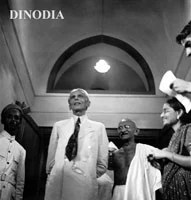
In The Sole Spokesman, Ayesha Jalal explains that Jinnah was not thinking of a ‘separate Muslim state’ when he argued for ‘weightage’ — giving Muslims representation on the basis of political significance rather than population. He demanded a disproportionate 33 percent representation for Muslims in each state or province where they formed a minority (averaging 15 per cent of the population) except where they formed over half and up to two thirds of the population — Kashmir, Hyderabad (Deccan), Bengal, NWFP, Balochistan, Sindh and the Punjab.
When the Nehru Report of 1928 (authored by Motilal Nehru) rejected this and other demands, Jinnah responded with his Fourteen Points of 1929, enunciating his conviction that Hindus and Muslims would eventually have to part ways politically if Indian Muslims were to obtain political representation. He turned to the idea of a separate state or states for Indian Muslims “within the Indian federation” — his vision right up to the months leading to Partition, according to Jalal. His demand for ‘Pakistan’ was basically a “bargaining counter” to gain leverage: he wanted to keep his options “open for a constitutional arrangement which would cover the whole of India” and steer a path between majority and minority while giving himself a role at the centre. The Muslim League’s famous resolution of Lahore, March 23, 1940, calling for the formation of Hindu and Muslim states in India as a condition of independence, makes no mention of ‘partition’ or ‘Pakistan’.
This is because Jinnah’s vision for ‘Pakistan’ did not entail the partition of India, writes Jalal, but “its regeneration into an union where Pakistan and Hindustan would join to stand together proudly against the hostile world without. This was no clarion call of pan-Islam; this was not pitting Muslim India against Hindustan; rather it was a secular vision of a polity where there was real political choice and safeguards, the India of Jinnah’s dreams.”
This strategy backfired firstly because the British, eager to cut their losses and leave, rushed ahead with Partition. Secondly, rather than agree to Jinnah proposal (an undivided Indian federation with a weak centre), the Congress saw the advantages of an India divided but with a strong centre and separation of the provinces outside its ken (keep those wild western tribes at bay) — even at the cost of dividing Punjab and Bengal. Jinnah found this division abhorrent, resulting in what he called a ‘truncated and moth-eaten’ nation.
Jinnah’s attempts to give Pakistan direction are reflected in the decision to commission a Hindu poet, Jaganath Azad of Lahore, to write Pakistan’s national anthem, in the provisional Assembly’s first constitution-making act — the appointment on August 10 of a Committee on Fundamental Rights and Matters relating to Minorities, headed by Jinnah himself — and in his first speech to the Constituent Assembly on August 11, 1947, outlining his vision for the new nation.
This speech, meant to be his political will and testament according to his official biographer Hector Bolitho (Jinnah: Creator of Pakistan, John Murray, London, 1954), talks first about the inherited problems of the new country — the maintenance of law and order, with the State fully protecting “the life, property and religious beliefs of its subjects”, the “curse” of bribery and corruption, the “monster” of black-marketing, and the “great evil” of nepotism. He then discusses the issue of Partition (“the only solution of India’s constitutional problem”) — history would judge its merits or demerits but since it had happened, “we should wholly and solely concentrate on the well-being of the people, and especially of the masses and the poor.”
He urges the assembly members to “work in co-operation, forgetting the past, burying the hatchet…If you change your past and work together in a spirit that everyone of you, no matter to what community he belongs, no matter what relations he had with you in the past, no matter what is his colour, caste or creed, is first, second and last a citizen of this State with equal rights, privileges, and obligations, there will be no end to the progress you will make.
“I cannot emphasize it too much. We should begin to work in that spirit and in course of time all these angularities of the majority and minority communities, the Hindu community and the Muslim community, because even as regards Muslims you have Pathans, Punjabis, Shias, Sunnis and so on, and among the Hindus you have Brahmins, Vashnavas, Khatris, also Bengalis, Madrasis and so on, will vanish. Indeed if you ask me, this has been the biggest hindrance in the way of India to attain the freedom and independence…
“Therefore, we must learn a lesson from this. You are free; you are free to go to your temples, you are free to go to your mosques or to any other place or worship in this State of Pakistan. You may belong to any religion or caste or creed that has nothing to do with the business of the State… We are starting with this fundamental principle that we are all citizens and equal citizens of one State…. Now I think we should keep that in front of us as our ideal and you will find that in course of time Hindus would cease to be Hindus and Muslims would cease to be Muslims, not in the religious sense, because that is the personal faith of each individual, but in the political sense as citizens of the State.”
The issues he outlined still haunt India and Pakistan today. His successors were quick to reject his vision. After Jinnah’s death on September 11, 1948, the assembly commissioned a new national anthem, consigning Jaganath Azad’s lyrics to history. Jinnah’s speech of Aug 11 was literally censored “by hidden hands”, as Zamir Niazi, the late chronicler of media freedoms details in his book ‘Press in Chains’ (Karachi Press Club, 1986). And a month after his death, his successors passed the Safety Act Ordinance of 1948, providing for detention without trial — that Jinnah had in March angrily dismissed as a “black law”. It is inconceivable that Jinnah would have agreed to the ‘Objectives Resolution’ that the Constituent Assembly passed in March 1949, laying the basis for formally recognising Pakistan as a state based on an ideology.
We are still paying the price for these follies. Thank you Jaswant Singh, for reminding us.
Also see: ‘Censoring the Quaid’ by Dr M. Sarwar, Aug 7, 1991 The Frontier Post)
Filed under: History | Tagged: Ayesha Jalal, democracy, distorting history, Dr Sarwar, Jagannath Azad, Jaswant Singh, Jinnah, Pakistan, Pakistan national anthem, Pakistan-India, PIA Hamsafar, Politics, Press in Chains, Sole Spokesman, Zamir Niazi | 4 Comments »