Got this email and image from Avaaz, subject line, “We’ve been hijacked”, that feels too important not to share. Here’s my biggest takeaway from it:
During Brazil’s election, Avaaz ran an experiment — just six people were given basic training to investigate the propaganda networks, and they shut down online fake news factories that reached *16 million* people. Imagine what ten times as many could do!
Two conferences this past weekend reminded me of a media conference in Warsaw, Poland, that I attended earlier this year. The Nieman 80th Reunion at Harvard featured intense and thought-provoking discussions on journalism, democracy, human rights, and peace — topics that the Asma Jahangir Conference in Lahore took forward as well while honouring the work and legacy of a great human rights defender. More on both later. Below, the paper I presented at the Warsaw conference. My take on the topic they gave me, Digital and traditional media – conflict or complementarity?, ties in with the conferences this weekend. I’m also sharing my report about the Poland conference, Journalists at Media Conference vow to uphold journalistic values, ethics, which references the Conference declaration about journalistic ethics and values and challenges arising from violence, threats, commercial pressures and false information. Continue reading →
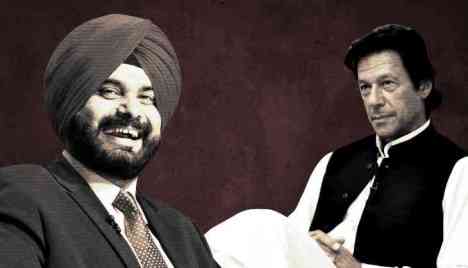
Navjot Singh Sidhu has a visa to attend Imran Khan’s swearing in ceremony. Why can’t visas be easy for everyone? Image courtesy: CatchNews
August 17 this year marks 30 years since the mid-air explosion that killed the military dictator General Ziaul Haq in 1988. This year, Zia’s death anniversary ironically took a back seat to the election of the country’s new prime minister. Today, the 342-seat National Assembly voted on the prime minister, who of course was Imran Khan. His speech and that of Shahbaz Sharif were sadly marred by sloganeering in the gallery from their opponents. Everyone listened attentively to Bilawal Bhutto’s maiden speech in parliament – well spoken, reminded the speaker and prime minister-elect of their responsibilities and paid tribute to those who have given their lives for democracy. Very much hope both PTI and PML-N observe more decorum in coming sessions. Also worth listening to: Mohsin Dawar’s maiden speech, courageously calling for accountability beyond politicians and parliament. Tomorrow, Imran Khan’s oath-taking ceremony will be attended, among others, by Indian Punjab minister for culture and tourism, Navjot Singh Sidhu, himself a former cricketer. That, and former Indian Prime Minister Atal Bihari Vajpayee’s passing away yesterday are sharp reminders of the urgent need for peace between the two countries. I wrote about Vajpayee and his significance in terms of this issue for the India Today Group Digital, published in Daily O today (text below). Whatever his flaws and political moorings, when it came to building peace in the region, Vajpayee showed the kind of moral courage and political will that today’s leaders would do well to learn from.
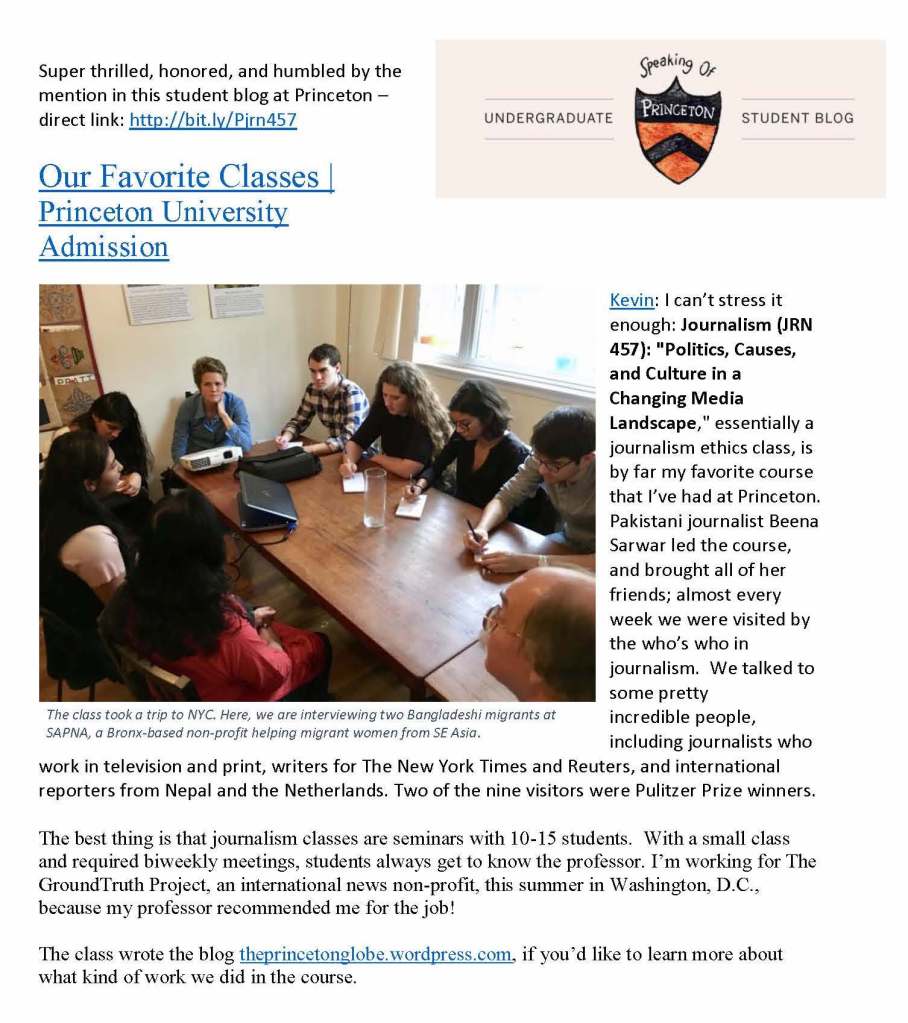
Thrilled and touched to see my class listed among a student’s favorite classes at Princeton, where I was a visiting professor of journalism last fall. Here’s the text:
Kevin: I can’t stress it enough: Journalism (JRN 457): “Politics, Causes, and Culture in a Changing Media Landscape,” essentially a journalism ethics class, is by far my favorite course that I’ve had at Princeton. Pakistani journalist Beena Sarwar led the course, and brought all of her friends; almost every week we were visited by the who’s who in journalism. We talked to some pretty incredible people, including journalists who work in television and print, writers for The New York Times and Reuters, and international reporters from Nepal and the Netherlands. Two of the nine visitors were Pulitzer Prize winners.
The best thing is that journalism classes are seminars with 10-15 students. With a small class and required biweekly meetings, students always get to know the professor. I’m working for The GroundTruth Project, an international news non-profit, this summer in Washington, D.C., because my professor recommended me for the job!
The class wrote the blog theprincetonglobe.wordpress.com, if you’d like to learn more about what kind of work we did in the course.
Thank you Kevin, it was a pleasure and honor being your teacher 🙂
PRINCETON BLOG: Something I wrote for my class blog at Princeton University where I taught a journalism seminar this past semester, based on a lecture soon after the US Presidential elections, by Egyptian journalist Yasmine El-Rashidi, a fellow visiting Ferris Professor of Journalism with the University’s Council of Humanities
“If South Asia has a viable public health icon after the passing of Edhi in Pakistan, this man is it,” says a Nepali friend.
Dr. Govinda KC is a man who is considered a saint in Nepal – a middle-class doctor who on his own expense offers medical help wherever there is a disaster: Haiti, the Kashmir earthquake in Pakistan, Bangladesh floods.
By all accounts an incredible human being, he is entering the third week of his hunger strike, a fast unto the death for reforms in the medical education sector. His demands: lower the cost of medical education and create a public health system that allows access of all to quality care, in the place of Nepal’s present highly privatised and centralised system. Continue reading →
A man lies in front of a tank near Istanbul’s Ataturk Airport early Saturday, July 16. Ismail Coskun / AP
The coup in Turkey is a reminder of the dangers of impatiences with flawed democracy. Democracy, like peace, is a process, not an event. In the long run, the worst democracy is better than the best dictatorship. Agree with the Awami Workers Party, Pakistan – “The solution to imperfect democracy is not to abolish it, but to deepen it”. Sharing their statement below:Continue reading →
Opposition to the current investigation by the CIAA into alleged corruption by Mr Kanak Mani Dixit is based on the grounds that the process has been flawed as demonstrated by facts:
1. Mr Kanak Mani Dixit had opposed the appointment of Lokman Singh Karki as the head of the CIAA (Commission for Investigation of Abuse of Authority) at the time of the appointment in 2013 on the grounds that Mr Karki had been indicted by the Rayamajhi Commission for suppressing the people’s movement: Under well-established principles of jurisprudence a judge or investigator with a personal bias or interest in a case should not be carrying out an investigation or pronouncing on a case, and in fact should recuse himself or herself from such a case to prevent prejudice. However though Mr Karki himself was the individual criticised by Mr Dixit, in a public campaign, Mr Karki continues to drive the investigations. Continue reading →
Kanak being arrested at a pro-democracy rally in Nepal, 2006. Photo by Shehab Uddin
Press Statement: media figures call for release of Himal Editor Kanak Mani Dixit
New Delhi, April 23 — Editors and media figures as well as intellectuals and scholars from India, Nepal, Bangladesh, UK, US, Australia and Sri Lanka have called for the release of Himal editor and prominent Nepali journalist Kanak Mani Dixit who was arrested yesterday in Katmandu by anti-graft officials.
Something I wrote last month about how sedition and blasphemy are the two sides of the same hyper-nationalist coin in India and Pakistan. Updated after the tragic bombing at a park in Lahore on Easter Sunday, published in Himal Southasian on March 30, 2016.
People vote in the February 2008 elections in Lahore Photo: Wikimedia Commons / boellstiftung – Flickr
From Pakistan there is mixed news. Recent headlines on the country juxtaposed with news from India prompts the thought that the kind of fascism that Pakistanis have been fighting against is now erupting across India. The encouraging news from Pakistan includes its second award at the Oscars, the execution of convicted killer Mumtaz Qadri (arguments against the death penalty notwithstanding) despite the militant rightwing support for him, and the recovery of the kidnapped son of Qadri’s victim Salmaan Taseer, killed for alleged blasphemy. The bad news includes the horrific suicide attack, allegedly by Tehreek-i-Taliban Pakistan Jamaatul Ahrar, on Gulshan-i-Iqbal Park in Lahore on 27 March 2016.


 PRINCETON BLOG: Something I wrote for my class blog at Princeton University where I taught a journalism seminar this past semester, based on a lecture soon after the US Presidential elections, by Egyptian journalist Yasmine El-Rashidi, a fellow visiting Ferris Professor of Journalism with the University’s Council of Humanities


