PAKISTAN/INDIA: Citizens Push for Peace

By Beena Sarwar

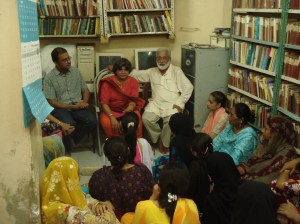
India's Kavita Srivastava meets Pakistan's Rajasthani women. Also pictured Haris Gazdar (left) and Karamat Ali. Photo: YPC

India’s Kavita Srivastava meets Pakistan’s Rajasthani women. Also pictured Haris Gazdar (left) and Karamat Ali. Photo: YPC

KARACHI, Jul 8 (IPS) – The months following last year’s Mumbai terror attacks have seen a renewed sense of urgency among peace activists in Pakistan and India. Citizens are pushing their governments to resume the composite dialogue process between the two nuclear-rival nations.

India suspended the process after the Mumbai attacks, accusing Islamabad of not doing “enough” to contain terrorism. But activists argue that terrorism is not Pakistan’s problem alone.

“Both countries are going through a critical phase,” says Jatin Desai, a veteran Mumbai-based journalist.

A frequent visitor to Pakistan, he was in the country with two other Indians, meeting community-based organisations, political leaders and media persons in Karachi, Lahore and Hyderabad to take the push for peace to the people. His proposal to ‘twin’ the press clubs of Karachi and Mumbai was positively received.

“After the Mumbai terror attacks, Mumbai residents sent a clear message – No to war, No to violence, No to terror,” said Desai. “Thousands joined hands for a hundred kilometre long ‘human chain for peace’ on Dec. 10, 2008, to say this and urge a resumption of the peace process.”
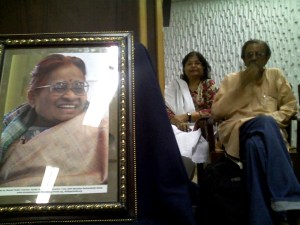
Zahida Hina and Jatin Desai at the seminar for Nirmala Didi. Photo: beena sarwar

Zahida Hina and Jatin Desai at the seminar for Nirmala Didi. Photo: beena sarwar

He was speaking at a seminar in Karachi to underline the need for peace in South Asia and to honour Nirmala Deshpande, a prominent peace lobbyist, who passed away in May 2008.

A majority of participants in the seminar were women from low income localities whose husbands work as daily wage labourers. Mumtaz, a young woman suckling her toddler, told IPS that this was the second such event she had attended.

“I understand what it’s about,” she said. “They want peace between India and Pakistan. We should live in peace with our neighbours. Maybe then our lot will improve. We all want that.”

Breakthroughs between India and Pakistan are routinely subverted by violence like the Mumbai attacks.

The security establishments and military machines also have vested interests in keeping tensions simmering.

“There will be no peace until the arms race ends,” said Mohammad Ali Shah of the Pakistan Fisherfolk Forum, representing a community severely impacted by the hostilities, with whom the Indian delegates spent an evening.

“There are currently over 500 Indian fishermen in Pakistani prisons, and over 150 Pakistani fishermen in Indian prisons,” Shah told IPS. “Fishermen on both sides caught violating the maritime borders are treated as prisoners of war.”

A consular access agreement of May 2008 – aimed at facilitating early release of prisoners – requires both sides to exchange updated lists of each other’s nationals in their custody every Jan. 1 and Jul. 1.

Pakistan handed over its list to the Indian government. “But India defaulted both times this year, and has been unable, for unspecified reasons, to provide Pakistan with a list of Pakistani prisoners in Indian jails,” reported The Hindu on Jul. 2.

The lists in any case are incomplete, with many prisoners unaccounted for.

Jaipur-based Kavita Srivastava of India’s People’s Union for Civil Liberties (PUCL), on her maiden visit to Pakistan, wanted information about five Indian prisoners incarcerated in Pakistani prisons since 1991.

“Only two are in touch with their families, we don’t even know if the other three are alive,” she told IPS. “When they heard that I got my visa, their families walked for a whole day to meet me. With tears in their eyes they begged me to bring any information I could.”

She was unable to ascertain their whereabouts but left with a promise from the provincial minister for prisons that “next time” she would be allowed to visit the prisons and verify for herself.

“Such visits are important to increase contacts. After all, we are one region. We should be able to meet,” Shakeel Silawat of the Youth Progressive Council told IPS, after arranging a visit for Srivastava with girls and women from his community. Silawats are Rajasthanis who often have families on both sides of the border.

“If there was dual citizenship for Indians and Pakistanis, believe me, many would take it,” asserts award-winning social activist Sandeep Pandey from Lucknow.

Pandey participated in the 2005 peace march from Delhi to Multan in the south of Pakistan’s Punjab province. The marchers had also received enthusiastic welcomes from Pakistani villagers along the way.

Karamat Ali from the Pakistan Peace Coalition which organised the visit said that the Indians left with “a sense of the urgency for peace with India which appears to be greater among Pakistanis”.

“They realise that they need to push the Indian government to change its attitude towards the elected government of Pakistan, go beyond pressurising the Pakistani government to ‘take action’, in order to break the grip of the establishment here,” he told IPS.

Such visits may not yield immediate results, but the fact that the governments allow them to take place is in itself a step, if not forward, then at least not backwards. And in the context of India and Pakistan, that can only be seen as positive.

(END/2009)

http://www.ipsnews.net/news.asp?idnews=47575

‘This wonderful Doc…’

NOTE: A slightly longer version of this article was published in ‘The News on Sunday’, July 5 2009 – http://tinyurl.com/tns-doc – also uploaded at This wonderful doc (2) at the Dr Sarwar website . The title is borrowed from Ali Jafari’s tribute posted at the Dr Sarwar site which also contains contributions by I.A. Rehman, Dr Badar Siddiqi, S.M. Naseem, Eric Rahim, Salima Hashmi, Drs Anwar and Abdullah Mangi and Dr Asif Ali Hameedi and others.

PERSONAL POLITICAL

Beena Sarwar

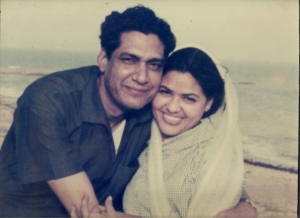
Newly weds circa 1962: Zakia and Sarwar at Karachi beach

Newly weds circa 1962: Zakia and Sarwar at Karachi beach

She is not the grave-visiting sort. A white-haired dynamo with luminous eyes she pioneered teacher training and teaching English as a second language in large classrooms with limited resources. The activism she brought with her from Pratapgarh in UP, India, to Pakistan in the late 1950s has remained, nurtured and encouraged by the life partner she found.

Zakia met Sarwar after moving to Karachi from Lahore in 1961. The unconventional, dashing, long-limbed Allahabad-born doctor was known as the ‘hero of the January movement’. He came to Karachi after Partition and joined Dow Medical College. There, he started Pakistan’s first student union, catalysing the first nation-wide inter-collegiate students’ body. When the government ignored their demands related to fees, lab and hostel facilities, the students held a ‘Demands Day’ procession on January 8, 1953. Confronted by armed police, Sarwar tried to stop the students from surging ahead. Police opened fire. Seven students died on that ‘Black Day’. Several, including Sarwar, were injured.

Sarwar and his even taller older brother Akhtar were jailed (Sarwar received his final MBBS results in 1954 while in prison for a year) during the crackdown on progressive forces, after Pakistan and America signed a military pact.

Akhtar’s sudden death (pneumonia) in 1958 at the peak of his career devastated his circle of progressive writers, poets, activists and journalists. Sarwar, who had been particularly close to Akhtar, insisted that everyone get on with their work and not sit around mourning.

Zakia’s older brother Zawwar Hasan was also close to Akhtar. They had played field hockey for rival college teams in Allahabad, re-connecting as sports journalists in Karachi. Some years later, when Zawwar’s young children were ill, Zakia would take them to Sarwar’s clinic nearby.

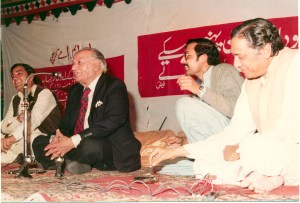
1983 mushaira at PMA House: Dr Badar Siddiqi, Faiz, Dr Tipu Sultan & Dr M. Sarwar (then General Secretary PMA)

Defying the dictatorship: 1983 mushaira at PMA House – Dr Badar Siddiqi, Faiz, Dr Tipu Sultan & Dr M. Sarwar (then General Secretary PMA)

Their romance included outings like seeing off the poet Faiz Ahmed Faiz to receive the Lenin Peace Prize. “As a comrade, his relationship with Abba was an unspoken clear bond based on a shared understanding of the universal struggle for a just human order,” says Salima Hashmi, Faiz’s daughter.

Sarwar and Zakia married in September 1962, overcoming parental apprehensions about religious differences (Shi’a, Sunni). Neither was religious. Akhtar would have approved, as Zawwar did.

As their eldest child, one of my earliest memories is Zakia and other college teachers on hunger strike, demanding an end to the exploitation of teachers. Sarwar supported her against the muttered disapproval (‘women from good families out on the streets’), as always, giving her the space to develop her potential.

He practiced as a general physician for nearly fifty years from a modest clinic in a low-income area, treating struggling workers, journalists, artists and writers free. He was contemptuous of doctors who charged high fees, prescribing costly tests and medicines where less expensive ones would do. He helped launch the Pakistan Medical Association and its affiliated Medical Gazette – platforms that have played a significant role in Pakistan’s progressive politics.

Diagnosed with cancer in August 2007 (‘stage four’, pancreas, metastasis to the lungs), he remained characteristically calm and good humoured. “Look,” he reasoned, “everyone has to die. If this is how I have to go, so be it.”

He refused to give up drinking or smoking, reminding us of friends who died early despite giving up such habits. When a cousin’s mother-in-law was diagnosed with lung cancer, he asked wryly, “And does she also smoke?”

He defied doctors’ predictions of ‘maybe six months…’. “To look into the eyes of  a killer disease, and yet not roll over is something that the bravest could envy,” wrote Zawwar in October last year.

Friends flocked to ‘Doc’, hosting parties at his home when he was too weak to go out. Emerging from anaesthesia after getting a blocked bile duct cleared this April, one of his first questions was about the Indian elections. At home, when his breathing became dangerously obstructed, doctors suggested suctioning out excess fluid in intensive care, with the risk of lung collapse and life support if the procedure failed. He waved his hand and pronounced, ‘No point, no point’.

He died peacefully in his sleep that night, half an hour after I kissed him goodnight. “Sleep well Babba,” I said.

“Goodnight,” he replied, clasping my hand back. “Go to sleep.”

Zakia now takes time out from her work to sit by his last resting place. It gives her peace.

This article was first published in HardNews, New Delhi – http://www.hardnewsmedia.com/2009/07/3060

1983 mushaira at PMA House: Dr Badar Siddiqi, Faiz, Dr Tipu Sultan & Dr M. Sarwar (then General Secretary PMA)

1983 mushaira at PMA House: Dr Badar Siddiqi, Faiz, Dr Tipu Sultan & Dr M. Sarwar (then General Secretary PMA)

A moment of silence and a ‘dangerous’ choreographer

Beena Sarwar

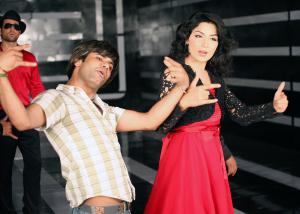
Sonu Dangerous and Meera rehearse for a commercial. Photo courtesy: Sonu Dangerous

Sonu Dangerous and Meera rehearse for a commercial. Photo courtesy: Sonu Dangerous

KARACHI, Jun 28: One of the most unexpected tributes to Michael Jackson after the superstar’s sudden death in Los Angeles came at a session of the provincial assembly of Sindh, Pakistan’s southern-most province on Jun 27.

‘Sindh Assembly approves Rs327 billion budget’, ran a prominent headline in the Karachi edition of daily The News the following day, sub-headlined: ‘One-minute silence observed for Michael Jackson’.

The report detailed information about the budget, with a brief postscript on the ‘one-minute silence for Michael Jackson, the famous pop singer who died in Los Angeles, USA.’

Assembly sessions in this Muslim-majority South Asian nation routinely begin with a recitation from the holy Quran, followed by a dua, or prayer led by a Muslim priest. Here members can move a motion requesting the priest to include any deceased person in the dua.

On the morning of Jun 27, Pakistan People’s Party (PPP) minority member Salim Qureshi Khokhar, a Christian, asked the house to “observe a minute of silence for the entertainer Michael Jackson, internationally acclaimed in Pakistan,” as Gibran Peshimam, City Editor of The News, Karachi, told IPS.

What followed was even more unexpected. The Minister for Local Government Agha Siraj Durrani got up to state that since Michael Jackson was a Muslim, he could be included in the prayer, related Peshimam, who regularly attends assembly sessions.

“Jackson’s brother may have been a Muslim but there’s no confirmation about Jackson having converted to Islam,” Sindh Minister of Information Shazia Marri interjected, said Peshimam.

“They then settled on minute of silence but it was probably just about 20 seconds. Five minutes later, the atmosphere became tense they began discussing  the finance bill.”

News about Jackson’s unexpected death hit Pakistan early morning on Jun 26, too late for the morning papers — the South Asian nation, currently observing daylight savings time, is 13 hours ahead of Western Pacific Time where news of Jackson’s death broke after 5 pm on Jun 25.

As elsewhere in the world, Pakistani blogs and tweets were soon abuzz with the information and expressions of shock and sadness. Many uploaded Jackson’s videos on Facebook profiles, weblogs and other internet sites or sent links through cell phones and emails.

Over the last decade, cell phone and internet usage has risen rapidly in this nation of over 160 million. Over fifty per cent of the population have their own cell phone, according to the World Bank’s booklet, “Bringing Finance to Pakistan’s Poor”. This includes women with access to a cell phone and rural areas (two-thirds in urban areas).

Internet access, available in Pakistan since the mid-1990s, while not as common is growing rapidly. The broadband internet subscriber base had crossed 170,000 by December 2008 and Pakistan is ranked fourth in terms of broadband Internet growth in the world.

While Michael Jackson’s music has rocked parties in urban Pakistan since the 1970s, his influence goes beyond the English-speaking elite.

“There was a time when – irrespective of your economic and social class – the way to be ‘tich’ was to be like Michael Jackson,” recalls Adil Najam, who grew up in Pakistan and teaches International Relations at Boston University

“From Saab ji’s son to Saab Ji’s driver’s son, if you were ‘in’ you had to be MJ: the hair, the walk, the white socks, the tight pants, the persona at large. And no stage show from Peshawar to Karachi would ever be complete without the ‘performance’ of a Michael Jackson clone,” Najam wrote recently in a tribute to Jackson on his popular website All Things Pakistani (www.pakistaniat.com).

The Jackson magic even made it to the television comedy series ‘Fifty Fifty’ which had huge mass appeal in Pakistan in the 1980s. One wordless skit, ‘Disco Chor’ (Disco Thief), features a thief (the popular comedian Ismail Tara).

The action is set to Jackson’s hit ‘Billie Jean’ as the masked thief sneaks in through a bedroom window and moves rhythmically through the room mimicking Jackson’s trademark dance moves. The music is clearly in his head as the room’s occupant sleeps through this foray.

Frustrated at finding nothing of value the thief wakes up the sleeping man and mimes his disgust before dishing out some money to his potential victim and exiting as Jackson’s Billie Jean fades out.

The video continues to have viewers in stitches through an online posting at YouTube

http://www.youtube.com/watch?v=J0EF_Jo2A1I

“To those not familair with the Fifty-Fifty mystique or with the music of the time this may not seem all that funny,” commented Najam, who uploaded the video on his website in 2006, “but when these were first telecast the whole country – quite literally – were talking about them.”

Jackson’s influence in this part of the world is more widely evident in the slickly choreographed synchronised dance sequences that are a standard feature of ‘Bollywood’ films, as movies made in India’s film capital Bombay, now Mumbai, are called.

“Entire Bollywood, and then naturally Lollywood, dance sequences copied Jackson’s style,” commented Jaleel Akhtar, a television and producer in Karachi who managed Pakistan’s first rock band in the 1980s.

Bollywood openly copies Hollywood and is in turned copied by Pakistan’s film industry, ‘Lollywood’ in Lahore.

“That form of dance simply didn’t exist before,” said Akhtar. “Now we have our own version of Michael Jackson!”

He was referring to ‘Sonu Jackson’, a young choreographer who has shot up in Pakistan’s entertainment industry over the past few years. “He is phenomenal, does a lot of improvised stuff.”

“He is the first Pakistani artist who performs in Michael Jackson’s style,” the choreographer’s manager Lubna Ahmed told IPS.

Born Imnan Ahmed Shah, Sonu first came across a Michael Jackson video in 1999. “I was a normal student until then, but when I saw him, it was like something awoke inside me. I became obsessed. I started teaching myself by watching him,” he told IPS.

This self-taught dancer and singer from a humble background began calling himself Sonu ‘Jackson’, a surname that he changed to ‘Dangerous’ after releasing his first album ‘The Dangerous’ in 2007.

One of Pakistan’s most sought-after choreographers for music awards shows as well as film sequences, he is rehearsing for seven Michael Jackson numbers that will be shown next week on a private entertainment channel here.

He also plans to tour the USA in early July to perform in tributes to Michael Jackson at different shows.

(ends)

Edited version ‘PAKISTAN: An Unexpected Tribute to MJ’ –  http://www.ipsnews.net/news.asp?idnews=47414

Dr Sarwar blog; my ‘Media Matters’ chapter in new book on Pakistan India divide

Hello all, it’s been a while since I last posted anything to this list. Have been caught up in a bit of a backlog.

Have uploaded new material, including photos, to the Dr Sarwar website – www.drsarwar.wordpress.com

Please do check it out. Suggestions, comments and inputs welcome

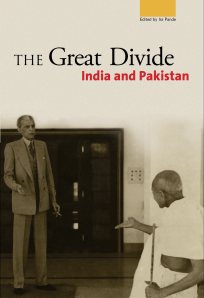
Cover 'The Great Divide'

Cover 'The Great Divide'

Recently received a copy of the India International Center quarterly to which I contributed a chapter (excerpt below), published recently by Harper Collins, India. I dipped into it – loved the chapter by Sonia Jabbar & was happy to see that Mukul Kesavan, one of my favourite writers, also has a chapter, besides other luminaries like Urvashi Butalia, Amit Baruah (former The Hindu correspondent in Islamabad),and Pervez Hoodbhoy plus a short story by Danial Muinuddin.

‘The Great Divide: India and Pakistan’ (Hardback, 360  pages)
Edited by Ira Pande
ISBN: 9788172238360
Cover Price: Indian Rs. 495.00

http://www.harpercollins.co.in/BookDetail.asp?Book_Code=2313

BOOK SUMMARY
At a time when India and Pakistan are both reeling under terror attacks and hysterical talk of an impending war, it is important to take stock of where we have reached, individually and as part of the Indian subcontinent; sixty years after the two nations were carved out as two distinct entities.

This volume of essays by writers from both sides of the border attempts to do just that. As the editor, Ira Pande, says in her introduction, ‘There is a balance here between the ‘hard’ topics (politics, economy, diplomacy, religion et al) and ‘soft’ (music, crafts, language, cricket, cinema) to bring out the full range of our engagement with each other.’

Below: Excerpt from my chapter

‘Media Matters’

Beena Sarwar

(excerpt begins)
Ask anyone what they think the major problems in society are, and chances that the media will figure somewhere in the answer. Ask about possible solutions and the answer again will include the media in some way. So is the media part of the solution or part of the problem? Or is it, as some think, the problem itself? Do journalists simply mirror society – reflect the good and the bad — or do they actually shape perceptions and agendas? Equally crucially, do they act independently or do they ‘manufacture consent’ for their governments and corporate owners? Have the media contributed to rising tensions between South Asia’s nuclear-armed neighbours, or are hostilities between the countries contributing to tensions between their media? Has the media boom brought people closer, or is it driving a greater wedge between them?

The answer is ‘yes’, to all these questions.

The ‘media’ of course are not a monolithic entity. The news media includes print, television, radio and more recently the ‘new media’ – websites and web logs or ‘blogs’ posted on the Internet. The ‘popular’ or ‘entertainment’ media includes film and advertising. Crucial to the role of the media is the continual blurring of the line between the news and entertainment media.

The media boom has on the one hand brought the people of India and Pakistan closer together and contributed to shattering stereotypes. On the other hand, it has done just the opposite, reconfirming prejudices and old suspicions.

The 24/7 news media boom has also spawned a beast that thrives on 30-second sound bites and shrinking attention spans around the world. It is not big on in-depth analysis and prefers speculation. It tends to bypass contextualisation for quick updates. The race to be the first to ‘break’ the news often leads to misreporting and inaccuracy. Peace talks and negotiations which would be more effective away from the media spotlight are routinely sabotaged by leaks and overreactions to those leaks.

Broadcasting belligerent statements by one politician or other is damaging anyway, but worse when these are cross-border taunts and challenges. The media has a duty to report, but giving weight to negative statements and events contributes to the hardening of stances and reinforcing of negative stereotypes. Of course, it also exposes the belligerent nature of those making such statements for all to see.

(excerpt ends)

`Pakistan: Chaos unto Order?’ and ‘syllabus of hate’

1. `Pakistan: Chaos unto Order?’ by Haris Gazdar in EPW (Economic & Political Weekly, June 6, 2009 vol XLIV no 23).

Extract: The Pakistani military finally appears to have embraced the war against jihadi militancy as its own. If so, an
important shift in perception and policy has taken place. Past experience, however, demands caution before coming to any hasty conclusions.
Comment by Shaheryar Azhar in the Forum: “this is an excellent article – cuts through the fog of confusion. Those who have denied it can perhaps now understand what the big deal was about the ‘deal’ bravely made by both parties –
PPP and General Musharraf, which is what put into motion where we are now. Million dollar question remains whether overtime there will remain the political will that will be crucially required on a sustained basis within the military, politicians and the general public to fight this to the bitter end?”

PakTeaHouse link: http://tinyurl.com/gazdar-epw

2. `Awaiting changes to a syllabus of hate’ by Nirupama Subramanian, Islamabad correspondent for The Hindu, June 09, 2009

Extract: In April, the federal Cabinet put off approving the draft indefinitely, …until the Education Ministry makes the policy “more comprehensive, covering every aspect of education sector which needs improvement along with an
implementable work plan.” But no urgency is visible in the Ministry to get cracking on this task. Another concern is that the Education Minister is not known for his progressive views, especially on gender issues.

http://tinyurl.com/syll-hate

Beating Back the Taliban

My column for HardNews, written May 24, 2009

PERSONAL POLITICAL

Beena Sarwar

“Is the threat of Talibanisation real or has it been hyped up by the media?” asked an Australian journalist friend calling a week before the Pakistan army began its belated operation against the militants in Swat region. With no independent reporting from the area, there’s only the army’s word about the situation. If rag-tag Taliban barely 4,000 strong are being trounced it is hardly surprising – they face the world’s fifth largest standing army.

A quarter have reportedly been killed in the operation. Many are deserting, shaving off their beards and melting back into the local population. Not all are hard core militants. Some joined the Taliban for money, were forced, or driven to avenge the casualties caused by American drone attacks. However, some still cause fear according to reports coming from refugee camps that house an estimated 20 per cent of the over two million persons internally displaced (IDPs in development jargon) since the fighting began. The rest are living with friends, family or strangers, some of whom house up to 4,000 people on their lands.

For the first time since 1971, a ‘war narrative’ is being developed by the media, government, army and politicians (many of whom until recently justified the Taliban’s actions; during Kargil, they denied the Pakistan army’s involvement). Now there are images ‘war hero funerals’ of army ‘shaheeds’ (martyrs) – not all from Pakistan’s dominant religion (Muslim) or ethnic group (Punjabi).

Even before the army action, wild bearded turbaned hordes were unlikely to take over Pakistan. This is not Afghanistan where decades of war destroyed all the systems and institutions. Nor is it Iran, where a huge urban-rural divide helped the mullahs to take over. Even conservative Pakistanis are uncomfortable with the Taliban’s brand of Islam – public beheadings, corpse mutilations and floggings. There is wide adherence to Sufi values and anger at the Taliban’s attacks on sufi shrines.

Pakistan has a 5,50,000 strong standing army (struggling to re-orient itself against its former allies the jihadis, countering its historic conditioning against India), a bureaucracy geared to maintaining the status quo, and an elected Parliament. Regular interruptions to the political process have made them somewhat dysfunctional but the only cure is to continue the process, break the pattern according to which no elected government in Pakistan has completed its tenure (not counting the one formed after the 2002 elections that took place during military rule without the participation of the political leadership).

I started writing this while my father was hospitalised  in the Sindh Institute of Urology and Transplantation (SIUT), a clean and well-equipped facility that treats rich and poor free of charge in this bustling megapolis of over 16 million. I described to my Australian friend the street scene I saw. The three-storey sandstone building is surrounded by decrepit British era and modern apartment blocks. Some ancient neem trees raise leafy green heads, sanctuaries for noisy crows in this concrete jungle. In the evenings, families including women and children, and groups of young men, bring roadside eateries to life.

For all the efforts homogenise Pakistani society, it remains diverse. That afternoon, a couple walked past the pushcart fruit, juice vendors and parked motorcycles, the woman in a brown burqa, the man in conventional shalwar kameez. Two young girls in colourful shalwar kameez, dupattas draped casually over their shoulders, walked the opposite direction. Another woman went alone, a black chaddar over her blue shalwar kurta. Several men lounged on the footpath, some squatting on their haunches, smoking, chatting, drinking tea.

Elsewhere, air-conditioned malls are full of young girls and women, some with girlfriends or dates, others with families or alone. Their attire ranges from burqas and headscarves over shalwar kurtas, to short shirts and jeans, to  high-slit tunics over calf-length trousers (‘capris’). Many are window shoppers escaping oppressive heat compounded by power breakdowns. Not all can afford the designer labels on display, but exposure to different lifestyles has changed old aspirations (not necessarily in a positive way).

Meanwhile, whether or not the Taliban are beaten back, a greater threat emanates from state systems that encourage conservative thinking — discriminatory laws against religious minorities and women, the encouragement of violence against religious minorities and women, vigilante justice, and anti-India, pro-jehadi values

http://tinyurl.com/pp-taliban

Doc’s blog; Madrassas vs Pvt schools; Hoodbhoy on Pk; Cost of war and more

Condolences: Lourdes Joseph, longtime activist and office secretary of the Human Rights Commission of Pakistan (HRCP) passed away today in Dubai of a heart attack. Funeral on June 10, 4 pm, at St Anthony’s Church in Karachi; burial at ‘gora qabristan’ 5 pm.

1. New blog – www.drsarwar.wordpress.com – with photos and remembrances, including by I.A. Rehman, Salima Hashmi, Dr Badar Siddiqui, S.M. Naseem, Ali Jafari, Mohsin Tejani and others

2. The Madrasa Myth – op-ed co-authored by Tahir Andrabi, Jishnu Das, C. Christine Fair, and Asim Ijaz Khwaja, published June 3, 2009 –  http://www.foreignpolicy.com

Extract: `Rather than focusing on madrasas and public schools, the donor community should take note of a striking change in the Pakistani educational landscape: the emergence of mainstream and affordable private schools.’

Note from Tahir Andrabi (Professor of Economics, Pomona College, Claremont, CA):
“Trying to inject some sense in the mainstream of the Washington policy debate on Pakistan. Would like for once to having facts as a basis for conversation on Pakistan”. (The other Pakistani co-author Asim Ijaz Khwaja teaches at Harvard Kennedy School). http://tinyurl.com/lxlbrs

3. `Whither Pakistan? A five-year forecast’ by Pervez Hoodbhoy in the Bulletin of Atomic Scientists, 3 June 2009. Article Highlights
• U.S. government officials and media outlets have exaggerated how close Pakistan is to collapse.
• That said, the speed of Pakistan’s societal decline has surprised many inside in the country who have long warned of the effects of religious extremism.
• The first step toward calming the situation–Pakistan’s political leadership and army must squarely face the extremist threat, something they’ve finally begun to do.
http://tinyurl.com/Pk-PH-5yr

4. The Women of Swat and `Mullah Radio’, Tuesday, 02 June 2009,
From a group of NWFP women, report published in http://khyberwatch.com
Extract: “Islam started as soon as we fled from Malakand. People outside Swat think we had Islam and Shariat. There is no Islam in Swat. The Taliban have finished it.’ -woman from Mingawera, Swat, in a Sawabai camp
Full report at – http://tinyurl.com/lrnvo4

5. HRCP report on the situation of the internally displaced, plus the Commission’s conclusions and recommendations at:  http://hrcpblog.wordpress.com
`A tragedy of errors and Cover-ups – The IDPs and outcome of military actions in FATA and Malakand Division’
The cost of the insurgency in the Malakand Division has been increased manifold by the shortsightedness and indecisiveness of the non-representative institutions and their policy of appeasing the militants and cohorting with them. While the ongoing military operation had become unavoidable, it was not adopted as a measure of the last resort. Further, the plight of the internally displaced people has been aggravated by lack of planning and coordination by the agencies concerned, and the methods of evacuation of towns/villages and the arrangements for the stranded people have left much to be desired….

Based on reports by HRCP activists in Malakand Division and other parts of NWFP/Pakhtunkhwa, visits to camps by its activists and senior board members, and talks with many displaced people and several Nazims and public figures
Direct link to report – http://tinyurl.com/mpy7et

6. From Isa Daudpota: Bill Moyers sits down with award-winning investigative journalist Jeremy Scahill to examine the human and financial costs of America’s wars.
http://www.pbs.org/moyers/journal/06052009/watch.html
Plus a new website he suggests checking out: www.whowhatwhy.com

Celebrating Dr Sarwar

A few days before he passed on, I had a visual image of Dr Sarwar being welcomed by many of his close friends who had passed on earlier – Faiz Ahmed Faiz, Ahmad Faraz, Habib Jalib, Suroor Barabankvi, his brother Akhtar… There are of course so many others. One thing is for sure – they’re together and they’re having a party.

Dr Sarwar with his friends Syed Sibte Hasan and Faiz Ahmed Faiz.    Photo by Dr Haroon Ahmed

Dr Sarwar with his friends Syed Sibte Hasan and Faiz Ahmed Faiz. Photo by Dr Haroon Ahmed

We had our own party here in Karachi on May 31 – Pakistan Medical Association held a reference at PMA House for Dr Sarwar titled ‘Celebrating Dr Sarwar’. The event was initiated by his old friend Iqbal Alavi of Irtiqa, who had been one of his jailmates in 1953.

Some 200 people attended. Doc would have enjoyed the gathering, and the music (his favourite jugalbandi by Ustad Bismillah Khan and Ustab Vilayat Khan), the photos (we put together a slide show), the videos (including a clip from the last interview he did, the week before being admitted to hospital and a few clips from a discussion with Dr Yusuf Ali & Dr Ghalib in London I’d recorded in 2001), the tributes and the resolve to move ahead and continue the struggle.

Mairaj Mohammed Khan, Fakhruddin G. Ebrahim, Salima Hashmi, Dr Badar Siddiqui, Dr Tipu Sultan and others spoke very movingly and from the heart. Tina Sani sang a Faiz poem she had composed, and Arshad Mahmud recited a couple of other Faiz poems for Doc. Aisha Gazdar video taped the event and so did Samaa TV. His Zakia Sarwar also spoke towards the end, very bravely, on what he had meant to her.

Links to a couple of reports about the event:

Progressive student leader remembered – http://tinyurl.com/sarwar-pma-dawn

‘Time to create a left-oriented think tank’ – http://tinyurl.com/sarwar-pma-news

And some earlier reports
In memory of Dr Mohammad Sarwar, The News, May 27, 2009
By Shahid Husain – http://tinyurl.com/sarwar-news

Ahmed Reza, BBC Urdu, 26 may, 2009
http://tinyurl.com/sarwar-bbc

Student politics pioneer Dr M Sarwar passes on, Tuesday, 26 May, 2009
http://tinyurl.com/sarwar-dawn

Dr Sarwar passes on – memorial meeting May 31st

200701-Sarwar-Banner image

Sarwar, Jan 2007. Photo: Anwar Sen Roy

He passed on peacefully in his sleep with his characteristic calm and dignity, shortly after we said goodnight… Here is the note we sent to the press that day (forgot to mention his role in the Medical Gazette, one of the founding members of a publication that provided a platform for progressive political views in dark times):

Dr M. Sarwar passes on

KARACHI, May 26: One of Karachi’s oldest general practitioners, well known physician and former student leader Dr Mohammad Sarwar passed away peacefully in his sleep at home early this morning, May 26 in Karachi, after a prolonged bout with cancer. He was 79.

A memorial meeting is scheduled at PMA House on Sunday, May 31 at 6.30 pm.

Dr Sarwar, Karachi, 2004

Dr Sarwar, Karachi, 2004

Brief bio:

Born in Allahabad, he came to Karachi for ‘sightseeing’ in 1948 and stayed on when he got admission in Dow Medical College. He was instrumental in forming Pakistan’s first student union, the Democratic Students Federation (DSF). He served as DSF’s President and Secretary General before the Mohammad Ali Bogra government banned it in 1954. He was also the driving force behind the Inter-Collegiate Body (ICB) comprising student unions in different colleges and the All Pakistan Students Organisation (APSO), established in 1953.

Sarwar spearheaded the January 8, 1953 ‘Demands Day’ that spelled out the needs of students, including the establishment of a full-fledged university campus (now Karachi University). He tried to prevent the students from surging forward in the face of the police threat when the procession reached Saddar. Sarwar was injured in the police firing that killed seven students that day, commemorated for years as a ‘Black Day’.

APSO brought together college students from all over the country to demand students’ rights regardless of their politics or ideology. The organisation’s influence was visible in the 1954 elections in former East Pakistan when a student leader defeated seasoned politician Noor-ul-Amin.

DSF also published the fortnightly award-winning journal Students’ Herald, edited by the well-known economist S.M. Naseem, then a student activist.

Dr Sarwar received his final medical college results in 1954 while he was in prison for a year — the McCarthy era in the United States impacted Pakistan as well and progressive elements here were rounded up and incarcerated. His elder brother, journalist Mohammad Akhtar (1926-58) was arrested shortly afterwards. Fakhruddin G. Ebrahim, then an upcoming lawyer, defended many of these political prisoners, including their friend Hasan Nasir who was tortured to death later.

After graduation, Dr Sarwar worked as a general physician with various health services until setting up his own clinic in Gulbahar (New Golimar) where he practiced for over forty years. He was also one of the pioneers of the Pakistan Medical Association (PMA) where he was twice elected general secretary. PMA played a vital role in progressive politics during the 1980s. During the Zia years, the PMA was one of the important ‘civil society’ organisations that consistently stood for democratic politics.

Dr Sarwar will be remembered for his inspirational leadership, generosity of spirit, warmth of character and clear-headed political vision.

He is survived by his wife, well known educationist and teacher trainer Zakia Sarwar, and three children, Beena Sarwar, Sehba Sarwar, and Salman Sarwar and three granddaughters, Maha, Myah and Minal.

Some news reports:

In memory of Dr Mohammad Sarwar, Wednesday, May 27, 2009
By Shahid Husain – 
http://tinyurl.com/sarwar-news

By Ahmed Reza, BBC Urdu, 26 may, 2009 – http://tinyurl.com/sarwar-bbc

Student politics pioneer Dr M Sarwar passes on, Dawn, Tuesday, 26 May, 2009 – http://tinyurl.com/sarwar-dawn

In memory of Dr Mohammad Sarwar Wednesday, May 27, 2009

By Shahid Husain

http://tinyurl.com/sarwar-news

Ahmed Reza, BBC Urdu, 26 may, 2009

http://tinyurl.com/sarwar-bbc

Thanks for your message. We’re grateful he passed on peacefully in his sleep with his characteristic calm and dignity, shortly after we said goodnight…

Here’s a link to a news report about him

Student politics pioneer Dr M Sarwar passes on, Tuesday, 26 May, 2009

http://tinyurl.com/sarwar-dawn

PAKISTAN’S INTERNALLY DISPLACED: Distribution is key. Plus: Women’s voices from camps in Mardan

In this post: Update by Naeem Sadiq,report from Mardan camps by Bushra Khaliq and an appeal by the Muslim Canadian Congress

1. Email from Naeem Sadiq:

There are numerous reports pouring in that highlight the scale  and the severity of the crisis and trauma being faced by the displaced persons of Malakand.  Just received a very frantic and moving phone call from a friend in Mardan.  He is a part of a team consisting of six outstanding  young engineers,  who took leave from their jobs, collected funds and rations and drove down to the camps in Mardan.  He was overwhelmed by  what he saw, and his version corroborates with the reports of  many other independent reporters, who have reported on similar lines.  If one can summarize the situation as it stands today.

  1. The scale of displacement  (any thing between 2 and 2.5 million people) is so large and its associated demands of  accommodation, food, health, and other basic needs so great in volume and spread that it is  simply beyond this government to handle.
  2. Some 80-90 percent of  the displaced persons are sheltered at places other than the formal camps set up by the government. These are those who received no support and are facing the greatest hardship.
  3. The few who are accommodated in camps have started to receive basic  support and services.
  4. The condition of the  large majority sheltered  in schools, hujras or accommodated by locals in their small homes is absolutely pathetic.  The focus of aid and attention needs to be urgently  shifted to this category.
  5. There is enough food and support material that is forthcoming.  Its distribution and management is inefficient and unfair.  Some of this stuff is already on sale in the local market.
  6. The visits of VIPs are unwelcome and a cause of great nuisance.  The VIPs are only interested in photographs and  media coverage.  They stop the traffic,  and the entire camp management shifts its focus from its basic job to showing the VIPs  a miniscule portion of the relief effort . (while the real problem lies elsewhere.)
  7. Unless we shift our attention to the 80% displaced persons who  have received no aid so far, we shall  not just loose this battle of hearts and minds but also breed anger and hostility amongst a very large population.
  8. The logistics of such a large scale requires very high professional management skills. Political speeches  and slogans run out of their shelf life in the first few days. We need to request  professors from places like LUMS and IBA to go down to Mardan and put into practice what they typically teach their students. The multinational companies could be requested to volunteer  their top managers for professional management of each location.

Pakistan has a challenge whose dimension is larger than what we have ever been exposed to. This challenge needs every citizen and group to come together.  If we fail, we would fail not because there was not enough food or blankets, but because we did not know how to manage a distribution system with efficiency, fairness and dignity.

Naeem’s response to my question about contact details to post out with his note, where people can donate or volunteer: “There are dozens , if not hundreds of agencies and groups who are collecting funds and other relief goods. SUNGI (Omar Asghar Khan’s foundation), Edhi, and almost all political parties, and religious groups are in the field.  Then there are indvidual groups (such as the team of six engineers I mentioned),  Dr. Awab and his team, Hissar Foundation and many others not known to me who are doing extremely good job.  Distribution is the key issue.”

Response to Naeem’s note by Imran Ali posted to the May 12th Group: “Your analysis is on the dot sir. I took a week off to be there. No preparation too many agencies and no coordination. Sir I also found that water and electricity are huge problems, as is the total disillusionment with Pakistan army and government. Taliban are condemned as villain no 2 but a very distant second. There are many heroic assistance efforts but they are not coordinated. Phones communication and coordination are the problem. The operation must finish in two months otherwise it will overwhelm us. The army is confident that it will.”

2. WOMEN’S VOICES – REPORT FROM CAMPS IN MARDAN

Bushra Khaliq, General Secretary, Women Workers Help Line, Lahore, who  visited three of camps set up in Mardan, housing some 32,725 persons, mostly from the working class.  Their findings in a nutshell, in their words:

  • Religious norms & oppressive tribal values lock women inside tents
  • More than 100 pregnant mothers in Sheikh Yasin camp at mercy of God
  • Filthy joint toilets may cause spread diseases among IDPs
  • Taliban, Army and US, all three adding woes to women of Swat

Most of the people they spoke to were against both Americans and Taliban. They believe that the army operation was launched under US pressure  and that the Army is not sincere in crushing the Taliban. They want some deadline regarding the end of the operation as they want to return home at the earliest.

Every family has been provided with a tent but life is miserable for them in the sizzling heat (over 40 degree Celsius) – a situation made worse by no electricity coupled with poor amenities. There were few dispensaries – Diarrhea, dysentery, skin diseases, eye sores, throat infection are widespread “due to the consumption of unsafe drinking water, smell from filthy toilets and inappropriate food, etc…. Every body has a story to tell but (most) pathetic are the stories of women inside these tents.”

“The good thing is that small children are duly engaged in educational activities. Unicef is providing primary educational service to these children, including school bags and books. Since government schools are closed in Mardan, and teachers were free so these govt school teachers have offered their services to teach children in tent schools.”

Full text of message plus pix at http://groups.yahoo.com/group/socialist_pakistan_news/message/15146

3. Note from Muslim Canadian Congress – Pls pass on to friends & family in Canada

May 19, 2009

MCC condemns Taliban onslaught in Pakistan;
Growing humanitarian crisis needs Canada’s attention

www.muslimcanadiancongress.org

(couldn’t find this note on their website but it was posted to me by someone in Canada)

TORONTO – The Muslim Canadian Congress (MCC) has expressed its deep concern with the humanitarian crisis unfolding in Pakistan where the country’s army is battling the Taliban insurgency. The MCC welcomes the long overdue initiative of the Pakistan Armed Forces to restore the writ of the
democratically elected government. However, the displacement of more than a million people as a result of the Taliban insurgency is becoming a humanitarian crisis, that needs to be tackled on an urgent basis by the international community before these camps become recruiting grounds for the next generation of the Taliban.

The MCC has urged the Canadian Government to take the lead in providing aid to the internally displaced persons (IDPs). If Western governments do not step in with humanitarian aid to these IDPs, the vacuum will be filled by Islamist groups who have already started setting up offices inside these
camps.

Regarding the current relief efforts, MCC president, Hasan Mahmud, has expressed reservations about some of the donations that are being contributed towards the relief efforts for the displaced citizens of Swat by Islamist groups in Canada.

“After the devastating effects of the 2005 earthquake in Northern Pakistan, Islamist charities like the Jamaat Dawa and others operated by Jamaat-e-Islami exploited a tragedy to collect funds which were then used to further their extremist ideology and provide more fodder to the vast network of militias operating under the Deobandi-Wahabi banner.”

A similar initiative by Pakistan’s right-wing political parties (Jamaat-e-Islami, Jamaat Dawa) is currently underway. These groups and individuals raise funds for humanitarian purposes in Pakistan and abroad, as well as seek to portray Taliban as a group that is redressing social and judicial grievances. Despite these portrayals, we have seen nothing but destruction of Pushtoon culture, barbaric massacres of opponents and the Pushtoon Shia population, destruction of educational institutions and imposition of medieval barbarism on hapless population in all areas where Taliban held sway.

Canadians should be wary that their humanitarian donations are strictly allocated to the Red Cross and UN and not to Islamist organizations and individuals like the above mentioned, whose subsidiaries are using it to fund militants that are attacking Canadian troops in the neighbouring country of Afghanistan.

For further information, please call Hasan Mahmud, President of the MCC at
(416) 742-5975