Dr Sarwar Reference, Aug 8, HRCP, Lahore

Press Release

Reference for pioneering student leader Dr Sarwar

For favour of publication

Lahore August 6: A Reference for the pioneering student leader Dr. Muhammad Sarwar will be held here at HRCP’s Dorab Patel Auditorium on Saturday August 8 at 5 p.m.

Dr. Muhammad Sarwar was amongst founding leaders of the Democratic Students Federation (DSF) and the All Pakistan Students Organisation (APSO). He was also instrumental in the formation of Inter-Collegiate Body of Karachi (ICB) which along with DSF spearheaded the students struggle for the acceptance of students charter of demands in 1953.

Twice elected to the office of General Secretary (national), Pakistan Medical Association (PMA) that continues to play a leading role in the affairs of medical profession, Dr. Muhammad Sarwar was amongst those who had formulated a people-friendly health policy. It was unfortunate that the policy, duly presented to the concerned quarters by the PMA, remains unimplemented.

Born at Allahabad, Dr. Sarwar came to Pakistan in 1948 and joined Dow Medical College,Karachi. After graduation he practiced for over forty (40) years at his clinic in the lower middle class locality, Golimar,

Coinciding with his Birthday, the Reference for Dr.Muhammmad Sarwar, will be addressed by Mr. Hameed Akhtar; Mr.I.A. Rehman;Mr. Abid Hasan Minto;Dr. Haroon Ahmad, Dr. M. Ilyas, Prof. Afzal Tauseef, Ms. Salima Hashmi; Dr.Izhar Chaudhry General Secretary PMA,Punjab, Mr.Farooq Tariq LPP leader,Mr.S.M. Naseem former editor “Students’ Herald”, Zaman Khan, Ammar Ali Jan, Dr. Farrukh Gulzar and Zakia Sarwar.

The Reference will be followed by tea. Later, participants may join discussion to be facilitated by Mr. S.M. Naseem, Beena Sarwar and Ali Cheema.

Issued on behalf of: Friends and Admirers of Dr. Muhammad Sarwar

By (Husain Naqi)

NOTE: MR MINHAJ BARNA AND DR ENVER SAJJAD ARE ALSO EXPECTED TO ARRIVE IN LAHORE FOR THE REFERENCE

Simply repealing 295-C will not stop the rot

Since it was introduced by Gen. Zia, the ‘blasphemy law’ 295-C has been used to settle scores, including financial rivalries, as umpteen fact-finding missions have recorded (included several I have participated in), much as the Zina laws have been used for revenge.

Now, simply repealing 295-C will not stop the rot. That must be done, but along with it we have to demand strict enforcement of law and order.

Those who incite violence and murder (eg mullahs who used loudspeakers) must be held culpable as well, charged, tried and punished in accordance with the law.

Ditto those who desecrate a holy book or symbol, no matter of what religion.

Below, links to some reports that provide a perspective on the issue:

PAKISTANI CHRISTIANS-THE VICTIMS OF HALF LAW IN GOJRA, by Brigadier Samson Simon Sharaf (Retired), Aug 5, 2009

http://chowk.com/ilogs/73055/47736

An Eyewitness Account from Gojra – Faris Kasim.  August 7, 2009

http://www.chowk.com/articles/an-eyewitness-account-from-gojra-faris-kasim.htm

Edited version in The News Op-Ed, Aug 8, 2009

http://www.thenews.com.pk/daily_detail.asp?id=191978

HRCP press releases, Aug 4 & Aug 1
http://hrcpblog.wordpress.com/2009/08/06/gojra-admin-knew-about-pre-planned-attacks-hrcp/

http://hrcpblog.wordpress.com/2009/08/06/hrcp-press-release-on-gojra-and-korian-incident/

Lethal Law, Newsline Sept 2001
http://www.newsline.com.pk/NewsSept2001/newsbeat.htm

PAKISTAN-INDIA: The frog who reached the top

Photo: Nicolas Reu/Caters News Agency

Photo: Nicolas Reu

PAKISTAN-INDIA: The winning frog’s approach just might work…

The Indian media is gunning for Prime Minister Manmohan Singh for his stand regarding the need for dialogue with Pakistan, just as the Pakistani media is gunning for the Pakistani leadership for their insistence on dialogue with India (going against long years of conditioning).

Reminds me of the little frog who made it to the top in a pole-climbing competition amidst the din of the crowd below cat-calling and yelling nasty comments. 

Unlike the other frogs who kept dropping out, he couldn’t hear the people yelling that he would never make it.

He was deaf. 

Urgent appeal for potable water in monsoon-affected areas of coastal Sindh

Appeal from A Ercelan, Pakistan Labour Trust

People in monsoon affected areas of coastal Sindh urgently need potable water.

Their dire condition is the direct result of decades of deprivation of fresh water, drainage of upstream pollution, and destruction of mangroves — with consequent depletion and degradation of ground water reserves specially through sea water intrusion. State policies of which many if not all of us are beneficiaries.

Please help by donating for Musaffa (brand name for water-filter bags developed by the Pakistan Council of Scientific and Industrial Research (PCSIR)). Musaffa bags contain mostly sand with some silver as the active steriliser, which kills e-coli about an hour after immersion.

Direct purchase of Musaffa bags for delivery to Pakistan Fisherfolk Forum (PPF) would be appreciated. You can collect money and go to Musaffa supplier directly, or have a PPF representative pick up the contribution and deliver a sale invoice from Musaffa supplier. An a/c payee check is preferred to cash. Pakistan Labour Trust

(PLT) has donated Rs 50,000 to deliver Musaffa filter bags to the Pakistan Fisherfolk Forum. The Musaffa supplier has made an additional donation of about half this amount through a discount.

Please join this PLT-PFF effort to provide at least 1000 families in emergency need of potable drinking water.

Contacts:

Faiz Saheb at +92-21-4534356 (off Amir Khusro Road, Karachi) to purchase.

Pakistan Fisherfolk Forum M Ali Shah +92-21-5090543 in Ibrahim Hyderi, Karachi).

Zardari: two articles and a comment

Meant to do this earlier but didn’t get around to it – two interesting articles about Zardari and a comment

July 12, 2009 ‘The advent of Asif Zardari’ by Kunwar Idris http://tinyurl.com/ksbydc

Shaheryar Azhar posted this to his group The Forum with the comment: “A very good article. This moderator to the dismay of some forum members has not focused on the ‘governance’ issue in Pakistan ever since the departure of the Musharraf government. This, of course, was by design.

“We must first decisively emerge victorious in our civil war – as long as Zardari’s government is doing a credible job on this front they deserve our full support. There will, however, come a time when we will shift our complete focus on ‘governance’, ‘corruption, ‘efficiency’ etc.-type make-or-break issues. Here we must acknowledge that what is different from the 90’s is not just more maturity being shown by the politicians or the existence of the Charter of Democracy or the working coalitions in all the four provinces or much greater consensus amongst politicians of consequence on key national issues – all of which individually and collectively is the big and surprise story of 2008 and 2009 but the existence of two empowered institutions, which were conspicuously missing then – independent judiciary and media. So rest assured, there will be time (soon inshalla) when our focus will shift laser-like to the bread-and-butter issues.

“There is one big caveat: as always military dictatorship, including military manipulation from the background will always be fought against. In Pakistan what is true is the following: Corrupt democracy anytime over any kind of military dictatorship.”

A follow up article at – http://tinyurl.com/m6zuva

July 15, 2009, ‘Meeting the president’, by Sayed Naseer Ahmad, Dawn:

“Never before had a head of state invited so many retired bureaucrats and asked them to speak their mind on national issues. The mere fact that several dozen retired bureaucrats, who could no longer influence decision-making, were invited to the presidency for a frank discussion showed that the incumbent valued good counsel.

“…Zardari said he thought that the militants and extremists had emerged on the national scene not because the civil bureaucracy was weak. In fact, they had been deliberately created and nurtured with the help of the international community as an instrument of policy in the 1980s. He then went on to advise the former bureaucrats to be “truthful to ourselves and make a candid admission of the realities”.”

Palestine remembered

PALESTINE: http://www.palestineremembered.com/

from Asim Ghani with the note

“It’s a wonderful site. Please forward it to as many people as you can. Thanks!”

DR SARWAR: New photos and articles

DR SARWAR: New updates and uploads www.drsarwar.wordpress.com

– ‘Hasan Nasir’s case should also be reopened’ – article by Shafqat Tanvir Mirza

– a couple of writings by Dr Sarwar (paper on democracy & letter to Editor)

– article by women’s rights and health activist and friend Hilda Saeed

– photos from Dr Sarwar’s student activist days & during his days as a PMA office bearer – also up at http://tinyurl.com/sarwar-pix

– poetic invite by Dr Farrukh Gulzar who is the driving force behind the Reference for Dr Sarwar on Aug 8 at HRCP Lahore (5-8 pm)

Dr Sarwar Reference, Aug 8, Lahore

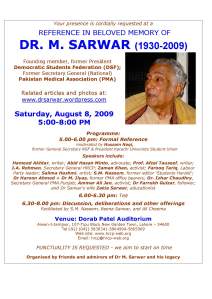
Final-Dr Sarwar reference-flyerYour presence is cordially requested at a
REFERENCE IN BELOVED MEMORY OF
DR. M. SARWAR (1930-2009)

Founding member, former President
Democratic Students Federation (DSF);
Former Secretary General (Central)
Pakistan Medical Association (PMA)

Related articles and photos at: www.drsarwar.wordpress.com

Saturday, August 8, 2009
5:00-8:00 PM
Programme:
5.00-6.00 pm: Formal Reference
moderated by Hussain Naqi, former General Secretary NSF & President Karachi University Student Union

Speakers:
Hameed Akhtar, writer; Abid Hasan Minto, advocate; Prof. Afzal Tauseef, writer;
I.A. Rehman, Secretary General HRCP; Zaman Khan, activist; Farooq Tariq, Labour Party leader; Salima Hashmi, artist; S.M. Naseem, former editor ‘Students Herald’;

Dr Haroon Ahmed + Dr M. Ilyas, former PMA office bearers; Dr. Izhar Chaudhry, Secretary General PMA Punjab; Ammar Ali Jan, activist; Dr Farrukh Gulzar, follower; and Dr Sarwar’s wife Zakia Sarwar, educationist

6.00-6.30 pm: Tea

6.30-8.00 pm: Discussion, deliberations and other offerings
Facilitated by S.M. Naseem, Beena Sarwar, and Ali Cheema
Venue: Dorab Patel Auditorium
Aiwan-I-Jamjoor, 107-Tipu Block New Garden Town, Lahore – 54600
Tel:(92) (042) 5838341-5864994-5865969

Web site: www.hrcp-web.org

Email: hrcp@hrcp-web.org

PUNCTUALITY IS REQUESTED – we aim to start on time
Organised by friends and admirers of Dr M. Sarwar and his legacy

For more information, please contact Dr M. Farrukh Gulzar 03004818390

Peace please, musically

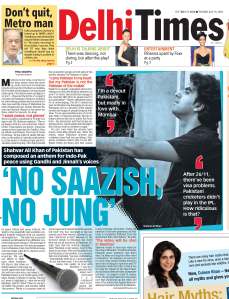
No Saazish No Jung - Times of India, July14-09-

No Saazish No Jung - Times of India, July14-09-

Shahvar Ali Khan: “No Saazish, No Jung”

In January I posted out information to my  yahoogroup about a joint signature campaign between Indians and Pakistanis, and also a note from a Lahori who loves Mumbai, Shahvar Ali Khan

(A Lahori’s love for Mumbai; Pk-India joint signature campaign – http://groups.yahoo.com/group/beena-issues/message/1028)com/

Recently, Shahvar wrote, composed and sang a song “No Saazish, No Jung” (no conspiracy, no war) – which you can download at – http://www.shahvaralikhan.com/

I’m thrilled that it’s getting some media attention even without a video. There was a piece in Instep, The News on Sunday, Pakistan on July 06, 2009, and this piece in Times of India, July 14, 2009 – ‘Now a song for Indo-Pak peace’ –
http://tinyurl.com/TOI-Shahvar

Below, text of the Press Trust of India report of July 7, 2009 published in Indian papers:

Pak singer puts Gandhi, Jinnah together in appeal for peace

Islamabad (PTI): A Pakistani singer has combined the voices of Mahatma Gandhi, Mohammad Ali Jinnah, Benazir Bhutto and US President Barack Obama in a new song that makes an impassioned plea for peace in the region.

Shahvaar Ali Khan’s “No Saazish, No Jung” is a peace anthem that tells “mullahs” and “foreigners” to leave his country alone.

Mullayae na kar tung, oo guraya na kar tung, meino rahen dae malang, mein nach nach kai larni yae jang de nal jang (Don’t bother me mullahs/Don’t bother me foreigners/Let me remain a free spirit/I will dance away and fight your war),” goes the song in Punjabi that combines a hard rock guitar riff with a folksy backing.

Khan, 25, said he plans to make a video based on the song. “I plan to shoot the video in Mumbai so that it will be an India-Pakistan peace initiative,” he said.

He is in touch with several Indian directors and is also looking for sponsors and TV channels to back the video so that it can be ready for release by the time Pakistan and India celebrate their independence days on August 14 and 15 respectively.

The song combines excerpts from speeches by Gandhi, Jinnah, Bhutto and Obama.

The voice of Gandhi can be heard intoning “…in the midst of death life persists, in the midst of untruth truth persists, in the midst of darkness light persists”.

Move on please, decisively

NOTE: Published in The Hindu op ed, July 14, 2009, as  ‘For the peace dividend’

http://www.hindu.com/2009/07/14/stories/2009071451040900.htm

A shorter, slightly edited version was first published in Dawn, July 13, 2009

http://www.dawn.com/wps/wcm/connect/dawn-content-library/dawn/news/pakistan/16-move-on-please-decisively-hs-07

Karachi, Aug 14, 2002: Citizens' peace demonstration at 'Quaid-e-Azam' M.A. Jinnah's Mazar - in the midst of testosterone-charged young men roaring about on motorcycles waving huge Pakistan flags. On learning what it was about, some of them joined the demo...

Karachi, Aug 14, 2003: Citizens' peace demonstration at 'Quaid-e-Azam' M.A. Jinnah's Mazar - in the midst of testosterone-charged young men roaring about on motorcycles waving huge Pakistan flags. On learning what it was about, some of them joined the demo.

Beena Sarwar

The forthcoming meetings of the Pakistani and Indian foreign secretaries and prime ministers on the sidelines of the Non-Aligned summit in Egypt on Jul 14 and 15, again raise hopes for a revival of the composite dialogue process, suspended since the Nov 26 2008 attacks in Mumbai. India accuses Pakistan of not doing enough to contain terrorism. Pakistan counter-accuses India of not cooperating in terms of sharing evidence and translations.

The Mumbai attacks came barely four days after President Asif Ali Zardari’s ground-breaking address to The Hindustan Times Leadership Summit via satellite link from Islamabad on Nov 22. Zardari, Pakistan’s first head of state to promise a “no-first nuclear-strike” policy against India, talked of a common South Asian economic bloc, even a passport-free ‘flexible Indo-Pak visa regime’.

It’s an all-too familiar pattern – goodwill gestures followed by incidents of violence that are used to set back the peace process (Bus yatra – Kargil; talks – Samjhota Express blast; peace overtures – Mumbai). Who benefits? Certainly not the ordinary people but the right wing, the security apparatuses, military establishments and arms lobbies on either side.

Those who critique the push for peace as an obsession of the ‘liberal elite’ and the ‘Punjabi lobby’ ignore sentiments at the grassroots level: while aware of the problems, people on both sides are keen to live as neighbours in peace. This is what surfaces during interactions with ‘ordinary people’ across the ethnic and economic divide as the Indian delegates found when they met with fishermen’s families, workers and community-based organisations in low income localities of Karachi, Hyderabad and Lahore.

At a seminar in Karachi recently to honour Nirmala Deshpande (‘Didi’), the peace activist who passed away in May 2008, most audience members were poor women from far flung localities, brought over by community based workers. Prominent writers, political leaders and activists who addressed the seminar included three Indian delegates (the visas of the other two were ‘pending for clearance’).

Mumtaz, a young Pushtun mother distracted by a six-year old and a suckling toddler, said that her husband was a daily wage earner who was at work that day. To be honest, she said she had hoped to get something out of the seminar like food (which was served at the end). She had completed eight grades of schooling (it showed in her bright eyes) and had attended one such event in the past. What did she think of the event? “I don’t understand everything they are saying, but I do understand that they want peace between India and Pakistan,” she replied, adding, “We should live in peace with our neighbours. Maybe then our lot will improve. We all want that.”

Jaipur-based Kavita Srivastava of India’s People’s Union for Civil Liberties (PUCL), had come with a concrete agenda: to get information about five Indian prisoners incarcerated in Pakistani prisons since 1991.

“Only two are in touch with their families, we don’t even know if the other three are alive,” she said. “When they heard that I got my visa, their families walked for a whole day to meet me. With tears in their eyes they begged me to bring any information I could.”

Kavita spent an evening in Ranchore Lines with Silawat women, Rajasthanis with families on both sides of the border. Shakeel Silawat of the Youth Progressive Council who helped organise the meeting, says such visits are important to increase contacts. “After all, we are one region. We should be able to meet”.

I remember an engineering student I interviewed in 1995 for the Indian magazine Outlook’s launch issue. He hated India’s Kashmir policy and wouldn’t wear Indian-made jeans – but believed that India and Pakistan should cooperate economically even while maintaining separate identities.

A student from Calcutta, who visited Lahore with the Nirmala Deshpande-led women’s peace bus in 2000 following the Kargil conflict, had no Partition baggage or ties to Pakistan. Yet she was overcome with emotion on arriving here. She befriended an engineering student who was volunteering with the group “out of curiosity” (having never met an Indian but hated India and Indians). He told me that, despite disagreeing with official policies “now at least we can talk about our disagreements.” Young Pakistanis and Indians wept as they said goodbye three days later.

I am reminded of these encounters by Ashutosh Varshney’s essay ‘Founding Myths’ (in ‘The Great Divide’, Harper Collins, 2009) in which he suggests that India-Pakistan rivalry be re-imagined “as a thoroughgoing competition, not as a do-or-die conflict”.

“A distinction needs to be drawn between two terms: adversaries and enemies. Adversaries can be respected, even admired; enemies are killed. India and Pakistan must cease to be enemies; they need to become adversaries competing vigorously to become better than the other.”

The stakes are high for both nuclear-armed neighbours riddled by internal insurgencies and ‘religious’ militancy, endemic poverty and high military budgets that directly and negatively impact development.

Zardari’s talk of a South Asian bloc and easing visa restrictions did not emerge from a vacuum – peace activists have been presenting such out-of-the-box ideas for years. The visiting Indians added more to the previous talk, like twinning press clubs and even dual nationality for Indians and Pakistanis (“believe me, many would take it,” asserted award-winning social activist Sandeep Pandey from Lucknow).

These ideas may be ahead of their time – but so then was the Pakistan-India Forum for Peace and Democracy notion first articulated in 1994 that Kashmir is not just a territorial dispute between Pakistan and India, but a matter of the lives and aspirations of the Kashmiri people, who must be included in any dialogue about their future. This formulation has now permeated political discourse.

When Sandeep Pandey and others participated in a peace march in 2005 from Delhi to Multan, villagers enthusiastically welcomed them along the way (though the urban-based media largely ignored this rural activity) and endorsed their  demands: One, resolve all problems through dialogue; two, de-weaponise and remove armies from the borders; three, end visa restrictions.

“One cyclist stopped and said, ‘Make the third demand your first. Once that happens, the rest will sort out’,” recalls Pandey.

The Indian delegates have now left with a renewed sense of the urgency Pakistanis feel about the need for peace with India. They also realise the need to go against the tide back home and push the Indian government to go beyond pressurising the Pakistani government to ‘take action’.

There may be no immediate results to any of these initiatives. But the fact that the governments allow them to take place itself speaks for the realisation of the need to at least maintain such contacts. And in the long run, they create a pressure for peace from below, something for the political and bureaucratic establishments to bear in mind when they next meet.