Remembering Anita Ghulam Ali

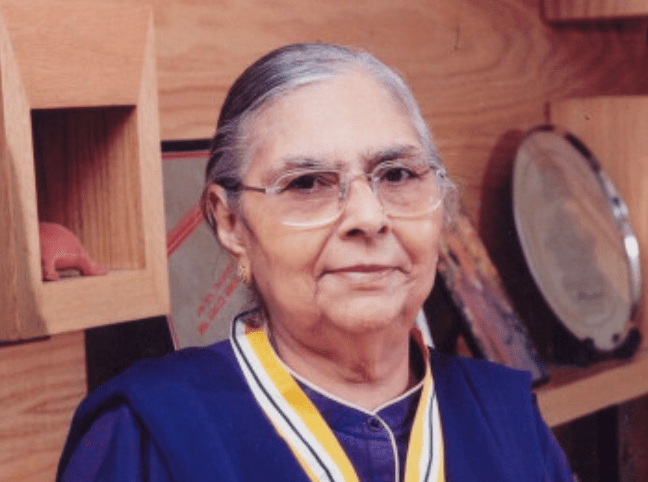
A trailblazer, Anita Ghulam Ali’s courage and biting wit will remain an inspiration. Photo: Courtesy Newsline magazine

Here’s the article I wrote on Anita Ghulam Ali for The News on Sunday: A legend passes on (Aug 17, 2014); also see Zubeida Dossal’s article about her, shared by Zubeida Mustafa. Here’s the link to her interview in Dawn, 2012.

She leaves a void that will be hard to fill, but her legacy will live on through the institutions she was associated with, and the people she mentored over the decades, particularly in the field of education. Although Anita Ghulam Ali had no children of her own, many of these individuals were as dear to her as if they were her own. She took a keen interest in their work and personal wellbeing, in the most non-interfering way, encouraging, questioning, supporting, and motivating. She would ask affectionately, with genuine concern, after their children and grandchildren, whom she’d seen grow from babies to “young ladies” or gentlemen, as she would put it.

It didn’t matter if you were a chaprasi or a CEO. With Anita Ghulam Ali, you could be assured of the same treatment, rooted in egalitarianism and respect for human dignity.

I can’t remember a time when she was not part of our lives. Heading the West Pakistan Teachers College Association (WPTCA), she had led the massive teachers’ strike in the late 1960s that my mother Zakia Sarwar participated in as a young lecturer at Sir Syed Girls College in Nazimabad, Karachi. They were demanding that private colleges, which had proliferated during the military regime of Ayub Khan, pay due wages to their teachers.

As many as 72 private colleges ungoverned by rules or regulations had cropped up in Karachi alone, compared to ten government colleges. The exploitative owners would make teachers sign for salaries listed as double of their actual pay, or make them perform menial tasks at their homes. Insults and harassment were common. The last straw was when anti-Ayub agitations closed down educational institutes for nearly five months, and private college owners stopped paying their teachers salaries. Some teachers resorted to operating pushcarts on the streets, vending clothes and other items to feed their families.

I visualise Anita Ghulam Ali as she must have been then, a short, stocky figure, hair pulled back severely from her broad forehead, intensely bright,
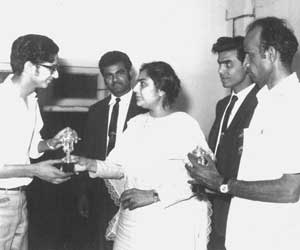
Distributing prizes at a debate competition at Islamia College
.Distributing prizes at a debate competition at Islamia College. File photo.

dark, slightly slanted eyes over wide, high cheekbones – the Slavic beauty inherited from her equally formidable and regal Georgian mother Shirin, a respected social worker.

The authorities, wanting the teachers to end their agitation, tried to get Anita’s father Justice Feroz Nana Ghulam Ali, to step in. A police officer went to tell him that his daughter was creating trouble and could be arrested.

“If she is breaking the law, by all means arrest her,” Justice Nana is reported to have replied calmly.

Anita Ghulam Ali remained true to her parents’ legacy, uncompromisingly honest and committed to humanitarian values all her life. A prominent leader in the field of education, she served as Sindh’s Education Minister in October 1996 and as a caretaker minister in November 1999. Some criticised her for having accepted a position under the military dictator Gen. Pervez Musharraf.

“I don’t care who appoints me, a dictator or a democrat. I just want to get the job done,” she told me.

A trailblazer in the field of education, leadership, and social activism, her courage, biting wit and will of steel, will remain an inspiration – not to mention her refusal to suffer fools. For over two decades she headed the pioneering Sindh Education Foundation, fending off corrupt ministers and bureaucrats who felt entitled to a share of the funds she raised. She would share stories of how she got the better of them, although there were setbacks too.

One minister had even eyed her paintings and ingratiatingly, but blatantly, asked her for them. She recalled the incident sardonically, relating how she had refused the man, telling him off in her own unique way – low-key, direct, firm, yet with a touch of irony and wry humour. She had nothing but contempt for such parasites, but she knew how to work with them, earning their respect, and getting what she needed.

Her pioneering adopt-a-school programme is now replicated in all provinces. A vocal opponent of child labour, she also initiated community-supported schools for underprivileged, working children in Karachi. These are places where working children can come in, be mentored, given education, get cleaned up, and receive medical care including vaccinations. As always, she had a pragmatic approach to the issue, recognising that these children work because they must, either as sole breadwinners for their families or to supplement the family income significantly.

A recklessly driven car crashed into her as she stood by the roadside many years ago, leaving her with long-term injuries that eventually confined her to a wheelchair. Additionally, she also suffered from debilitating arthritis. But Anita Ghulam Ali refused to let anything get in the way of her work. She obtained permission from her apartment authorities to get a small lift installed for her top-floor apartment. Later she courageously stood firm against the land developers who wanted to raze the building and build a multi-storey (illegal) structure there. Had it not been for her, the builders would have had their way long ago.

Anita Ghulam Ali received several awards, from the government – including the President’s Pride of Performance medal and the Sitara-e-Imtiaz – as well as from various private organisations. But the down-to-earth, unpretentious, totally unmaterialistic person that she was, for her, the real recognition came from the genuine love and respect she received from those whose lives she touched.

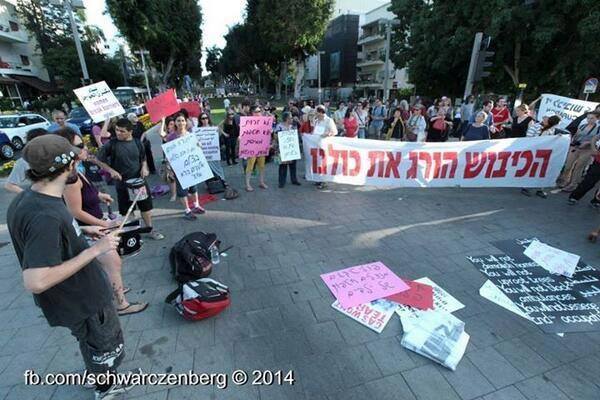
“The Occupation kills us all”: Israelis in Tel Aviv protest Netanyahu’s attack on Gaza

Banner: “The Occupation Kills us All”. Israelis protesting in Tel Aviv against Netanyahu’s assault on Gaza (Thanks Farrukh Abbas for the share). Photo: Haim Schwarczenberg, Israeli photographer living in Jaffa, taking part in the Palestinian struggle against the Israeli occupation and oppression https://www.facebook.com/schwarczenberg

I’m sharing below a slightly edited Facebook comment by Syed Farrukh Abbas, a blogger and a student of media studies, based in Pakistan, that he posted with the photo above. Farrukh is also one of the administrators of the Laal Facebook page, which is where I know him from. To his words below, I just want to add: Respect and salute to, and solidarity with, all those in Israel who stand up and protest Israeli atrocities – including all those I know personally who’ve been doing this consistently for years, termed ‘traitor’ and ‘agent’ by the Israeli right-wing (sound familiar, anyone?). Here’s Farrukh’s note: Continue reading →

Hamid Ansari: Mumbai man missing in Pakistan (we treat each other’s citizens differently)

Hamid Ansari, 27, MBA, Rotarian from Mumbai... missing since Nov 2012

Hamid Ansari, 27, MBA, Rotarian from Mumbai… missing since Nov 2012

My article on the case of the Indian national Hamid Ansari who has ‘disappeared’ in Pakistan, published in The News, July 11, 2014; an abbreviated version in Hardnews, India. See Hamid’s mother’s online petition appealing to the governments of India and Pakistan to find her son and my friend Indian journalist Shivam Vij’s earlier articles on this case, in The Friday Times, and in the Christian Science Monitor

On July 1, the Peshawar High Court directed Pakistan’s defence and interior ministries to provide full information about an Indian national, Hamid Ansari, who disappeared from the mountainous Kohat district in late 2012. There is room here for cautious optimism on several fronts. Continue reading →

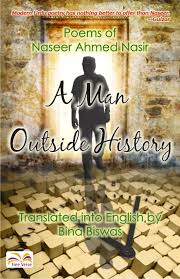
“I lay his poems on my lips and sip at leisure” – Gulzar on Naseer Ahmed Nasir

2014- Man Outside HistoryMy piece for the weekly Aman ki Asha page on July 9 and on the TOI blog

The iconic lyricist and poet Gulzar in his preface to Dr Bina Biswas’ translation of a collection of Urdu poetry pays rich tribute to Pakistani poet Naseer Ahmed Nasir

———

“A Man Outside History“
Poems of Naseer Ahmed Nasir
Translated into English by Bina Biswas
Foreword by Gulzar
Free Verse, an imprint of LiFi Publications,
New Delhi, 2014; Pp 173; INR 300
(available in Pakistan with Messers Al Abbas International, Rana Chamber, 2-Dil Muhammad Road, Lahore)

————-

Continue reading →

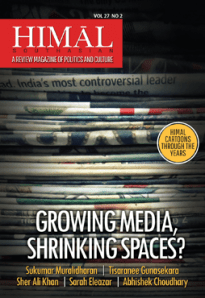
Pakistan’s media wars – my article for Himal Southasian

Himal-Growing media, shrinking spaces?Himal Southasian, a publication I’m proud to have been associated with since its inception in 1996, has a new issue on the media. My piece Pakistan’s media wars (below) and Mass media and the Modi ‘wave’ by Paranjoy Guha Thakurta are web exclusives. Two additional points to my article:  1. Corporate media owners in Pakistan have always been part of reactionary and anti-democratic forces in general. Their disputes with censoring governments have almost always had commercial motivations. 2. Journalists have played a positive role whenever they remained united in their professionalism. They compromise this unity when they allow journalistic standards to slip and try to become power brokers themselves.

By Beena Sarwar

4 July 2014

What is the political fallout of the battle between a media behemoth and Pakistan’s largest security agency?
Continue reading →

The North Waziristan military operation and appeal to help internal refugees

IDPs Bannu. Courtesy: Dawn

IDPs Bannu. Courtesy: Dawn

While supporting the much delayed military operation against the militants, we need to also support the democratic political process and strengthening accountability and the rule of law in Pakistan. See ‘Recapturing North Waziristan: A tragic necessity‘ – interview of Pervez Hoodbhoy in Viewpointonline. Meanwhile, the fighting is taking a toll on the people of North Waziristan, thousands of whom have fled the fighting and are now refugees in their own land – internally displaced people or IDPs in development jargon.

Here are links to three moving articles on the issue that highlight the humanitarian aspect and suffering, by Rashida Dohad, Owais Tohid and Taha Siddiqui. Rashida and Taha also make the point that militant organisations are reaping dividends in terms of goodwill “while the state fidgets or forsakes”; credible organisations are made to obtain non-objection certificates while religious and extremist organisations are allowed “to operate freely”. Continue reading →

Tricks of the Dirty Tricks Brigade

Belatedly updating my blog with the article I wrote for The News on Sunday, June 15, 2014, as part of a Special Report on conspiracy theories. Other reports in that issue were Dr M. Taqi’s The truth behind conspiracy theories in Pakistan, an interview of Nadeem Farooq Paracha and more.  Lots has happened since then, but this remains relevant.

Tricks of the Dirty Tricks Brigade

Graphic: TNS

If India and Pakistan develop a good relationship, how will the security establishment justify its existence? Continue reading →

Pakistan/India: There is no honour in killing… End the culture of impunity

HK-Iqbal - Farzana pic

Iqbal holds up a picture of his wife, Farzana Parveen, killed outside the Lahore High Court. Photo: Aamir Qureshi/AFP/Getty Images

On the murder of Farzana Parveen in Pakistan and the two Dalit girls in India – something I wrote last week, published in The News and in The Times of India blog

There is no honour in killing

End the culture of impunity

Beena Sarwar

Last Tuesday, May 27, two crimes that shocked the world took place, one in the morning in Lahore, Pakistan and the other at night in Uttar Pradesh, India. Three young women – two of them just girls, really, were killed in these incidents. A fourth casualty was the unborn child of the five months pregnant woman in Pakistan. Continue reading →

Censored! Pakistan blocks progressive Facebook pages

PTA censor BhensaGot the word a few hours ago. Without any notice, warning or explanation, Pakistan Telecommunications Authority (PTA) has blocked several progressive pages on Facebook. Interestingly, there is no bar on the pages spewing hatred and furthering the ideology of banned groups.

The blocked pages include Laal, the largest leftist page in South Asia with over 408,000 followers. The other pages include those that post largely in Urdu and therefore reach large numbers, like: Continue reading →

Masood Hasan: A man who represented all that is good and decent

Masood HasanGrieved to have had to write this. Published in The News today.

Columnist, humourist, cricket and jazz buff, advertising doyen and connoisseur of the finer things in life Masood Hasan, 72, passed away in his beloved Lahore on Sunday, June 1.

Sunday was the day of his popular column ‘Over the Top’ in the op-ed page of The News, where it has been published since the launch of weekly The News on Sunday (originally The News on Friday) in 1994. Continue reading →