Happy V-Day all. Remembering the schoolchildren in Khairpur, Sindh, who presented my mother with Valentine’s Day cards many years ago. And this piece I wrote in 2009 about a cheeky initiative – Peaceful Pink Panties to Tame Rightwing Goons, published by InterPress Service, a global syndicated service based in Rome, for which I was the principle correspondent in Pakistan for several years. Posting to this website for the first time for the record, though I had linked it to an earlier post about ‘vigil-aunties’ No to vigil-aunties: thousands protest media’s moral policing in Pakistan (Jan. 2012)
Image from thepinkchaddicampaign.blogspot.com, a cheeky initiative (no pun intended) by a spunky young woman in India, 2009. Can’t imagine this being done today.Continue reading →
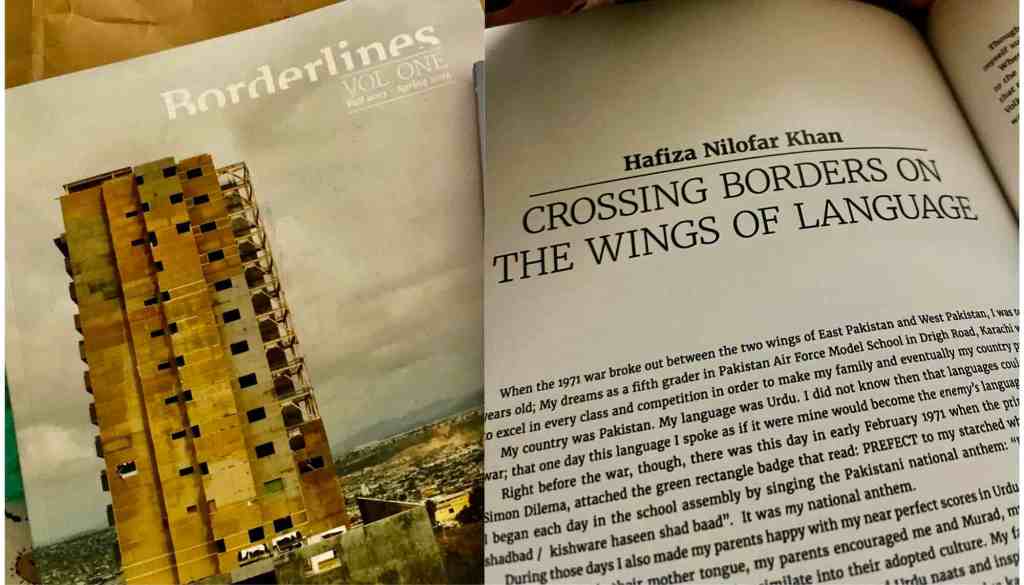
It was only as an adult long after 1971 that I learnt about the internment camps where Bengalis in then West Pakistan had been detained. My source was an essay titled ‘Crossing Borders on the Wings of Language’, by Hafiza Nilofar Khan, in Borderlines, Vol. 1 (2014), an anthology published by Voices Breaking Boundaries, my sister Sehba Sarwar’s nonprofit in Houston (now archived at the University of Houston).
The ten-year-old Hafiza whose father is in the Pakistan Air Force and proud of her prowess in Urdu suddenly finds herself and her family in the situation that Lahore-based historian Ilyas Chatta details in his recently published book Citizens to Traitors: Bengali Internment in Pakistan 1971-1974 (Cambridge University Press, 2025).
“TO BE HOPEFUL in bad times is not just foolishly romantic. It is based on the fact that human history is a history not only of cruelty, but also of compassion, sacrifice, courage, and kindness. What we choose to emphasize in this complex history will determine our lives. If we see only the worst, it destroys our capacity to do something. If we remember those times and places — and there are so many — where people have behaved magnificently, this gives us the energy to act, and at least the possibility of sending this spinning top of a world in a different direction. And if we do act, in however small a way, we don’t have to wait for some grand utopian future. The future is an infinite succession of presents, and to live now as we think human beings should live, in defiance of all that is bad around us, is itself a marvelous victory.” ― Howard Zinn
This quote at the end of an email from the great broadcaster David Barsamian of Alternative Radio is from Howard Zinn’s collection of essays published in, ‘A Power Governments Cannot Suppress’(City Lights Books, 2007) and also published on ZNet as “The Optimism of Uncertainty.”.
Thought to share here. Salute, Howard Zinn. Salute, David ji. And revisiting my precious meeting with Howard Zinn in Cambridge MA some years ago, thanks to the wonderful filmmaker B.J. Bullert in Seattle WA.
COMMUNITY INVITE: If you are in the Boston area, you are invited to a screening of my documentary film ‘Democracy in Debt: Sri Lanka Beyond the Headlines’ (25 min), followed by a discussion, at the Cambridge Public Library on Sunday 24 November, 2-4 pm. If you are not here or unable to join, please tell people you know who might like to:
‘Democracy in Debt: Sri Lanka Beyond the Headlines’ A film by Beena Sarwar Sunday 24 November, 2-4 pm At Cambridge Public Library.
Trailer: ‘Democracy in Debt: Sri Lanka Beyond the Headlines’
The film will be followed by a discussion moderated by Pratyush Bharati of the Boston South Asian Coalition. Discussants include Bangladesh origin activist Hayat Imam of the Massachusetts Peace Action, Sri Lankan human rights lawyer Thyagi Ruwapathirana, a fellow at the Harvard Law School, and the filmmaker Beena Sarwar, a journalist and peace activist from Pakistan.
Those wishing to watch the film through the Global Community Screenings series are welcome to participate by filling in the form at this link.
Support non-profit journalism. Help Sapan News meet its NewsMatch challenge and raise $15,000 by year end. All donations to Sapan News are tax-deductible.
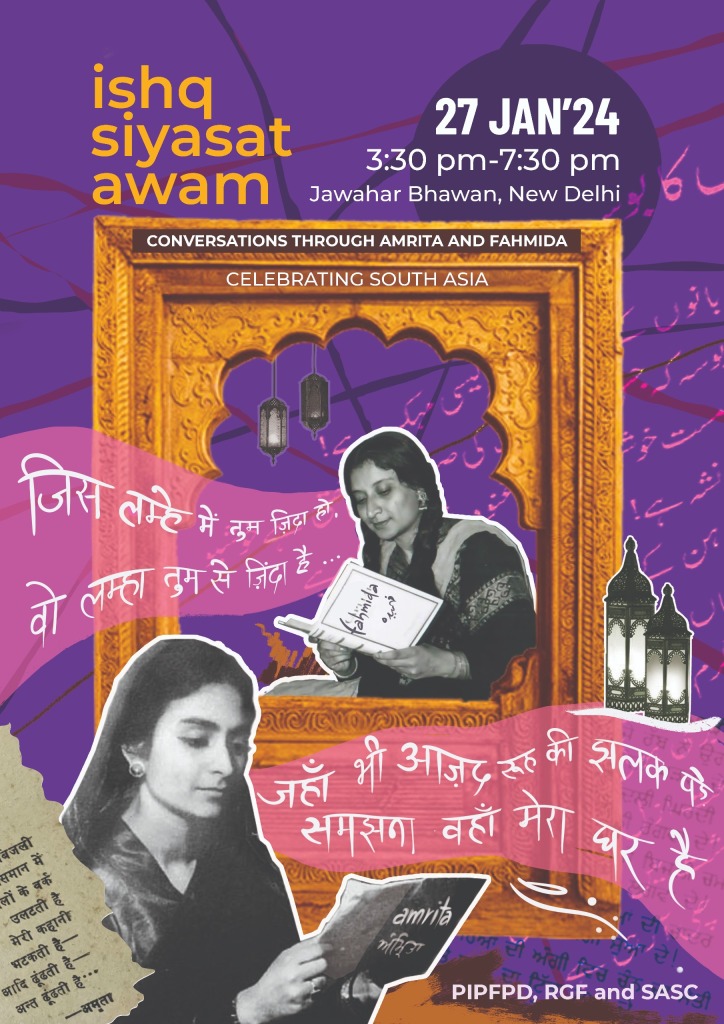
Radical love, epitomised by the late Amrita Pritam and Fahmida Riaz is ‘one of the seeds of the revolutionary thought process’, to quote the Pakistan India People’s Forum for Peace and Democracy (PIPFPD) stalwarts who organised the event – Vijayan MJ, Tapan Bose, and Dr Syeda Hameed. Their consistent work over the decades for peace and justice is truly inspirational, and I feel privileged to know them personally.
I was also privileged to know one of the late poets personally, Fahmida ‘Khala’ (aunt) to me, who was close to my father Dr. M. Sarwar. He led the Democratic Students Federation (DSF), Pakistan’s first student movement while at Dow Medical College in Karachi, 1949-54.
I’ve uploaded archives about the movement here: drsarwar.wordpress.com. Principles of that struggle continue to show the way, like the importance of coming together across divides for a minimum common agenda. For DSF, it was student rights. For Sapan, it’s Southasia Peace. We need it now, for the sake of the people of the region, and beyond.
The Videos section of the Dr Sarwar blog includes a playlist of video clipsfrom the event held at the Karachi Arts Council in January 2010 to commemorate DSF and the student movement, a few months after my father passed on.
Compered by the actor Rahat Kazmi, the event featured speeches from young activists, students, and academics like Amar Sindhu, Alia Amirali,Ali Cheema, and Varda Nisar, as well as veterans like I.A. Rehman, besides the singer Tina Sani, Taimur Rahman and his band Laal, and Fahmida Riaz.
Fahmida Khala recited her poem ‘Palwashey Muskurao’ (Palvasha, smile), dedicated to daughter of late Afzal Bangash of the Mazdoor Kissan Party (Workers’ and Peasants’ Party), and the followers of other late leftist leaders. They may no longer be on this earth, but their principles and aspirations for human rights and dignity continue to show the way.
A message from the journalist Amitabh Pal about a mutual friend, David Barsamian of Alternative Radio in Colorado reminded me of this piece originally published in The News on Sunday, 8 Oct. 2006, about an event with Noam Chomsky where I first met David. The article is still all-too relevant, but the link no longer works so I’m sharing the piece here without any changes; just added some hyperlinks and photos.
Essential reading – and doing: Eqbal Ahmad
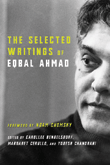
Book launch: The Selected Writings of Eqbal Ahmad, Cambridge, September 28, 2006.
Beena Sarwar
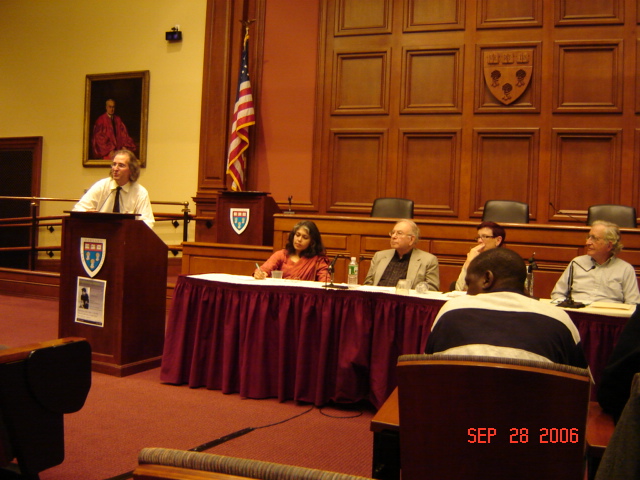
John Trumbour addressing the event. Panel: Beena Sarwar, Stuart Schaar, Margaret Cerullo, Noam Chomsky. Photo: Courtesy MAPA.
When Venezuelan president Hugo Chavez in his address to the UN on Sept 20, held up a copy of Noam Chomsky’s Hegemony or Survival: America’s Quest for Global Dominance (2003) and recommended it as essential reading to understand contemporary world politics, he could have been talking about The Selected Writings of Eqbal Ahmad, for which Chomsky, Eqbal’s long-time friend, wrote the foreword. Chavez identified “the hegemonic pretension of the North American imperialism” as “the greatest threat on this planet” to the survival of the human race.
The book that Jack launched (at HLS)
Chomsky also gave the main address for this collection of Eqbal Ahmad’s writings (Columbia University Press, 2006) at the book’s launch in Cambridge, USA, on September 28. John Trumpbour and Emran Qureshi of the Labor & Worklife Program at the Harvard Law School, who organised the event, didn’t publicise the event too aggressively because of the hype Chavez had generated for Chomsky.
The hall did get quite full, but they didn’t have to turn anyone away at the door. The venue may have had something to do with this. Chomsky, a linguistics professor now retired from the neighbouring MIT, is rarely invited to Harvard. Harvard Law School professor Alan Dershowtiz criticises Chomsky for being too “black and white” but often has to concede the basic truth of the points Chomsky makes.
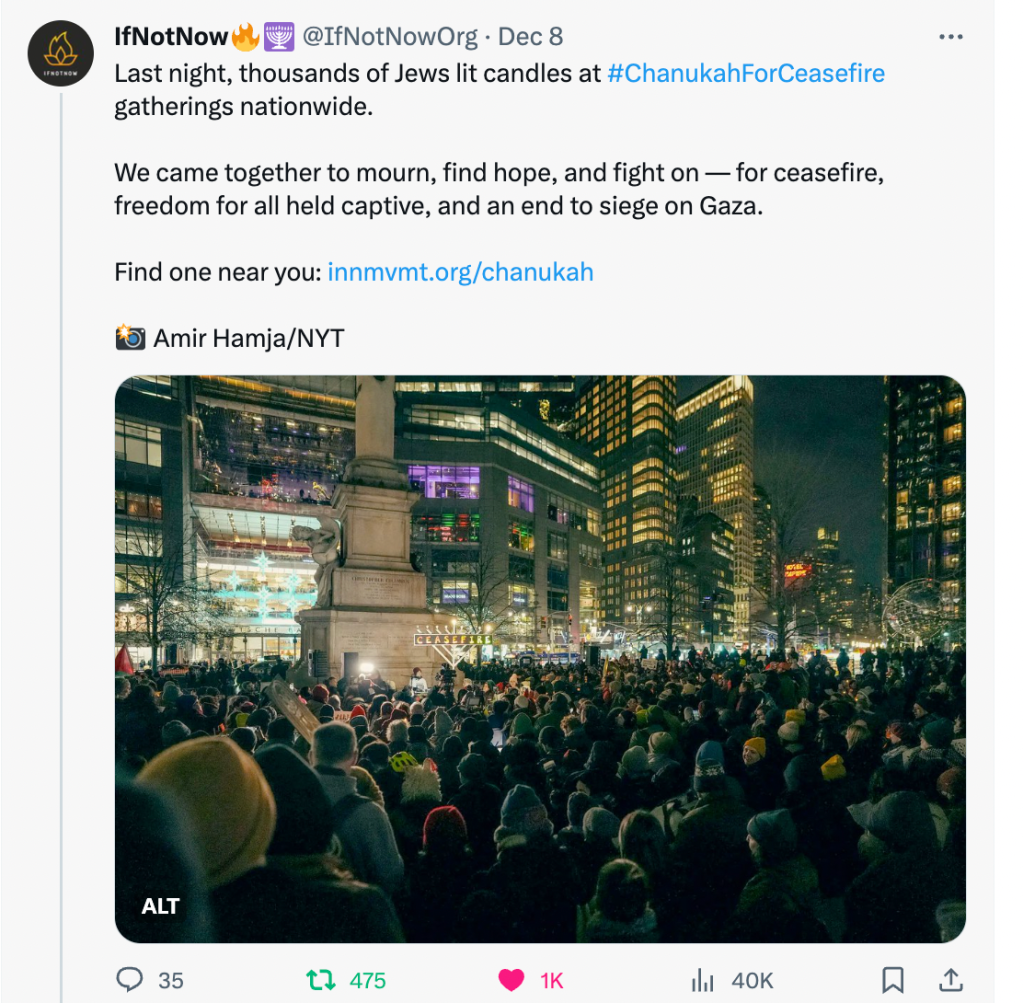
Greetings to those observing Hanukah and salute to those participating in #ChanukahForCeasefire demonstrations around the United States. Thousands of Jews have been lighting candles at #ChanukahForCeasefire gatherings, coming together “to mourn, find hope, and fight on — for ceasefire, freedom for all held captive, and an end to siege on Gaza,” says IfNotNow, a movement of American Jews “organizing for equality, justice, and a thriving future for all: our neighbors, ourselves, Palestinians, and Israelis.” To find one near you, go to: https://innmvmt.org/chanukah.
Such actions, and those of thousands including high school students marching around the world to call for #ceasefirenow, provide hope in a world that feels heavy. It is unbearable to think of the thousands killed, maimed and displaced in conflict areas, especially children.
Public opinion worldwide is clearly for #CeasefireNow, calls being ignored by those who could stop the bombing that continues to claim lives. What can we do? Hold on to ourselves and do what we can, where we can, when we can. Inform ourselves, share information – double-check before sharing so we don’t pass on #fakenews — donate to causes, participate in public actions.
I woke up on Wednesday morning wondering if people would take time out to be still for 10-15 min on the same day, to collectively visualise peace, to engage in prayer, meditation, or just breathe and be calm in the midst of strife and violence. And maybe that stillness, if echoed by around the world on the same day will have an effect.
This developed into the global virtual vigil by Southasia Peace Action Network, or Sapan, taking place this Sunday across different time zones. We asked people to spare 10 minutes to #be4peace, in their own way, anytime between 10am-12 noon in their own time zones.
Old friend and fellow peacemonger Mazher Hussain in Hyderabad, India, who runs the Confederation of Voluntary Associations, India, activated his contacts. Interfaith scholar and activist Urmi Chanda in Mumbai made a visual, tweaked by another volunteer, Srinivas at COVA.
#be4peace image by Urmi Chanda: The watermelon as a symbol of resistance.
By Saturday night, over 40 organisations had endorsed the call, along with dozens of peacemongers around the world, from Australia to the U.S. west coast. We even got pledges from Tel Aviv, France, and Croatia. See list of public endorsements at the Sapan website.
On another note, I am thrilled that the latest Sapan News features includes a piece by Rumi Nagpal, a high school student in Colombo on learnings from an uprising and his late grandmother who was a theatre artist. And Rajeev Soneja in Boston shares his take on India-Pakistan cricket drawing from a great archive of cricket books, with some historic photos shared by my old friend, news photographer Rahat Ali Dar in Lahore.
Lastly, sharing below a compilation of what I’ve been reading and watching, in no particular order.
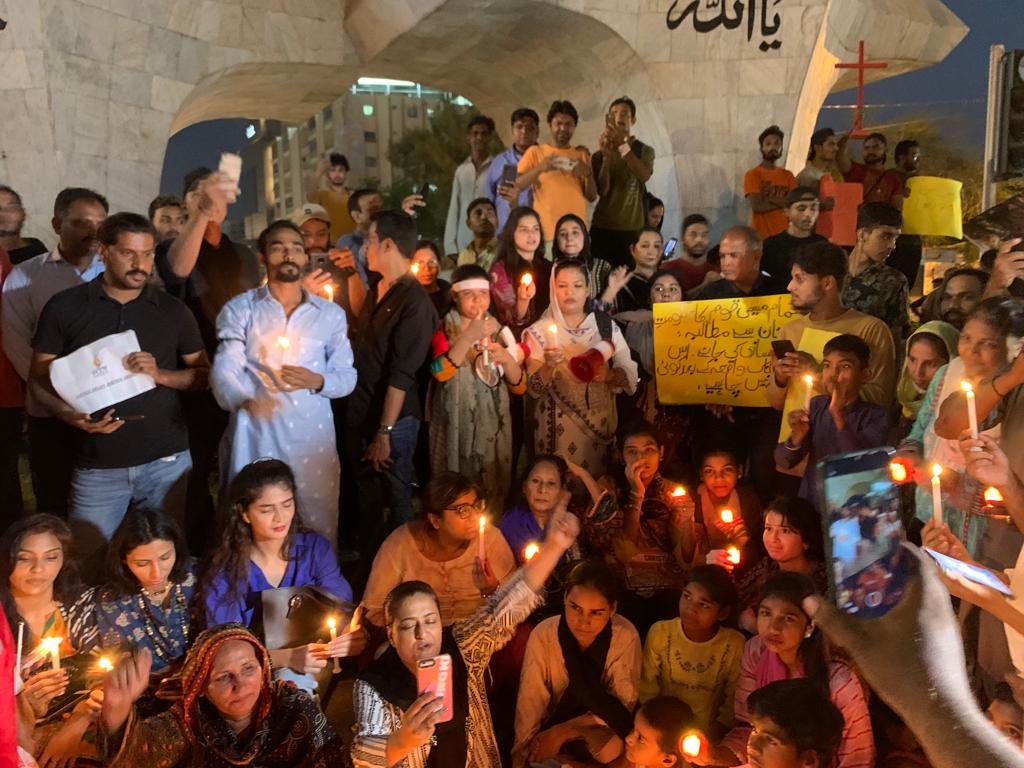
The attacks on the Christian community in Jaranwala near Faisalabad (former Lyallpur) are among a long string of such violence instigated by extremist elements seeking power in the name of religion in Pakistan. I co-wrote this article for Sapan News with a young reporter in Karachi who was initially only reporting on Pakistan’s first Minority Rights March. Then Jaranwala happened. We now present a longish read putting the violence in context and tracking the trajectory of a turning point in the state’s responses, with a couple of inputs from India
Karachi protest at Teen Talwar, 19 August 2023. Photo: Abdullah Zahid
Karachi protest at Teen Talwar, 19 August 2023. Photo: Abdullah Zahid
“Manzoor Masih – will be remembered!… The Christians of Shanti Nagar – will be remembered!… Rimsha Masih – will be remembered!… ”
Activist and dancer Sheema Kermani led the chanting, evoking the names of a long list of Pakistani Christian individuals and communities targeted by extremist elements in the name of religion over the years.
TODAY, 11 am ET/8 pm Pakistan timeSapan will host a writing workshop with my old friend Mohsin Tejani from Karachi, and his friend Lee Krishnan from Mumbai. They met 25 years ago at the Andover Breadloaf Writing Academy where they are both trainers. Since they’re here again, they offered to do this workshop in person. People can also join online with children, parents, grandparents, significant others, friends or on their own. Details here:Writing Together, Across Borders.








 Journeys to democracy