Remembering Kuldip Nayar, journalist, activist, peacemonger

Kuldip, Nandita, Asma J

A precious photo: Kuldip Nayar, Nandita Das and Asma Jahangir at Wagah border. Photo: courtesy Seema Mustafa, The Citizen

I was sad to hear about the passing away of veteran journalist and peacemonger Kuldip Nayar, 95, in Delhi. His passing in general evoked great sadness — as well as a resolve to keep working for his values — not only in India but the land of his birth, Pakistan. I had got to know Kuldip ji over the years through the Pakistan India People’s Forum for Peace and Democracy (PIPFPD) that I joined as a young journalist from Lahore when it was launched in 1994-95, as the largest people-to-people organization between the two countries. The last time I met him was at Allahabad train station a few years ago. The lawyer S.M.A. Kazmi and our family friend Zia ul Haq — the comrade, not the general, himself now over 90 were dropping me off and picking him up. He got the surprise of his life. We didn’t have much time to chat as my train was about to leave but I treasure that memory.

Sharing here the two pieces I put together for Aman Ki Asha (hope for peace), the India-Pakistan website I edit. One is pegged on a tribute from Dr Syeda Hameed in Delhi his long-time friend and fellow-activist, former member of the Planning Commission of India and founder trustee of the Women’s Initiative for Peace in South Asia (WIPSA) and the Centre for Dialogue and Reconciliation. She aptly termed him the “gentle giant of India Pakistan peace” in her wonderful piece in The Citizen. See also her account of the Aman Dost Yatra (peace and friendship march) at the border. In the other piece, I put together other tributes paid to him by Pakistanis.

Here are links to both pieces: Remembering the ‘gentle giant of India Pakistan peace’,  and Pakistanis pay tribute to Indian journalist Kuldip Nayar.

SyedaH-KuldipN

(L-R) Dr Syeda Hameed, Navaid Hamid, Kuldip Nayar, Maulana Syed Jalauddin Umari. File photo – Indiatomorrow.ne.

Noam Chomsky, Arundhati Roy among writers, artists urging Bangladesh #FreeShahidul

FreeShahidul

Academics, writers, artists and journalists around the world , including Noam Chomsky, Pulitzer Prize winning photojournalist Patrick Farrell, celebrated writers Arundhati Roy and Bapsi Sidhwa, artist and daughter of poet Faiz Ahmed Faiz Salima Hashmi, historian Ayesha Jalal, Urvashi Butalia, and others from Harvard to UC San Diego, have urged the Bangladesh government to free the detained photojournalist Shahidul Alam, picked up on 5 August — see statement and endorsements below. See also eminent photographer Raghu Rai’s powerful open letter to Prime Minister Sheikh Hasina. and the Change.org petition urging Dhaka police to drop charges and release him.

Shahidul Alam’s detention underlines the growing crackdown on dissenting voices in Bangladesh, in a pattern that is visible elsewhere too. The court denied him bail and gave the  police a seven-day remand. This was subsequently reduced and the court ordered that Shahidul be sent to a hospital and given an immediate medical exam and treatment. However, at the time of writing (Aug 7), he is still at the Detective Branch and has not been moved to hospital. (UPDATE Aug 8: He was moved to hospital amid tight security and a few medical tests conducted. His family was allowed to visit him before he was taken back to the DB Special Branch centre).
Continue reading

Targeting of Marvi Sirmed latest in attacks on human rights activists, journalists, in Pakistan

Marvi Sirmed ransack-2018

Journalist couple Marvi and Sirmed Manzoor’s house ransacked: Humiliating violation of privacy besides theft of laptops, cell phone, passport. Online photo

Journalists in Pakistan are under increasing pressure, besides severe, ongoing censorship. The break in to columnist and activist Marvi Sirmed’s house and its ransacking is the latest in the series of intimidation, threats and violence to those who uphold democratic values and are critical of the security establishment.

Continue reading

Pakistani journalists protest growing censorship

This slideshow requires JavaScript.

Over 100 Pakistani journalists, editors, columnists, media persons from across the media landscape in the country have endorsed this statement since it was initiated on 19 April, protesting against the ongoing curbs on freedom of expression in the country. It follows on the heels of a statement signed by prominent academics including Noam Chomsky. Besides the stifling of debate at university campuses, articles are being pulled off media websites in Pakistan like Babar Sattar’s oped (published in this blog) as well as three other pieces in The News on Sunday this past weekend. Others were not published to begin with, like Mobashir Zaidi’s oped in The News, and Gul Bukhari’s article on 16 April that The Nation didn’t run (published in Naya Daur). Statement and list below.

Continue reading

Nonfiction: Integrity above all

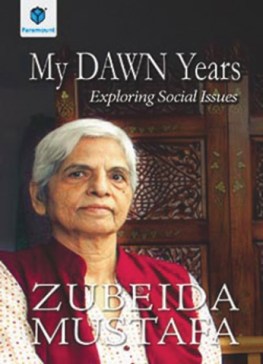
Zubeida Mustafa book cover

My book review of Zubeida Mustafa’s memoirs, published in Dawn, Books & Authors, 4 February, 2018

My Dawn Years: Exploring Social Issues
By Zubeida Mustafa
Paramount, Karachi
ISBN: 978-9696374046; 240pp.

When a pioneering journalist pens her memoirs, you pay attention. Especially when she is Zubeida Mustafa of Pakistan, a long-time feminist and champion of social causes who, from her editorial perch at the daily Dawn, witnessed momentous transitions in the country’s media and political landscapes for over three decades. Beyond being a witness to change, she has also, as she realises with a thrill, “been a part of it, at times driving it and at times being driven by it.”

Continue reading

Raza Khan, still missing. Why does it matter?

BringBackRaza3Raza Khan’s disappearance, like that of Zeenat Shehzadi earlier, is part of a new phase of such illegal abductions in Pakistan, violating due process and rule of law. Targeting young people from ordinary backgrounds, without social capital or networks, signals the miltablishment’s growing desperation to control the narrative on the military, religion and India, I argue in this opinion piece for the Washington PostIn Pakistan, promoting peace with India can be bad for your health — and freedom (Dec. 22, 2017; updated text below). Since then, a journalist covering this issue narrowly escaped an abduction attempt in Islamabad, and another journalist was picked up and beaten in Karachi, then released. 
Continue reading

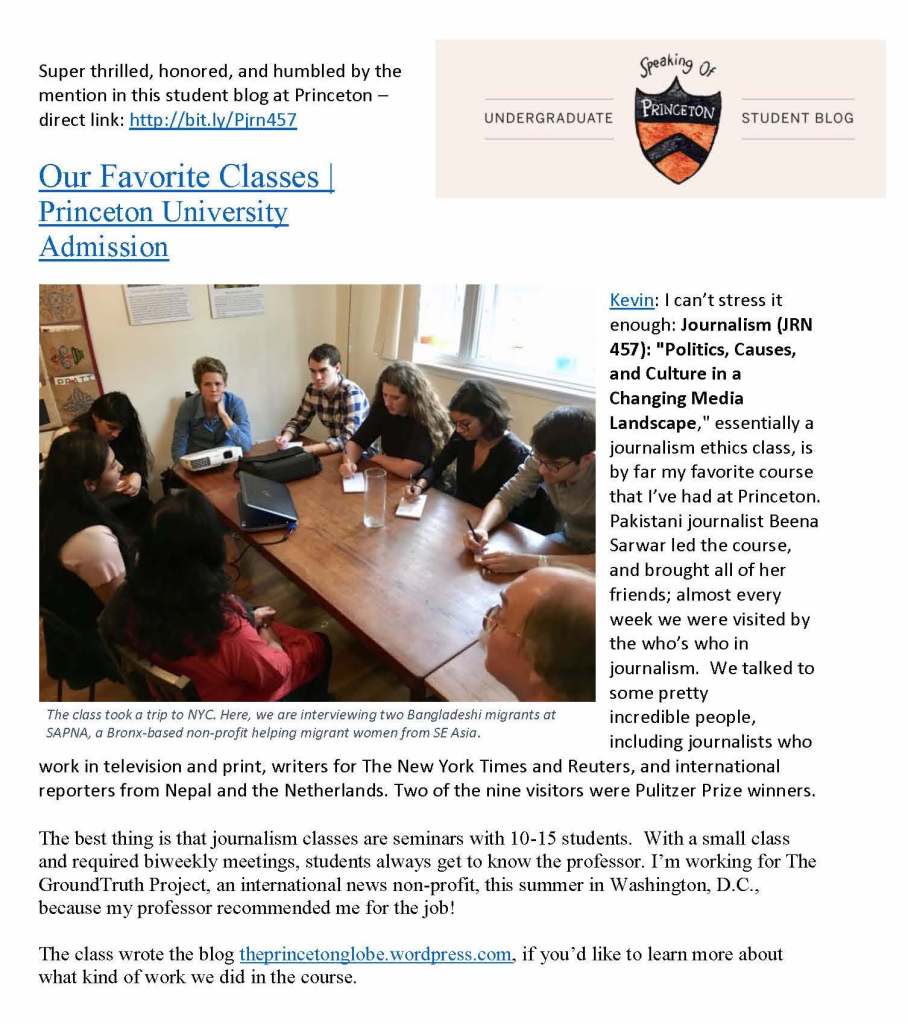
My Princeton journalism class “favorited”

From the Princeton student blog

Thrilled and touched to see my class listed among a student’s favorite classes at Princeton, where I was a visiting professor of journalism last fall. Here’s the text: 

Kevin: I can’t stress it enough: Journalism (JRN 457): “Politics, Causes, and Culture in a Changing Media Landscape,” essentially a journalism ethics class, is by far my favorite course that I’ve had at Princeton. Pakistani journalist Beena Sarwar led the course, and brought all of her friends; almost every week we were visited by the who’s who in journalism.  We talked to some pretty incredible people, including journalists who work in television and print, writers for The New York Times and Reuters, and international reporters from Nepal and the Netherlands. Two of the nine visitors were Pulitzer Prize winners. 

The best thing is that journalism classes are seminars with 10-15 students.  With a small class and required biweekly meetings, students always get to know the professor. I’m working for The GroundTruth Project, an international news non-profit, this summer in Washington, D.C., because my professor recommended me for the job!

The class wrote the blog theprincetonglobe.wordpress.com, if you’d like to learn more about what kind of work we did in the course. 

Thank you Kevin, it was a pleasure and honor being your teacher 🙂