Off-Kendrik started over 16 years ago, “committed to building a broad platform for South Asian theatre groups and the next generation of South Asian Americans through theatre and storytelling”.
PERSONAL POLITICAL By Beena Sarwar
I went to see ‘Madho’ last night with my mother at the Third South Asia Theatre festival, SAATh 2024, in the Boston area. A musical play set in Lahore, it is written and directed by Sarbpreet Singh, an engineer by profession whose passion is music and storytelling.
I meant to share this when it was first published on Sapan News recently, my article co-authored with Dr Serena Hussain and Vishal Sharma, but was caught up with the Colombo screening of my Sri Lanka documentary. Thought I’d post now – the piece is still relevant especially given a recent article in an influential foreign policy magazine debunking the idea of Southasia
Images from various SAARC summits sourced from copyright-free photos. Collage by Pragayan Srivastava
Why the regimes ushered in through the democratic political process need to collaborate for a better future for the peoples of the region
By Dr Serena Hussain, Vishal Sharma and Beena Sarwar
The recent elections in Britain, France, and India are a reminder of the power of the people – and also of the importance of regional cooperation.
Pakistani PM Benazir Bhutto with her Indian counterpart Rajiv Gandhi at 1988 SAARC Summit in Islamabad. Source: Dawn
The Indian elections were the third electoral exercise in South Asia this year, after Bangladesh in January and Pakistan in February. Sri Lanka is also required to hold presidential elections before October.
As part of the democratic political process, elections determine the leadership that will shape not only a nation’s destiny, but also in closely connected regions.
The governments may choose to be isolationist, or follow the will of foreign powers, or cooperate and collaborate with neighbouring nations. Can and will South Asia’s regimes cooperate to promote regional peace, prosperity and progress as they have done in previous decades such as, during the 1950s, 1980s, and 2000s?
Such collaboration is essential for the sake of the peoples of the region.
Guest post: A personal tribute to Karamat Ali (19 August 1945 – 20 June 2024) by Mandira Nayar in Delhi, for Sapan News
Karamat Ali was many things but for Mandira Nayar he was always the person who returned her grandfather Kuldip Nayar to Lahore, where he was born and which he considered home. The relationship between them defies labels but it has a bond that is deep and unbreakable, stronger than many relationships with names, she writes:
There are many words for friendship. Arabic has twelve. You can choose from friendships of different shades — the intense saqeeb, a true friend; sameer, someone who you like to have a conversation with, or the casual zameel, an acquaintance.
Announcement from Pakistan India People’s Forum for Peace and Democracy for an online memorial
Memorial meeting at Arts Council of Pakistan, Karachi, for Karamat Ali
Comrades at the Human Rights Commission of Pakistan in Lahore remember Karamat Ali
English has just the one — a bland ‘friend’. The short dost (friend) in Hindustani encompasses in its tiny frame a sort of bro-code for the intense relationship that Hindi film songs refer to, between Maana Dey’s ‘Yaari hai Imaan’ (My friend is my faith) to Sholay’s anthem ‘Yeh Dosti Hum Nahi toRe.nge‘ (This friendship we will never abandon).
‘Dost’
So I struggle to find a word to describe the relationship between Karamat Ali, labour leader, peace activist, revolutionary, lover of music, and my grandfather Kuldip Nayar, journalist, peace-activist and fellow dreamer. And by extension, my relationship with Karamat Sahib.
This relationship without a name has a bond that is deep and unbreakable, stronger than many relationships with names.
Karamat Ali was many things but for me he was always the person who returned my grandfather to the home he was born in.
As news of Noam Chomsky’s failing health makes the rounds, I share some learnings from my interactions with a trailblazing public intellectual whose moral compass has impacted the world
PERSONAL POLITICAL By Beena Sarwar
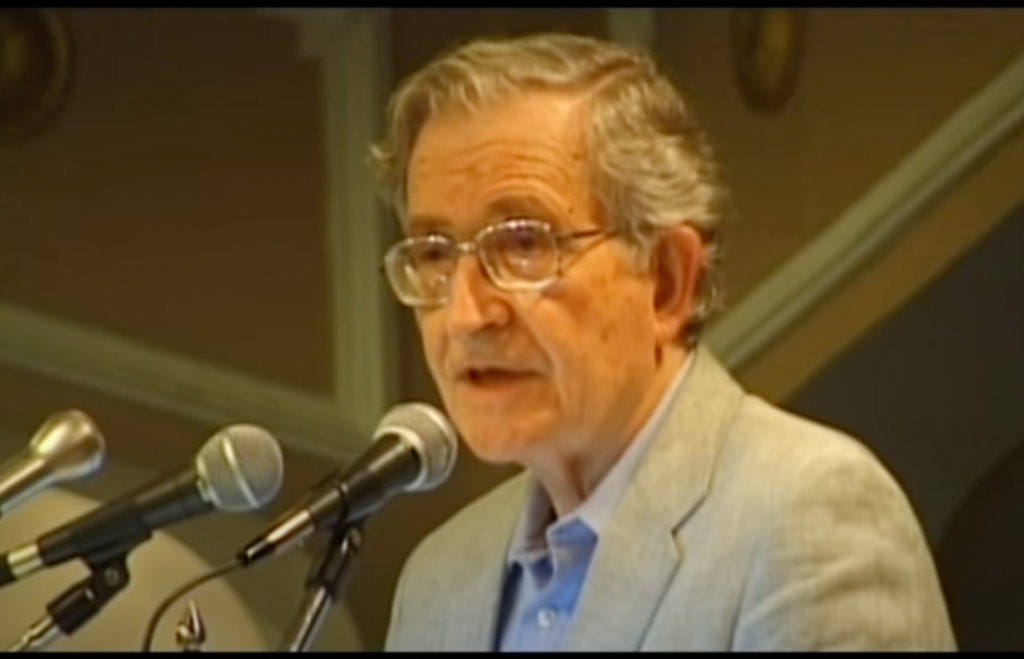
Noam Chomsky in Pakistan, 2001. Screenshot from VPRO news report by Beena Sarwar.
I once asked Noam Chomsky how he manages to remember so many facts and figures and hold audience attention. He replied that he didn’t convey any new information, that his talks are based on materials already in the public domain, and that he simply joins the dots – providing context – and repeats the information consistently and in different ways.
His response was typical of his humility as well as his courtesy towards a much younger person to whom he owed nothing.
Chomsky teaches us that it is not necessary to be loud and sensationalist in order to be heard. This, together with the clear and courageous moral compass he has provided over decades, is a most valuable lesson.
Noam Chomsky was already a legend when I first met him over two decades ago in December 2001 when he visited Pakistan for the inaugural Eqbal Ahmad Memorial lecture series.
Boats on Dututwewa at sunset. Photo by Ben Samarasinghe
The lakes, paddy fields and forests of the ancient village of Dutuwewa are a world away from Colombo’s high-rises and colonial buildings. As elsewhere, decisions taken by ‘old men’ in the corridors of power impact life here, just as these rural voters will impact politics nationally
PERSONAL POLITICAL FROM DUTUWEWA WITH LOVE
By Beena Sarwar
Times are tough and it’s hard to make ends meet. A refrain heard from just about anyone in my home country Pakistan where the rupee has dropped to around 300 to the dollar. This is now comparable to the rupee in Sri Lanka, recovering from the biggest economic crash in its history.
Stories of hardship echo from the island nation’s largest city Colombo to the farming heartlands around Anuradhapura district, a little over 200 km to the north-east. At the core of Anuradhapura lies the irrigation tank called Dutuwewa which sustains several villages.
Sri Lanka’s rural landscape is dotted with as many as 14,000 such large and small irrigation lakes, known as wewas, built by kings thousands of years ago.
A nearly five-hour drive on surprisingly good roads – testament to the rural infrastructure built after the end of the 26-year long civil war 15 years ago – brings us to the serene lakes, lush paddy fields and dense forests of Dutuwewa. A world away from the corridors of power and the glittering, air conditioned, high-rises of Colombo and its historic colonial buildings left behind by 500 years of colonizers – the Dutch, the Portuguese and the British.
A village school in a forest
The din of crickets from the surrounding forest forms the backdrop to everything in Dutuwewa. The headmistress of the Palugollagama government school, who gives only her initials and last name, I. R. Ekanayake, is an ‘old girl’ who taught at schools around the district for 26 years and was posted to her alma mater as principal four years ago. There are two vice principals, 36 teachers and 506 students.
‘A country may believe it wins something by killing people but can anything be as valuable as human life?’
Reverberations of America’s campus protests are felt in a remote rural area in the middle of a jungle in the heart of an island nation at the cusp of Southasia and the Indian Ocean
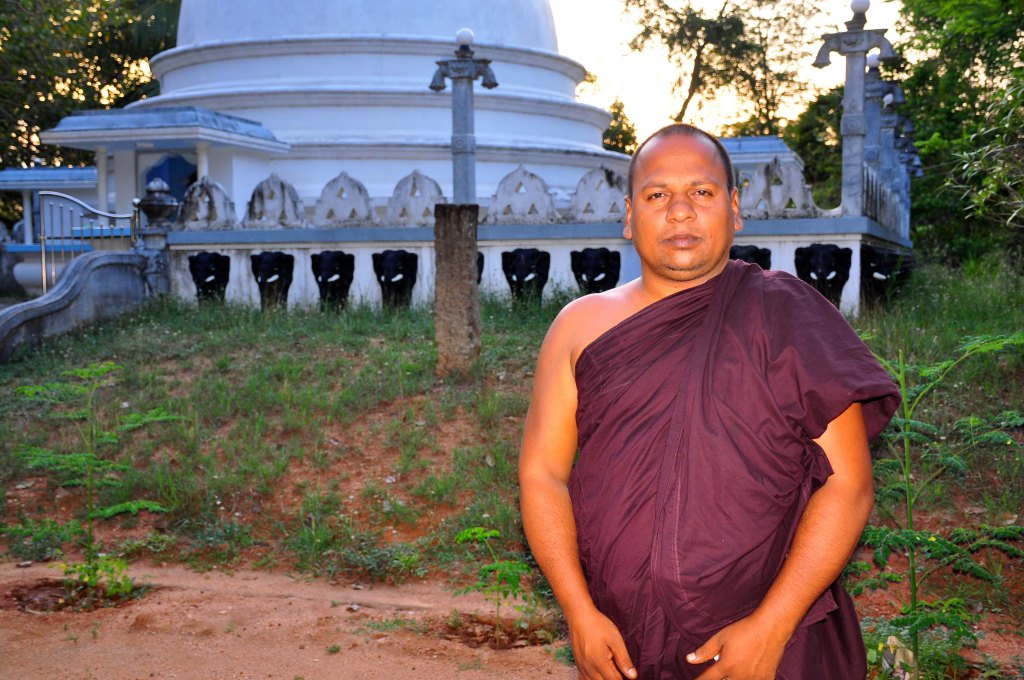
Venerable Kokawewa Sumedha: “Nahi Verena Verani” (Hatred cannot end hatred). Photo: Ben Samarasinghe
POSTCARD FROM DUTUWEWA
By Beena Sarwar and Uditha Devapriya
Ripples of the student protests in America calling for divestment from Israel and an end to the violence on Palestine are being felt in a remote village in the heart of rural Sri Lanka.
“What gives America the right to lecture us on human rights when their police are beating up brown students protesting for innocent Palestinians?” asks Kokawewa Sumedha, known respectfully as the Thera (Buddhist monk), in a historic village called Dutuwewa, in the Anuradhapura District in Sri Lanka’s North-Central Province.
The village is named after Sri Lanka’s hero King Dutugemunu who ruled from 161 to 137 BC. He is said to have founded the place while traveling, after his tethered horse broke loose and was found grazing here.
We’re sitting on a stone bench lining the verandah of the Thera’s residential dwelling at the premises of the Sri Purvaramaya Viharaya, Gataleva, the Buddhist temple that the Thera has served for 25 years. The oppressive heat and din of the crickets from the surrounding jungle, known for its wild elephants, are a world away from the centres of power.
A tribute to the spirit of Anja – and the courage of journalists
The story behind a poignant photo exhibition that opens at Harvard today featuring the work of the late photojournalist Anja Niedringhaus who covered Afghanistan and Pakistan at the height of the war between the Taliban and the USA. The show, and its accompanying book, are co-curated by the reporter Kathy Gannon who was injured in the attack that killed Anja.
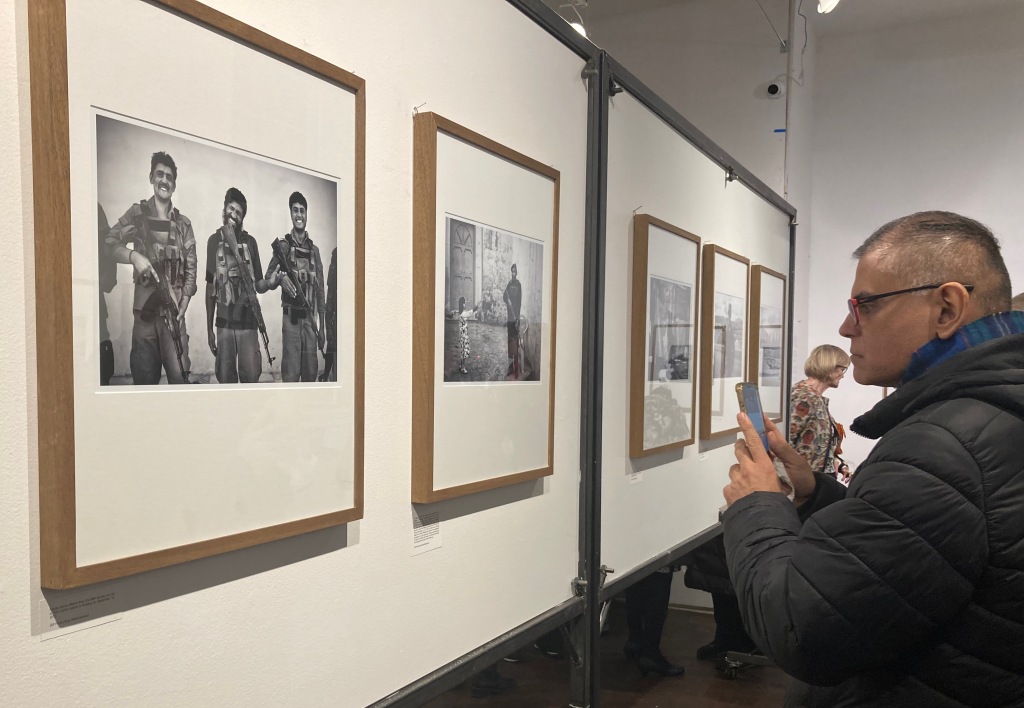
Pakistani journalist Raza Rumi at the exhibit opening at the Bronx Documentary Center last month. Photo: Beena Sarwar
PERSONAL POLITICAL By Beena Sarwar
An exhibition of powerful images from Afghanistan and Pakistan by the late Pulitzer-prize winning photojournalist Anja Niedringhaus opens in the Boston area today.
Kathy Gannon shares an iconic photo by Anja Niedringhaus during a talk at Emerson College, Boston, 2022. Photo by Beena Sarwar
“If France and Germany can be part of the European Union, why can’t Pakistan and India be part of a Southasian Union?” asked Dr Mubashir Hasan, former finance minister of Pakistan, a hawk-turned-dove who co-founded the Pakistan-India People’s Forum for Peace and Democracy (PIPFPD). He had roped me into it when I was a young journalist in Lahore in the mid-1990s. When he said these words to me some years ago, and I replied that this was impossible, he responded, “Par hum baat toh kar sakte haiN” – but we can at least talk about it.
Years later, in 2021, during a time of renewed tensions between Pakistan and India, his words inspired the foundation of the Southasia Peace Action Network, Sapan, that we now write like a word, Sapan, rather than in all caps, conveys the meaning of a dream.
“This is a dream that connects millions, giving hope for solidarity, peace, and friendship in the region. The network, which encourages dialogue and connections amongst Southasians and across various issues, has managed to virtually overcome borders and build bridges between those who have historically been divided” writes young peacebuilder Mansi Chandna from Jaipur, who attended the event from her current base in Manchester.
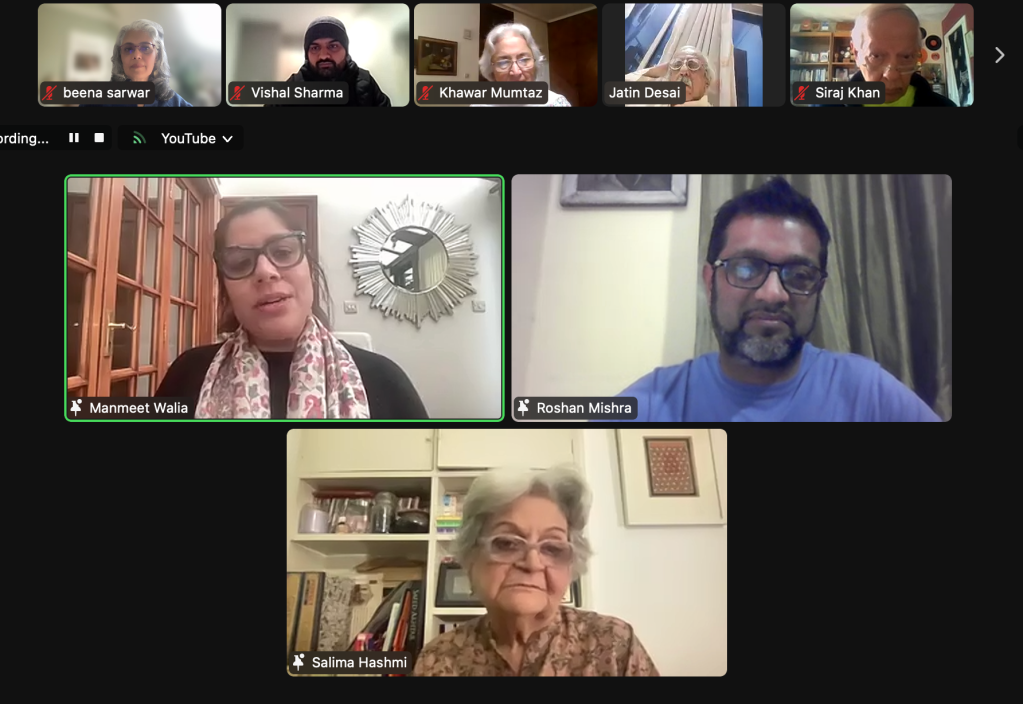
Art and Southasian Voices panel at the Sapan third anniversary event: Manmeet K. Walia, Roshan Mishra, Salima Hashmi. Screenshot from video recording.
Sharing my curtainraiser for Sapan News about a poignant photo exhibition opening at the Bronx Documentary Center in New York today, featuring the work of the acclaimed photojournalist Anja Niedringhaus. She covered Afghanistan and Pakistan at the height of the war between the Taliban and the USA, and was killed ten years ago, on 4 April 2014.
An Afghan police commander walked up to the car she sat in with Kathy Gannon outside a government compound in Khost, where they were covering the presidential election for the AP. Anja, 48, died instantly. Seven bullets shattered Kathy’s arms and shoulders. The Afghan doctor who initially operated on her saved her arm, using various ‘jugaRs‘ (improvisations). Doctors at the French military hospital in Kabul where she was later medi-evaced said they would have amputated it had she reached them first.
In all the years I’ve known Kathy, I’d never heard her complain or mention her injuries or trauma. When I hesitantly asked about it now, for this piece, she detailed the information matter-of-factly, even cheerfully, focuses more on Anja, her courage, and her spirit. All that applies to Kathy herself.
Kathy, who also on the Sapan News Advisory Council, has co-curated the show and its accompanying book.
Anja Niedringhaus’ photos showcased in a tribute posted by her colleagues at AP
The exhibition will travel to Cambridge MA, 9-10 May 2024, co-sponsored by the Nieman Foundation and the Shorenstein Center at Harvard University. Anja was a Nieman Fellow 2007.
Exhibition information: Bronx Documentary Center 614 Courtlandt Ave, Bronx, NY 10451 On View: April 4 – May 5, 2024 Gallery hours: Thurs-Fri 3-7PM, Sat-Sun 1-5PM
Book information: Anja Niedringhaus By Ami Beckmann, Kathy Gannon, and Muhammed Muheisen Hardcover, 80 pages, 44 images Release date: April 2024 Published by Fort Orange Press Price: USD 30
Note: We have been doing this work voluntarily for the past three years and need support of all kinds – like, share, encourage.
And donate – thank you to those who contributed to help Sapan News meet our NewsMatch goal by December 31. We made it!
We now need to raise $3,000 more in the next three weeks. Will you help? Here is the link to share with friends who might want to contribute – no amount is too small: www.sapannews.com/donate
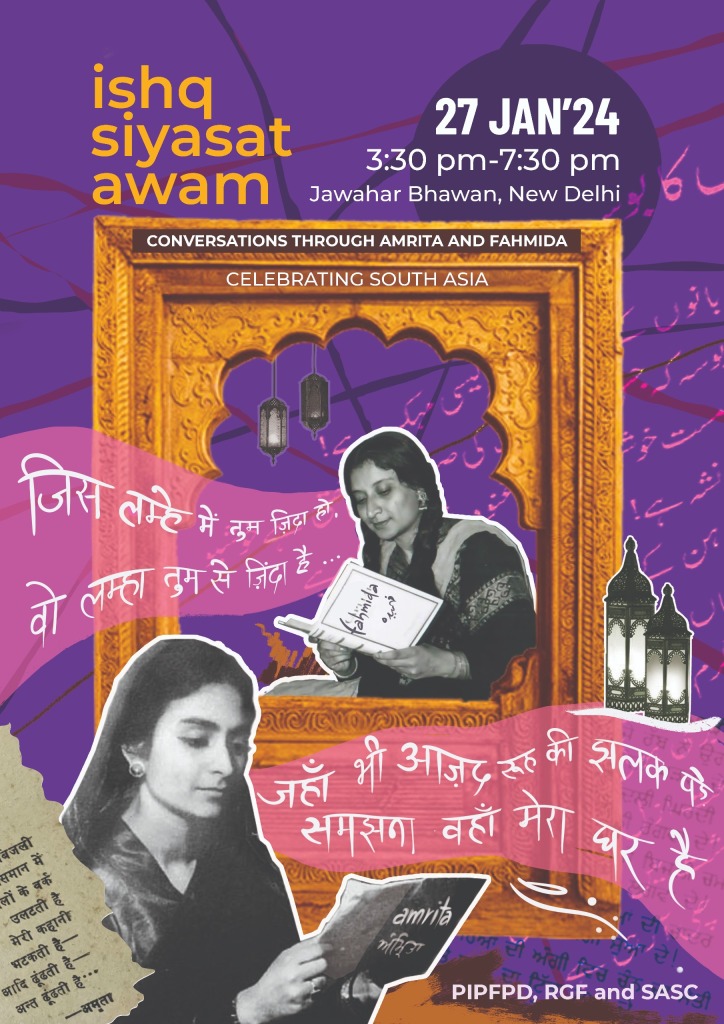
Radical love, epitomised by the late Amrita Pritam and Fahmida Riaz is ‘one of the seeds of the revolutionary thought process’, to quote the Pakistan India People’s Forum for Peace and Democracy (PIPFPD) stalwarts who organised the event – Vijayan MJ, Tapan Bose, and Dr Syeda Hameed. Their consistent work over the decades for peace and justice is truly inspirational, and I feel privileged to know them personally.
I was also privileged to know one of the late poets personally, Fahmida ‘Khala’ (aunt) to me, who was close to my father Dr. M. Sarwar. He led the Democratic Students Federation (DSF), Pakistan’s first student movement while at Dow Medical College in Karachi, 1949-54.
I’ve uploaded archives about the movement here: drsarwar.wordpress.com. Principles of that struggle continue to show the way, like the importance of coming together across divides for a minimum common agenda. For DSF, it was student rights. For Sapan, it’s Southasia Peace. We need it now, for the sake of the people of the region, and beyond.
The Videos section of the Dr Sarwar blog includes a playlist of video clipsfrom the event held at the Karachi Arts Council in January 2010 to commemorate DSF and the student movement, a few months after my father passed on.
Compered by the actor Rahat Kazmi, the event featured speeches from young activists, students, and academics like Amar Sindhu, Alia Amirali,Ali Cheema, and Varda Nisar, as well as veterans like I.A. Rehman, besides the singer Tina Sani, Taimur Rahman and his band Laal, and Fahmida Riaz.
Fahmida Khala recited her poem ‘Palwashey Muskurao’ (Palvasha, smile), dedicated to daughter of late Afzal Bangash of the Mazdoor Kissan Party (Workers’ and Peasants’ Party), and the followers of other late leftist leaders. They may no longer be on this earth, but their principles and aspirations for human rights and dignity continue to show the way.
I have known Rob Vreeken for over 30 years, since we met in Amsterdam in the early 1990s. He worked at the leading Dutch daily newspaper De Volkskrant, that we visited — women journalists from Pakistan, Sri Lanka, India, and Indonesia, in The Netherlands on a month-long fellowship. I have lost contact with the other fellows but Rob and I stayed in touch on email.
The last time we actually met was when he traveled to Pakistan as a foreign correspondent, soon after my daughter was born. He visited our home in Karachi and met my family, thoughtfully bringing along a baby gift. He has also been very supportive of my ventures, from Aman ki Asha, to the Southasia Peace Action Network and Sapan News, , the media outlet I started in August 2021.
Since ‘retiring’ from De Volkskrant a few years ago, Rob has been the paper’s Istanbul correspondent. After the Oct. 7 attacks, he also reported from Israel and the West Bank.
November 11, 2023: Rob Vreeken with Palestinian activist Saleh Diab in East Jerusalem. Photo by Faiz Abu Rmeleh
In November, he shared some photos which I thought would be interesting for my students at Emerson College, where I taught a Global Journalism course last fall. He subsequently shared his experiences with my students, who really appreciated his insights – like, it’s okay to say “I (or we) don’t know” rather than rushing to provide opinion or information, and the importance of acknowledging mistakes that we as journalists and human beings make.
I’m sharing Rob’s first piece written specially for Sapan News. It is a clear and fair analysis of the ICJ hearings at the Hague that he watched live from Istanbul.
You can see the photos I shared with my class in a slideshow embedded in his piece at the Sapan News website. The article, like all our features, is available for syndication with due credit to Sapan News – http://www.sapannews.com.
Lawyer Vusi Madonsela (left)of the South Africa legal team; looking at him Tal Becker (right), head of Israeli team. Photo by Rob Vreeken, Istanbul.
Check out the Sapan News website and contribute to help support nonprofit journalism. All contributions are tax-deductible, thanks to Sapan News’ fiscal sponsor Tasveer.







 Journeys to democracy