
Conversations 8: Clap with both hands

Dilip and my ongoing weekly email exchange (archives at the Aman ki Asha website, published in The News on Sunday Political Economy section, Aman ki Asha page on April 18, 2010:
April 15 2009

Dear Beena,

Rejuvenated by a few days tramping in the hills, I return to our fray, if that’s the word. Continue reading

Conversations 7: Frankly my dear, let’s give a dam(n)

I’m really behind on my postings. Below, Dilip & my Conversations (7th installment), published in The News on Sunday’s Aman ki Asha page in the Political Economy Section on April 4, 2010

April 1 2010

Hi Beena,

OK, so perhaps we are agreed that we should find a way to take forward the idea of a joint war memorial and/or peace parks on the borders. We should ask about your view that a serving soldier cannot openly support such an idea. I cannot imagine that doing so would be equated to refusing to serve and being called a conscientious objector. Perhaps we can write a letter to senior officers in both our countries, suggesting such memorials, and see where it goes. I’ll draft one and let’s discuss it. Continue reading

CONVERSATIONS-4: It’s about time

Published in The News on Sunday Aman ki Asha page, Political Economy section, on March 14, 2010

Conversations 4: It’s about time

Dilip D’Souza and Beena Sarwar continue their correspondence, attempting to share thoughts honestly, without fear and hostility, exploring what divides our countries, and seeking ways to bridge the divide

March 11, 2010

Dear Beena,

Again, so much to address! But since I asked what annoys you about Indians, and since you answered so frankly, let me make that the theme for this installment of our exchange, and in two ways.

First, your beef is with “the hard-nosed nationalism and sense of superiority of many Indians, the refusal to introspect and see flaws within their own society.” Personally, I’m bothered too by this reluctance to see flaws, by the sense of almost manifest destiny and even entitlement that a lot of us Indians nurse. Continue reading

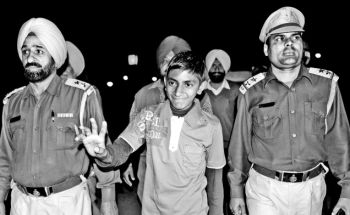
Young Pakistani prisoner released from Indian jail

Policemen escort Pakistani prisoner Mohammad Ateeq (13) to the India-Pakistan Wagah border on Friday. AFP photo published in The Hindu, March 13, 2010


Great news – Ateeq, the 13-year old boy imprisoned at Hoshiarpur Juvenile Prison in India, reached home late last night “amidst mayhem in Lahore” as advocate Asad Jamal put it, “and jubilation among family members and mohalladars”.

See initial report inAman ki Asha page Feb 24 – written prior to Asma Jahangir and I.A. Rehman going to Amritsar to plead his case on Feb 26.

See report in The News, Saturday, March 13, 2010: Boy returns home after two months in Indian jail Continue reading

CONVERSATIONS-3: Let’s introspect

Printed in the aman ki asha page of Political Economy, The News on Sunday, March 7, 2010

Dilip D’Souza and Beena Sarwar continue their email exchange, attempting to share thoughts honestly, without fear and hostility, seeking ways to bridge the gulf between Pakistan and India

Mar 2 2010

Dear Beena,

Since we’ve started on this path of exploring the anti-the-other-country feelings, let’s take it a little further and see where it goes.

First, you draw a distinction between the (sometimes) elected Pakistani governments and what you call the “establishment” – the army/bureaucracy nexus, if you will. Nawaz Sharif was, you tell us, pro-India, but this establishment undermined his government’s efforts in that direction. Continue reading

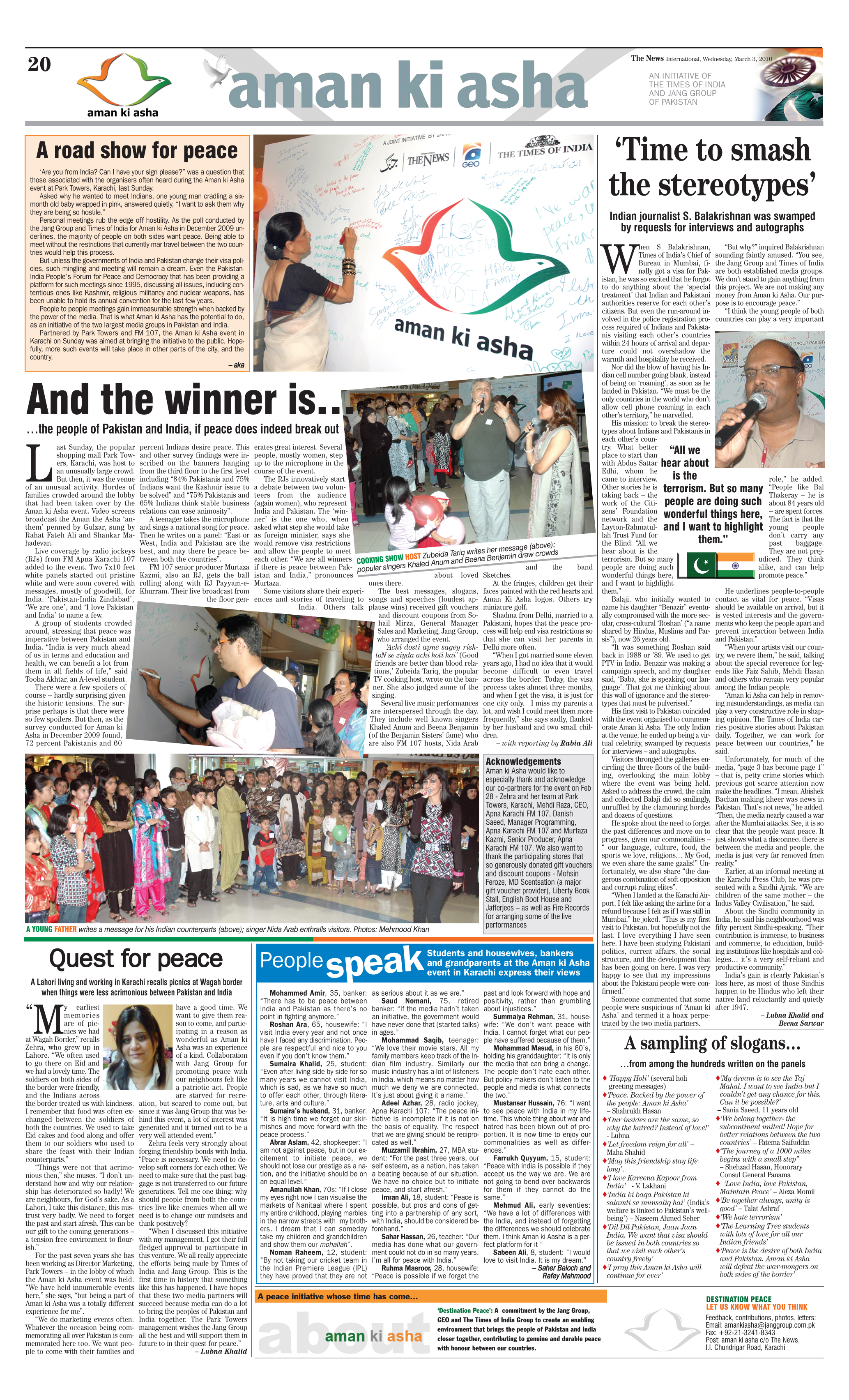
A road show for peace; S. Balakrishnan: ‘Shatter stereotypes’

Below – introduction from the ‘aman ki asha‘ page in The News on Wed, March 4, and thoughts from S. Balakrishnan, Times of India’s chief of bureau in Mumbai who happened to be in Karachi at the time

A road show for peace

`Are you from India? Can I have your sign please?” was a question that those associated with the organisers often heard during the Aman ki Asha event at Park Towers, Karachi, last Sunday (Feb 28).

Asked why he wanted to meet Indians, one young man cradling a six-month old baby wrapped in pink, answered quietly, “”I want to ask them why they are being so hostile.”

Personal meetings rub the edge off hostility. As the poll conducted by the Jang Group and Times of India for Aman ki Asha in December 2009 underlines, the majority of people on both sides want peace. Being able to meet without the restrictions that currently mar travel between the two countries would help this process. Continue reading

Conversations-2: Let’s keep it going

Our second installment of Conversations, below – published in the Political Economy section of The News on Sunday’s Feb 27 edition, Aman ki Asha page, which also includes:

– ‘The Price of Peace‘ by Waqar Gillani on visa hurdles for peace activists

– ‘The MEPIC dimensions‘ by Rafey Mehmood, about a study center established by SZABIST (Shaheed Zulfikar Ali Bhutto Institute of Science and Technology) focusing on the Mid East Pakistan India and China.

Below: Dilip D’Souza and Beena Sarwar continue their correspondence from last week, attempting to share thoughts honestly, without fear and hostility, exploring what divides our countries, and seeking ways to bridge the divide

Feb 23 2010

Dear Beena,

That was a good start, thank you. While I know that terrorism continues unabated in Pakistan, I had no idea of the numbers you quoted to me. 8000 civilians and 3000 security personnel killed in seven years, is a tragic, horrifying toll. I think more of us in India need to comprehend the magnitude of what’s happening today in Pakistan.

There’s plenty in your letter that I’d like to discuss. But for now, I’d like to focus on one theme you brought up. Continue reading

Hope for young Ateeq, a real life ‘Ramchand Pakistani’

Below, a report I wrote on Feb 23, published in The News aman ki asha page of Feb 24 (see accompanying report ‘Prisoners of archaic laws‘ by Rabia Ali), shortly before 12-year old Ateeq’s hearing in Amritsar on Feb 26 – which Asma Jahangir and I.A. Rehman of the Human Rights Commission of Pakistan managed to attend.

12-year old Ateeq from Lahore, currently in the Juvenile Jail in Hoshiarpur, India

Here is an update from Asad Jamal in Lahore on Feb 26:
Release orders were passed for the 12 years old Pakistani boy in Indian Juvenile (Hoshiarpur) Prison after Asma Jahangir appeared in the Juvenile Court in Amritsar today. Now the Pakistan authorities have to complete procedural matters and bring the boy back home. Asma Jahangir met the boy in Amritsar and found him traumatised. She had taken video film of the boy’s father as well some clothes for him. Local lawyers/activists arranged and distributed sweets after the court order. Continue reading

Dolphin-watching, Karachi, and the fishermen’s lament

PERSONAL POLITICAL article written on Jan 26, 2010, published in The News on Sunday Footloose page Feb 7, as ‘Wild, pure magic of malhars’

Photo by MAHA SARWAR SHAHID, age 13

Beena Sarwar

Out on a fishing boat under a clear blue early morning sky to go dolphin watching, the violence, squabbles and tensions that mark daily life fade into irrelevance – including the recent tensions arising from the Indian Premier League’s refusal to bid for Pakistani cricketers.

We cruise the sparkling azure waters of the Arabian Sea parallel to the lengthy sand spit (imaginatively called ‘Sandspit’) along the Karachi coast. About five kilometres out to sea, we can still clearly see the recreational ‘huts’ that dot Sandspit beach. As we pass another fishing boat, the crews exchange greetings – just as highway truckers and bus drivers do. Continue reading

HAITI: How and why Pakistanis can help

Excerpts from appeal and joint statement by Todd Shea and Ethan Casey at the Alive and Well in Pakistan blog, addressed to Pakistani-Americans:

The aftermath of the October 8, 2005 earthquake was Pakistan’s finest moment. The nation’s citizens, government, military, and expatriates stepped up together and contributed money, material, time, professional skills and other resources to alleviate the suffering of the survivors of the devastating quake that killed more than 80,000 people.

The 7.0 earthquake that struck Haiti on January 12 has devastated that small, desperately poor country at least as much as the 2005 earthquake devastated Pakistan. Pakistan has resources that Haiti lacks – like a competent, patriotic army and an affluent expatriate community. Continue reading