A tribute to the spirit of Anja – and the courage of journalists
The story behind a poignant photo exhibition that opens at Harvard today featuring the work of the late photojournalist Anja Niedringhaus who covered Afghanistan and Pakistan at the height of the war between the Taliban and the USA. The show, and its accompanying book, are co-curated by the reporter Kathy Gannon who was injured in the attack that killed Anja.
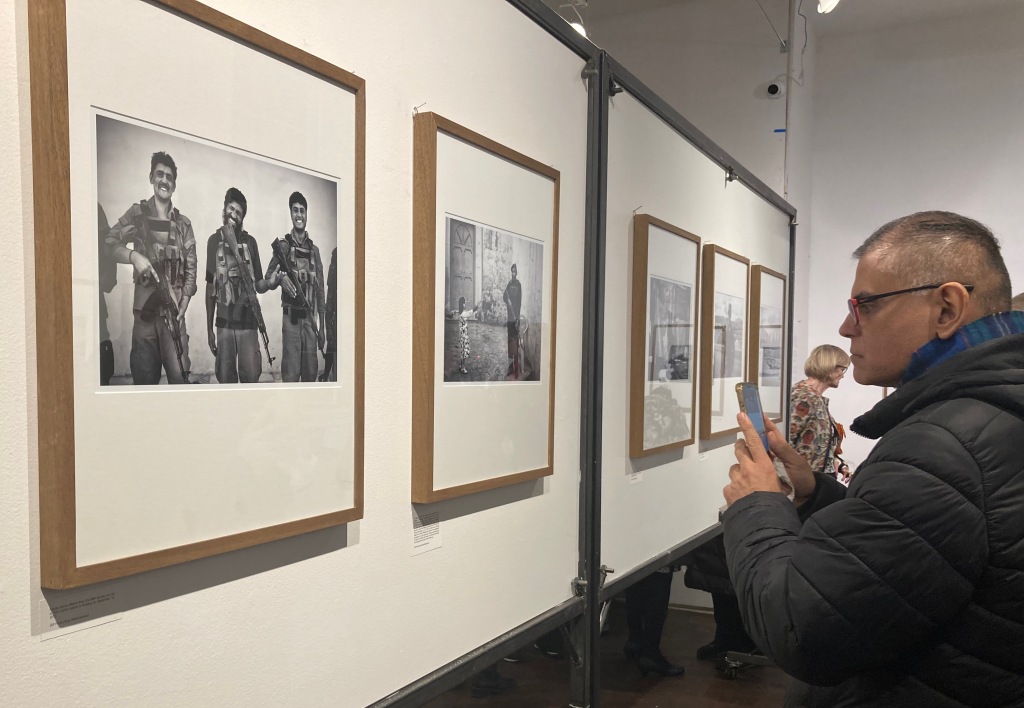
Pakistani journalist Raza Rumi at the exhibit opening at the Bronx Documentary Center last month. Photo: Beena Sarwar
PERSONAL POLITICAL By Beena Sarwar
An exhibition of powerful images from Afghanistan and Pakistan by the late Pulitzer-prize winning photojournalist Anja Niedringhaus opens in the Boston area today.
A message from the journalist Amitabh Pal about a mutual friend, David Barsamian of Alternative Radio in Colorado reminded me of this piece originally published in The News on Sunday, 8 Oct. 2006, about an event with Noam Chomsky where I first met David. The article is still all-too relevant, but the link no longer works so I’m sharing the piece here without any changes; just added some hyperlinks and photos.
Essential reading – and doing: Eqbal Ahmad
Book launch: The Selected Writings of Eqbal Ahmad, Cambridge, September 28, 2006.
Beena Sarwar
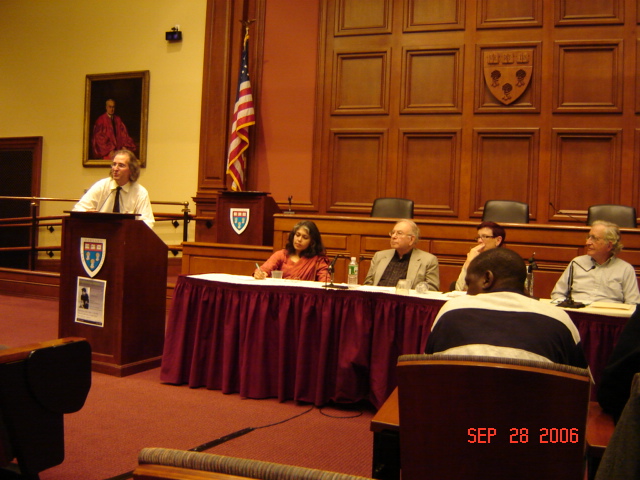
John Trumbour addressing the event. Panel: Beena Sarwar, Stuart Schaar, Margaret Cerullo, Noam Chomsky. Photo: Courtesy MAPA.
When Venezuelan president Hugo Chavez in his address to the UN on Sept 20, held up a copy of Noam Chomsky’s Hegemony or Survival: America’s Quest for Global Dominance (2003) and recommended it as essential reading to understand contemporary world politics, he could have been talking about The Selected Writings of Eqbal Ahmad, for which Chomsky, Eqbal’s long-time friend, wrote the foreword. Chavez identified “the hegemonic pretension of the North American imperialism” as “the greatest threat on this planet” to the survival of the human race.
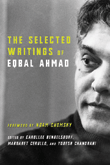
The book that Jack launched (at HLS)
Chomsky also gave the main address for this collection of Eqbal Ahmad’s writings (Columbia University Press, 2006) at the book’s launch in Cambridge, USA, on September 28. John Trumpbour and Emran Qureshi of the Labor & Worklife Program at the Harvard Law School, who organised the event, didn’t publicise the event too aggressively because of the hype Chavez had generated for Chomsky.
The hall did get quite full, but they didn’t have to turn anyone away at the door. The venue may have had something to do with this. Chomsky, a linguistics professor now retired from the neighbouring MIT, is rarely invited to Harvard. Harvard Law School professor Alan Dershowtiz criticises Chomsky for being too “black and white” but often has to concede the basic truth of the points Chomsky makes.
A compilation of offerings from our Sapan network, including my latest venture Sapan News syndicated features. Together, we aim to further the narrative of regionalism, peace, and dialogue. What can you do? Read on
Visual: Aekta Kapoor/Sapan
Delighted to have acclaimed actor and director Sarmad Khoosat join us Sunday July 16 for Sapan’s first fundraiser, hosted by poet Dr Arvinder Chamak in Amritsar. Sarmad will be in conversation with the wonderful journalists Malinda Seneviratne in Colombo, Mandira Nayar in Delhi; and Lubna Jerar in Karachi.
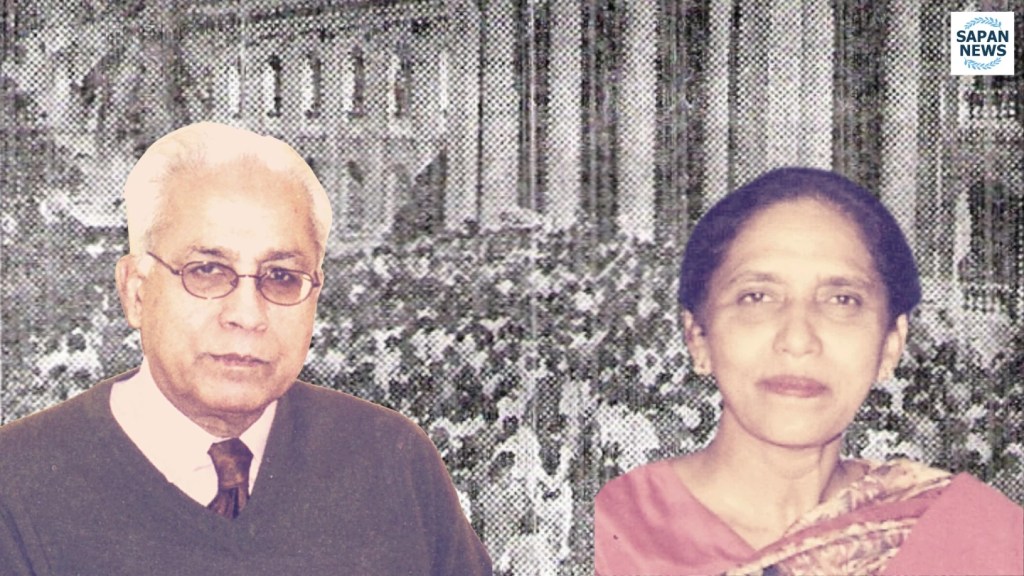
OBITUARY: The legacy of a decades-old connection between social worker Shahida Haroon (1937-2023) and economist Eric Rahim (1928-2023) endures through the ongoing struggle for student rights, economic justice and democracy in Pakistan
Demands Day at D.H. Science College, 07 Jan. 1953, Eric Rahim, Shahida Haroon Saad. Collage by Aekta Kapoor/Sapan News
It was while trying to reach Eric Rahim in Glasgow this week to inform him of my aunt Shahida Haroon’s passing in Karachi that I learnt he too was no more.
A respected journalist and economist, Uncle Eric as I called him, had passed away peacefully at home on 2 May 2023, aged 94. He was a mentor to my father Dr M. Sarwar (1929-2009), and Shahida, who departed this earth on 25 June, at 87.
Shahida did her Master’s in economics from Karachi University in 1958, a subject she didn’t enjoy or do well in. When she went to Punjab University for a second Master’s in social work, encouraged by her brothers Akhtar, 11 years older, and Sarwar, eight years older, Akhtar asked his friend Eric Rahim to look after her. It was Eric, then a columnist at The Pakistan Times, who met Shahida at the train station after her overnight journey.
Following up from my earlier post, here’s the video recording of the Razia Bhatti Memorial Lecture 2023 I delivered online recently for the Center of Excellence in Journalism at IBA, Karachi.
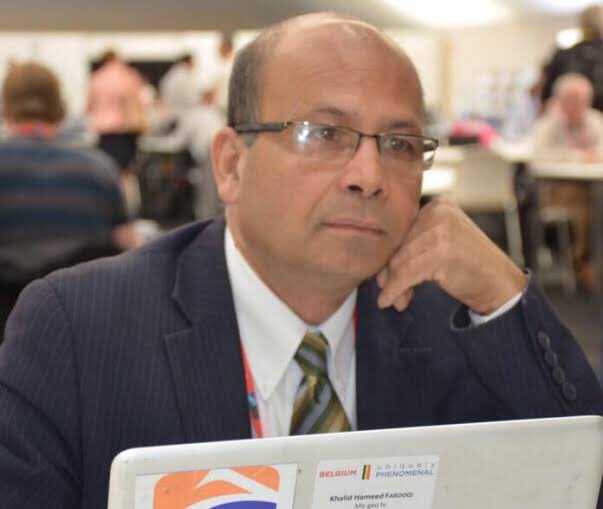
Two wonderful colleagues and friends departed this world rather suddenly within days of each other last month, leaving behind multitudes to mourn their loss — and celebrate their lives: Khalid Hameed Farooqui, Geo News correspondent in Brussels, 7 May, and Editor The News Talat Aslam, 25 May. We honoured both at the In Memoriam section of the Southasia Peace or Sapan event on the last Sunday of May, along with others.
Khalid Hameed Farooqui: A lifetime of politics, journalism, and activism in Europe and Pakistan.
Talat Aslam: His tweets @Titojourno gathered a fan following for his posts on politics, food, film, music and nocturnal wanderings in Karachi.
The tribute to Khalid by European Commission chief spokesperson Eric Mamer in a press briefing shortly after Khalid’s passing speaks for the respect he inspired amongst colleagues and political figures:
Tribute given to Geo’s senior correspondent Khalid Hameed Farooqui – who passed away last weekend – by European Commission. What brilliant praise. pic.twitter.com/xFZRZ3yDNX
Friend Saifullah Saify in Amsterdam organised a wonderful online tribute for Khalid, with tributes from personalities like Farhatullah Babar, and journalists Hamid Mir, Asma Shirazi, Munizae Jahangir, Amber Rahim Shamsi, Murtaza Solangi, Mazhar Abbas, Raza Rumi, Nazir Leghari – see video clips at this playlist on his YouTube channel.
Sharing below my piece on Tito, as friends and family called Talat, one of three articles carried by The News on Sunday in a full page tribute. The two other remembrances, by colleagues Zia ur Rehman and Gulraiz Khan, are online here. My piece includes a couple of my illustrations for Tito’s columns in The Star 1986-88.
: Remembering two gems, stellar journalists and old friendsContinue reading →
Rajdeep Sardesai: A stable Pakistan is in India’s interests. Screenshot by Tej Kaul from yesterday’s show.
Thanks to the Pakistan Supreme Court for the unanimous judgement upholding the opposition’s right to a no-confidence motion and declaring as void the ruling party’s attempt to dissolve the assembly and hold fresh elections. The situation had many of us on tenterhooks given its potential to disrupt the democratic political process that has only just begun taking hold in the country.
Since 2008, only two cycles of elected governments have completed their term and handed over power to the next one without the assemblies being dissolved. Imran Khan was the third political leader to grasp the baton of this relay. If he passed the baton on to the next elected government that would be a historic hat-trick in Pakistan’s history and hopefully strengthen the process and pave the way for it to continue. He can still redeem himself by doing that after losing the no-confidence move on Saturday and stepping into the opposition.
Of course elections aren’t the be-all and end-all of a democratic political process. But as the wise know, the process is crucial. As a sportsman, Imran Khan should know that the game is only an event that needs an ongoing, continuous process of rigorous, consistent training.
Unfortunately the former captain of the Pakistan cricket team has turned out to be a sore loser. My commiserations to his supporters, many of whom had placed their hopes in him to improve the system. They need to recognise that an individual can’t do this alone. He has to work with others, and needs to pick the right people for his team. And stay in the game.
Sharing personal memories of the brilliant Sara Suleri whose genre-defying book Meatless Days inspired generations of writers, feminists, memoirists and dislocated Southasians. Thanks Ailia Zehra at The Friday Times for asking me to write this piece.Published as a Sapan syndicated feature in TFT, The Wire, Geo TV blog, South Asia Monitor and The Print – shared here with additional pix and links.
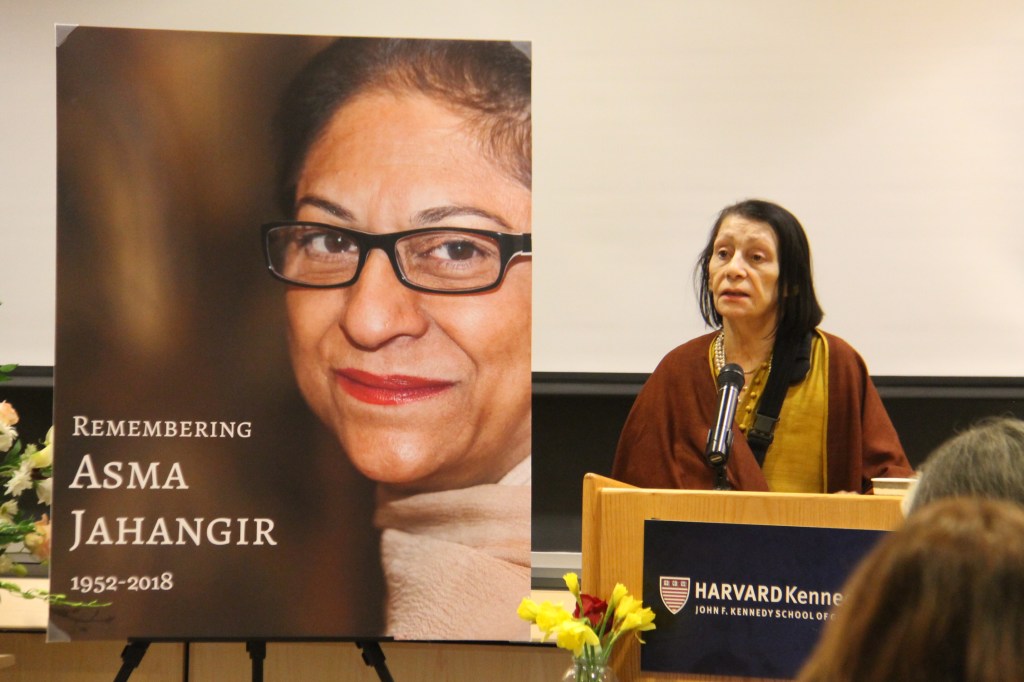
February 2018: Sara Suleri pays tribute to Asma Jahangir. Photo: Beena Sarwar.
PERSONAL-POLITICAL
By Beena Sarwar
March 25, 2022, Sapan News Service:
“Aur bataiye” – tell me more, a polite invitation to keep talking. I can hear her voice, perhaps naturally husky, made deeper with years of cigarette smoking and perhaps more recently with pain and other medications.
She’d send her love to Pakistan whenever I’d call before flying out from Boston, where we had both ended up around ten years ago – she after retiring as Professor Emeritus of English from Yale University. I had transplanted myself from my home city Karachi where I was editing Aman Ki Asha, hope for peace – between India and Pakistan.
“Dream on!” I hear Sara say. And yet, she agrees, it’s important to keep going. She’s also a hundred percent supportive of our push for a regional approach – the South Asia Peace Action Network, or Sapan, the more recent endeavour, launched last year with a wonderful group of inter-generational, cross-border peacemongers.
This is a followup report to a piece I did in May about a Pakistani Hindu family that migrated to India but wants to go home to Pakistan, made more desperate after a personal tragedy. This not about patriotism or religion but humanity. p.s. I sent this report to several media houses. It’s been published in The News, NayaDaur, South Asia Monitor,The Wire, Aman Ki Asha, Pakistan Today, Vibes of India, and its Gujrati portal and others. Note the credit at the end — Sapan News. This report may be a soft launch for syndicated service I’ve long dreamt of. Sapan News is linked with the South Asia Peace Action Network, Sapan, recently initiated by some of us. Check it out! Grateful for your support.
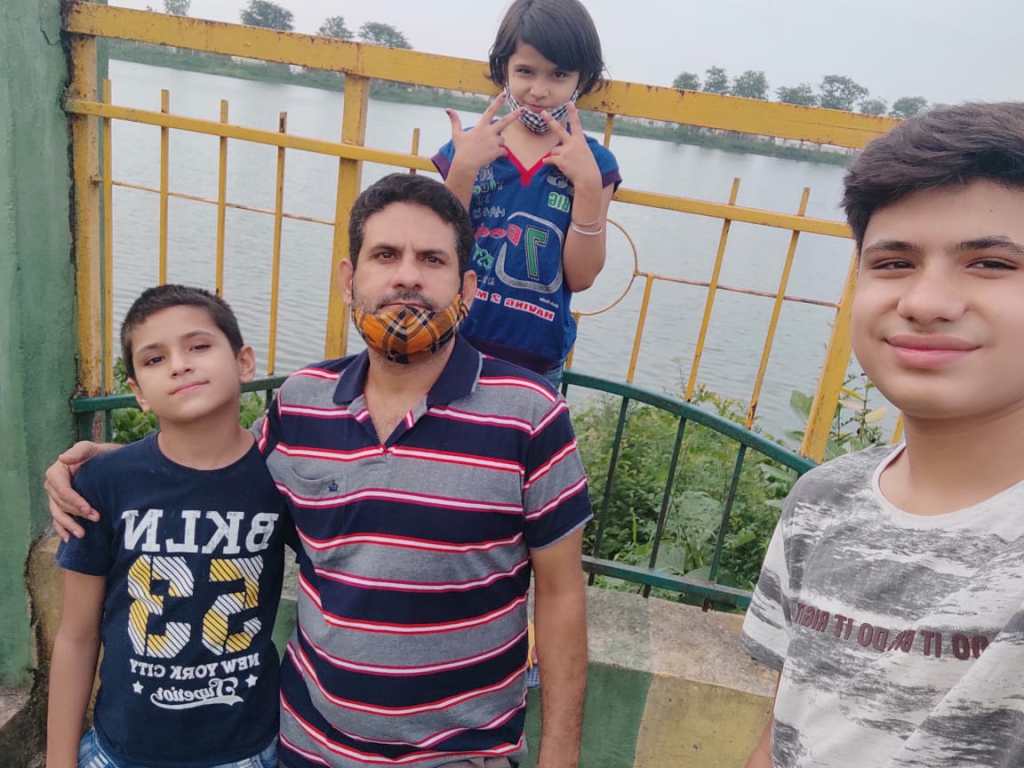
A couple of weeks ago, Ajeet Kumar borrowed a car and took his children on a rare outing: Coping with bereavement and desperate to go home. Photo: Supplied.
A Pakistani Hindu stuck in India with three children after his wife died in April is pleading with the authorities to let him return to before Independence Day, August 14.
“Mein TooT gaya huN – I am broken,” says Ajeet Kumar Nagdev, 41, speaking on phone in Urdu from Balaghat, Madhya Pradesh. His wife Rekha Kumari, 38, died on April 22, a day before the last Attari-Wagah border opening. “What can I do? The children break me, but I have to get up and keep going.”
Struggling to look after them, fearful of what will happen if one of them gets sick or if something happens to him, Nagdev feels trapped. He worries about their schooling. They miss their mother.
It is outrageous that for nearly a month now, chief editor and owner of the country’s largest media group has been behind bars. Mir Shakilur Rahman was arrested by Pakistan’s National Accountability Bureau on March 12, in connection with a 34-year old land case.
Leading lawyers agree that the case is baseless. They are among the many voices – journalists, international human rights organisations and media platforms, rival media groups, civil society organisations at home and abroad – outraged by this travesty of justice and urging MSR’s release #FreeMirShakilurRehman.
Amnesty International is deeply concerned with the arrest of Jang group editor-in-chief Mir Shakilur Rehman in what appears to be yet another incident of harassment of journalists in Pakistan. He must be guaranteed a fair trial and access to legal representation.
— Amnesty International South Asia, Regional Office (@amnestysasia) March 16, 2020
Leading international organisations have called for MSR’s release
The detention is widely seen as part of an ongoing attack on media freedom in Pakistan. The case, clearly motivated by vendetta, is particularly disturbing at a time when everyone needs to be on the same page in fighting the global COVID-19 pandemic. See my story in Naya Daur, also posted below with updates, about a maverick poet and intellectual with no affiliation to the Jang/Geo media group, on hunger strike since March 29 for MSR’s release.







 Journeys to democracy