The News on Sunday last week asked me to write a piece on the narratives surrounding gender in mainstream and social media, the space to take up the debate on the subject and whether that has increased or shrunk over the years, and what sort of narratives are emerging from movements like the Aurat March (the impact and social deconstruction of certain slogans deemed ‘controversial’ and ‘immoral’ by right wing quarters within the society). I began writing this just before the controversy over ‘Mera jism meri marzi’ (my body, my choice) kicked off that I mention, in the piece below, part of the TNS Special Report on the issue published 8 March 2020, which includes several related pieces worth reading.
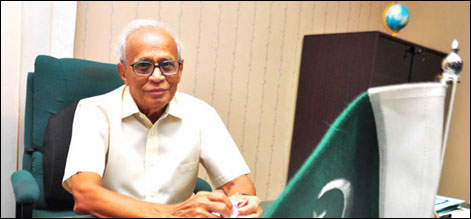
Fakhruddin G. Ebrahim (12 February 1928-7 January 2020) gained respect early on in his career for refusing to take oath under the military dictatorship of Gen. Ziaul Haq. Through his life he wore many hats — founder member Human Rights Commission of Pakistan, Pakistan Supreme Court judge, Governor Sindh, Chief Election Commissioner, to name some. But a little-known feather in his cap is his pro bono work for the imprisoned leftist and student activists of the 1950s, that he credited for his politicisation. Those, he would say, were “the best days” of his life. Here’s that story as I heard it from him and from my father Dr. M. Sarwar, published in The News on Sunday and The Wire a few days after Fakhru Uncle passed on.
Fakhruddin G. Ebrahim: A fine legacy(online photo)
By Beena Sarwar
As the debate on the much-delayed restoration of student unions in Pakistan gathers momentum, we celebrate and commemorate a beloved jurist who cut his teeth by taking on cases of detained student activists pro bono in the 1950s.
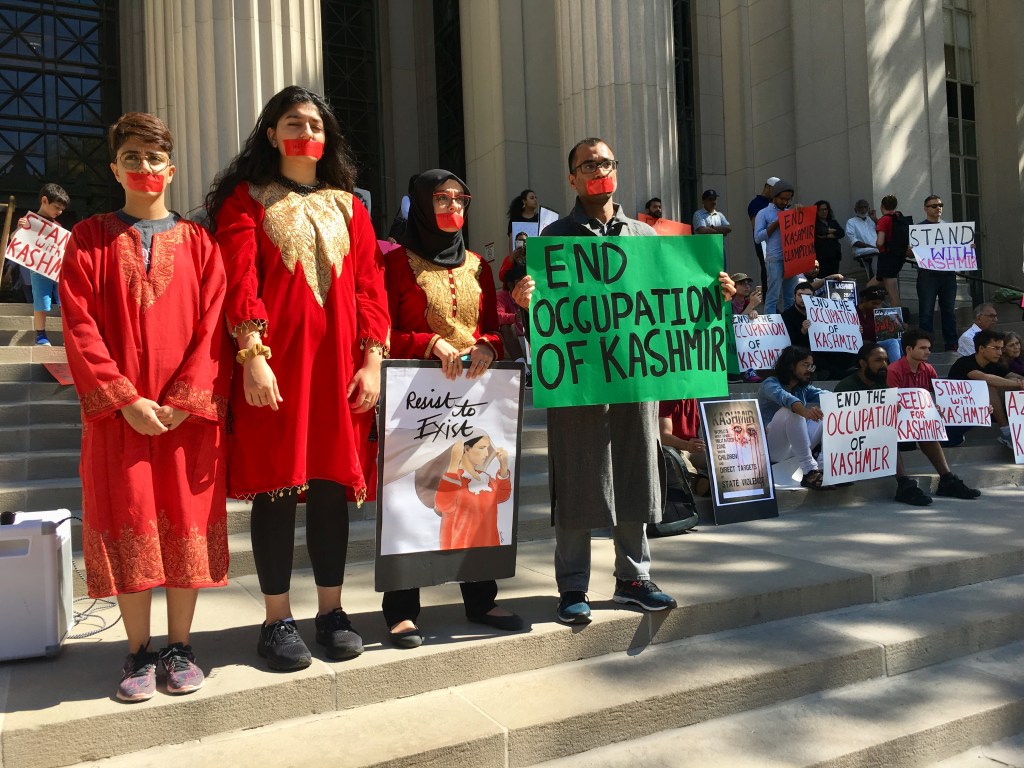
Demonstrators at MIT, part of a series of peaceful world-wide protests in solidarity with Kashmir on the weekend of 21 September, International Peace Day. Photo: Beena Sarwar
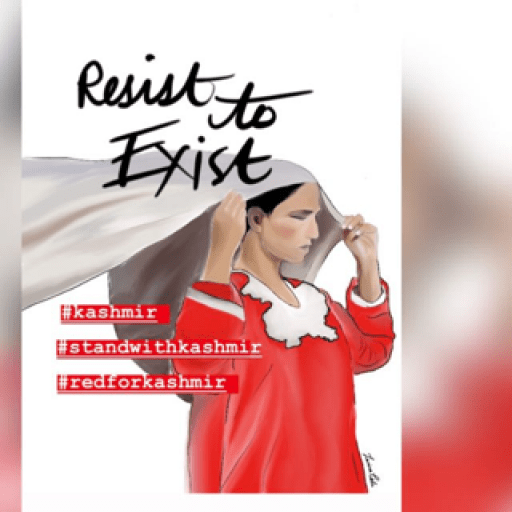
Sunday, 22 September, Cambridge MA: “Resist to exist” proclaimed a placard on the steps of MIT. The placard featured the picture of a woman in a red pheran, the long woolen tunic traditionally worn by Kashmiris from the Himalayan region in India’s north-west tip.
Visual by Zarina Teli, based on a photograph by Sumaya Teli.
The woman holding the placard also wore a red pheran, her mouth taped shut like the others in the pheran-clad group she stood with to symbolize the communications blackout in her home state since 5 August this year. The pheran reflects an iconic image that has become integral to the Kashmiris’ resistance movement, as covered by NPR news recently (Finding resistance in fashion, Kashmiri creator turns to the pheran).
The color red, taken up by thousands in their social media profile
images, has come to symbolize the Kashmiris’ spirit of resistance and defiance.
The woman and her companions stood with other peace-loving South
Asians and friends on the steps of MIT this past Sunday at noon, to demand that
the Indian government “immediately restore communication in Kashmir, remove the
draconian measures enforced in the name of security and order, and respect
Kashmiris’ right of self-determination”.
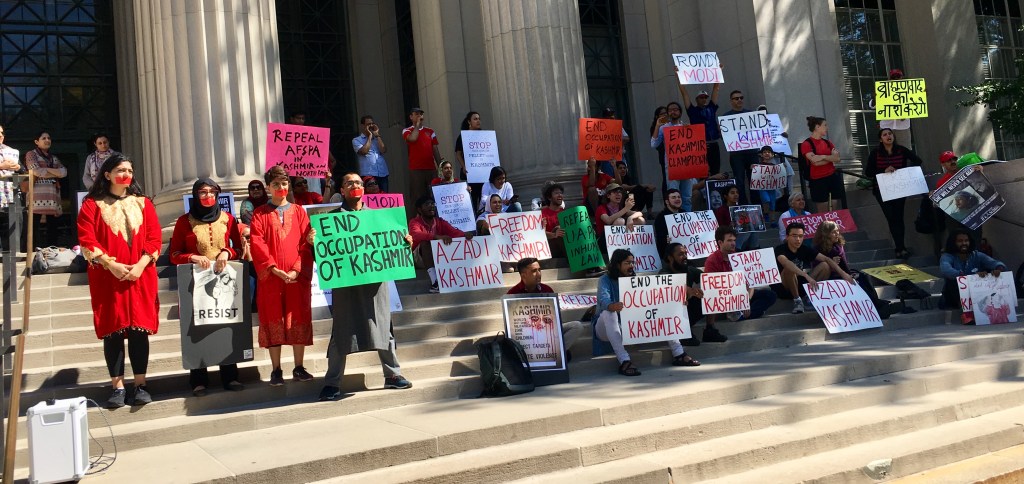
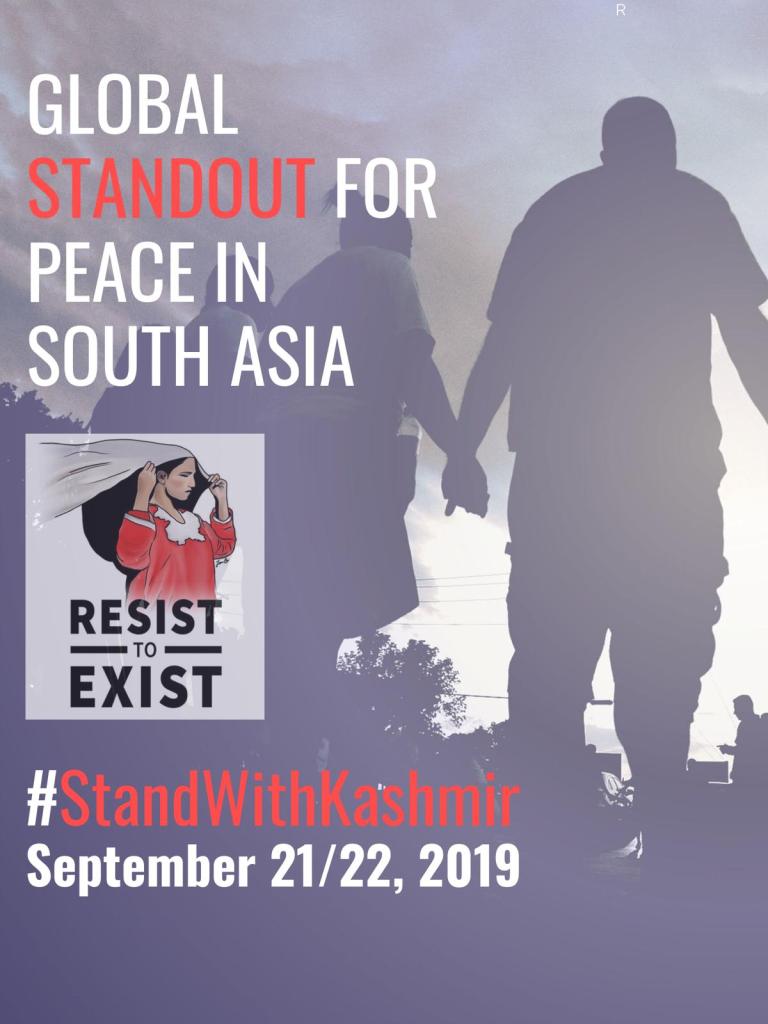
Boston event – Global Standout for Peace in South Asia. Photo: Beena Sarwar
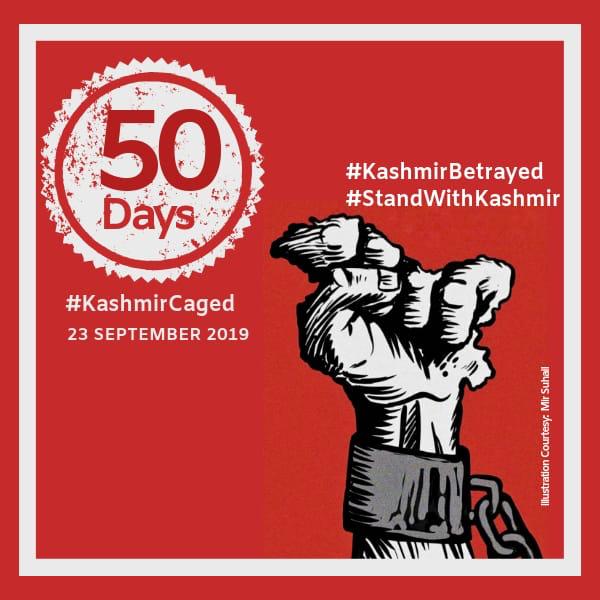
The next day, Monday 23 September, marked Day 50 of “the
unprecedented and total communications blackout for 8 million Kashmiris
enforced on them by the Indian government. Kashmiris, living in the most
militarized region on earth, now fear that the present communications blackout
is part of a larger plan to ‘ethnically cleanse’ Kashmir,” according to the
statement read out at the event.
The event at MIT was part of a series of peaceful protests that weekend in solidarity with the Kashmiri people, coordinated by a small coalition called the Global Standout for Peace in South Asia.
Besides Boston, the Standouts took place in the San Francisco Bay
area, Kolkata (India), Gotenburg (Sweden), Islamabad (Pakistan), and Kathmandu
(Nepal), on the same weekend as Indian Prime Minister Modi shared the stage
with U.S. President Trump in Houston. Solidarity with Kashmir protests took
place in Houston also, as well as Seattle WA.
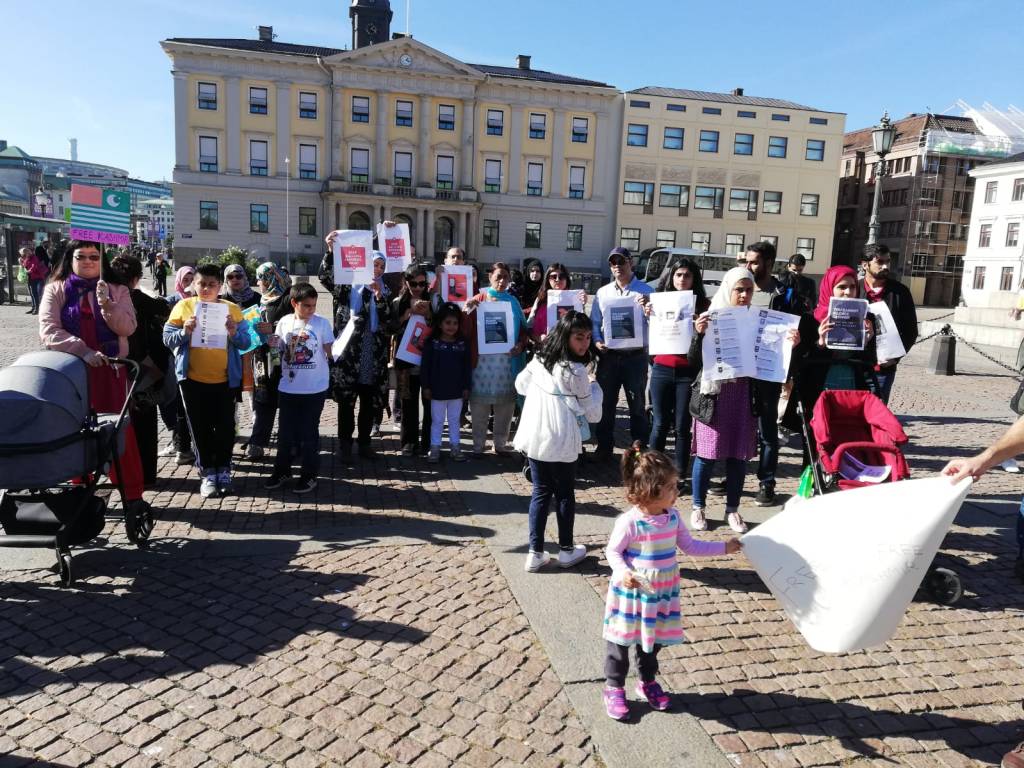
Standout for Peace in solidarity with Kashmir, Goteburg, Sweden
Nuclear-armed neighbors India and Pakistan both lay claim to
Kashmir. The Global Standout protestors showed their rejection of these
territorial claims by not carrying the flags of any nation or state.
Supporting organizations in Boston included Massachusetts Peace
Action, CODEPINK: Women for Peace, MIT Students Against War, Stand With
Kashmir, Coalition for Democratic India, Alliance for a Secular and Democratic
South Asia, and Boston University Students for Justice in Palestine.
Addressing the participants,
Cambridge City Councillor Sumbul Siddiqui encouraged them to keep ‘speaking out
for justice’.
The event ended with a drum sounding 50 beats, one for each day since the communications lockdown up to that point.
This weekend, starting with 21 September 2019, the UN International Day of Peace, marks a series of events taking place in cities around the world in solidarity with Kashmiris.
The largest people-to-people group in the region, the Pakistan-India People’s Forum for Peace and Democracy has since its formation in the mid-1990s been calling for India and Pakistan to see Kashmir not as a territorial dispute but as a matter of the lives and aspirations of the peoples of Jammu and Kashmir, who must be involved in any dialogue about their future. That seems even further from the table now. Continue reading →
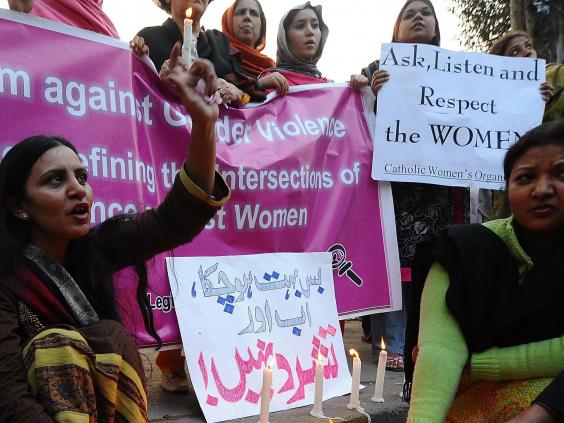
Women mark the International Day for the Elimination of Violence against Women, Lahore, November 25, 2010. (Getty)
Found this old report I wrote about a young woman who miraculously survived horrific domestic violence, published in The News on Sunday, 18 January 2004. What has changed in Pakistan since I reported on it and what hasn’t? Posting it here as I couldn’t find it online. Continue reading →
At a small gathering last year, our friend S. Ali Jafari read his essay in Urdu about my father, whom he called “Doc”. His son Salman videotaped the reading, which forms the basis of this 14-minute video I edited for 26 May 2019, ten years after Dr M. Sarwar passed away peacefully at home in Karachi, at age 79.
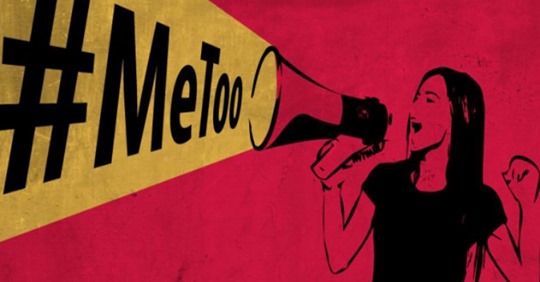
Something I wrote about sexual harassment and abuse, published in The News on Sunday. It was a difficult piece to write, took a lot of thought, time, and research, and forced me to introspect on uncomfortable ideas. I went through a learning process that I’ve have tried to share. One idea links to the concept of restorative justice. Another is that, regardless of whether or not guilt is proven, such cases are forcing society to re-evaluate acceptable behaviour. This, in fact, may be the #MeToo movement’s most enduring contribution.
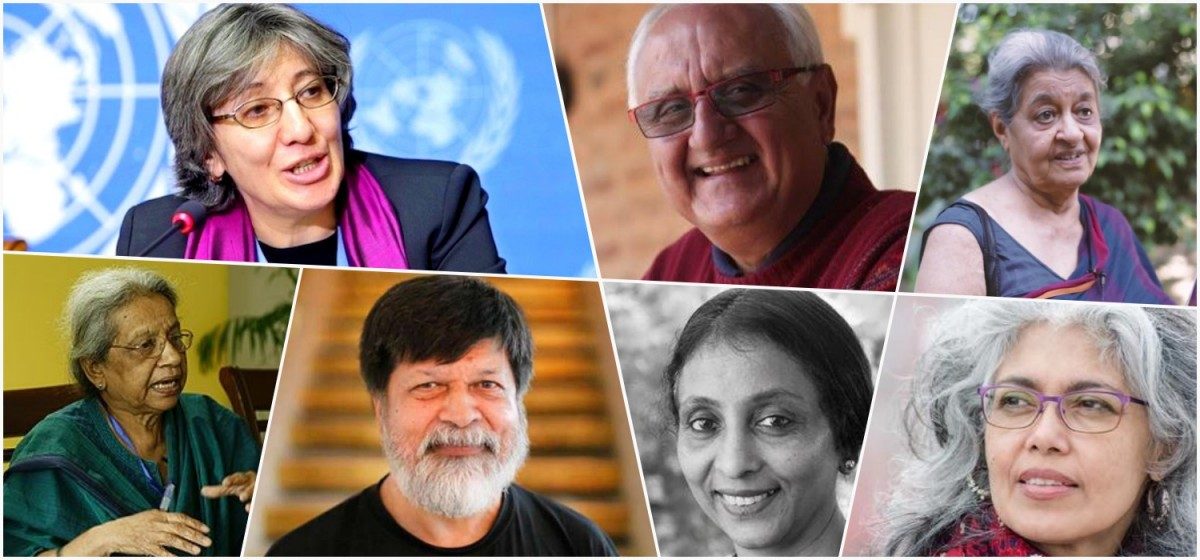
Thanks to friends who initiated this statement in solidarity with the artists, thinkers and people of Sri Lanka, that I have signed along with over 250 other activists, academics and journalists from across South Asia. Please feel free to endorse and share. Signatories include human rights activists from Afghanistan and Bangladesh, journalists from Nepal, Pakistan and India, and historians and feminists from India and Pakistan, among others who have been at the forefront of facing similar realities in their respective nation-states for decades. Full text below, updated from the version published earlier in TheWire.in.
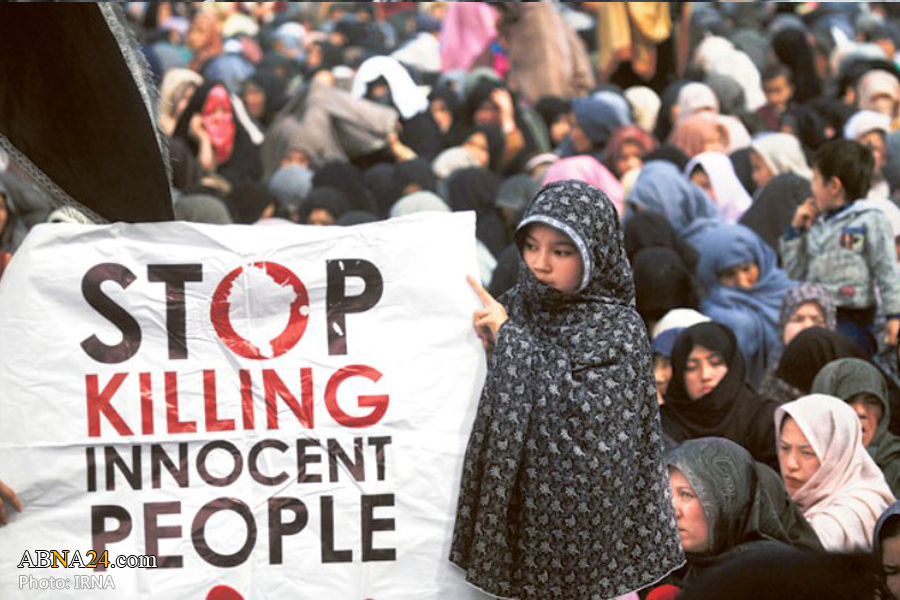
The Hazara community’s sit-in, Quetta, protesting their target killing. Photo: IRNA
Had the Hazaras who were killed in a bomb blast in Quetta died in the Notre Dame fire instead, there might be more outrage about their persecution and targeted killing in Pakistan, comments a designer friend disgusted by the apathy of Pakistan’s elites to the Hazara community’s ongoing sit-in, braving the rain and cold of Quetta while his “timeline is on fire with pix of the burning cathedral and people’s pictures in front of it”. Continue reading →




 Journeys to democracy