Donate a breeding goat to a flood refugee this Eid

Not everyone was able to save their precious goats (AFP: Arif Ali)

The flood waters are receding but the needs of the flood refugees and survivors remains enormous. Blogger Farrukh Siddiqui summarises the main needs in this post  How can We Help flood victims in Pakistan

Here’s another way to help them: donate a live breeding goat to help them re-start their lives in a sustainable way.

At least two organisations I know of are working on this novel idea: Pakistan Animal Welfare Society and Sadiqa Salahuddin’s Indus Resource Centre (IRC) which has a long history of working on education (especially of girls) in the Khairpur area of Sindh.
Continue reading

Personal Political: Dear Abhijeet, please come to Pakistan

Yes, we do have theatre in Pakistan. Sania Saeed in 'Mein Adakara Banoongi'. Many other listings at http://www.danka.com.pk/

My monthly column Personal Political in The News on Sunday (Political Economy section, as ‘Going beyond ‘nothing’ in Pakistan’) and in Hard News, New Delhi

Good music too: Zeb and Haniya. See their interview at http://bit.ly/zebhania

Oct 24, 2010 Personal Political

Going beyond ‘nothing in Pakistan’

Beena Sarwar

“There is nothing in Pakistan,” said the Indian playback singer with finality. “They have no auditoriums, no facilities, there is nothing there. Everything is here (in India).”

Another example of the misconceptions about Pakistan, I thought, waiting to respond. The playback singer, Abhijeet Bhattacharya, and I were participating in a talk show for NewsX TV in New Delhi. Participating from a hired studio in Karachi, I could hear, but not see, the others.

When I tried to reply to this comment, the Indians couldn’t hear me, although I could still hear them through my earpiece connected to a phone line. I was no longer on air. NewsX had booked a live uplink from Pakistan for 20 minutes, which was over. Symbolic? Continue reading

India and Pakistan are stronger together

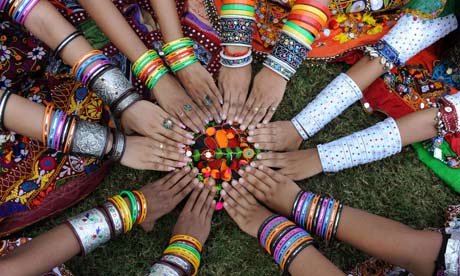
Indian dancers from the Rang Rasia Group traditionally touch their master's turban before the rehearsing Garba in Ahmedabad. Photograph: Sam Panthaky/AFP/Getty Images

My article in The Guardian recently prior to our talk at The Guardian Foundation:

India and Pakistan are stronger together

Loosening cultural, travel and trade restrictions is a vital first step to rediscovering our two countries’ shared heritage

India and Pakistan may be neighbours but it’s surprising how little they really know about each other. Their rich common heritage is easily forgotten amid mutual baiting and negative stereotyping, and it’s difficult to imagine them ever being truly at peace until these obstacles have been overcome.

“I’m really surprised to see so many women … I thought you would be all covered in burqas,” said a journalist at the Indian Women’s Press Club when the Pakistani contingent arrived last April on a visit organised by Aman ki Asha (a joint initiative for peace by the Times of India and Pakistan’s Jang media group). >

Statement: Citizens for Democracy

Several concerned citizens of Pakistan drafted this statement, endorsed by the signatories below.  It was published in various newspapers on Sept 24. See report in Dawn and at South Asian Media Net. Update: advertisements in Jang and News today, Sept 27, 2010. Please endorse if you agree.

Sept 23, 2010

We the Citizens for Democracy:

  • Concerned about an all-sided institutional, financial and societal destabilization in a terrorism-ridden country reeling under the unprecedented havoc caused by the floods;
  • Alarmed at strategic and political uncertainty, reinforcing hopelessness and chaos, due to an ongoing power-struggle among various institutions of the state;
  • Reiterate our full faith in constitutional, democratic and representative system that ensures freedoms and fundamental rights, an independent judiciary, a free and responsible media and above all sovereignty of our people reflected through federal and provincial legislatures;
  • Continue reading

IRC’s Khairpur and Hyderabad camps: Eid report by Sadiqa Salahuddin

Eid distribution at IRC camp - Sadiqa Salahuddin (in cap)

Sadiqa Salahuddin, a dear family friend, has been working in the Khairpur area for over a decade, providing education to children there (mostly girls) through her Indus Resource Centre (IRC). Since the floods hit, they have turned their energies towards relief work.

Here’s an update from her, received this morning, about Eid, the festival that marks the end of the month of fasting, in the IRC camps:

September 14, 2010
Dear Friends,

Eid in a Tent City was a unique experience of my life. I do not remember seeing so many happy faces around on Eid as I saw this year. This might seem contrary to what we are hearing and watching on television about the deprivation and gloom among internally displaced persons (IDPs) on Eid. I have no doubt about media portraying realities but what I am saying is real too. A young journalist has captured Eid in our Tent City in Tribune. Please see this report Learning to say ‘I love you’ Continue reading

Dear Angelina Jolie…

Angelina in Pakistan – ‘dressed accordingly’ (Sept 8, 2010)

Okay, I know I’m going to get flak for this from Angelina lovers and those who may not get my point, but I think it’s an important point to make. It has nothing to do with floods or flood relief, but everything to do with Pakistan’s image, especially pertaining to women. So here goes… Something I wrote a few days ago:

Dear Angelina Jolie

Hello from Karachi. I truly admire your work, your compassion, your raising awareness about those less fortunate, around the world. It’s wonderful that you were able to come to Pakistan again and meet with the flood victims. Your voice will go a long way towards bringing their plight to front stage, where it needs to be.

What I say next should not be taken personally. I am speaking as a woman who lives in one of the most misunderstood and maligned nations of the world. We, the women of Pakistan, have had to fight long and hard for our rights – and we continue to do so. One of the fights we are still fighting is the right to dress as we choose. Continue reading

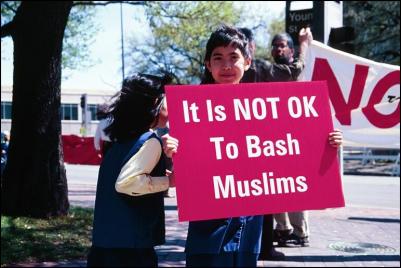
Gainesville Muslims show how to react intelligently and peacefully

Abdullah Shah, 5, visiting the United States from Pakistan with his parents, at an Ecumenical Prayer Vigil July 8 in Gainesville, Fla. — Photo by Scott Camil

Wrote this on Sept 9, before the pastor called off his silly, but potentially dangrous plan. beena

Muslims of Gainesville appeal for calm

Muslims of Gainesville, Florida, have appealed to fellow Muslims to remain calm in response to the ‘Quran burning day’ announced by a pastor in that city.

“Remember that this does not represent America, this does not represent Florida and this does not represent Gainesville,” wrote Mohsen Ali, a Gainsville resident of Pakistani origin in an email sent to friends on September 6, 2010, subsequently posted at various places including this blog.

Ali pointed out that Terry Jones, the pastor who announced this sacrilege heads a ‘fringe group’ — the little known Dove Church initiating the sacrilege reportedly has less than a hundred members. “This is not a global conspiracy against Islam, these are just few hate mongers trying to get attention.” Continue reading

Transparency for Flood Donations – Isa Daudpota

From longtime friend, activist, media-watcher and accountability-demander Isa Daudpota in Islamabad:

Transparency for Flood Donations

Q. Isa Daudpota

Pakistanis and foreign donors recoil at the general lack of credibility of the government and other institutions when it comes to proper utilization of funds.  It is important that this perception is removed quickly if one is to move beyond the immediate relief funding for the flood, which will dwarf in comparison with long-term rehabilitation of people and infrastructure restoration. Continue reading

Personal Political: A flood of despair, a trickle of hope

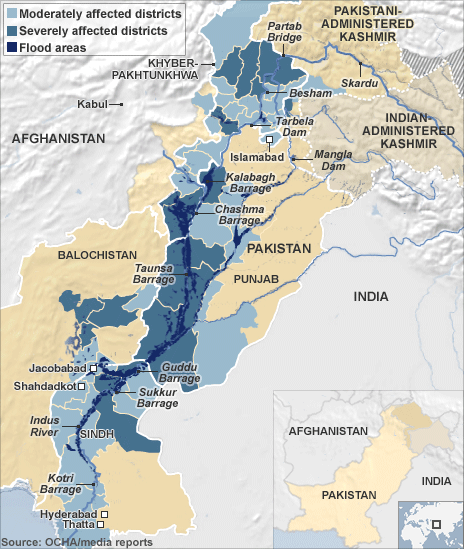
About a fifth of Pakistan is under water. BBC graphic, Aug 25, 2010

Karachi, Aug 24, 2010 – my monthly column, written three weeks into the most devastating floods Pakistan has ever known, and shortly after India’s aid offer of $5 million to help flood-affected Pakistan, published in The News on Sunday (Aug 31) and Hardnews, India (Sept 1). India later upped the offer by $20 million.
Explaining the decision to the Lok Sabha (Parliament) on Aug 31, External Affairs Minister S.M. Krishna said in his speech, “We cannot remain unconcerned with this grave humanitarian crisis of enormous magnitude in our immediate neighbourhood.”

PERSONAL POLITICAL: A flood of despair, a trickle of hope

Beena Sarwar

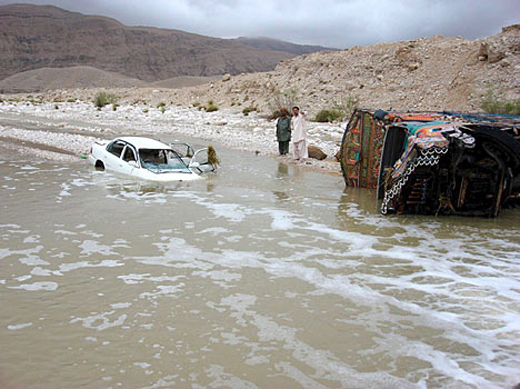
July 28, 2010 was a bad day for Pakistan. That morning, heavy rains led to a private airline plane crashing into the Margalla hills near Islamabad, killing all 152 on board. The rains also brought the most devastating floods in living memory.

That day, I and a few Pakistani water experts landed in Delhi for a closed-door seminar on water as an issue that causes tensions between India and Pakistan, organised by the Centre for Dialogue and Reconciliation and Aman ki Asha where I work. By the time we returned home on July 31, the floods had claimed 500 lives in northern Pakistan and left thousands homeless. Continue reading

Floods turn the world’s hottest place into an island

Ghari Kheru, Dist. Jacobabad, Aug 19, 2010.

A query from Lahore the other day about whether the town of Jacobabad was submerged got me on the phone with friends to inquire. Fortunately, it was just a rumour. But in the process, I got information that had to be used… hence this feature, published in The News today.

Floods turn the world’s hottest place into an island

Beena Sarwar

Jacobabad is famous for being one of the hottest places in the world with temperatures reaching up to 52°C in summer, April-Sept. This year, the unprecedented floods in Pakistan have done nothing to cool things down for this colonial town. Temperatures in Jacobabad district, on the border of Sindh and Balochistan, remain excruciatingly high despite floodwaters submerging surrounding areas.

Jacobabad area map showing flooded area in red.

The old town of Jacobabad, founded in 1947 by a British General John Jacob, is for now at least a virtual island, accessible only by boat despite its distance from the river. Gen. Jacob, commandant of the Sindh Horse for years, died and was buried here in 1858. Today the Victorian tower erected in his memory watches over an almost abandoned town. Continue reading