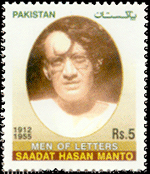
Great post by the Indian journalist and blogger Shivam Vij in Kafila.org, compiling information from several articles, interviews and videos: ‘A Hundred Years of Manto‘. Excerpt:
Where would we be without Manto? He died in 1955 but lives on in the hearts of millions of people in both Pakistan in India because his work has by now helped generations understand, and if I may say so, come to terms with the Partition of 1947 whose ghosts haven’t left us yet. Manto’s centrality in understanding Partition remains despite a growing body of historical research on the subject…
'Saving Face' co-directors, Daniel Junge and Sharmeen Obaid Chinoy: American-Pakistani cooperation wins
My report for IPS, featuring an interview with Dr Mohammad Jawad, published before ‘Saving Face’ premiered on HBO on March 8, International Womens Day
Acid survivors fight back: a story of hope amidst despair
Beena Sarwar
BOSTON, March 8: When the Oscar-nominated film ‘Saving Face’ won an Academy Award in Hollywood Best Documentary (Short Subject), it was the triumph of several ‘firsts’: the first time ever that a Pakistani filmmaker had won an Oscar; Pakistan’s first Oscar winner was a woman; and it was the first time that an American and a Pakistani had co-directed an Oscar-winning film.Continue reading →
Incidentally, Indian expats face the same restrictions.
Story also copy-pasted below.
By Beena Sarwar
BOSTON: India and Pakistan have agreed to ease visa restrictions on each other’s citizens – but until that actually happens, American citizens with dual Pakistani nationality will continue to face what they allege is discrimination by the Indian visa authorities.Continue reading →
A morning show broadcast in Pakistan on Jan 17, 2012, on Samaa, a Pakistani television channel, has catalysed what could well be the beginning of a media consumer rights movement.
In the show, Subah Saverey Maya kay Sath (Early Morning with Maya), the host Maya Khan, charges through a public park looking for dating couples to interrogate. With her is a battalion of other women, who join her in self-righteously lecturing the couples they come across – does your family know you are here, why don’t you meet at home if you are engaged, and, most outrageously, if you are married, where is your nikahnama (marriage certificate)?
When the harassed couples ask for the camera to be turned off, the Samaa team pretends to acquiesce but carries on filming with sound. As several people have pointed out, this intrusive behaviour could result in putting those couples in life-threatening situations in a country where forced marriages and ‘honour killings’ continue to be the norm.Continue reading →
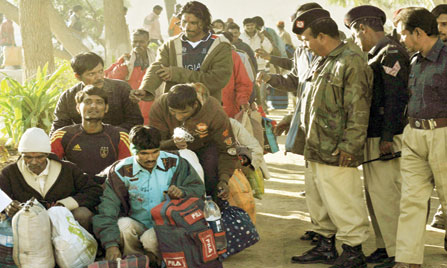
Indian fishermen released from Pakistani prisons, waiting to go back
Below, my article on the India-Pakistan prisoners issue published in Aman ki Asha on Jan 11, 2012, followed by a correction from Sen. Iqbal Haider and further clarification from B.M. Kutty. Also please do read Shivam Vij’s thought-provoking and thorough report ‘Why is Gopal Das free and not Dr Chishty?‘, published in Aman ki Asha, and Anahita Mukherji’s report in The Sunday Times of India about how the Indian prisoners were treated in Pakistan (surprisingly well) – Warm memories of time in Pak jail.
Looking a New Year gift horse in the mouth
Pakistan’s release of 183 Indian prisoners on Jan 7, 2012 is a welcome step but it also highlights the ongoing issues faced by cross-border prisoners Continue reading →
Faisal Khan (in cap) with Tara Gandhi, giving Khudai Khidmatgar membership to Tanzila. Photo: courtesy TCN
The Khudai Khidmatgar (Red Shirts) movement will be launched in India on Jan 20, 2012, marking the 24th death anniversary of the ‘Sarhadi Gandhi’ Khan Abdul Ghaffar Khan, with a membership drive, and addresses by distinguished peace activists, writers and poets Date: January 20, 2012 Time: 3.30-5.30 pm, Place: 5 Tees January Marg New Delhi Contact: +91-9911292235 and +91-999050543
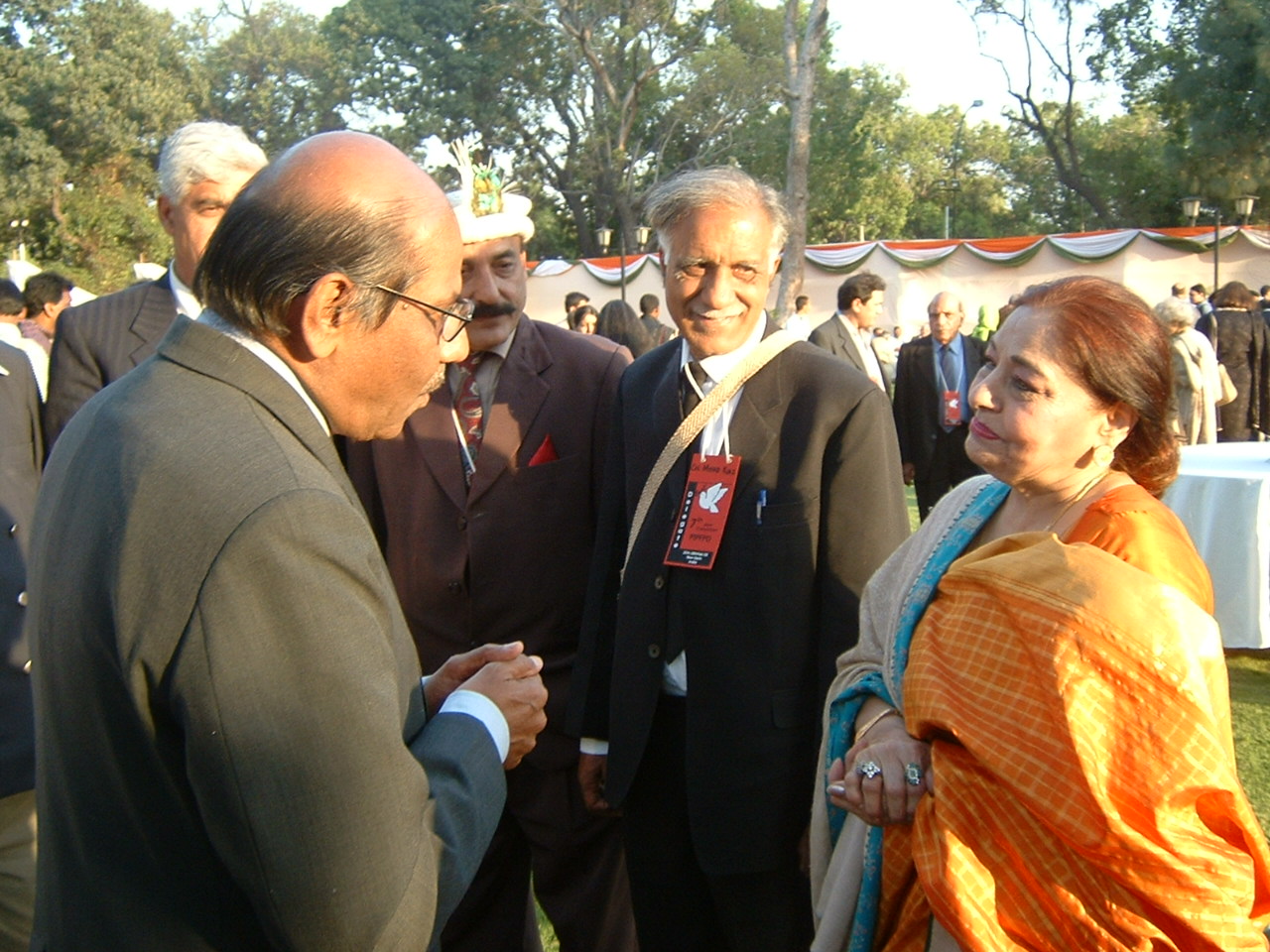
PIPFPD 7th Joint Convention, New Delhi 2005: Pakistani ghazal queen Farida Khanum with then Indian Foreign Secretary Shyam Saran at a reception at Hyderabad House. Photo: Beena Sarwar
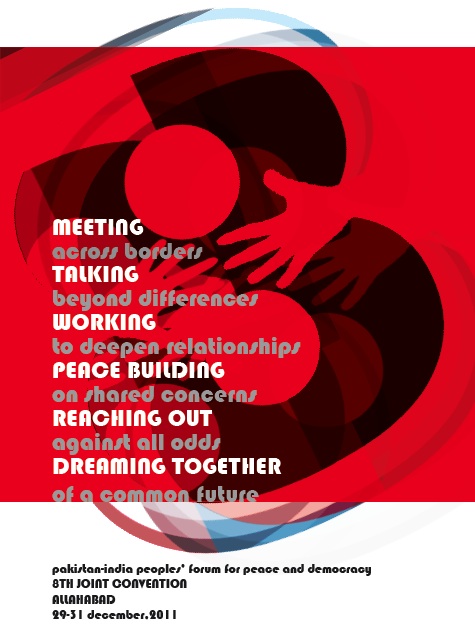
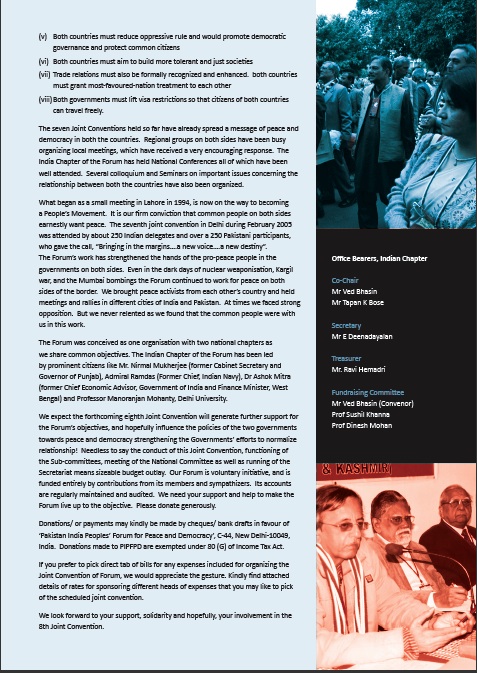
My curtain raiser on the Eighth Pakistan-India People’s Forum for Peace and Democracy (PIPFPD) Joint Convention being held in Allahabad, India, Dec 29-31, 2011 (slightly shorter version published as an op-ed in The News). When the name was being decided, the Indians insisted that Pakistan should be mentioned first, rather than the usual formulation that places India’s name first. This apparently trivial gesture typifies the PIPFPD’s cooperative spirit.
People for peace | By Beena Sarwar
The Indian government’s clearance of visas for 237 Pakistanis to attend a major peace convention in Allahabad, Dec 29, 2011 to Jan 1, 2012, is a welcome step, allowing the much-delayed Eighth Joint Convention of the Pakistan-India People’s Forum for Peace and Democracy (PIPFPD) to finally be held.
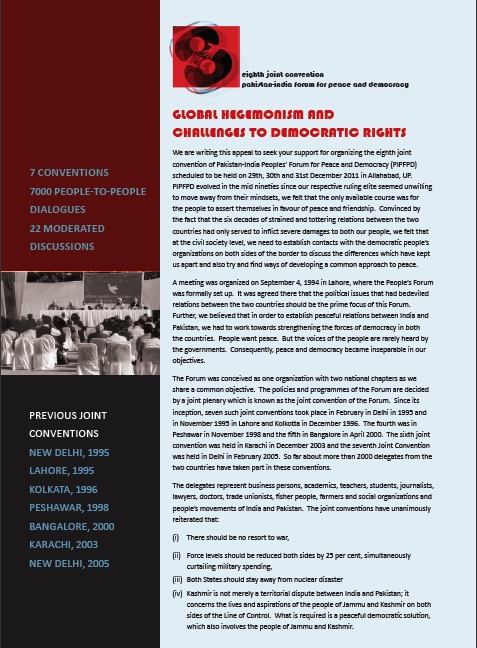
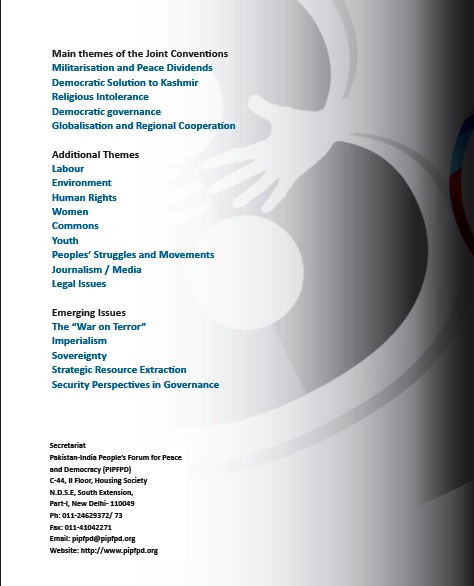
The PIPFPD is the largest people-to-people organisation between the two countries, formed in 1994 by eminent intellectuals, academics and activists from both sides. Discussions at the Joint Conventions revolve around issues ranging from ‘war, de-militarization, peace and peace dividends’, to ‘Democratic solution to Kashmir problem’, ‘Democratic Governance’ and ‘Religious intolerance in India and Pakistan’. ‘Globalization and Regional co-operation’ was added at the 5th Joint Convention in 2000 at Bangalore.
The principles laid out in the initial PIPFPD Declaration of 1994 are even more relevant today than they were then: that the “politics of confrontation between India and Pakistan has failed to achieve benefits of any kind for the people of both countries”, and that the respective governments should honour the wishes of their people who “increasingly want genuine peace and friendship”.
Better relations, said the Declaration, “will help in reducing communal and ethnic tension” and “will help the South Asian region to progress economically and socially”. The Declaration urged the Governments of Pakistan and India to “agree to an unconditional no-war pact immediately” and to recognise that “a democratic solution to the Kashmir dispute is essential”.
Over 200 Pakistani and Indian delegates participated in the groundbreaking First Joint Convention in New Delhi, 1995. For the first time, Indians and Pakistanis sat together to freely discuss the contentious issues of Kashmir, demilitarization, and the politics of religious intolerance. PIPFPD’s formulation about Kashmir is now part of public discourse: that Kashmir should not be viewed merely as a territorial dispute between India and Pakistan but as a matter of the lives and aspirations of the Kashmiri people, who must be involved in any discussion about their future.
The seven joint Conventions held since in various cities across the region, alternating between both countries, have involved hundreds of ordinary citizens. Delegates pay for their own travel expenses, while the hosts arrange inexpensive board and lodging. These Conventions have yielded not only lasting relations between individuals but also spawned dozens of Indo-Pak organisations and meetings between different ‘sectors’ – fisherfolk, teachers, students, journalists, doctors, lawyers, labour unions, rights groups and others.
It was PIPFPD’s First Joint Convention in New Delhi in 1995 that led to the first regular column by an Indian journalist in a Pakistani newspaper (The News on Sunday) since the 1960s. Today, most newspapers and TV channels in Pakistan have correspondents, stringers and resource persons in India, and vice versa.
Initial delays to the Eighth Joint Convention came from Pakistan, where it was supposed to be held in Peshawar in 2007, after the Seventh Joint Convention in New Delhi in 2005. The political situation provided justifications to deny the necessary permission: escalation in the ‘war on terror’, the lawyers’ movement, the return and then the tragic assassination of Benazir Bhutto, and escalating violence in Pakistan as the new government tried to tackle the militants unambiguously.
When it became clear that trying to hold the Convention in Pakistan would add to more delay, the organisers decided to move it to India. That took over a year and much negotiation. Conditions were verbally set out and apprehensions voiced about the possibility of ‘wrong speeches’ being made – not just by the Pakistanis but by Indians. However, those raising the objections were unwilling to spell out their apprehensions in writing.
In the end, persistence and people pressure paid off. Several Indo-Pak events have been held over the past two years, including by Aman ki Asha. Many were initiated by Indians, contrary to the perception that “Indians don’t care about peace with Pakistan”.
Significantly, some of the most inspiring initiatives have come from Mumbai, a city still reeling from the horrific attacks of Nov 26-28, 2008 that many Indians squarely blame Pakistan for. However, many Indians, including Mumbaikars, argue that all Pakistanis should not be held responsible for the actions of a few.
An extraordinary expression of this spirit was the 50-kilometre long ‘human chain for peace’ formed by some 60,000 Mumbaikars on Dec 12, 2008, urging the Government of India to show restraint in dealing with Pakistan — just days after the attacks that claimed 164 lives and left over 300 wounded. This hugely impressive event was overshadowed by the jingoism amplified by the media, but the Indian government did not (for several reasons) pander to those baying for action against Pakistan.
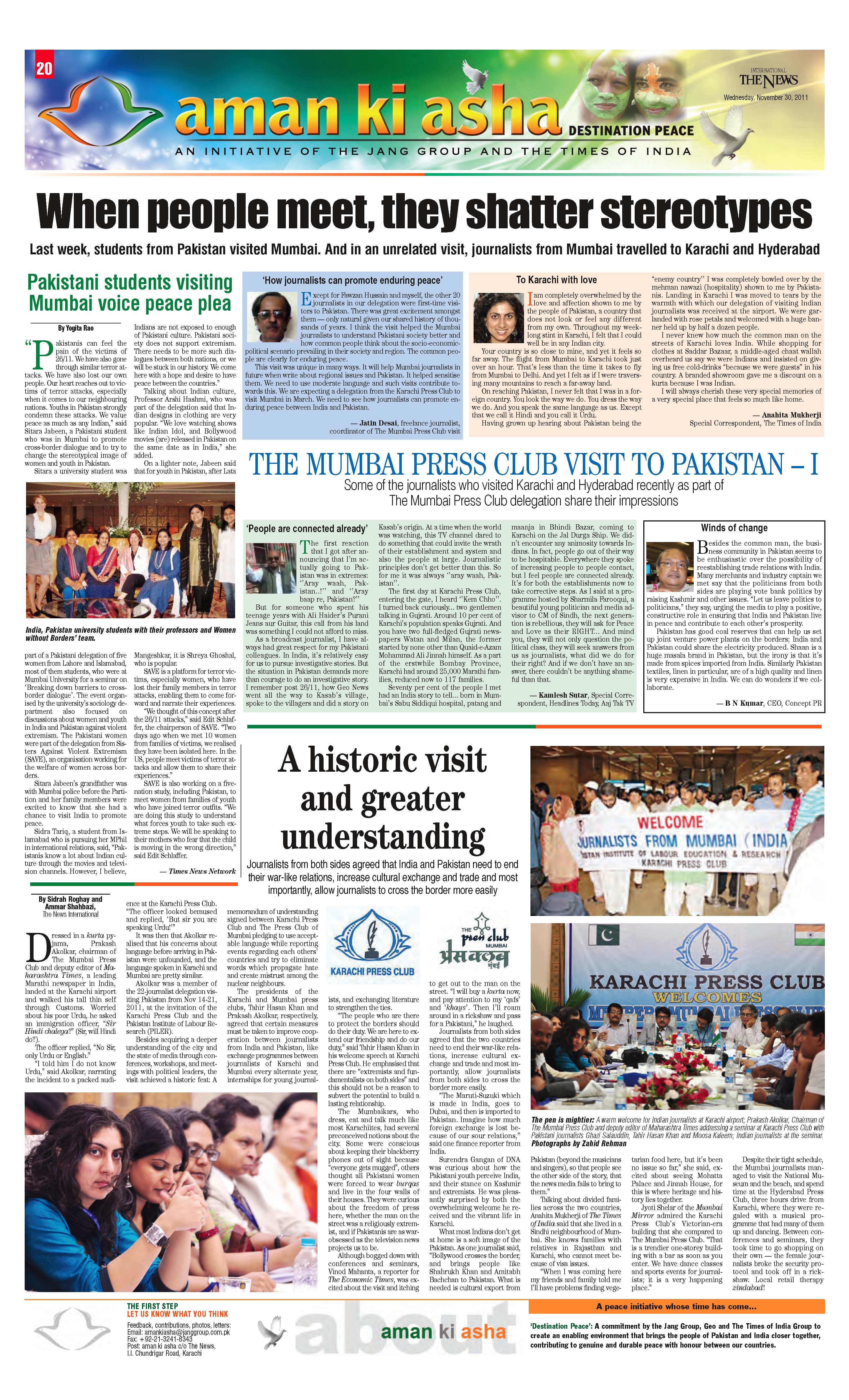
Earlier this year, students from Mumbai came up with a pioneering initiative they called ‘Ummeed-e-Milaap’ (hope for unity), a platform for Indian and Pakistani students to connect, in over 30 colleges in Mumbai, Lahore and Karachi. Last month, a 22-member delegation of journalists from The Press Club of Mumbai travelled to Pakistan to connect with colleagues in Karachi and Hyderabad, culminating in a joint Declaration of Cooperation.
The world is changing. The old paradigms and policies based on paranoia and hatred must give way to a realisation that it is only with cooperation with each other that India that Pakistan can fulfil their respective potentials. The Seventh Joint Convention articulated some visionary steps that both governments can take towards this end (see www.pipfpd.org). The Allahabad Convention will take forward these demands, foremost among which is easing the current restrictive visa regime.
We have seen what happens when thousands of cricket fans are given visas to attend matches across the border: nothing, except for goodwill and a reaffirmation that the people are ready for good relations and personal contacts. As the Allahabad Convention gets under way, do our governments have the political will and vision to follow the people to peace or will they remain mired in outdated security state paradigms?
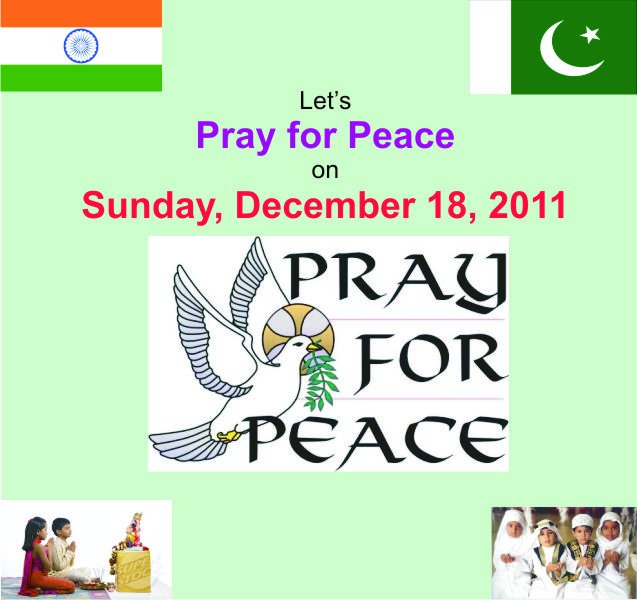
From Indian actor Nandita Das in Mumbai, to peace groups and individuals all over India and Pakistan, and in countries as far away as Korea, Australia, Canada and America, thousands are supporting Pray for Peace Between India and Pakistan Day on Sunday, Dec 18, 2011.
Inspired by the idea of the power of collective prayer or meditation, Toronto-based Swati Sharan randomly picked the date several months ago. “These prayers can be done from anywhere on the globe by any one, of any nationality… the more people pray for something at a given time, the greater the difference it can make,” she wrote in an initial article in May explaining the idea, Continue reading →
Here are PDFs of two recent Aman ki Asha pages that I tried to email to the Mumbai journalists who visited Pakistan recently, as the pages feature their responses. Since the second PDF file was for some reason too large to email, I’m posting both of them here. Click these links for the PDFs:
Come to think of it, that’s not a bad idea anyway. Maybe I should upload more of these pages. The content is all available on the Aman ki Asha website anyway, but there you can’t see the great layouts the designers have been doing.Continue reading →
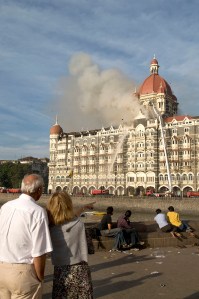
On the third anniversary of the Mumbai terror attacks of Nov 26, 2008, a NATO air strike in Pakistan killed 24 Pakistani soldiers. NATO says its helicopters were providing air cover to troops on the ground chasing insurgents; Pakistan says that the strike was a deliberate violation of its sovereignty (the question is, why?). The loss of human lives in any circumstances is tragic; sincere condolences to the families of the soldiers killed. Coming on the heels of ‘memogate’, this is not going to help US-Pakistan relations. Let’s hope that the political leadership is not swayed by the hysteria deliberately being whipped up by certain sections (as usual).


 Great post by the Indian journalist and blogger Shivam Vij in Kafila.org, compiling information from several articles, interviews and videos: ‘A Hundred Years of Manto‘. Excerpt: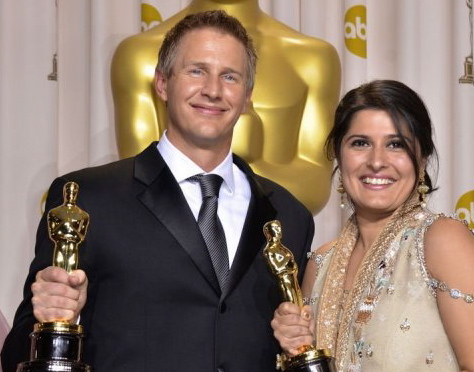



 Journeys to democracy