Solidarity with Sri Lanka

The situation in Sri Lanka is really dire. We at Sapan issued this statement 02 June – posted to website. Pls share widely: Southasians express solidarity with Sri Lanka, concern about economic and humanitarian crises.

Excerpt: “Amidst all the tension and uncertainty, it is important to note the undercurrent of hope enabled by the active engagement of individuals, organisations and civil society calling for accountability and good governance.” 

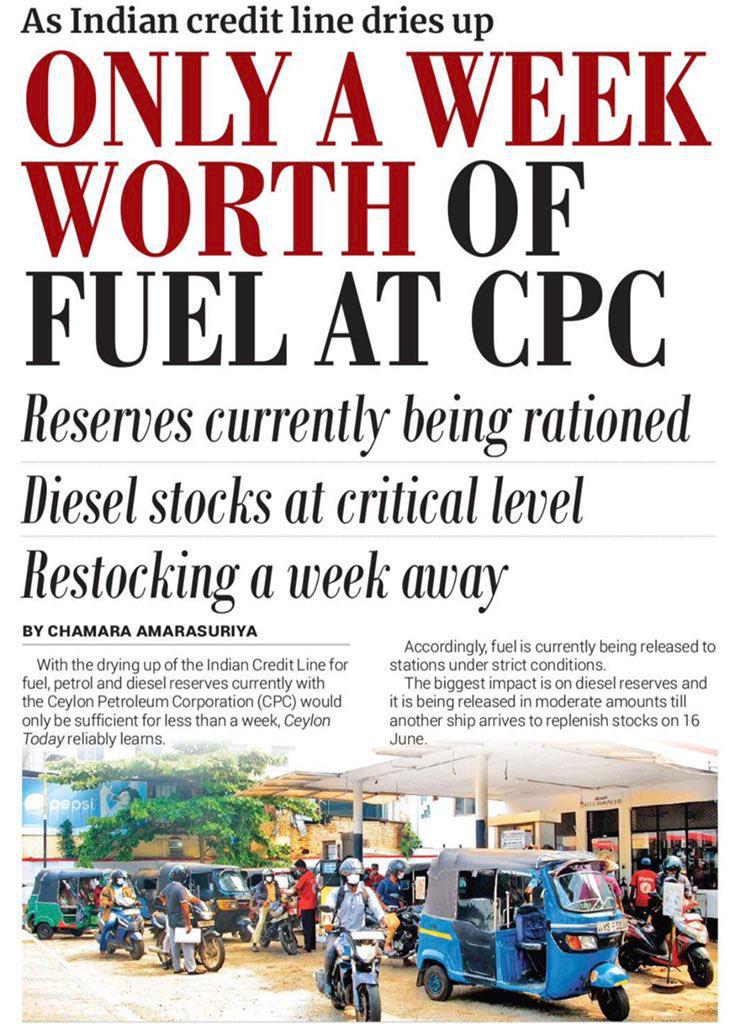
Here’s the scan of a report shared just now by a friend waiting in a petrol queue – the Ceylon Petroleum Corporation has only a week’s worth of fuel left:

She also shared a short piece from the Daily Mirror today. Excerpt:

“The people of Sri Lanka deserve to live their lives without these politically-triggered interruptions.  Towards that end, I implore international companies that Sri Lanka works with to not divert business from here when we need their support and partnership the most.  Hopefully tourists will return once the country finds stability.  The wonders of this country still remain as beautiful, unmarred by the constant disruption.”  – Paradise Disrupted

A 58-year old daily wage labourer who lives in a single room on the outskirts of Colombo with her husband shares how they’ve had to switch from cooking with gas, to kerosene, and now firewood. Her husband forages for vegetables and edible leaves on his way home from work. See her story at: Financial Pandemic: ‘Sri Lanka is not a country for poor people now’, The Fuller Project, 20 May, 2022.

Kabir festival in Boston this weekend

UPDATE 11 June: Due to rain Kabir Festival postponed to Sunday June 19,2022. Please inform everyone

Some friends have been working hard on the upcoming Kabir Festival in Cambridge MA. Excited for it and fingers crossed it doesn’t rain. Our weekly Wednesday meeting this time focused on Kabir, and they showed this documentary by Kashif ul Huda, TwoCircles.net

Details about the Kabir Festival in the press statement below:

Kabir Festival 2022: Celebrating the humanistic values of an ancient mystic

Event poster

BOSTON: A cultural event to commemorate the birth anniversary of Kabir Das, an ancient South Asian mystic and social reformer will take place Sunday, 12 June 2022, at Danehy Park, Cambridge MA.

The Kabir Festival 2022 honors the values propagated by Kabir Das, a 15th century poet whose message of humanism, fraternity, love, harmony and equality resonates today in a world that is in many ways much like his. Then as now, great and astonishing changes were taking place, causing anxiety, fear, strife and dislocations.

Kabir’s message of humanism, fraternity, love, harmony and equality resonates today in a world that is in many ways much like his. Then as now, great and astonishing changes were taking place, causing anxiety, fear, strife and dislocations.

Ahead of Kabir’s birth anniversary on 14 June 2022, several individuals and organizations of the South Asian community are organizing a Kabir Festival in Cambridge. The organizers hope to bring Kabir’s message of peace, harmony and love to people in our troubled times.

The festival includes performances by local musicians, singers and artists. The event is free and open to the public. All are welcome.

The outdoor gathering will observe Covid-19 guidelines as per the City of Cambridge.

Participating organizations include Learn Quest Academy of Music, New England Hindi Manch, Kabir Society, Sanjha Punjab, Southasia Peace Action Network, Subdrift Boston, Boston Study Group and Jago World.

Contact: Rupal Shah: Email – south-asian-center@googlegroups.com

Sapan News

The Wednesday discussion also shared this music video by the Kabir Cafe in Mumbai:

May Day and Eid greetings: Solidarity with workers around the world and Southasia

It was activist friend Kavita Srivastava in Jaipur who suggested focusing on ‘Labour Rights and Democracy’ for our April event ahead of May Day. Like all Sapan events since launch in March 2022 – the Southasia Peace Action Network – this was also on the last Sunday of the month.

As usual, we live-streamed the discussion on FB – video at this link. We truly appreciate all the ‘likes’, comments and shares that help ensure that our voices are heard amidst the din.

Thanks to old friend and talented musician Arieb Azhar in Islamabad for agreeing to sing at the last minute. Dhonobad Khushi Kabir in Dhaka for transliterating the first verse of the workers’ anthem, The Internationale in Bangla for him. She knows them all by heart. Arieb also sang some of his own verses in Urdu, reflecting contemporary realities. He’s doing an English translation to add. Here’s the clip – thanks Priyanka Singh in Delhi for uploading it so fast.

Priyanka has a great affinity for music and poetry – she was reciting a poem at the online PIPFPD event in January 2021 where I first ‘met’ her. Not surprised she also took time out to post the extempore song by young Lucky Akter in Dhaka ended her presentation with. A former former student activist working with Bangladesh’s oldest and largest peasant organisation, Lucky’s stirring call for rights is lovely even if you don’t understand Bangla.

Continue reading

Evoking the madness of Manto, what we need is ‘one big roar of laughter across Southasia’

Sharing a feature I co-wrote with Priyanka Singh in Delhi about Sapan’s last event on the first anniversary of the Southasia Peace Action Network. The next one, on labour rights and democracy, will take place on the last Sunday of April.

Southasia Peace Action Network's avatarSouthasia Peace Action Network

Artists, journalists, sportspersons, healthcare workers, educators, businesspersons, students, gather for the first anniversary of a Southasian peace coalition.

By Beena Sarwar and Priyanka Singh

April 9, 2022, Sapan News Service: “Each of our countries is facing moments of total insanity and the only recourse is laughter – one big roar across Southasia,” said arts educator Salima Hashmi of Lahore, speaking at an event organised recently to mark a year of Sapan, the Southasia Peace Action Network

“To see the ludicrousness of Southasia right now,” she said, we need the “dark humour” of the great storyteller Saadat Hasan Manto.

The online discussion tackled various themes in nine breakout sessions, even as Pakistan plunged into a constitutional crisis and Sri Lanka into an economic tailspin.

“It’s us the little people who can say the emperor has no clothes, and laugh at the demi-gods pretending to be gods — because they…

View original post 1,665 more words

Pakistan Constitution upheld – for now

Rajdeep Sardesai: A stable Pakistan is in India’s interests. Screenshot by Tej Kaul from yesterday’s show.

Thanks to the Pakistan Supreme Court for the unanimous judgement upholding the opposition’s right to a no-confidence motion and declaring as void the ruling party’s attempt to dissolve the assembly and hold fresh elections. The situation had many of us on tenterhooks given its potential to disrupt the democratic political process that has only just begun taking hold in the country.

Since 2008, only two cycles of elected governments have completed their term and handed over power to the next one without the assemblies being dissolved. Imran Khan was the third political leader to grasp the baton of this relay. If he passed the baton on to the next elected government that would be a historic hat-trick in Pakistan’s history and hopefully strengthen the process and pave the way for it to continue. He can still redeem himself by doing that after losing the no-confidence move on Saturday and stepping into the opposition.

Of course elections aren’t the be-all and end-all of a democratic political process. But as the wise know, the process is crucial. As a sportsman, Imran Khan should know that the game is only an event that needs an ongoing, continuous process of rigorous, consistent training.

Unfortunately the former captain of the Pakistan cricket team has turned out to be a sore loser. My commiserations to his supporters, many of whom had placed their hopes in him to improve the system. They need to recognise that an individual can’t do this alone. He has to work with others, and needs to pick the right people for his team. And stay in the game.

I shared my views on Al Jazeera last Sunday, and yesterday on a panel discussion with Rajdeep Sardesai at India Today, both linked here.

(ends)

Let’s teach our kids about peace before someone else teaches them to hate

Sharing a piece I wrote with Rahul Mukherji in Kolkatta pegged on April 6 – #WhiteCard International Day of Sport for Development and Peace. A Sapan syndicated feature.

Southasia Peace Action Network's avatarSouthasia Peace Action Network

By Rahul Mukherji and Beena Sarwar

April 7, 2022, Sapan News Service: On 6 April 2022, an 11-year-old boy in Islamabad and 8-year-old in Kolkata raised White Cards to each other, in support of the International Day of Sport for Development and Peace.

In doing so, Arman in Pakistan and Riaan in India were not just making a gesture of peace and friendship towards each other, but for their countries, and the world.

Tweet by Aman ki Asha (@amankiasha_1) on 6 Apr 2022.

The heartwarming little video shared on social media was one among millions of #WhiteCard photos and videos being posted that day as symbolic gestures calling for peace through sports around the globe. Participants included world champions, Olympic champions, sportspersons and fans.

In 2013, the United Nations General Assembly createda historical link to the first modern Olympic Gamesof 1896 by declaring 6…

View original post 436 more words

Sara Suleri bows out

Sharing personal memories of the brilliant Sara Suleri whose genre-defying book Meatless Days inspired generations of writers, feminists, memoirists and dislocated Southasians. Thanks Ailia Zehra at The Friday Times for asking me to write this piece. Published as a Sapan syndicated feature in TFT, The Wire, Geo TV blog, South Asia Monitor and The Print – shared here with additional pix and links.

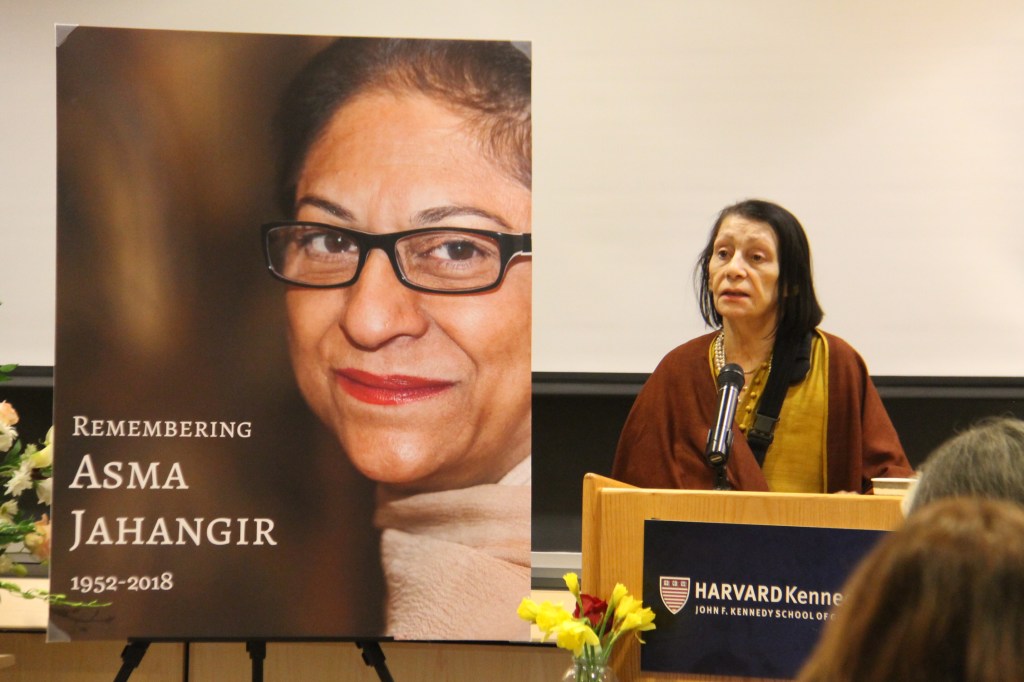
February 2018: Sara Suleri pays tribute to Asma Jahangir. Photo: Beena Sarwar.

PERSONAL-POLITICAL

By Beena Sarwar

March 25, 2022, Sapan News Service:

Aur bataiye” – tell me more, a polite invitation to keep talking. I can hear her voice, perhaps naturally husky, made deeper with years of cigarette smoking and perhaps more recently with pain and other medications.

She’d send her love to Pakistan whenever I’d call before flying out from Boston, where we had both ended up around ten years ago – she after retiring as Professor Emeritus of English from Yale University. I had transplanted myself from my home city Karachi where I was editing Aman Ki Asha, hope for peace – between India and Pakistan.

“Dream on!” I hear Sara say. And yet, she agrees, it’s important to keep going. She’s also a hundred percent supportive of our push for a regional approach – the South Asia Peace Action Network, or Sapan, the more recent endeavour, launched last year with a wonderful group of inter-generational, cross-border peacemongers.

Continue reading

Sapan Logo competition: Submit your logos for a good cause and win a cash prize!

Hello designers out there – here’s a chance to contribute to a great cause AND win recognition plus prize money. As Sapan, the South Asia Peace Action Network turns one (yes, already!) we’re looking to re-vamp our logo. So we launched a logo competition. Deadline: 25 March 2022. See details in the shared post.

We love the logo that a volunteer created on short notice – not a designer but a law student then. Note: This isn’t a commercial proposition but one of our youngest volunteers wanted to add a cash prize incentive and pledged a contribution. Others followed so we have a little money in our kitty for the winner. p.s. More contributions welcome.

#logo #designers #competition

Southasia Peace Action Network's avatarSouthasia Peace Action Network

Deadline for submissions: March 25, 2022

Announcing a design contest to create a novel, catchy logo for Southasia Peace Action Network (Sapan).

The competition winner will receive a certificate and will be listed on Sapan’s website and social media platforms. There is also a nominal cash prize, amount to be disclosed later as pledges are coming in.

We will use the logo on our website, social media marketing, and other purposes.

Designers are free to choose any fonts, color combinations, and symbol options. The logo must include a symbolic component that is recognizable without the name “Southasia Peace Action Network” next to it.

Sapan vision: See Founding Charter

Contest timeline

  • March 9-25:Submit entries by email to southasiapeaceactionnetwork@gmail.com
  • March 25:The logo is up on social media for voting
  • Based on the points from the social media vote and jury, the final winner will be announced by March 31, marking…

View original post 388 more words

From the Zia dark years in Pakistan to the ‘hijab row’ in India

I was initially hesitant to add my two bits to the ‘hijab row’ in India about which so much has already been written. But I’m glad I did – gained a lot of insights and info that I tried to share with a wider audience. Thanks to Ullekh NP, Executive Editor at Open Magazine in India for prodding me. Published 25 Feb with the headline Hijab Row in India: Just Like Us, with a powchaerful illustration copied below. I’m thrilled that my SAWM sisters, the South Asian Women in Journalism, liked it enough to share it on their website under Article of the Day category. Posting the essay below with materials not used in the Open article, including my 1983 (or was it ’82?) piece in The Star with my own illustrations, HUNDRED AND ONE USES OF A CHADDAR, and link to Fahmida Riaz reciting her poem.

Illustration by Saurabh Singh for Open Magazine

WOMEN ACROSS SOUTH Asia and beyond have for centuries loosely covered their heads and bosoms, regardless of religion, shielding themselves from unrelated men as well as from the hot sun.

Those entering the work force in urban areas have been quicker to shed traditional attire. Those who find these changes threatening sometimes find ways to keep women in their place. Religion offers a convenient pretext.

The more conservative Muslim women in South Asia also traditionally wore a burqa, more all-enveloping than a chaddar or dupatta. My grandmother in Allahabad, U.P., used to wear a brown burqa that she discarded eventually in Karachi.

Growing up in Pakistan under the military dictatorship of Gen. Ziaul Haq, 1977-88, women like me have first-hand experience of such tactics. We watch in horror as shadows of the ZIa dark years seem to spread across the border into India.

Continue reading

Chakwalians, Rotarians to gather for “a tsunami of peace” reunion at Kartarpur Corridor

Gurdwara Darbar Sahib Kartarpur: Bringing people together. Image credit: Facebook/@syed.alli

Dozens of Indians and Pakistanis with ancestral roots in Chakwal will meet up mid-week at Kartarpur Darbar Sahib in Pakistan, taking advantage of the visa-free corridor inaugurated in November 2019 by Prime Minister Imran Khan for Baba Guru Nanak Dev’s 550th birthday celebrations.

Delhi-based Rotarian Anil Ghai, whose own family has strong connections to Chakwal since before Partition in 1947, will lead the Indian delegation.

The family had to flee with whatever belongings they could take, in a Dakota aircraft, remember area natives. Ghai’s visit to Pakistan in 1996 had led to rekindling those ties.

The establishment of Chakwal International Group about six months gave momentum to the upcoming ground-breaking meeting planned for Wednesday, 23 February.

“Everyone is welcome, they do not have to be Rotarians,” says Mohammed “Mo” Ayyaz, a Rotarian in London who is also from Chakwal and one of the driving forces behind the initiative.

Continue reading