Amateur theatre group from Pakistan tours USA with Partition stories

My article on Islamabad-based group Theatre Wallay’s theatre project ‘Dagh Dagh Ujala’ (This Stained Dawn), that toured the US recently, published in Scroll.in today – Partition retold: A Pakistani theatre group dramatises survivor stories to shatter myths. Below, the unabridged version filed on Oct. 26.
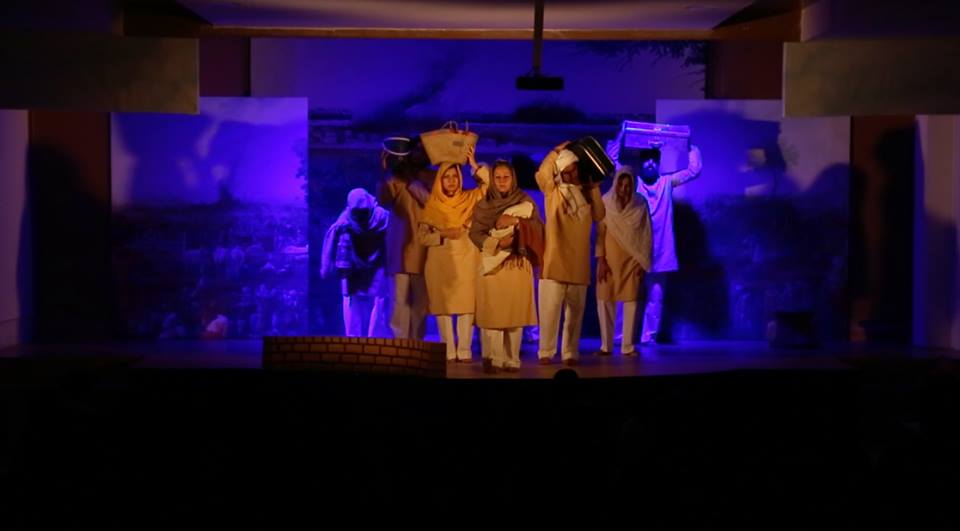
DaghDagh Ujala-Isbd

Scene from the play, Islamabad performance. Photo courtesy: Fizza Hasan

Beena Sarwar

An amateur theatre group in Pakistan has started its tour of the USA with a dramatisation of Partition stories based on interviews of Partition-survivors by group members.

The play’s title Dagh Dagh Ujala’ (This Stained Dawn) refers to the first words of the Urdu poem ‘Subh-e-Azadi’ (Dawn of Freedom) by the acclaimed poet Faiz Ahmed Faiz. Penned in 1947 on the eve of India’s Independence from British rule and its bloody partition, the poem is popular on both sides of the border. Continue reading

‘Brain drain’ — a blessing or a curse?

Brain drain — Blessing or curse?
Read the full article here, as well as the accompanying pieces by Raza Rumi and others.

Lift the goodwill: Indians, Pakistanis find creative ways to protest hate, violence, bigotry

Dunkin' Donuts sign in Islamabad with the Pakistani and Indian flags: peace meals

Dunkin’ Donuts sign in Islamabad with the Pakistani and Indian flags: peace meals

The right-wing Shiv Sena’s recent vigilante actions targeting Pakistani musicians, sportspeople, and diplomats in Mumbai have led to embarrassment and widespread condemnation in India, and of course to the right-wing in Pakistan gleefully pointing fingers at India.

There have also been compassionate and creative responses from Pakistanis, who have all too often suffered the poison of bigotry and injection of religion into politics.  After a Pakistani family had to spend the night on the footpath in Mumbai because they lacked the requisite papers (Form C) allowing them to stay in a hotel, Pakistani entrepreneur Iqbal Latif responded by offering free meals to Indians visiting Pakistan at his Dunkin’ Donuts franchises. His gesture was widely reported and drew a massive response in India.

A friend in India points out that the hyped up anti-Pakistan protests are a predictable forerunner to the upcoming state elections in Bihar and Uttar Pradesh that are critical for the ruling coalition in particular. That may well be the case, but meanwhile, Indians are also finding ways to creatively and peacefully express their distaste for bigotry and hooliganism. After the Sena successful blocked respected Pakistani musician Ghulam Ali’s concert in Mumbai, one Indian made a painting that he tweeted:  Continue reading

The real cost of conflict in South Asia

My article on the symposium I attended last week at University of Texas, Dallas, published in Aman ki Asha

The real cost of conflict in South Asia

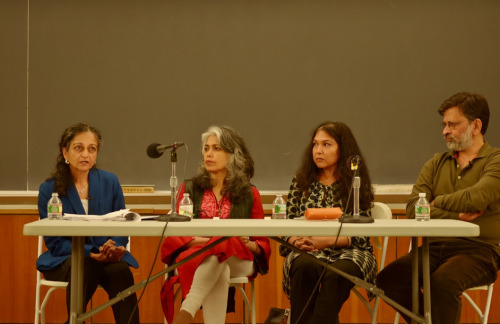
Peacetalks symposium: Raza Rumi, Pritpal Singh, Amitabh Pal, Nyla Ali Khan. Photo by Beena Sarwar

By Beena Sarwar

Born in the Rawalpindi area in 1943, Suresh Bakshi was about four years old when his family left their ancestral home after Partition in 1947. But he still remembers and has strong feelings for the place where he was born.

These feelings created a powerful conflict when, as an Indian Army soldier, he fought in the 1965 war against Pakistan. Continue reading

Rahul Roy: Addressing “masculinities” through film

My blog post for Harvard South Asia Institute on Rahul Roy’s documentary film series on ‘masculinities’
Filmmaker Rahul Roy, right, captures in his films the nuances, masculinities and realities in a slice of urban life over the years.

Filmmaker Rahul Roy, right, captures in his films the nuances, masculinities and realities in a slice of urban life over the years. Photo: Ashima Duggal

By Beena Sarwar

Indian filmmaker Rahul Roy first met and began filming four young men in 1999 for his documentary film When four friends meet, interacting with them and filming for about two years in the Delhi slum where they live. He stays in touch with the four – Sanjay, Sanju, Kamal and Bunty – over the years and 12 years later, returns to do a sequel titled Till we meet again. Continue reading

Rest in peace, Shahab Ahmed, prominent Islamic scholar from Pakistan

A beautiful sunny day…  and Shahab Ahmed’s funeral. His friends, including prominent scholars some of whom had known him for decades and traveled long distances to be there, like Kamran Ali Asdar and Shahnaz Rouse; many from Harvard like Homi Bhabha, Parimal Patil, Asad Ali Ahmed, Martha Minnow, Asim Khwaja; students and former students now themselves teachers; family members; all devastated and in shock. We were together in this panel at Harvard on the ‘blasphemy’ issue a few years back. I had last heard from him in July when his then fiancé Nora replied on his behalf to an email I’d sent. That’s when I learnt he was ill in hospital. My report today, basically just getting the facts out for now. Thanks to Nora for sharing his biographical details and photo at her time of grief. (NOTE: Updated below with comments from Michael Cook, his dissertation advisor, and others):

Prominent Islamic scholar Shahab Ahmed laid to rest

Shahab Ahmed-Photo by Rehan Lashari

Shahab Ahmed in Pakistan. Photo by Rehan Lashari, courtesy Nora Lessersohn

Prominent Islamic scholar Shahab Ahmed, originally from Pakistan, was laid to rest on Saturday morning at the historic Mt. Auburn cemetery in Cambridge, Massachusetts, his adopted home. Born in Singapore on Dec 11, 1966, he passed away on Sept 17, 2015 in Boston.
Continue reading

‘A Bangladesh tragedy with universal resonance’

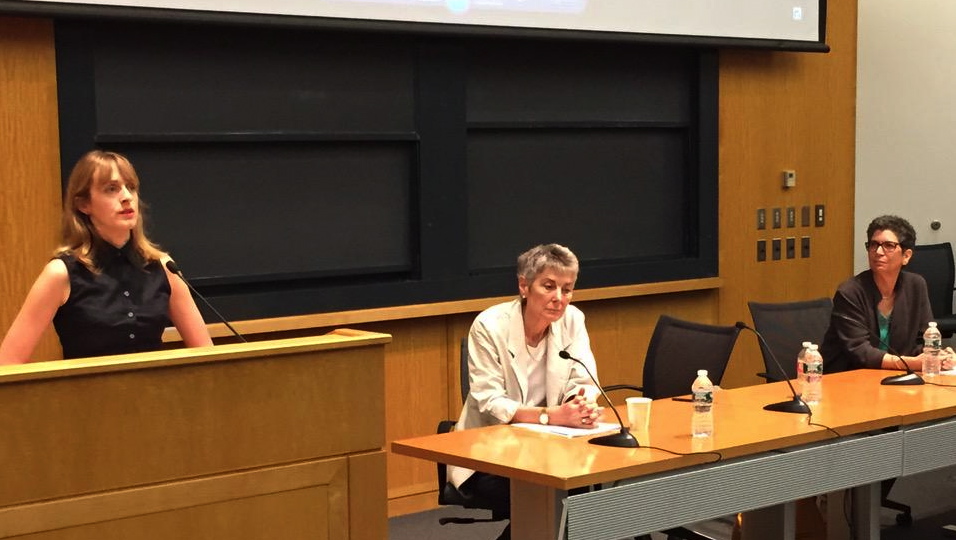
Zara Hayes introducing "Clothes to Die For", with Jennifer Leaning and Ruth Barron.

Zara Hayes introducing “Clothes to Die For”, with Jennifer Leaning and Ruth Barron.

I wrote this piece recently for the Harvard South Asia Institute after attending the screening of a documentary film on the Rana Plaza tragedy in Bangladesh, “Clothes to Die For”. The screening was followed by a discussion with the filmmaker, Zara Hayes whom I’d assumed was Bangladeshi but turned out to be British – “I get that all the time,” she told me.  Continue reading

Pakistani, Indian citizens appeal: “Let’s talk peace”

Over 400 artists, writers, activists, academics, lawyers, businesspeople, journalists and students from Pakistan and India appeal to their governments, fellow citizens, politicians and media to strive for peaceful relations between the two countries

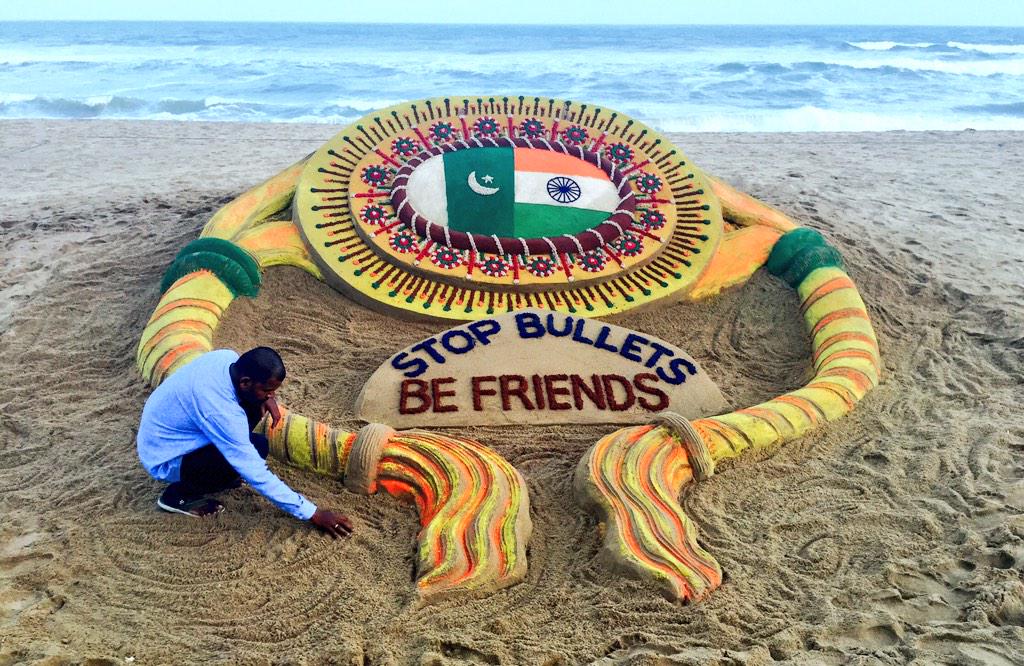
Sand artist Sudarsan Pattnaik’s piece for Raksha Bandhan at Puri beach, Odisha, with a message urging India and Pakistan to “Stop Bullets, Be Friends”

Sand artist Sudarsan Pattnaik’s piece for Raksha Bandhan at Puri beach, Odisha, with a message urging India and Pakistan to “Stop Bullets, Be Friends”

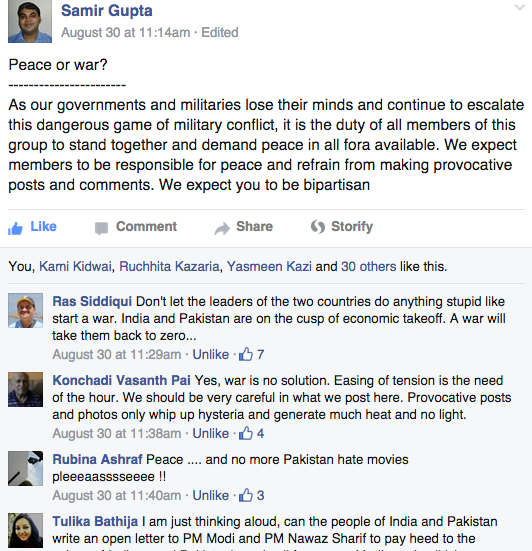
It started out as an admin note to members of the Aman ki Asha Facebook group, by volunteer moderator Samir Gupta on August 30, 2015. The pinned post he put up on the AKA group wall read:

Screen Shot 2015-09-01 at 3.23.14 PM“Peace or war?
———————–
As our governments and militaries lose their minds and continue to escalate this dangerous game of military conflict, it is the duty of all members of this group to stand together and demand peace in all fora available. We expect members to be responsible for peace and refrain from making provocative posts and comments. We expect you to be bipartisan”

Several group members commented there, expressing their support for the idea. Continue reading

Something to celebrate

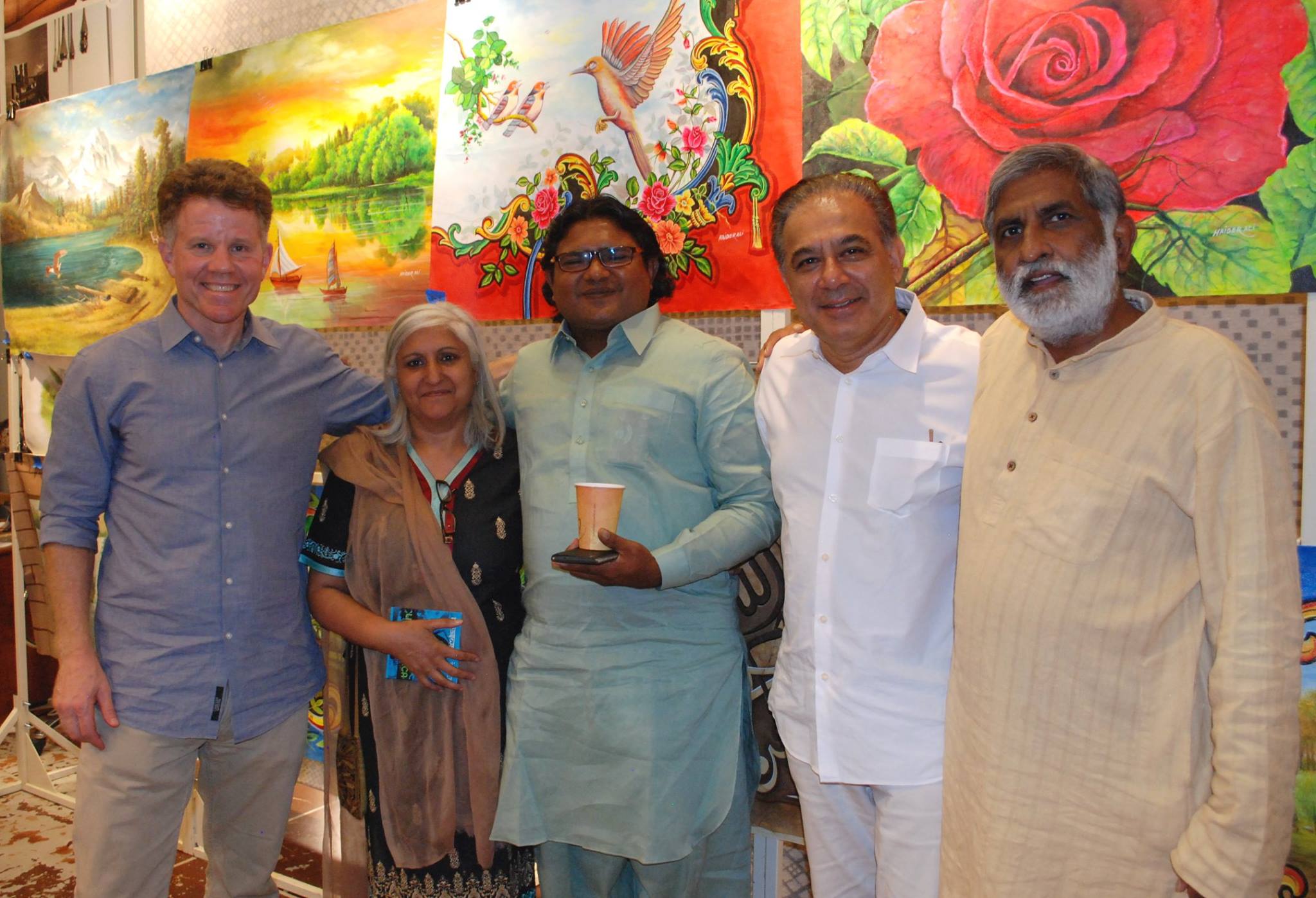
Celebrating Indian and Pakistani Independence Days with Karachi Truck Artist Haider Ali and friends at Dover Rug (L-R): Ken Shulman, Hardeep Mann, Haider Ali, Mahmud Jafari, Jaspal Singh. Photo: Beena Sarwar

Celebrating Indian and Pakistani Independence Days with Karachi Truck Artist Haider Ali and friends at Dover Rug (L-R): Ken Shulman of Away Games, Hardeep Mann, Haider Ali, Mahmud Jafari, Jaspal Singh. Photo: Beena Sarwar

A friend points out that my last few posts have been about death and loss. Then with Pakistan and India’s Independence Days coming up (Aug 14 and 15 respectively) someone asked, ‘What’s there to celebrate?’ My response: Yes, there is much to mourn, and sometimes there doesn’t seem to be that much to celebrate. As Jimmy Engineer says, the fight between good and evil is an eternal one. Doesn’t mean we stop living. When Indians and Pakistanis jointly Celebrate India, Pakistan Independence Days for Peace, Aug 14-15, 2015, it symbolises the desire to own an occasion that has been appropriated by hyper-nationalist, jingoistic war-mongers. Through this joint commemoration and greeting and wishing each other, we defy our government and security establishments’ efforts to create a negative narrative about ‘the other’. That, surely, is something to celebrate. Continue reading

PAKISTAN: CAPITAL PUNISHMENT: It’s not just about Shafqat

My oped in The News, Pakistan below. Also see my earlier piece on the issue in in Scroll – Clamour to hang Shafqat Hussain reflects vengeful mood in Pakistan after Peshawar attacks

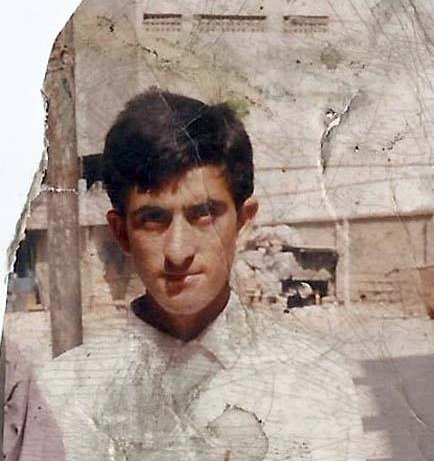
Shafqat Hussain - more than 10 years ago, before he left his village in AJK

Shafqat Hussain – more than 10 years ago, before he left his village in AJK

PAKISTAN: CAPITAL PUNISHMENT
It’s not just about Shafqat

by  Beena Sarwar

Shafqat Hussain is due to be hanged — for the seventh (not fifth, as I wrote earlier) time — at 4.30 am on August 4, 2015. His ‘black warrant’ was issued on July 27, despite a comprehensive 12-page report by the Sindh Human Rights Commission (SHRC) on July 16 that urges the Sindh government to move to stay the execution, and approach the Supreme Court of Pakistan to “consider the evidence which could not be produced at the trial by defence”.

The SHRC’s recommendations cannot be taken lightly. This is a government-appointed statutory body set up in 2013 under the Human Rights Act of 2011 passed by the Sindh government. A respected retired judge of the Supreme Court heads it. At stake is a human life.

Continue reading