Salute to a stellar actor and courageous humanist: Farewell Om Puri (October 18, 1950 – Jan. 6, 2017)

I’m not a great film follower but this is something I felt compelled to write yesterday. Published in the Aman ki Asha website and crossposted here.
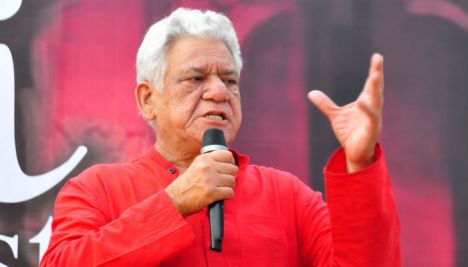
om-puri-ians

The legendary Indian actor leaves a legacy of humanistic and compassionate values and peace aspirations

Legendary actor Om Puri’s untimely death has saddened film and peace lovers not only in India but in Pakistan and around the world. Like his long-time friends and colleagues Naseeruddin Shah and Mahesh Bhatt, and younger colleague Nandita Das, he had a special relationship with Pakistan due to his desire for better relations between the two largest countries of South Asia. Continue reading

Binge-watching desi films

My article in The News on SundayJan 1, 2017, on two film festivals in New York recently showcasing work from Pakistan and India. I wanted to write more about some of them but didn’t have space. Below, with additional links and pix.

mah-e-mir

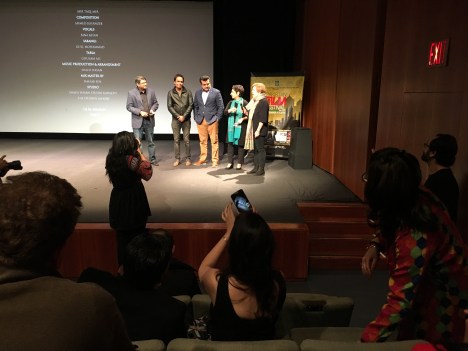
Mah-e-Mir director Anjum Shehzad and producers Badar Ikram, Khurram Rana with Ambassador Maleeha Lodhi. Photo: Beena Sarwar

Desi audiences thronged to two recent film festivals in New York showcasing films from Pakistan and India

Many of the films in what is being heralded as a revival of Pakistan cinema feature the sprawling megapolis of Karachi. The multifaceted city’s historic sandstone buildings, sandy beach, traditional tiles, boundless energy emerge in these films… dreamily romantic under a perpetual full moon (Mah-e-Mir), wildly eclectic (Mailay), effervescent, multi-cultural (Actor In Law), violently revengeful (Gardaab), creative, musical (Ho Mann Jahan), a playground for street dancing (Dance Kahani), a tangle of underworld sewers and space-age factories (Teen Bahadur, animation). Continue reading

Lessons for journalists from a Pulitzer Prize-winning composer

Beena Sarwar

Notes from the Nieman Pulitzer 100 event in Cambridge MA, “POWER: Accountability and Abuse,” presented by the Nieman Foundation for Journalism at Sanders Theatre, Harvard University 

wynton-marsalis-nieman-pulitzer-100
Sep. 9, 2016

Cambridge, MA: The thousand-seater Sanders Theatre filled up fast in anticipation of the Wynton Marsalis concert that was kicking off the Nieman Pulitzer 100 event, a few days before my first journalism class at Princeton University. No photography or videos of the performance were allowed but I figured the rule didn’t apply before they started playing so I sneaked a quick photo. Continue reading

As tensions rise between India and Pakistan, we remember a friend who called for peace

Sharing a piece I wrote with Dr. Partha Banerjee about our friend Haider “jigar”Rizvi, published by PRI on October 28, 2016, a year after he died in Lahore. Reproduced here with photos that we weren’t able to get to PRI in time.

Haider in Gilgit-fb page

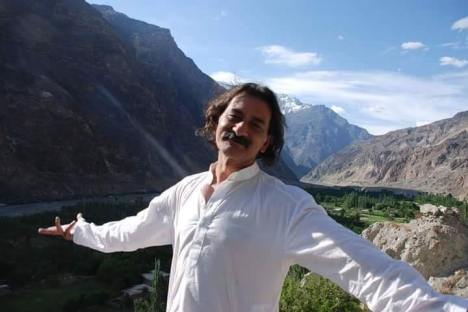
Haider Rizvi celebrating life and love at Ghizar District, Gilgit, 2015. Photo by Qamar Abbas.

Last year around this time, we were saddened by the death of our poet and journalist friend Haider Rizvi in Lahore, Pakistan, on Oct 29, 2015. Haider had lived in New York, and was for many years a correspondent for the Inter Press Service (IPS), based at the United Nations.

With Haider’s untimely passing, we lost someone who loved to make friends irrespective of religion, color or caste — someone who believed firmly in peace.
Continue reading

Activists support peace defenders in Pakistan, denounce false allegations

MEDIA STATEMENT
Activists support peace defenders in Pakistan, denounce false allegations

LONDON, Oct. 30: Some two dozen activists from Pakistan working in the fields of media, peace, culture, development and politics, USA, Canada and U.K. met in central London to discuss India-Pakistan relations and reaffirm the need for peace between the nuclear-armed South Asian neighbours. They reiterated the vision of Pakistan’s founder Quaid-e-Azam Mohammad Ali Jinnah that relations between the two countries should be like those of Canada and the United States.

London India Pakistan peace cropped

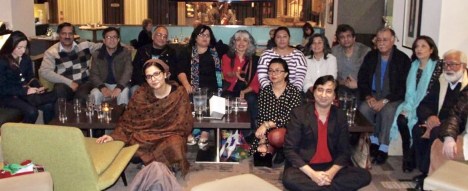
Group photo of some of the peace activists after the meeting in London.

Continue reading

“Future of Pakistan” Conference: London Declaration 2016

IMG_0602.JPGLondon Declaration for Pluralism and Democracy in Pakistan
October 29, 2016

Several prominent liberal, progressive and nationalist intellectuals, human rights and social media activists, and public figures from Pakistan gathered in London for a conference on ‘The Future of Pakistan’ organized under the banner of South Asians Against Terrorism and for Human Rights (SAATH), co-hosted by US-based columnist Dr Mohammad Taqi and former Pakistan ambassador to the United States, Husain Haqqani.

https://www.facebook.com/plugins/video.php?href=https%3A%2F%2Fwww.facebook.com%2FImam6%2Fvideos%2Fvb.621360947%2F10154657030630948%2F%3Ftype%3D3&show_text=0&width=400
Continue reading

World Polio Day, Oct 24: ‘Any number more than zero is too much’

A slightly revised version of my article in The News on Sunday on Oct. 23, 2016, posted here with additional links and photos. The world watches as the last three polio endemic countries strive to relegate the crippling virus to history

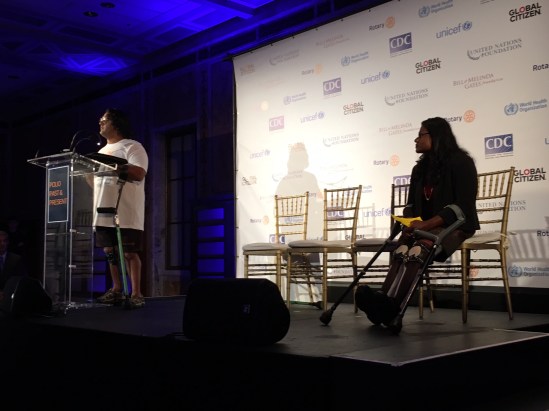
ramesh-ferris-minda-dentler

Polio survivors Ramesh Ferris and Minda Dentler share their experiences – and dreams about a polio-free world. Photos: Beena Sarwar

“In 1955 Dr Jonas Salk invented the preventive vaccine. It is outrageous that 25 years later I contracted polio,” says author and global health advocate Ramesh Ferris.

Standing on his good leg, a crutch compensating for the paralysed one in braces, eyes gleaming behind black-rimmed glasses, Ferris passionately addresses the audience of about a hundred physicians, scientists and international diplomats. They include representatives from the world’s three remaining polio endemic countries — Pakistan, Afghanistan, and Nigeria. Continue reading

P. Sainath – upcoming talks in America

Sainath-MIT1aThe eminent journalist P. Sainath, author of the groundbreaking collection of reports Everybody Loves a Good Drought, is headed to the USA from his base in India. He will give a series of talks at various campuses about his work and the unique, empowering, online journalistic endeavour he launched last year, the People’s Archive of Rural India – PARI. Worth going to hear him speak if you are in the area. See my article about him: Travels though history with a rural archivist.

Campus times and dates below, with some posters by a PARI volunteer. Continue reading

Finding lost heritage: Pakistan’s Sikh legacy

My Personal Political column in Himal Southasian, Aug 3, 2016, published also in Aman ki Asha and TOI blogs, posted here with additional links and visuals.

Author Amardeep Singh shares a story from his travelogue. Photo: Beena Sarwar

Author Amardeep Singh shares a story from his travelogue. Photo: Beena Sarwar

Finding lost heritage

“If you could visit any place in Pakistan, where would you go?” asks Amardeep Singh whenever he gives a talk to introduce his recently published travelogue Lost Heritage – The Sikh Legacy In Pakistan.

The question, aimed primarily at Sikh members of the audience, invariably elicits two answers: Sikh holy places. Their ancestral village.

It was the same in Boston on June 18, 2016 at the E-5 Center where Amardeep Singh gave his 42nd such talk. He understands the response all too well. After all, he too once had the same “myopic” reasons, as he says, for wanting to go to Pakistan, which he considers his “homeland”, being the land of his ancestors and also where Sikhdom’s holiest sites are located, like Nankana Sahib, birthplace of Guru Nanak, the first Sikh Guru. Continue reading

Lifting the veil: Queer life undercover in South Asia

AMZ-photo

“Secret” – fine art photo by Ali Mehdi Zaidi

The struggle of Muslim homosexuals in Pakistan, South Asia, or as expatriates is not just about LGBTQ rights but part of the larger fight for inclusion and pluralism within Islam. My essay published in The Boston Globe Ideas section (July 31, 2016)  on South Asian and Muslim attitudes towards homosexuality, reproduced below with additional links, info and photos, as well as parts not included in the final published version. The attack in the Orlando gay nightclub put the spotlight not just on the perpetrator, but his victims — Muslim gay (queer) folk who are particularly vulnerable to homophobia besides facing Islamophobia in the West, and receiving little or no support from the Muslim community at home and abroad. Plus they are now increasingly targeted by extremists claiming legitimacy from Islam. Thanks to all those who took the time to speak to me, gave feedback and entrusted me with their stories, and to the Boston Globe editors for their empathy and openness.  Continue reading