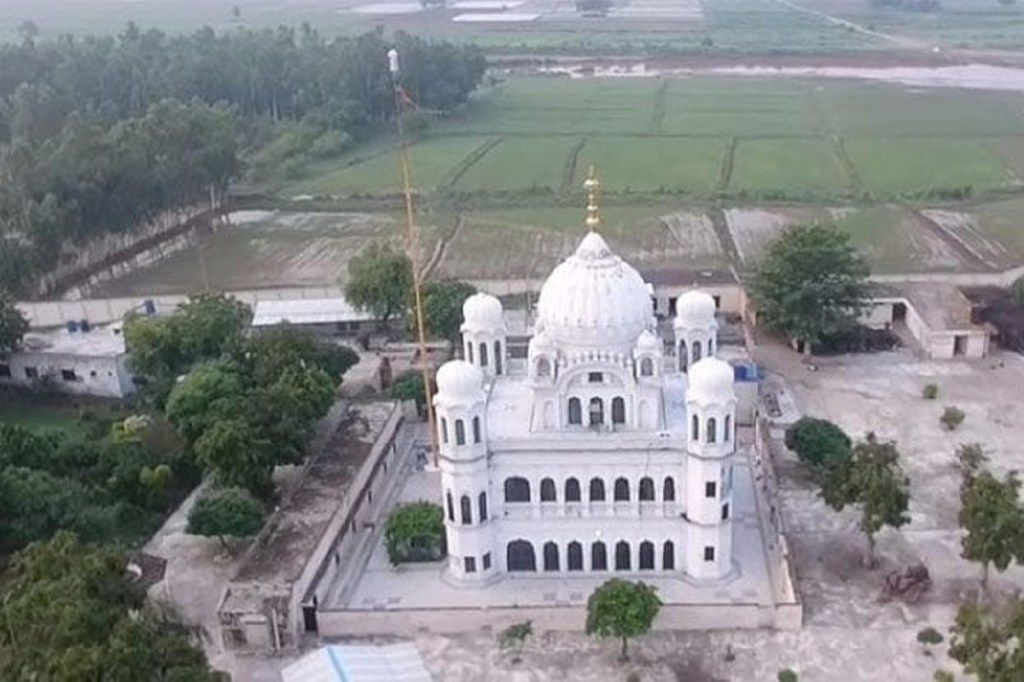
Gurdwara Darbar Sahib Kartarpur: Bringing people together. Image credit: Facebook/@syed.alli
Dozens of Indians and Pakistanis with ancestral roots in Chakwal will meet up mid-week at Kartarpur Darbar Sahib in Pakistan, taking advantage of the visa-free corridor inaugurated in November 2019 by Prime Minister Imran Khan for Baba Guru Nanak Dev’s 550th birthday celebrations.
Delhi-based Rotarian Anil Ghai, whose own family has strong connections to Chakwal since before Partition in 1947, will lead the Indian delegation.
The family had to flee with whatever belongings they could take, in a Dakota aircraft, remember area natives. Ghai’s visit to Pakistan in 1996 had led to rekindling those ties.
The establishment of Chakwal International Group about six months gave momentum to the upcoming ground-breaking meeting planned for Wednesday, 23 February.
“Everyone is welcome, they do not have to be Rotarians,” says Mohammed “Mo” Ayyaz, a Rotarian in London who is also from Chakwal and one of the driving forces behind the initiative.
The last Sapan – South Asia Peace Action Network – event of the year was titled “Growing up, growing together” with activists across the region resolving to continue working for a better tomorrow. It was wonderful to hear so many young people speak – most under 35 years old. Thanks to all those who worked so hardto make the event a success – including the poetry and music at the end.Sapan’s next monthly event on the last Sunday of January will have more music and culture.
Commemorating Human Rights Day, the founding of SAARC, and 50 years of Bangladesh’s independence, Sapan discussion highlights the commonality of human rights issues across the region
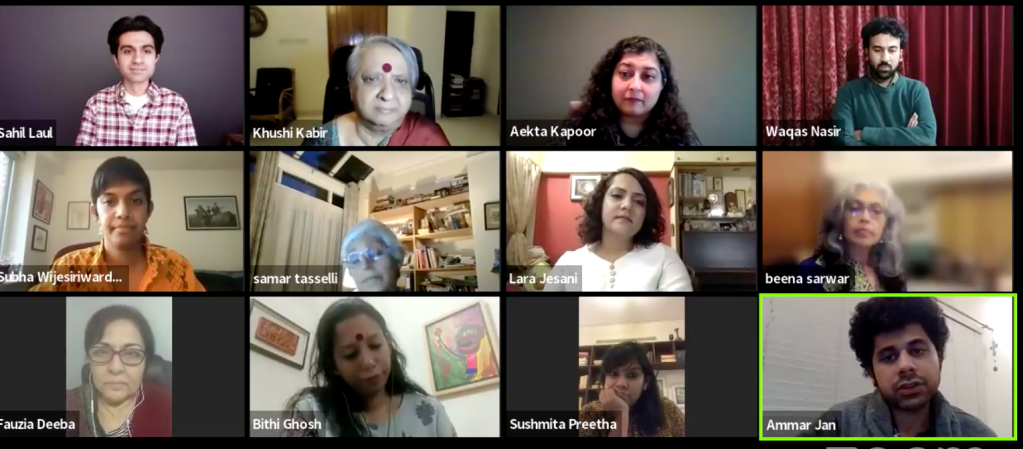
Some of the participants at the event – most speakers were under 35-years old. Screenshot.Continue reading →
The spirit of South Asia and the power of the four-letter word love
Commemorating 16 Days of Activism against Gender Violence, remembering Kamla Bhasin
By Beena Sarwar
The annual international 16 Days of Activism against gender violence takes place this year without the pioneering feminist and poet Kamla Bhasin, even as her songs and poetry enliven events during this period and beyond.
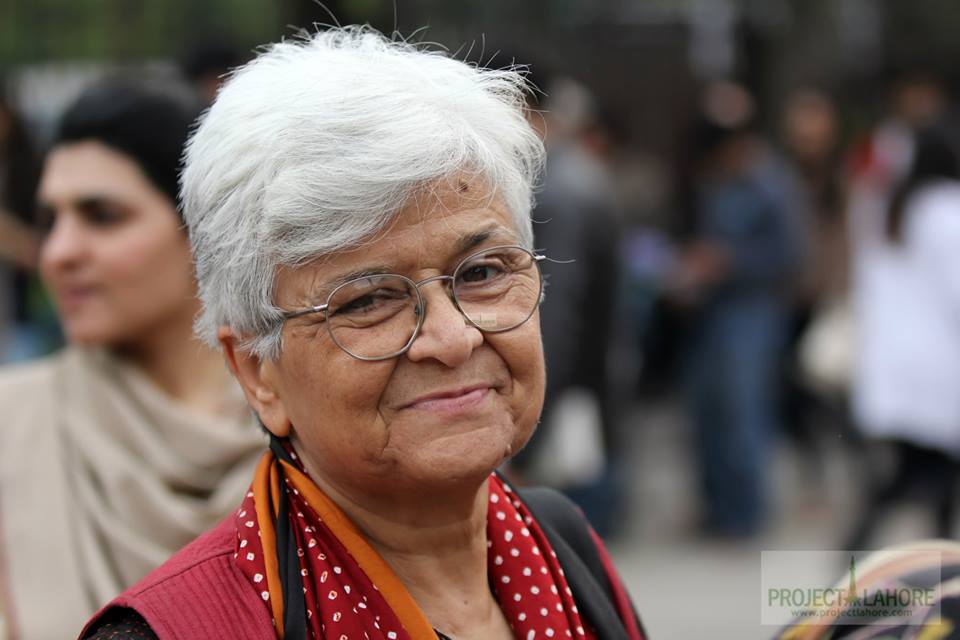
Kamla Bhasin. Radical love. Photo: Kashif Saeed
The 16 Days are observed annually starting 25 November, the International Day for the Elimination of Violence against Women. They end 10 December, with international Human Rights Day. These are integrated issues that Kamla fought for all her life. And she did this with love, joy, music, poetry and compassion.
As she famously said, “I am a feminist, and I do not hate men. I am a feminist and I do not hate women who are not feminists. I am a feminist – and I laugh.”
The Sapan Resolution on Climate Change ahead of COP26 is still relevant
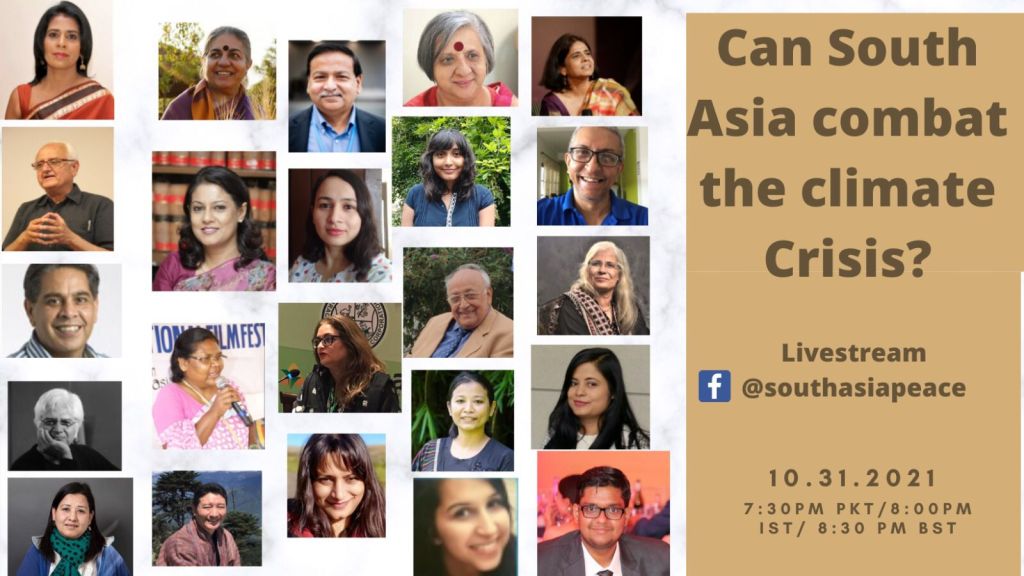
At the South Asia Peace Action Network, Sapan, event at the end of October, participants and speakers answered YES to the question of Can South Asia combat climate change? – and also suggested how.
The informative and engaging session hosted by Khushi Kabir and moderated by Afia Salam was followed by breakout rooms focusing on Climate justice, Cross-border reporting, Water issues, Renewable energy, and Indigenous communities, each facilitated by expert moderators and rapporteurs. See details at this link.
At the end of the event, youth activists Disha Ravi of India and Durlabh Ashok Pakistan read out a Resolution that participants endorsed. Read the Resolution at this link.
Speakers, moderators and rapporteurs: Dilrukshi Handunnetti, Vandana Shiva, Saleemul Haq, Khushi Kabir, Sunita Narain, Nalaka Gunawardene, Afia Salam, Sarita Bartaula, Durlabh Ashok, Priyanka Singh, Pragya Narang, Kinga Tshering, Pratima Gurung, Kunda Dixit, Ali Tauqeer Sheikh, Kanak Dixit, Syeda Rizwana Hasan, Shilsila Acharya, Disha Ravi, Prem Shankar Jha, Rani Yan Yan Yoddha, Lubna Jerrar Naqvi, Dayamani Barla. Collage by Aekta Kapoor.
UPCOMING EVENT: FEMINISE TO HUMANISE – COMBATING GENDER-BASED VIOLENCE IN SOUTHASIA. Details at the Sapan website at this link.
The United States and India should join with other regional powers to deal with the Taliban and help the Afghan people – Noam Chomsky
BOSTON, 27 September: Prominent academic Noam Chomsky has urged the United States and India to engage with the Taliban, work towards overcoming differences with other regional powers, and help the Afghan people rather than blocking ”the best of the options that are available”.
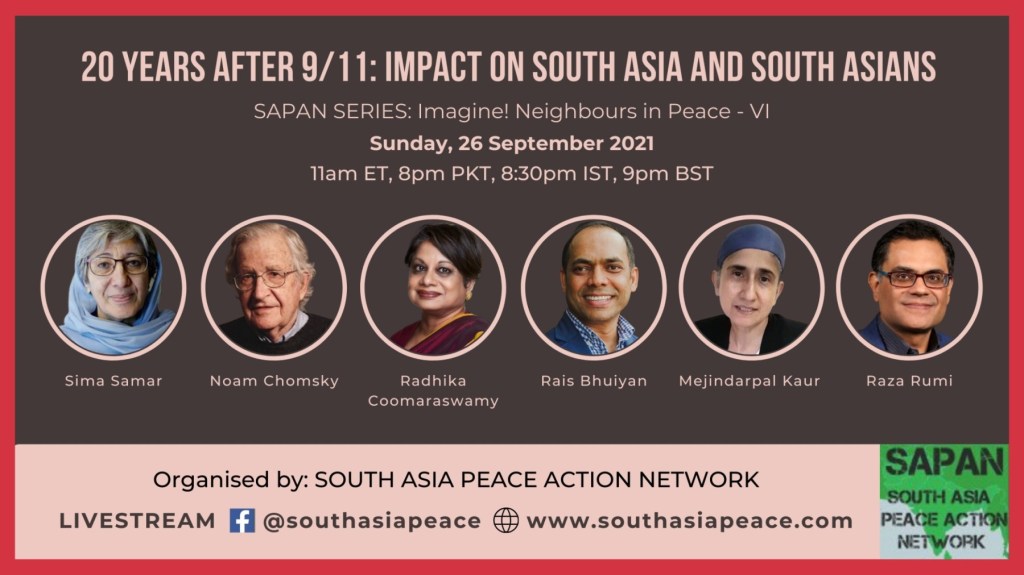
He was speaking last Sunday at the tail end of a webinar titled “20 Years After 9/11: Impact on South Asia and South Asians” organised by the recently launched South Asia Peace Action Network, Sapan. Speakers shared stories of hope and inspiration, besides those of distress and challenges.
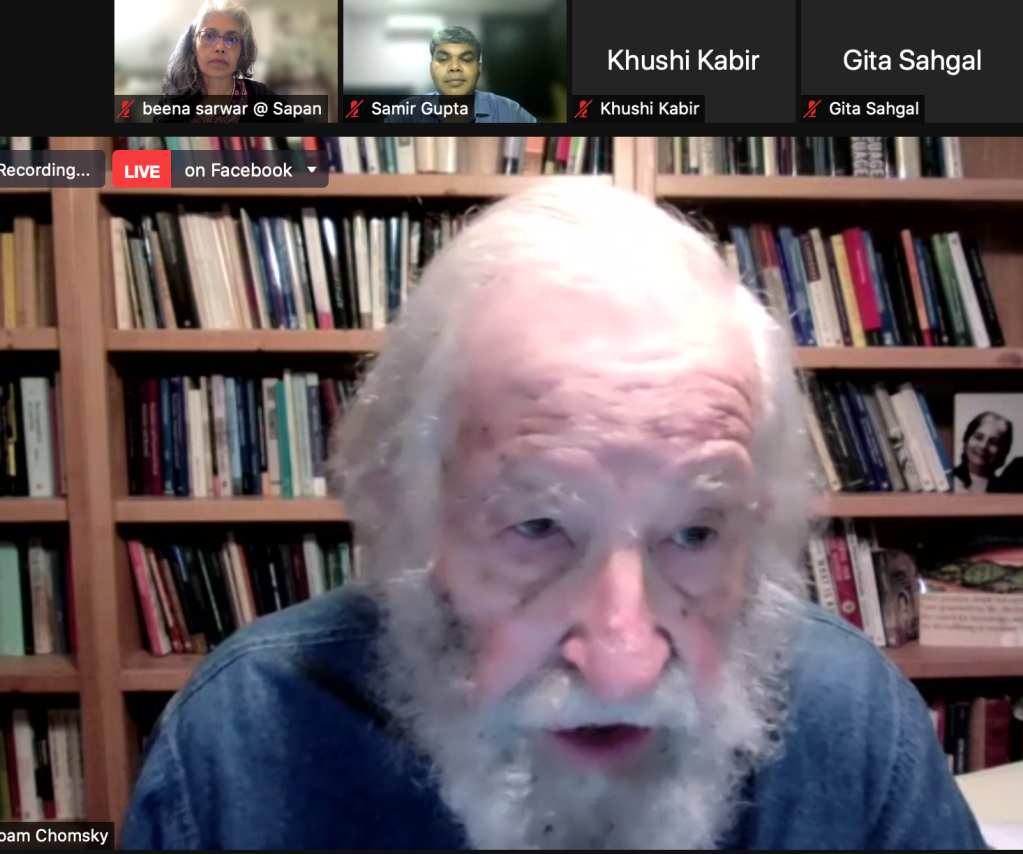
Noam Chomsky: Put the Afghan people first. Screenshot from Sapan webinar, 26 September 2021.
Marking two decades of the September 2001 attacks on New York City, global thought leaders and activists from across South Asia and the diaspora will meet across time zones this Sunday to discuss the impact of “9/11” on the region and its people.
The online event also commemorates the global International Peace Day, September 21.
I wrote this piece recently about someone I was honoured to consider a friend although we never met. Hal Gould came to mind when we launched Sapan, the South Asia Peace Action Network, earlier this year. I knew he was over 90 by then, a few years older than my late father Dr M. Sarwar, who Hal had felt an affinity with. We’re in a pandemic and I hadn’t heard from him in a while.
Dr. Harold A. Gould: A man of many parts
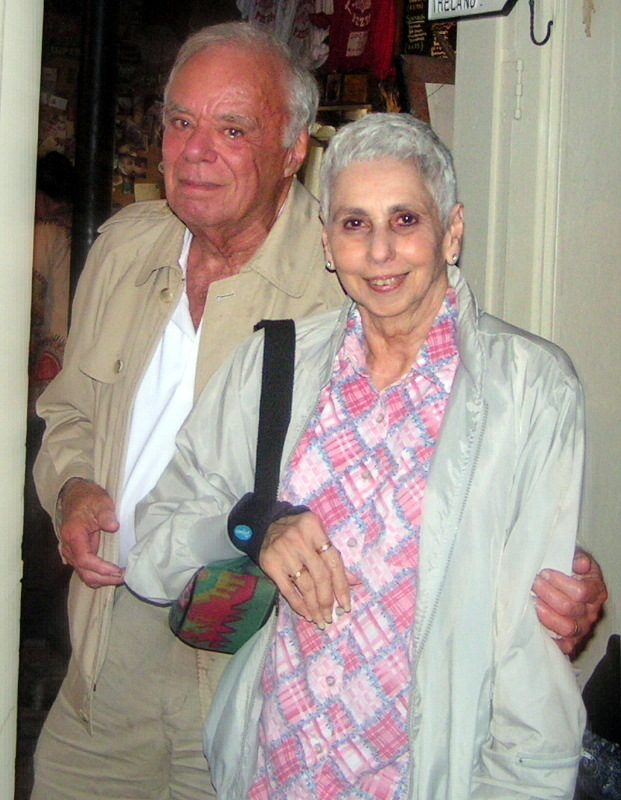
Hal Gould with wife Ketayun, his “Persian queen”. Photos: Courtesy Philip McEldowney)
Hal and I had been in touch since early 2008 after he read my op-ed in Dawn, “An inconvenient truth” (Feb. 22, 2008) about Pakistan’s ‘return to democracy’, marking the country’s first-ever peaceful electoral transfer of power. He had quoted from it in his column for the then newly launched online magazine South Asia Monitor, in which he urged America and the world to allow democracy to take root in Pakistan without outside interference.
My piece had emerged in response to an American friend’s outraged comment: “What kind of democracy is it that puts the fate of the country in the hands of a Nawaz Sharif and an Asif Zardari?” Trying to put the issue in context, I had written: “It’s surely not worse than a democracy which puts the fate of America – and the world – in the hands of a George W. Bush… TWICE!” I added that India had twice elected a right-wing BJP government-backed by religious militants. This was, of course, before Trump and Modi.
Interesting times, these. As a scholar who has done seminal work on caste in India, I am sure Hal would have had something to say about the Dismantling Hindutva conference taking place this weekend that is under massive attack from those who refuse to distinguish between Hindus and Hindutva…
Then came the sad update about his stroke, followed by news of his passing – shared by his son to the Friends of Hal email list that Hal used to post to. I found it hard to put the piece together in the middle of all that was going on but I felt Hal deserved a proper remembrance.
Hal’s son Armeen eventually sent around an obituary which I’ve drawn from, including a list of the books Hal authored. For the photos I’m indebted to historian Richard Barnett – who I had interviewed years ago for The Frontier Post – who connected me with another friend of Hal and of South Asia, Philip McEldowney at University of Virginia who dug about and sent some.
Meant to share this earlier – great discussion last weekend on the rights of the incarcerated in South Asia, organised by Sapan, the South Asia Peace Action Network. Besides human rights advocates and experts, there were testimonies from those who have suffered incarceration, and presentations from Sapan volunteers about prison conditions and best practices in the region. The issues raised are relevant beyond the region. Hope we can keep the momentum going – and we need help to do that. Please like, comment, share and post about this issue that affects all of society. Thank you.
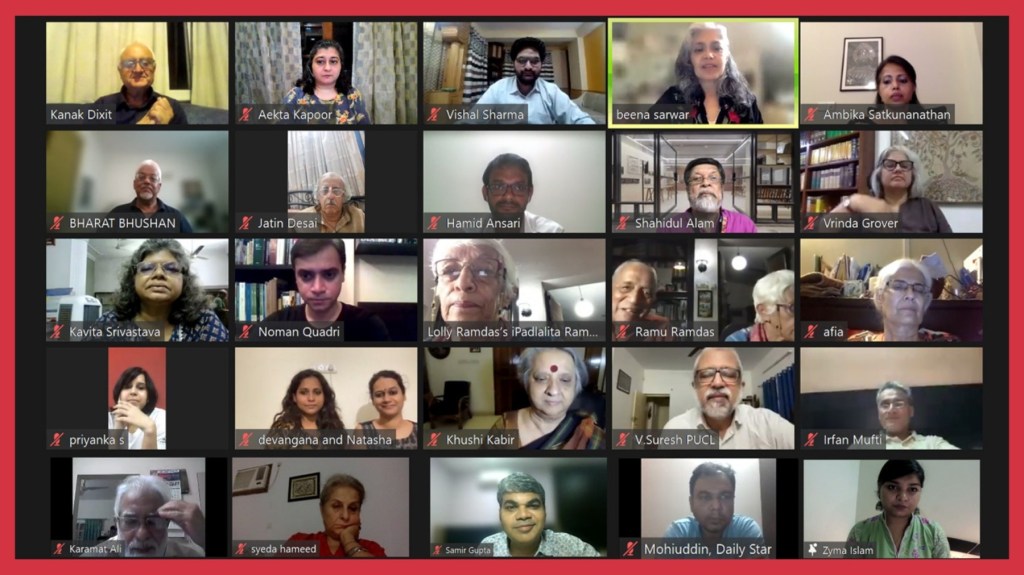
Participants turned on cameras at the end for a group photo. Collage by Aekta Kapoor, eShe magazine.
29 August 2021: “If the government becomes the monster that it can be, then the belly of the beast contains the people in jail”, said Nepali journalist Kanak Mani Dixit, speaking at a regional session on the rights of the incarcerated in South Asia, particularly in light of the ongoing Covid-19 pandemic.
He was among the prominent activists, legal experts, concerned citizens, and formerly incarcerated persons across the region who came together online to discuss the issue on Sunday, 29 August 2021, under the umbrella of Sapan, the South Asia Peace Action Network, of which he is a founding member.
Held a day before the International Day of the Victims of Enforced Disappearances, 30 August, the meeting underlined the need to recognise enforced disappearance as a distinct crime. The recent commemoration of World Humanitarian Day on 19 August also pegged the need for compassion and empathy for vulnerable communities. The tragic situation in Afghanistan further highlights the need for solidarity in the region and to insist on upholding human rights principles.
The event featured gut-wrenching testimonies in various languages from those who have experienced incarceration in the region, including those who were picked up but not produced before the courts for months or years. Those who fill the prisons tend to be the poorest of the poor as many pointed out.
Glad to report that Ajeet Kumar Nagdev and his children are on the train headed to Amritsar, and will hopefully cross the border on Saturday along with some 50 other Pakistanis who had been stranded in India due to the coronavirus pandemic. Thanks for all those who helped Nagdev and his family, especially Samir Gupta, Shishir Arya and others, including the helpful folks at the Pakistan High Commission, New Delhi, operating under stressful conditions. Salute to all of you.
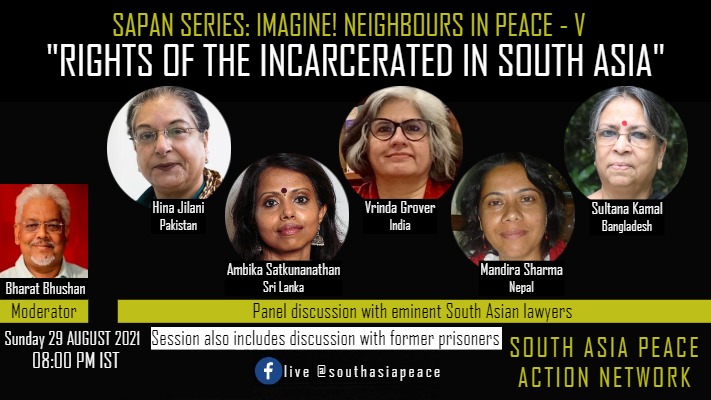
Meanwhile, need help getting the word out about this upcoming regional event Sunday, on the rights of the incarcerated with legal experts and human rights activists from around the region. Pls subscribe, join, share, post, comment, like, tweet, whatever you can. Much appreciated.
Poster for the event. Thanks Vishal Sharma.
The main panel is coincidentally all women…. (Read more)