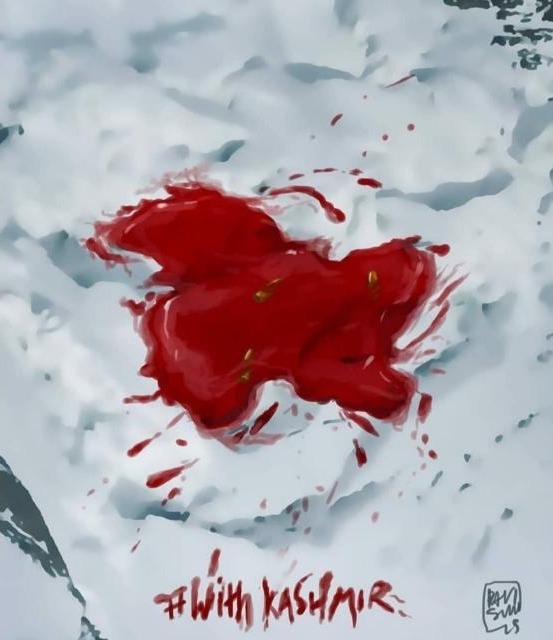
Sharing below a press release rejecting India’s continued violations of the constitutionally guaranteed rights of the people of Jammu and Kashmir – from the Pakistan India People’s Forum for Peace and Democracy (PIPFPD), the region’s largest and oldest people-to-people organisation, launched in 1994.
Also below – a PDF of the just-released report by the Forum for Human Rights in Jammu and Kashmir, an informal group of concerned citizens including retired Indian judges and armed forces personnel. The Forum aims to ensure attention to continuing human rights violations in the disputed region that both India and Pakistan claim. This is its third report.
“I’ve been attending online events for the past two years, and this was the best, most engaging by far”, a young activist in Delhi after the South Asia Peace Action Network event on Sunday, featuring sportswomen from around the region and their stories.
This was the best feedback ever, especially with the tech issues we had behind the scenes.
International award-winning sportswomen from around South Asia participated in the event. We tried to do a ‘group photo’ but it didn’t go the way we were planned, so Aekta Kapoor found a creative solution and put together this collage for the Sapan website. Top row (L-R): Mabia Akhter Shimanto, weightlifter, Bangladesh; Sana Mir, former captain Pakistan cricket team; Ashreen Mridha, basketball player, Bangladesh; Nisha Millet, swimmer, India; Middle row: Ayesha Mansukhani, athlete and sports investor, India; Champa Chakma, cricketer, Bangladesh; Khalida Popal, former captain, Afghanistan football team; Preety Baral, tennis player, Nepal. Bottom row: Noorena Shams, squash player, Pakistan; Roopa Nagraj, cricketer, UAE/India; Gulshan Naaz, partially blind runner, India; Caryll Tozer, athlete, Sri Lanka; Rumana Ahmed, captain Bangladesh national cricket team.
The South Asia Peace Action Network webinar Neighbours in Peace and Health, June 27, 2021, was the third in the SAPAN series: Imagine! Neighbours in Peace, a title borrowed from an unpublished Chowk.com volume, 2005
Visuals by SAPAN volunteer Vishal Sharma in Simla.
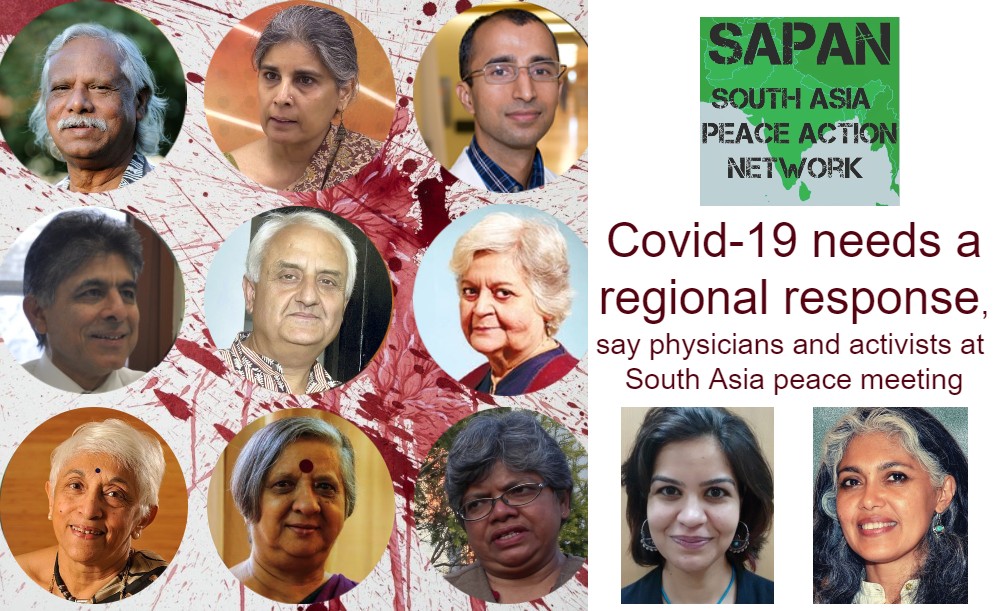
Sunday’s event included prominent physicians like Dr Zafrullah Chowdhury, Dr Anup Subedee, Dr Vandana Prasad, and Dr Hamid Jafari of Pakistan (led the team that eradicated polio in India). Speakers included Salima Hashmi, Khushi Kabir, Kanak Dixit, Lalita Ramdas, besides journalists Beena Sarwar, Mandira Nayar and others. Activist Priyanka Singh conducted the event.
“South Asian countries cannot go it alone, that’s irrational,’’ said Dr. Zafrullah Chowdhury, renowned public health activist and Ramon Magsaysay awardee from Bangladesh.
The hard lockdown in his country will lead to furthering the inequalities in society, he warned, emphasizing that it is irresponsible to impose lockdowns without providing food. “Poverty has increased. There are 25 million more poor without food.”
Dr Chowdhury was among the physicians and health right activists across countries who came together on Sunday 27 June at a webinar organised by the South Asia Peace Action Network (SAPAN) to emphasize that the coronavirus pandemic must be fought collectively.
– I.A. Rehman’s last interview, with youth group Aaghaz-e-Dosti
My young friends Atiqa Shahid in Sweden and Nickhil Sharma in Germany got this scoop, an interview with the visionary journalist I.A. Rehman, shortly before he passed away. He looks frail but his words are clear and strong. Wrote this short piece in Aman Ki Asha and thought I’d share it as well, below.
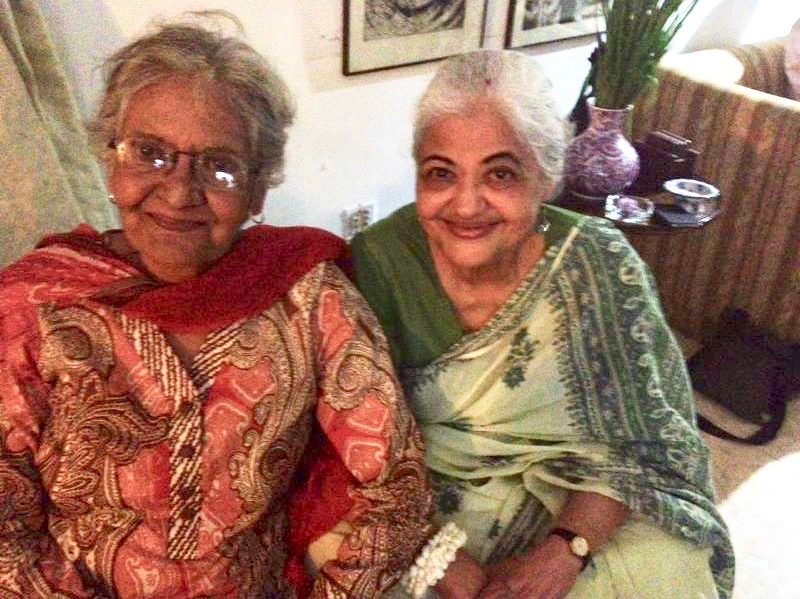
Sheen Farrukh, Zakia Sarwar: At our place in Karachi a couple of years ago. Photo: Beena Sarwar
Meanwhile, trying to process other losses. Another dear friend of my parents, journalist friend Sheen Farrukh passed on today in Karachi. A feisty, independent-minded pioneering journalist, she was so encouraging when I came into the field. Always supported me in all my causes – her causes too. Appreciate our friends artist K.B. Abro and writer Attiya Daud who had moved in with her and looked after her. RIP Sheen Khala.
Aaghaz-e-Dosti’s interview with I.A. Rehman, 27 March 2021
“We are neighbours, situated next to each other. We have a shared history and geography. We have fought for our freedom together… Plus human beings are social animals, and social animals talk to each other. Unfortunately, our politicians and states due to their own compulsions have not allowed us to do this”
Create economic and healthcare closeness across South Asia during the Covid-19 crisis – Amartya Sen
Posting this a couple of days late, but it’s still relevant: South Asia Peace Action Network press statement 31 May 2021
Create economic and healthcare closeness across South Asia during the Covid-19 crisis – Amartya Sen
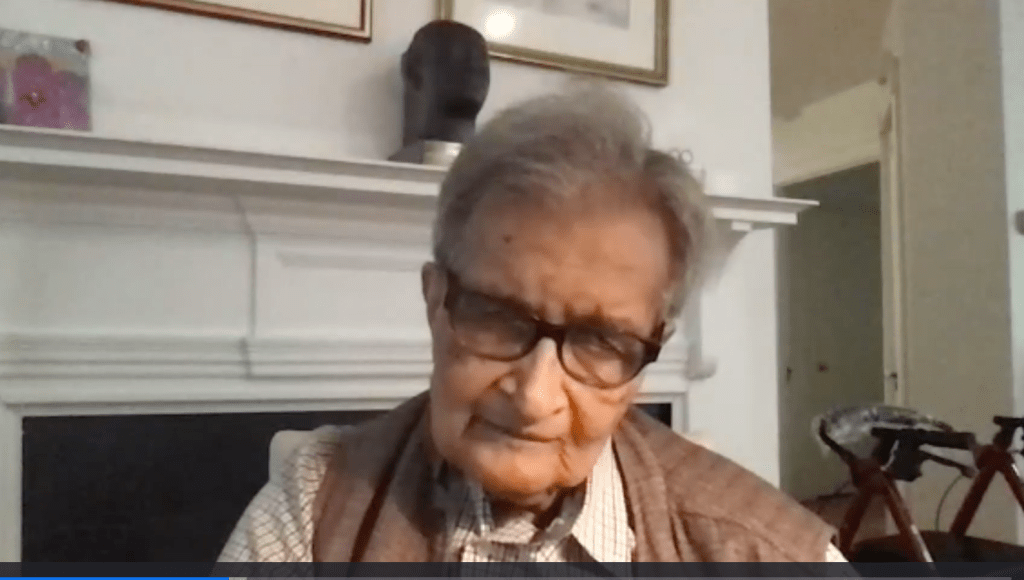
Amartya Sen: Our battle is not just against the Covid virus but also against the economic injustice of hunger and poverty (screengrab)
“We have to learn to maintain physical distancing but at the same time create economic and healthcare closeness in South Asia,” said Nobel laureate Amartya Sen, speaking at a webinar on South Asia’s response to the Covid-19 pandemic. The gathering also adopted a resolution describing the pandemic as a wake-up call for regional cooperation, and pressed for equitable vaccine supply across the region.
Stressing the need for contact and collaboration across South Asian borders, Prof. Sen said our battle is not just against the Covid virus but also against the economic injustice of hunger and poverty created by the pandemic.
Prof. Sen was among nearly 200 opinion-makers and activists from across South Asia and the diaspora who came together to attend the webinar titled: ‘South Asian Solidarity in the Time of Covid: Sharing Grief, Inspiration, Hope and Strategies’.
Urge South Asian governments to learn from India’s colossal tragedy and increase healthcare budgets, take urgent action to prevent similar crises in other countries
Even while grieving the loss of her father to Covid-19 the previous day, journalist Barkha Dutt was able to put aside her own pain to send out a powerful message to the world: “Don’t treat this as our problem alone,” she said in an interview to ITV.
Her father was one of over 2,500 Indians who reportedly succumbed to the coronavirus on Tuesday – the real numbers are suspected to be far higher as many dying at home are not counted as Covid victims. If the Covid-19 crisis “erupts” in India, it will “hit the world.” Countries understandably want to shut borders as a “necessary” short term response and put their citizens first but “we live in a world where we cannot be separated indefinitely,” she added.
A number of us had made a similar plea underscoring the connected nature of today’s world and the regionalism of South Asia, at an online discussion originally aimed to focus on Khelne Do (play for peace) on Sunday under the series title – Imagine! Neighbours in Peace’. We changed the focus at the last minute to share grief and solidarity as the situation in India spiraled out of control.
Wonderful discussions at a brainstorming meeting some of us got together for. Thanks to Mandira Nayar – granddaughter of the late, great Kuldip Nayar for putting this statement together.
Press statement, March 28, 2021:
India and Pakistan peace activists across time zones came together for a virtual brainstorming session on March 28, inspired by the work of giants like Dr Mubashir Hasan, Asma Jahangir, Kuldip Nayar and Nikhil Chakravartty and others. On the agenda was the way forward for the movement, how to invigorate it by involving more allies, younger people and expatriates.
A couple of weekends ago I was invited to share my thoughts with Indian Diaspora Washington DC Metro on a topic close to my heart: India-Pakistan: Youth, Media, Aspirations, Common Issues. I posted the information to social media and was amazed at the response – the most I’ve had for any post in a long time. An indication of the passions and aspirations associated with this issue. Sharing a recording of the video below.
Coincidentally, this event took place barely a week after the Directors General of Military Operations (DGMOs) of India and Pakistan’s agreement that came into effect at midnight Feb. 24/25, to implement the 2003 Ceasefire that couldn’t have happened without high level approval. Then a couple of days ago, the Pakistan Army chief in a speech reached out to India, saying it’s time to bury the past, move forward – read my friend Nirumpama Subramaniam’s analysis in The Indian Express here.
Here’s the talk I gave. They edited out the worst of the abuses. but you can still see some of the trolling that took place. Just a glimpse of what we are up against when we stand for peace, countering the military-industrial complex:
Sharing here a piece I wrote published in The Wire and later in Aman Ki Asha about a poor man from a tiny village on the India-Pakistan border who went missing in 2008. For nine years his family didn’t know where he was. But his government knew for four years before the family learnt from another released prisoner that their loved one was in a prison across the border.
Under-trial for three years, he then served a five-year conviction – but remained imprisoned for three more years while the government dawdled over verifying his nationality.
When they finally repatriated him at the end of January this year following court orders, he was made to travel 1000 km upcountry, then wait for three more days at a border town until police from his home state went to bring him back, another 1000 km downcountry. Here’s a map I made about his enforced travels:
Ismail Sama’s short journey across the border (small arrow) – and his long journey home. Fisherfolk caught violating the maritime border also have to endure this when imprisoned on the other side.
Here’s a follow up story by Gopal B. Kateshiya, ‘Coming back is second birth for me’: Kutch man returns home after 13 years in Pakistan jail, The Indian Express. Extract: “A scorpion stung me and I felt giddy. I lost my direction. Next morning, around 10.30 am, Pakistan rangers caught me, telling me I had intruded into their country. They took me to hospital and after my condition improved, they handed me over to Inter Services Intelligence (ISI),” said Ismail, son of a farmer.
Ismail Sama with his family: Reunited and it feels so good. Photo: Courtesy Indian Express.
Thirteen years is a long time. The story would be remarkable if it was a one-off but sadly, such incidents are not rare.
<p value="<amp-fit-text layout="fixed-height" min-font-size="6" max-font-size="72" height="80">Here's a report published some years ago which outlines some of the main problems (PDF). Here’s a report published some years ago which outlines some of the main problems (PDF).