Arundhati ‘Pakistani’ and right-wingers ‘patriotic’

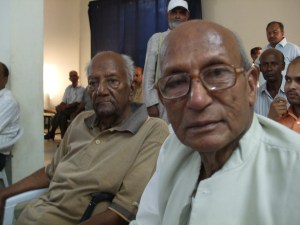
The FMP panel in Delhi, April 15, 2009

The FMP panel in Delhi, April 15, 2009. Photo: FMP

Panel members Arundhati Roy & Aniruddha Bahal. Photo: B. Sarwar

Panel members Arundhati Roy & Aniruddha Bahal. Photo: B. Sarwar

PERSONAL POLITICAL

Beena Sarwar

“Shouldn’t Arundhati Roy come from Pakistan?” sarcastically asked a Delhi freelance journalist, commenting on the Facebook posting about a panel discussion, ‘Does Media Jingoism Fan India Pakistan Tensions?’ The cynical remark stemmed from his annoyance, shared by many, at Roy’s consistent exposure of India’s ‘warts’.

The panel, organised by the recently formed Forum of Media Professionals (www.fmp.org.in ), included four journalists from India besides the celebrated writer and activist Arundhati Roy as well as four Pakistani journalists and The Hindu’s Islamabad correspondent Nirupama Subramanian.

Delhi is far cleaner and greener since I was last there nearly five years go, thanks to laws (that are actually implemented) banning diesel and making CNG compulsory. On a more intangible level, another kind of pollution remains, reminiscent of a phenomenon we face in Pakistan: right-wing jingoism fuelled by emotional appeals to religion and nationalism.

The jibe about Arundhati Roy, disguised under an urbane sarcasm, is just one aspect of bigoted nationalism. Going by that logic, those in Pakistan who fight for justice — a struggle that necessitates exposing wrongdoings, or ‘washing dirty linen in public’ according to our critics — should represent India. Another aspect of such thinking is evident in the comments back home when I show my documentary ‘Mukhtiar Mai: The Struggle for Justice’, in Pakistan: “Why don’t you make such films about violence against women in India? Women there have these problems too.”

I wonder at this competitiveness that makes us feel self-congratulatory when we can point out how much worse the other is in some way.

Thankfully, not everyone takes this myopic view. In Allahabad, at a crowded meeting of the Pakistan-India People’s Forum for Peace and Democracy (PIPFPD), there was none of this one-upmanship or finger pointing. The audience immediately saw the commonalities of the issues raised in the films I showed, on Pakistan’s flawed and discriminatory Hudood Laws and Mukhtiar Mai. They understood that the phenomenon in Pakistan of Taliban ‘punishing’ women for alleged transgressions is not much different from those who rape, kill or lynch women and couples for the sake of ‘honour’ in India itself or indeed in traditional communities in Pakistan.

The difference is that most of these ‘honour crimes’ are committed by relatives of the women who ‘transgress’, as opposed to the Taliban who are taking it upon themselves to enact these punishments as part of the imposition of their own criminal justice system that flouts the writ of the state.

Another difference is that the family in Haryana who hanged their daughter and the man she eloped with (in their own home) will be charged, tried and probably punished. In Pakistan, the ostensibly Islamic Qisas and Diyat (retribution and blood money) laws imposed by a military dictator in the 1980s allow the murder victim’s family members to ‘forgive’ the perpetrators who are often their own relatives.

As for the Taliban and their sympathisers, none have ever been charged for their criminal transgressions, ranging from blackening women’s faces on billboards, to disrupting public events in that involve women (remember the Gujranwala marathon?), to blowing up schools, killing teachers and dragging women out of their homes and murdering them for alleged ‘immorality’.

At the Allahabad meeting, the tone was set by senior advocate Ravi Kiran Jain in his introduction when he stressed on the need for a stable government in Pakistan, and the desire to remove misunderstandings. His words reminded me of Nirupama Subramanian’s appeal at the panel discussion in Delhi urging Indians to “be sensitive to Pakistan as a country that has problems and show moderation in we respond to these problems.”

Many Indians already understand this, but we don’t hear their voices in the media very often. For instance, Utpala, a women’s rights activist during the discussion in Allahabad talked about the need for Indians and Pakistanis to be allowed to visit each other’s countries. Her own visit to Pakistan many years ago, she said had expanded her ‘angan’ (literally, courtyard). She ended by asking, “How can we in India be happy until there is a pro-people, pro-women government in Pakistan?”

The Delhi panel was disrupted for a minute or so by one man at the back of the auditorium who stood up and shouted anti-Pakistan, pro-war slogans. The organisers threw him out. He turned out to be from the Sri Ram Sene, one of the faces of India’s right-wing ‘Sangh Parivar’, who . Three or four others were outside, whom the organisers had refused to allow entry as they were not signing their names in the register. The SRS, which does not otherwise have much presence in Delhi, later claimed it had sent ‘thirty’ men to disrupt the meeting.

True to form, illustrating the very issues we had been discussing, most media hyped up the disruption which then overshadowed the discussion itself. Pakistani journalists were ‘roughed up’, ‘attacked’, the meeting disrupted for ’15-20 minutes’ and so on. The incident set off a chain reaction across the border, giving right-wing forces in Pakistan the opportunity to condemn the ‘anti-Pakistan feelings in India’. A ‘human rights’ organisation held a demonstration against the ‘attack’. Jamat-e-Islami’s recently elected chief Munawwar Hasan promptly issued a statement saying that it should serve as an eye-opener to those who talk of friendship with India and they should refrain from visiting India (‘ba’az ajana chahiye’).

For such people, obviously the anti-Pakistan slogans raised by one miscreant are paramount over the dozens of people in the IIC auditorium who listened respectfully to the discussion and engaged in a dialogue with the speakers later. The people in Allahabad and at the Delhi Press Club a few days later who came to hear a Pakistani journalist and express their support for a democratic order in Pakistan also don’t count, even if some of them were prepared for a rough time, like Zafar Bakht in Allahabad who had lent his school’s auditorium for the event. “After hearing of the Delhi incident, we rolled up our sleeves and were prepared,” he said later.

In the end, the anti-Pakistan slogans raised by one miscreant hogged the media limelight rather than those who filled the auditorium, heard the speakers respectfully and engaged in dialogue later. This is the nature of the media beast. Who is going to tame it?

India trip, the ‘attack’ and some articles

Allahabad Chapter of PIPFPD: Comrade Kameshwar Prashad Agarwal

No disruptions at the Allahabad Chapter of PIPFPD, attended, among others, by Comrade Kameshwar Prashad Agarwal

Hello everyone, have been traveling with limited access to internet, hence the silence.

I was among the journalists at a panel discussion ‘Does media jingoism fan tensions between India and Pakistan?’ organised by Forum of Media Professionals at the India International Centre in New Delhi on April 15. The event got a lot of play because of misreporting.

The Indian media hyped up a minor disruption, reporting that the Pakistani journalists in the panel were ‘attacked’ or ‘roughed up’. The Pakistani media picked up on the photos and subsequently there were condemnations and even demonstrations in Pakistan about the ‘attack’.

To set the record straight, no one was roughed up or attacked. One man did disrupt the meeting – but very briefly, from the back of the auditorium. The organisers had turned away 3-4 men who refused to sign the register – he must have sneaked in. The discussion was half over when he stood up and started shouting anti-Pakistan, pro-war slogans (someone sitting near him said he’d just come in). The organisers pushed him out. TV cameramen and photographers followed.

Most papers and channels used photos and footage of the scuffle outside, rather than focusing on the discussion inside, which continued, despite the noise we could hear outside for a couple of minutes. The interruption lasted for maybe a minute or so. The discussion started at 10 am and continued till 1.30 pm. It turned out that he was from the Sri Ram Sene, the same group that tried to prevent Valentines Day celebrations in India, to whom thousands of people sent ‘pink chaddis’ in response.

The incident demonstrated what we had been talking about, that TV, being a visual medium, focuses on images rather than words. Hence their running after the scuffle rather than focusing on the discussion. This is the nature of the beast. Those keen to tame it might try organizing mass emails, letters and phone calls to demand meaningful change.

Here is Rahimullah Yusufzai’s article on the incident – `The good, the bad and the ugly’, The News, Apr 21, 2009 <http://tinyurl.com/dxtuo3>

Our visit also involved several other interactions with the media. Rahimullah Yusufzai, the veteran reporter from Peshawar was the most sought after for his views on Talibanisation, living as he does in the heart of the storm. Here is the link to a full page ‘idea exchange’ published April 19, a forum that The Indian Express regularly holds: “I don’t think we have reached a stage when the Taliban will take over Pakistan” – <http://tinyurl.com/dzeyc9>

I showed some of my documentaries at a meeting of the Allahabad chapter of the Pakistan-India Peoples Forum for Peace and Democracy (PIPFPD) and at the Delhi Press Club, organised by Youth4Peace. Here are links to a couple of reports on the Press Club screening:

‘In Pakistan, change has to come from within, says journalist’ -Indian Express, Apr 20, 2009 – <http://tinyurl.com/covts7>

`Pak journalist’s short take on women’s rights’, Mail Today, Apr 20, 2009 – <http://tinyurl.com/cmb7ey>

More later

“No Sazish, No Jang” (No Conspiracy, No War) – a peace song

A young friend, Shahvar Ali Khan in Lahore has composed a song for which he recently launched the audio.  The MP3 is downloadable. Video coming soon.

Download and listen to Mulla na kar tang…. (Mulla, stop bugging us!) at
\”No Sazish, No Jang\” (No Conspiracy, No War) by Shahvar Ali Khan

It is a worthy effort in the midst of total madness, as Asad Jamal in Lahore says.

PAKISTAN: Another Terror Attack For TV Cameras

beena-22

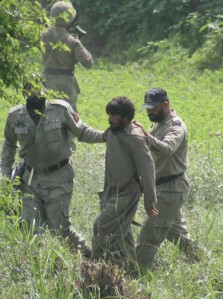
A Taliban militant, part of the group that attacked a police academy near Lahore, being led away by troops. Photo: Rahat Dar

KARACHI, Mar 31 (IPS) – The brazen armed attack on a police academy near Lahore on Monday underlines the danger that the Pakistani state faces from militancy linked to the ‘war on terror’, but with historic roots in the earlier Afghan war of liberation from Soviet occupation, that was converted into a ‘jihad’ against ‘God-less communists’.

The incident is also part of a chain of such attacks that highlight the need for out-of-the-box thinking to a regional, political approach and regional cooperation in this global, border-less conflict.

Eyewitnesses to Monday’s drama said that the gunmen scaled the six-foot high boundary walls of the academy soon after 7 am. They lobbed hand grenades at the 700 or so recruits on parade and ran at them, firing automatic weapons.

Police and paramilitary troops fired aerial bursts in jubilation and shouted ‘Allah-o-Akbar’ (God is great) after they re-gained control of the Academy premises a tense eight hours later.

The final death toll was far lower than the 28 or so initially reported by television channels: eight policemen, one civilian, and four militants who blew themselves up with suicide vests.

Television channels showed heart-rending scenes of distraught relatives at various hospitals where the dead and injured were taken.

The role of the electronic media while covering such incidents has come in for much criticism. In their rush to be first with the news, channels often provide incorrect information – or “lies”, as a press photographer who was at the scene of the Mar 30 drama put it more bluntly.

The al- Qaeda-linked Taliban leader Baitullah Mehsud, based in Waziristan Agency in Pakistan’s north-west tribal areas, claimed responsibility for the latest attack, the second this month in Lahore, capital of Punjab, Pakistan’s most populous and powerful province.

On Mar. 3, some dozen gunmen ambushed the visiting Sri Lankan cricket team in uptown Lahore, injuring several cricketers and killing six policemen and a driver. The gunmen disappeared after the shooting spree and have yet to be apprehended.

On Mar. 27 a suicide bomber killed dozens of worshippers at a crowded mosque near the north-western town of Jamrud on the highway to Afghanistan. Unconfirmed reports suggest that the motive may have been related to money as criminal elements operate freely in the area.

However, the Lahore attacks, taking place in an urban metropolis with dozens of television channels, were far more spectacular and effective, as Asha’ar Rehman, Resident Editor of daily Dawn in Lahore commented.

“A suicide bombing, in the eye of the terrorist perhaps, is too fleeting a moment in the life of a people who have become so used to the occurrence,” said Rehman.

“It is obvious that the terrorist is looking for more than momentary fame. He now wants to stretch the harrowing experience for as long as he possibly can, to the chagrin of onlookers who cannot keep their eyes off the television.”

The attack on the three-storey police school on the outskirts of Lahore a few kilometres from the Wagah checkpoint on Pakistan’s eastern border with India also bore other similarities with the ambush on the cricketers.

Underlining huge security lapses and intelligence failures, both took place in the early morning hours, with well-equipped, well-trained militants attacking supposedly well-protected targets. The Sri Lankan cricketers should have been extended presidential level security while the police school was peopled with – well, policemen, under training though they were.

Their commonalities include the possibility of local support that must have existed in order to facilitate them.

Both attacks drew comparisons to the Nov 2008 attacks in Mumbai, India. Some commentators accused India of being behind them in retaliation for the Pakistani link that emerged in the Mumbai tragedy.

The Mumbai attacks were in turn compared with the suicide attack on Marriott Hotel in Pakistan’s capital Islamabad on Sept 20, 2008. The attack was heavily symbolic given its high-security status and proximity to the corridors of power.

Earlier, militants had eliminated a much more symbolic and high value target – former Prime Minister Benazir Bhutto, as she left an election rally in Rawalpindi on Dec 27, 2007.

Other high-profile attacks, in the recent past, include the suicide car bombing at a police checkpoint in Peshawar that kills 35 and injured about 80 people last September.

In August 2008 twin suicide bombings at the gates of a weapons factory in the town of Wah near Islamabad left 67 dead. Earlier in March 2008, suicide bombers targeted a police headquarters in Lahore, leaving some 24 dead.

But Monday’s attack was so far “the biggest and potentially the most dangerous attack on a state facility in Pakistan,” noted Asha’ar Rehman.

“There were hundreds of trainee policemen inside the compound – trainees among a police force that, according to adviser on interior Rehman Malik, lacks basic training to combat terrorism. They were ill-equipped to stop the advance of a handful of visibly skilled gunmen. It could have been far worse.”

The drama ended with an unexpected twist, again a throwback to Mumbai, when security forces captured some militants alive.

One of them, a bearded man with an expressionless face, was nabbed while heading towards the helipad in the fields behind the Police Academy. He was carrying hand-grenades apparently to attack the helicopters with.

News photographer Rahat Dar told IPS that he was perched along with other media persons on the rooftop of a nearby building watching events unfold at the academy in front of them. “We turned around towards the back when we heard shouts of ‘Got him, got him!’” he said.

Security personnel yanked off the man’s shalwar, baggy trousers to ensure that he was not armed. They also beat him up, prompting Islamabad-based journalist Mariana Baabar to question whether police are actually trained to capture a live terrorist.

“It was the Punjab police in action – doing what comes to them naturally. Obviously, they cannot differentiate between a rare live person who could give them tons of information and an ordinary criminal,” she wrote in a front page comment in daily The News. “Nothing amazing or new except that this was a rare chance to see it live on our screen”.

Police repeatedly kicked the man, apparently having “decided that they would keep kicking him with their boots till he was no more…,” wrote Baabar. “It took an army guy… to stop the angry and out of control police from this brutal kicking. At least someone realised that it was essential to get this suspect alive.”

Identified as an Afghan named Hijratullah, the encircled man presented a pathetic sight as he struggled to cover himself with his shirt.

The other three suspected militants in custody have not yet been identified. They were captured when trying to escape from the premises wearing police uniforms.

Political analysts have long been warning that there are no easy military solutions to the ‘war on terror’. The al- Qaeda and Taliban now appear to have converged with Pakistan’s ‘home-grown’ militancy that American and Saudi dollars cultivated during the Afghan war against Soviet occupation.

Analysts hope that the interactions between global leaders at the high-powered meetings in Europe this week will help initiate a change in the global approach to these issues.

The U.N.-backed conference at the Hague on Mar. 31 to discuss the future of Afghanistan, participated in by about 80 countries including Iran and the United States, is expected to also discuss a regional approach to the issue, says Marjan Lucas of the Dutch Peace Organisation (IKV).

“It is important that America understands what they’ve done to the region and develop partners with civil society and elected representatives rather than the army as they have been doing,” she told IPS in Karachi, having arrived from Lahore the day before the police academy was attacked.

The Hague conference will be followed by the G20 and NATO Summits where U.S. President Barrack Obama is expected to hold bilateral meetings with several world leaders.

What is certain is that there are no easy answers, and that there are likely to be more such links in the terrorist chain before things get any better.

Smitu Kothari – rest in peace

Smitu Kothari
Smitu Kothari

Just heard the sad news from Rani (Khawar Mumtaz) in Lahore about Smitu Kothari’s sudden and unexpected departure from this world.

Last I met Smitu it was in 2004, when I interviewed him about his late friend, the Pakistani activist Omar Asghar Khan, for a documentary commissioned by Asia Foundation broadcast on Geo TV. During the same trip I interviewed his father Rajni Kothari, a meeting he facilitated, for another documentary in the Asia Foundation/Geo TV series, on Eqbal Ahmad.

Besides being an ardent environmental and freedom of information activist, Smitu was one of the earliest and most genuine advocates of Pakistan-India peace. May he rest in peace.

His cremation is at 4 pm today in Delhi. Deepest condolences to his aged father and his family, including a 12-year old daughter.

p.s. Found this news item which gives some details…
http://www.sindhtoday.net/south-asia/77983.htm

Environmentalist Smitu Kothari dies of cardiac arrest

New Delhi, March 23 (IANS) Smitu Kothari, 59, one of India’s leading
social and environmental activists, died of a cardiac arrest early
Monday at the All India Institute of Medical Sciences.

Kothari was editor of the Lokayan Bulletin published by the Lokayan
group which promotes dialogue between NGOs and the rest of the world.

He also co-edited Ecologist Asia with other environmentalists
including Vandana Shiva, Claude Alvares and Bittu Sahgal and has been
a visiting professor at Cornell and Princeton universities.

P.S. March 27: Amit Sengupta’s obituary on Smitu in Hard News – excerpt:
“Now, that he has become bark and sky and earth, and now that the saline waters are still soaked inside the eyes and hearts of his father, wife, brothers, friends, strangers and comrades, it’s the tree of life which must hold his eyes and his mind, like leaves, flowers and seeds, as his legacy of regeneration, retreat and resistance”
http://www.hardnewsmedia.com/2009/03/2772