Indian Peace Delegation meets Pakistan Prime Minister, policy makers and people in successful visit

PRESS STATEMENT

Indian Peace Delegation meets Pakistan Prime Minister, policy makers and people in successful visit

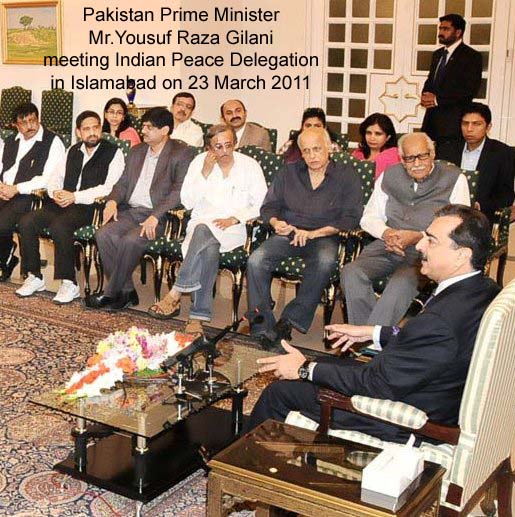
An Indian Peace Delegation visited Pakistan from March 17-25, 2011. During their stay they visited Karachi, Hyderabad, Islamabad and Lahore. They met Pakistan Prime Minister Mr. Yusuf Reza Gilani, Sindh Chief Minister Mr. Syed Qaim Ali Shah, Senators of various political parties, civil society activists, journalists, members of business community, and students amongst others. Continue reading

Indian peace delegation is back from Pakistan with a message of love & friendship

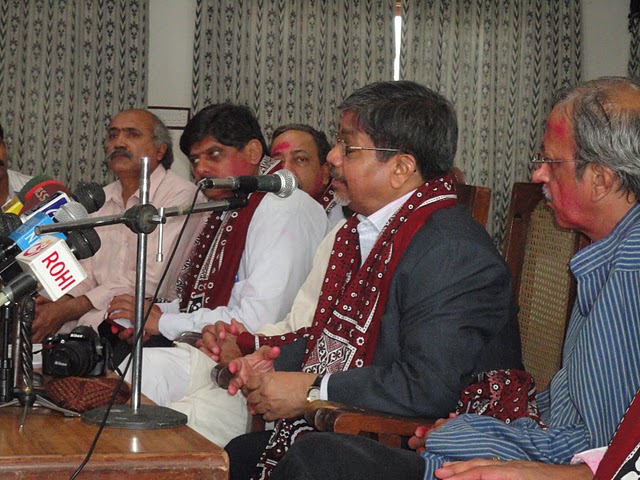
Their faces smudged with the colours of holi, Indian peace delegation wearing Sindhi ajraks address a gathering in Hyderabad. Photo: Piler, Karachi

PRESS STATEMENT: Indian peace delegation is back from Pakistan with a message of love & friendship

An Indian Peace Delegation visited Pakistan from 17th to 25th March 2011. During their stay they visited Karachi, Hyderabad, Islamabad and Lahore. They met Pakistan Prime Minister Mr. Yusuf Reza Gilani, Sindh Chief Minister Mr. Syed Qaim Ali Shah, Law makers of various political parties, civil society activists, journalists, members of business community,  students amongst others. The 12 member Indian delegation was led by Mr. Kuldip Nayar and included Mr. Mahesh Bhatt, Mr. Bhalchandra Mungekar, Mr. Shahid Siddiqui, Mr. Jatin Desai, Dr. Mazher Hussain, Ms. Kamla Bhasin, Mr. Ramesh Yadav, Mr.Sanjay Nahar, Mr. Haris Kidwai, Mr. Laxmi Prasad. Mr. Krishna Rao. Continue reading

Indian Supreme Court judges appeal to Pakistan for prisoner’s release, quote Faiz, Shakespeare

March 14, 2011, New Delhi: “The quality of mercy is not strained” and  “Qafas udaas hai yaaron” – Indian Supreme Court judges quote Shakespeare and Faiz in appealing to the Pakistani authorities to release an Indian prisoner detained for 27 years, applaud “humanitarian spirit on both sides”. Judgement below (thank you Jatin Desai for sending the judgment so fast)

REPORTABLE

IN THE SUPREME COURT OF INDIA
CRIMINAL ORIGINAL JURISDICTION

WRIT PETITION (CRIMINAL) NO. 16 OF 2008

Gopal Dass Thru. Brother Anand Vir    ..       Petitioner

-versus-

Union of India and anr.        ..  Respondents

J U D G M E N T Continue reading

Personal Political: Dear Abhijeet, please come to Pakistan

Yes, we do have theatre in Pakistan. Sania Saeed in 'Mein Adakara Banoongi'. Many other listings at http://www.danka.com.pk/

My monthly column Personal Political in The News on Sunday (Political Economy section, as ‘Going beyond ‘nothing’ in Pakistan’) and in Hard News, New Delhi

Good music too: Zeb and Haniya. See their interview at http://bit.ly/zebhania

Oct 24, 2010 Personal Political

Going beyond ‘nothing in Pakistan’

Beena Sarwar

“There is nothing in Pakistan,” said the Indian playback singer with finality. “They have no auditoriums, no facilities, there is nothing there. Everything is here (in India).”

Another example of the misconceptions about Pakistan, I thought, waiting to respond. The playback singer, Abhijeet Bhattacharya, and I were participating in a talk show for NewsX TV in New Delhi. Participating from a hired studio in Karachi, I could hear, but not see, the others.

When I tried to reply to this comment, the Indians couldn’t hear me, although I could still hear them through my earpiece connected to a phone line. I was no longer on air. NewsX had booked a live uplink from Pakistan for 20 minutes, which was over. Symbolic? Continue reading

India and Pakistan are stronger together

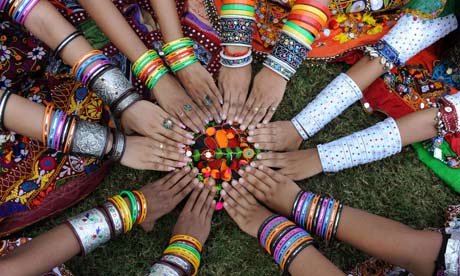
Indian dancers from the Rang Rasia Group traditionally touch their master's turban before the rehearsing Garba in Ahmedabad. Photograph: Sam Panthaky/AFP/Getty Images

My article in The Guardian recently prior to our talk at The Guardian Foundation:

India and Pakistan are stronger together

Loosening cultural, travel and trade restrictions is a vital first step to rediscovering our two countries’ shared heritage

India and Pakistan may be neighbours but it’s surprising how little they really know about each other. Their rich common heritage is easily forgotten amid mutual baiting and negative stereotyping, and it’s difficult to imagine them ever being truly at peace until these obstacles have been overcome.

“I’m really surprised to see so many women … I thought you would be all covered in burqas,” said a journalist at the Indian Women’s Press Club when the Pakistani contingent arrived last April on a visit organised by Aman ki Asha (a joint initiative for peace by the Times of India and Pakistan’s Jang media group). >

From Kerala with love

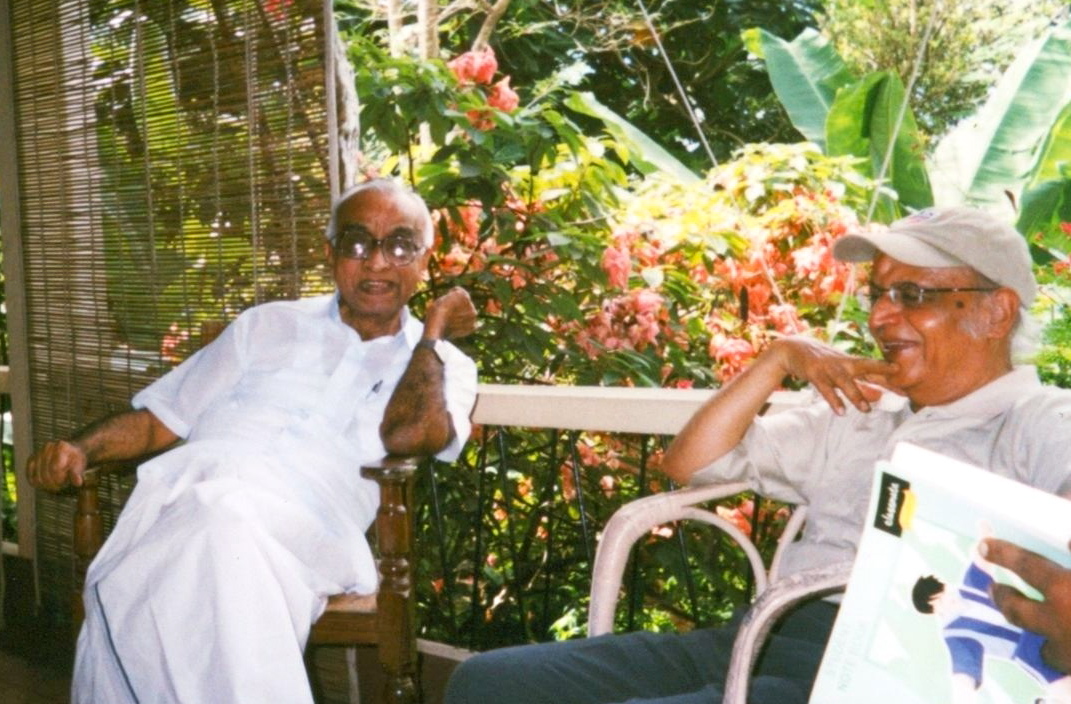
Prof. Raj and S.M. Naseem, Kerala, 2004

My article published in the Aman ki Asha page on Sept 23, 2010

From Kerala with love

An over three-decade long friendship between Pakistani and Indian economists leads to an unexpected offer of help for Pakistan’s flood victims

By Beena Sarwar

The visa and travel restrictions between India and Pakistan mean that Indians and Pakistanis who become friends often meet for the first time in a third country.

For economists S.M. Naseem, a Pakistani, and Prabhat Patnaik, an Indian, the third country was Thailand, 1978. They were both members of ILO’s Asian Regional Team for Employment (ARTEPP) in Bangkok, headed by Prof. K. N. Raj. Prof. Raj, who died last year in Kerala, was also known as the author of the Kerala Model, and founded the Centre of Development Studies in Trivandrum after heading the Delhi School of Economics (where his students included Prabhat Patnaik) and as serving as the Vice Chancellor of Delhi University.

Continue reading

Flood relief: Beyond politics

Article published in Aman ki Asha page, Aug 25, 2010

Beyond politics

It is heartening to see efforts by Indians and others around the world to help Pakistan in its hour of need

Even as the deadliest floods in living memory rage across Pakistan – affecting more people than the 2005 Kashmir earthquake, the 2006 Asian tsunami, and the 2010 Haiti earthquake combined – tensions between India and Pakistan can still obstruct efforts to help those in need. With over 20 million people affected – more than the population of Australia or several European nations – and about a quarter of Pakistan under water, some people still find time to play politics.

When India generously offered $5 million to Pakistan, cyberspace and media pundits exploded with negative comments. From Pakistan came comments like: “Too little too late” and “Pakistan should not accept because of the bloodbath in Kashmir”. From India came: “The PM should withdraw the offer if Pakistan doesn’t immediately accept it”, and “India should not offer aid to Pakistan because they sponsor terrorism”.

It is to the credit of both governments that they did not succumb to this pressure. Meanwhile, Indians at home and abroad, as well as others, are increasingly stepping up on a private level to help out with flood relief efforts in Pakistan. Continue reading

‘Bridging Partition: People’s Initiatives for Peace’ review

‘Bridging Partition: People’s Initiatives for Peace Between India and Pakistan’ – recent publication including my essay – review in Daily Times

‘What good is a dead body if you can’t see the person alive?’

Published in Hardnews, India and The News on Sunday, Pakistan

PERSONAL POLITICAL

What good is a dead body if you can’t see the person alive?

Beena Sarwar

India-Pakistan relations have Nazo Reshi vacillating between hope and despair. Hailing from Srinagar, she is married to a Pakistani and lives in Islamabad. “Every time I apply for a visa for Jammu and Kashmir it is a marathon,” she wrote in an email to Aman ki Asha, the peace initiative of the Jang Group of Pakistan where I work and the Times of India Group.

“The intricacies of the visa application keep increasing. Nobody realises the plight of women like me who are divided from their families, often from villages all over India and Pakistan. Continue reading

Competitor to militant Islam: Daata’s langar closed for first time in 927 years…

Langar at Daata Darbar

The horrific suicide bombings which claimed over 40 lives on Thursday night at the shrine of the revered sufi poet Hazrat Daata Ganj Baksh, the patron saint of Lahore, are a gory reminder of the urgent need for all concerned to join forces against ‘terror’.

A little over a year ago, after the attack on the Sri Lankan cricketers in Lahore in March 2009, Siddharth Varadarajan urged India and Pakistan to forget the conspiracies and acknowledge that they face the same threat – ‘Lahore attack shows urgency of joint action on terror‘.

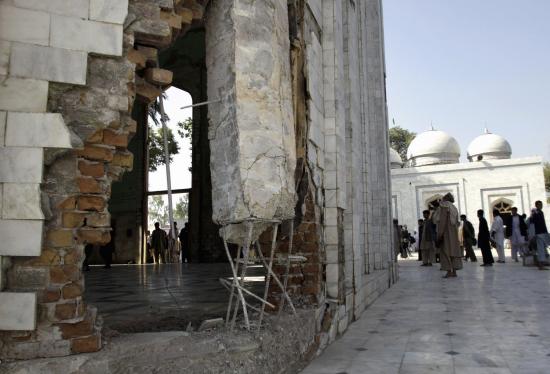
Rehman Baba's shrine damaged in the attack of March 2009

He suggested that “Cricket is the most visible icon of secular Pakistan, and perhaps the only competitor militant Islam faces in its struggle to tame the wayward Pakistani mind”. My response was that there is another, even more deep-rooted competitor that militant Islam faces – the deep-rooted, widespread adherence to Sufi Islam and values, superstition, taweez dhaga etc. “I fear (hope hope hope I am wrong) a major attack on any urs taking place at any of the major shrines any time soon,” I wrote at the time.

Two days later Hazrat Baba Rehman’s shrine outside Peshawar was attacked, thankfully without any casualties. Continue reading