Chicago, Shahidul and ‘Three Cups of Tea’

Three Cups of Tea_Mech.indd

Published in Hardnews, New Delhi,April 2, 2009

PERSONAL POLITICAL

Beena Sarwar

I love how connections sometimes just ‘happen’, criss-crossing the world, spanning generations, borders and continents. This particular stream traverses Pakistan’s early progressive struggle to Chicago, an inspiring book by an American who recently received Pakistan’s highest civilian honour, and a Bangladeshi photographer who came to Pakistan to document that moment.

In Chicago for a seminar in May 2007, I stayed with Danial Noorani. He is active with Apna Ghar, a domestic violence shelter for immigrant, primarily South Asian women. His late parents Malik and Mumtaz Noorani were close friends of my parents, active in the Communist Party and city goings-on. Tall jovial Malik Uncle ran a publishing house. ‘Jan-e-Man Phuphi’ (as we called the bright-eyed Mumtaz Noorani because of the endearment she used for us children) was active with Anjuman Jamhooriat Pasand Khawateen (Democratic Women’s Association, headed by Tahira Mazhar Ali, still going strong in Lahore).

There is some symbolism about meeting their son in Chicago. I remembered hearing of Dr Eqbal Ahmad’s disappointment when he found a monument to a policeman rather than the Chicago workers demonstrating for the eight hour day were killed by police fire in 1886. Ironically, the US does not observe May 1 as Labour Day.

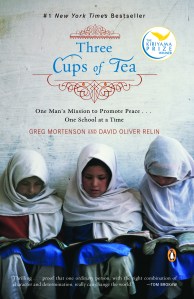
Before I left, Danial gave me a paperback titled ‘Three Cups of Tea’ by someone I had vaguely heard of, Greg Mortenson. I couldn’t put it down. It is mandatory reading for anyone interested in education, Pakistan and the ‘war on terror’.

Mortenson builds schools in Pakistan’s remotest areas. The book, co-authored by David Oliver Relin, is sub-titled ‘One Man’s Mission to Promote Peace . . . One School at a Time’– a mission as endangered by the ‘taliban’ as by the militaristic policies of the US and Pakistani governments operating without a political roadmap.

It started in 1993, when Mortenson was recuperating in atiny, unmapped village, Korphe, after being injured while climbing the world’s second highest mountain K2 in the Karakorams. Shocked that the village ‘school’ was a patch of land where children sat in the open scratching their lessons with sticks on the ground, he vowed to build them a school.

Back in the US, he saved rent by sleeping in his car and not taking his girlfriend out to dinner. Not surprisingly, they broke up. Mortenson kept trying to raise funds, manually typing letters to seek help. Two years later he was back at Korphe with a truck-load of building materials.

But he was in for a shock. The villagers told him that they first needed a bridge across the ravine that isolated them. Mortenson nearly went off in a huff. Then he thought about it and realised they were right. An important lesson for aid organizations: ask people what they want and need instead of giving them what you think they should have.

Besides making Korphe more accessible to the world, the bridge enabled the village women to make short trips to visit family on the other side rather than investing days as they used to. And yes, the school was also built. Mortenson has since helped to build some 78 schools in Pakistan (and Afghanistan), providing education to over 28,000 children, including 18,000 girls.

The second part of the book tells a grimmer story: the impact of the mushrooming Wahabi madrassahs and the ‘war on terror’ following ‘9-11’. Mortenson recalls an invitation to the Pentagon to talk about his work, only to realise that they’re not really interested. If they listened to him, perhaps the world would be in less of a mess.

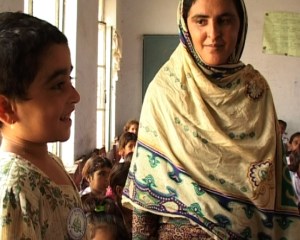
Last August, the Pakistan government announced that Pakistan’s highest civil award, Sitara-e-Pakistan (“Star of Pakistan”) would go to Mortenson for his courage and humanitarian effort to promote education, and literacy in rural areas. The Bangladeshi photographer Shahidul Alam mentioned it when we met last month in Kathmandu. He flew in from Bangladesh especially to record the moment. On March 23rd, 2009, he was in Islamabad with friends of Mortenson watching the awards ceremony live on television.

These are, as Salma Hasan Ali wrote on Shahidul’s blog, “kernels of hope that remind us that all will not be lost to violence and a distorted mindset.”

(ends)

‘From Pakistan with Love: Saneeya Hussain’

‘Celebrating Saneeya’ – feminist, activist, environmentalist, my former editor, and dear friend. Made this 5-min documentary after she died in Brazil in 2005… Saneeya, we will always miss you and be inspired by you and your infectious laughter… See also Saneeya Hussain Trust
http://saneeyahussaintrust.com/

More on women – and Rahman Baba

Sangota Girls Public School, Swat, destroyed by militants. Photo by Kamran Arif

Sangota Girls Public School, Swat, destroyed by militants. Photo by Kamran Arif

Forgot to include the following in my posting focusing on women

AMMU JOSEPH’s article ‘Our freedom is at stake’ is linked to the issues Kalpana Sharma identified in her article on the attacks women in India are facing, which as I wrote, looks like an Indian version of the Vice & Virtue dept of the Taliban that we are facing here in Pakistan. Ammu’s Bangalore Mirror article of Feb 12 (but still very relevant) at

– http://tinyurl.com/clhdzy

And now to RAHMAN BABA: As the political confrontation heats up in Pakistan ahead of the lawyers’ long march, joined by the Sharifs who were disqualified from politics recently, before all this reaches a stage where it overtakes all other discourse (which it already seems to have, to an extent), wanted to post a few items related to the disturbing attack on Rahman Baba’s shrine near Peshawar on March 5. The attack caused widespread outrage and practically every paper took it up. The incident took place just two days after the March 3 attack on the Sri Lankan cricketers in Lahore that led to a knee-jerk reaction among many Pakistanis blaming India for the attack.

Countering the culture of blame-counter blame, Siddharth Varadarajan, Associate Editor The Hindu, wrote on March 4 that finding ways to “encourage Pakistani cooperation and, more generally, to stabilise that country, are the most important challenges facing Indian diplomacy”. See his article ‘Lahore attack shows urgency of joint action on terror’ – Forget the conspiracies, the threat to Pakistan and India is the same – http://tinyurl.com/au8xhy

I thought he was spot on, on the whole and had a comment to add to his statement that “Cricket is the most visible icon of secular Pakistan, and perhaps the only competitor militant Islam faces in its struggle to tame the wayward Pakistani mind.”

I wrote: “There is another, even more deep-rooted competitor militant Islam faces – the widespread adherence to Sufi Islam and values, superstition, taweez dhaga (tying threads, getting amulets) etc. I fear (hope hope hope I am wrong) a major attack on any urs (birthday celebrations of Sufi saints) taking place at any of the major shrines any time soon…”

The following day, militants bombed the shrine of the 17th century Sufi poet Rahman Baba. An AP report in the Independent commented that the attack highlighted “the gulf between hard-line Muslims and many in the region who follow a traditional, mystical brand of Islam… A professor at Peshawar University told a local TV station that in many Pashtun homes, Baba’s poems are kept alongside the Islamic holy book, the Quran.” http://tinyurl.com/b45yo5

The caretaker of the shrine said he had got a letter three days before the attack warning against the perpetration of this “shrine culture” and objecting to the fact that women were coming to pray at the shrine. Militants used remote control bombs that destroyed the outer wall of the Mausoleum and partially damaged the building one month ahead of Baba’s urs, scheduled for April 5.

According to Pashtun Post <www.pashtunpost.com/>, Yousaf Ali Dilsoz, President of Rahman Baba Adabi Jirga says that Rahman Baba is the icon of Pashtuns spirituality and their love for peace and tolerance. “Saidu Baba, a revered saint from Swat valley, is known to have said that if the Pashtuns were ever asked to pray on a book other than the Koran, they would undoubtedly go for Rahman Baba’s work.”

Pashtun Post contains translations of some of Baba’s verses – http://tinyurl.com/c6neqy

Some excerpts:

Sow flowers so your surroundings become a garden
Don’t sow thorns; for they will prick your feet

If you shoot arrows at others,
Know that the same arrow will come back to hit you.

Humans are all one body,
Whoever tortures another, wounds himself.

(ends)

Focus on women – Pakistan, India, Afghanistan, a docu on Swat and more

Still from my film 'Mukhtiar Mai: The struggle for justice'

Still from my film 'Mukhtiar Mai: The struggle for justice'

A collection of articles published around March 8, including mine for IPS and The News, plus articles by Kalpana Sharma, Cassandra Balchin, Zofeen Ebrahim, Ayesha Khan (study on Lady Health Workers in Pakistan), link to a documentary on a Swat schoolgirl and more. Another post pending on issues around the attack on Rahman Baba’s shrine near Peshawar, will compile and post soon.

‘A new political context for Juliet’ – my article for The News on Sunday, about women speaking out all over the country, attempting to exercise their rights to personal autonomy – in a post-colonial age that harks back to medieval times when women were considered family property

Women Defy Militancy, Patriarchy – story for IPS outlining the twin threats of militancy and patriarchy that women face in Pakistan
http://www.ipsnews.net/news.asp?idnews=46024

In both articles, I refer to a documentary ‘Class Dismissed in Swat Valley’ (NYT) that focuses on Malala, an 11-year-old Pakistani girl on the last day before the Taliban close down her school. A must see – very moving and informative – profiling the great courage of ordinary people under adversity
http://tinyurl.com/avq4c9

I learnt of this film through an article that Shabbir Imam in Peshawar forwarded from the Anchorage Daily News by Shehla Anjum, a Pakistan-born writer based in Alaska, ‘Taliban wages war against girls’ education in Pakistan’. The writer followed up the story in the documentary by contacting Malala and her father.
http://tinyurl.com/dmxtld

The IPS website – http://www.ipsnews.net – contains a link to the other articles around Women’s Day –
http://www.ipsnews.net/new_focus/women/index.asp
This link includes other articles worth looking up, from Palestine and Afghanistan, and ZOFEEN EBRAHIM’S article about child marriage in Pakistan
http://www.ipsnews.net/news.asp?idnews=46022

KALPANA SHARMA in her column `The Other Half’ in The Hindu, Sunday Magazine, March 8, 2008, writes about the attacks women in India are facing – a chilling account of what looks like an Indian version of the Vice & Virtue dept of the Taliban that we are facing here in Pakistan…
http://tinyurl.com/bql9vg

CASSANDRA BALCHIN – a three-part series on the challenges faced by Muslim women around the globe and the debates within the Muslim world to deal with these challenges, the demand for equality within the family, and more, in Open Democracy – http://www.opendemocracy.net – I’ve shortened the three URLs for easy reference here:
Home truths in the Muslim family – The global pressure to reform Muslim family law is mounting
http://tinyurl.com/bxhf8v

Musawah: there cannot be justice without equality – Muslim scholars and activists from 48 countries launch a global initiative for justice with equality between men and women
http://tinyurl.com/akg2q8

Musawah: solidarity in diversity – a global initiative to reform Muslim Family Law finds solidarity in diversity and a growing convergence around human rights values.
http://tinyurl.com/bbvvhd

AYESHA KHAN’s recent study on LHWs and Women’s Empowerment in Pakistan can be accessed through the Collective for Social Science Research website
The study is at this link: http://tinyurl.com/cssr-lhv