Beating Back the Taliban

My column for HardNews, written May 24, 2009

PERSONAL POLITICAL

Beena Sarwar

“Is the threat of Talibanisation real or has it been hyped up by the media?” asked an Australian journalist friend calling a week before the Pakistan army began its belated operation against the militants in Swat region. With no independent reporting from the area, there’s only the army’s word about the situation. If rag-tag Taliban barely 4,000 strong are being trounced it is hardly surprising – they face the world’s fifth largest standing army.

A quarter have reportedly been killed in the operation. Many are deserting, shaving off their beards and melting back into the local population. Not all are hard core militants. Some joined the Taliban for money, were forced, or driven to avenge the casualties caused by American drone attacks. However, some still cause fear according to reports coming from refugee camps that house an estimated 20 per cent of the over two million persons internally displaced (IDPs in development jargon) since the fighting began. The rest are living with friends, family or strangers, some of whom house up to 4,000 people on their lands.

For the first time since 1971, a ‘war narrative’ is being developed by the media, government, army and politicians (many of whom until recently justified the Taliban’s actions; during Kargil, they denied the Pakistan army’s involvement). Now there are images ‘war hero funerals’ of army ‘shaheeds’ (martyrs) – not all from Pakistan’s dominant religion (Muslim) or ethnic group (Punjabi).

Even before the army action, wild bearded turbaned hordes were unlikely to take over Pakistan. This is not Afghanistan where decades of war destroyed all the systems and institutions. Nor is it Iran, where a huge urban-rural divide helped the mullahs to take over. Even conservative Pakistanis are uncomfortable with the Taliban’s brand of Islam – public beheadings, corpse mutilations and floggings. There is wide adherence to Sufi values and anger at the Taliban’s attacks on sufi shrines.

Pakistan has a 5,50,000 strong standing army (struggling to re-orient itself against its former allies the jihadis, countering its historic conditioning against India), a bureaucracy geared to maintaining the status quo, and an elected Parliament. Regular interruptions to the political process have made them somewhat dysfunctional but the only cure is to continue the process, break the pattern according to which no elected government in Pakistan has completed its tenure (not counting the one formed after the 2002 elections that took place during military rule without the participation of the political leadership).

I started writing this while my father was hospitalised  in the Sindh Institute of Urology and Transplantation (SIUT), a clean and well-equipped facility that treats rich and poor free of charge in this bustling megapolis of over 16 million. I described to my Australian friend the street scene I saw. The three-storey sandstone building is surrounded by decrepit British era and modern apartment blocks. Some ancient neem trees raise leafy green heads, sanctuaries for noisy crows in this concrete jungle. In the evenings, families including women and children, and groups of young men, bring roadside eateries to life.

For all the efforts homogenise Pakistani society, it remains diverse. That afternoon, a couple walked past the pushcart fruit, juice vendors and parked motorcycles, the woman in a brown burqa, the man in conventional shalwar kameez. Two young girls in colourful shalwar kameez, dupattas draped casually over their shoulders, walked the opposite direction. Another woman went alone, a black chaddar over her blue shalwar kurta. Several men lounged on the footpath, some squatting on their haunches, smoking, chatting, drinking tea.

Elsewhere, air-conditioned malls are full of young girls and women, some with girlfriends or dates, others with families or alone. Their attire ranges from burqas and headscarves over shalwar kurtas, to short shirts and jeans, to  high-slit tunics over calf-length trousers (‘capris’). Many are window shoppers escaping oppressive heat compounded by power breakdowns. Not all can afford the designer labels on display, but exposure to different lifestyles has changed old aspirations (not necessarily in a positive way).

Meanwhile, whether or not the Taliban are beaten back, a greater threat emanates from state systems that encourage conservative thinking — discriminatory laws against religious minorities and women, the encouragement of violence against religious minorities and women, vigilante justice, and anti-India, pro-jehadi values

http://tinyurl.com/pp-taliban

Doc’s blog; Madrassas vs Pvt schools; Hoodbhoy on Pk; Cost of war and more

Condolences: Lourdes Joseph, longtime activist and office secretary of the Human Rights Commission of Pakistan (HRCP) passed away today in Dubai of a heart attack. Funeral on June 10, 4 pm, at St Anthony’s Church in Karachi; burial at ‘gora qabristan’ 5 pm.

1. New blog – www.drsarwar.wordpress.com – with photos and remembrances, including by I.A. Rehman, Salima Hashmi, Dr Badar Siddiqui, S.M. Naseem, Ali Jafari, Mohsin Tejani and others

2. The Madrasa Myth op-ed co-authored by Tahir Andrabi, Jishnu Das, C. Christine Fair, and Asim Ijaz Khwaja, published June 3, 2009 –  http://www.foreignpolicy.com

Extract: `Rather than focusing on madrasas and public schools, the donor community should take note of a striking change in the Pakistani educational landscape: the emergence of mainstream and affordable private schools.’

Note from Tahir Andrabi (Professor of Economics, Pomona College, Claremont, CA):
“Trying to inject some sense in the mainstream of the Washington policy debate on Pakistan. Would like for once to having facts as a basis for conversation on Pakistan”. (The other Pakistani co-author Asim Ijaz Khwaja teaches at Harvard Kennedy School). http://tinyurl.com/lxlbrs

3. `Whither Pakistan? A five-year forecast’ by Pervez Hoodbhoy in the Bulletin of Atomic Scientists, 3 June 2009. Article Highlights
• U.S. government officials and media outlets have exaggerated how close Pakistan is to collapse.
• That said, the speed of Pakistan’s societal decline has surprised many inside in the country who have long warned of the effects of religious extremism.
• The first step toward calming the situation–Pakistan’s political leadership and army must squarely face the extremist threat, something they’ve finally begun to do.
http://tinyurl.com/Pk-PH-5yr

4. The Women of Swat and `Mullah Radio’, Tuesday, 02 June 2009,
From a group of NWFP women, report published in http://khyberwatch.com
Extract: “Islam started as soon as we fled from Malakand. People outside Swat think we had Islam and Shariat. There is no Islam in Swat. The Taliban have finished it.’ -woman from Mingawera, Swat, in a Sawabai camp
Full report at – http://tinyurl.com/lrnvo4

5. HRCP report on the situation of the internally displaced, plus the Commission’s conclusions and recommendations at:  http://hrcpblog.wordpress.com
`A tragedy of errors and Cover-ups – The IDPs and outcome of military actions in FATA and Malakand Division’
The cost of the insurgency in the Malakand Division has been increased manifold by the shortsightedness and indecisiveness of the non-representative institutions and their policy of appeasing the militants and cohorting with them. While the ongoing military operation had become unavoidable, it was not adopted as a measure of the last resort. Further, the plight of the internally displaced people has been aggravated by lack of planning and coordination by the agencies concerned, and the methods of evacuation of towns/villages and the arrangements for the stranded people have left much to be desired….

Based on reports by HRCP activists in Malakand Division and other parts of NWFP/Pakhtunkhwa, visits to camps by its activists and senior board members, and talks with many displaced people and several Nazims and public figures
Direct link to report – http://tinyurl.com/mpy7et

6. From Isa Daudpota: Bill Moyers sits down with award-winning investigative journalist Jeremy Scahill to examine the human and financial costs of America’s wars.
http://www.pbs.org/moyers/journal/06052009/watch.html
Plus a new website he suggests checking out: www.whowhatwhy.com

Celebrating Dr Sarwar

A few days before he passed on, I had a visual image of Dr Sarwar being welcomed by many of his close friends who had passed on earlier – Faiz Ahmed Faiz, Ahmad Faraz, Habib Jalib, Suroor Barabankvi, his brother Akhtar… There are of course so many others. One thing is for sure – they’re together and they’re having a party.

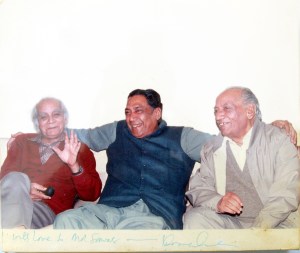
Dr Sarwar with his friends Syed Sibte Hasan and Faiz Ahmed Faiz.    Photo by Dr Haroon Ahmed

Dr Sarwar with his friends Syed Sibte Hasan and Faiz Ahmed Faiz. Photo by Dr Haroon Ahmed

We had our own party here in Karachi on May 31 – Pakistan Medical Association held a reference at PMA House for Dr Sarwar titled ‘Celebrating Dr Sarwar’. The event was initiated by his old friend Iqbal Alavi of Irtiqa, who had been one of his jailmates in 1953.

Some 200 people attended. Doc would have enjoyed the gathering, and the music (his favourite jugalbandi by Ustad Bismillah Khan and Ustab Vilayat Khan), the photos (we put together a slide show), the videos (including a clip from the last interview he did, the week before being admitted to hospital and a few clips from a discussion with Dr Yusuf Ali & Dr Ghalib in London I’d recorded in 2001), the tributes and the resolve to move ahead and continue the struggle.

Mairaj Mohammed Khan, Fakhruddin G. Ebrahim, Salima Hashmi, Dr Badar Siddiqui, Dr Tipu Sultan and others spoke very movingly and from the heart. Tina Sani sang a Faiz poem she had composed, and Arshad Mahmud recited a couple of other Faiz poems for Doc. Aisha Gazdar video taped the event and so did Samaa TV. His Zakia Sarwar also spoke towards the end, very bravely, on what he had meant to her.

Links to a couple of reports about the event:

Progressive student leader remembered – http://tinyurl.com/sarwar-pma-dawn

‘Time to create a left-oriented think tank’ – http://tinyurl.com/sarwar-pma-news

And some earlier reports
In memory of Dr Mohammad Sarwar, The News, May 27, 2009
By Shahid Husain – http://tinyurl.com/sarwar-news

Ahmed Reza, BBC Urdu, 26 may, 2009
http://tinyurl.com/sarwar-bbc

Student politics pioneer Dr M Sarwar passes on, Tuesday, 26 May, 2009
http://tinyurl.com/sarwar-dawn

Dr Sarwar passes on – memorial meeting May 31st

200701-Sarwar-Banner image

Sarwar, Jan 2007. Photo: Anwar Sen Roy

He passed on peacefully in his sleep with his characteristic calm and dignity, shortly after we said goodnight… Here is the note we sent to the press that day (forgot to mention his role in the Medical Gazette, one of the founding members of a publication that provided a platform for progressive political views in dark times):

Dr M. Sarwar passes on

KARACHI, May 26: One of Karachi’s oldest general practitioners, well known physician and former student leader Dr Mohammad Sarwar passed away peacefully in his sleep at home early this morning, May 26 in Karachi, after a prolonged bout with cancer. He was 79.

A memorial meeting is scheduled at PMA House on Sunday, May 31 at 6.30 pm.

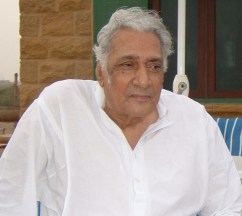
Dr Sarwar, Karachi, 2004

Dr Sarwar, Karachi, 2004

Brief bio:

Born in Allahabad, he came to Karachi for ‘sightseeing’ in 1948 and stayed on when he got admission in Dow Medical College. He was instrumental in forming Pakistan’s first student union, the Democratic Students Federation (DSF). He served as DSF’s President and Secretary General before the Mohammad Ali Bogra government banned it in 1954. He was also the driving force behind the Inter-Collegiate Body (ICB) comprising student unions in different colleges and the All Pakistan Students Organisation (APSO), established in 1953.

Sarwar spearheaded the January 8, 1953 ‘Demands Day’ that spelled out the needs of students, including the establishment of a full-fledged university campus (now Karachi University). He tried to prevent the students from surging forward in the face of the police threat when the procession reached Saddar. Sarwar was injured in the police firing that killed seven students that day, commemorated for years as a ‘Black Day’.

APSO brought together college students from all over the country to demand students’ rights regardless of their politics or ideology. The organisation’s influence was visible in the 1954 elections in former East Pakistan when a student leader defeated seasoned politician Noor-ul-Amin.

DSF also published the fortnightly award-winning journal Students’ Herald, edited by the well-known economist S.M. Naseem, then a student activist.

Dr Sarwar received his final medical college results in 1954 while he was in prison for a year — the McCarthy era in the United States impacted Pakistan as well and progressive elements here were rounded up and incarcerated. His elder brother, journalist Mohammad Akhtar (1926-58) was arrested shortly afterwards. Fakhruddin G. Ebrahim, then an upcoming lawyer, defended many of these political prisoners, including their friend Hasan Nasir who was tortured to death later.

After graduation, Dr Sarwar worked as a general physician with various health services until setting up his own clinic in Gulbahar (New Golimar) where he practiced for over forty years. He was also one of the pioneers of the Pakistan Medical Association (PMA) where he was twice elected general secretary. PMA played a vital role in progressive politics during the 1980s. During the Zia years, the PMA was one of the important ‘civil society’ organisations that consistently stood for democratic politics.

Dr Sarwar will be remembered for his inspirational leadership, generosity of spirit, warmth of character and clear-headed political vision.

He is survived by his wife, well known educationist and teacher trainer Zakia Sarwar, and three children, Beena Sarwar, Sehba Sarwar, and Salman Sarwar and three granddaughters, Maha, Myah and Minal.

Some news reports:

In memory of Dr Mohammad Sarwar, Wednesday, May 27, 2009
By Shahid Husain – 
http://tinyurl.com/sarwar-news

By Ahmed Reza, BBC Urdu, 26 may, 2009 – http://tinyurl.com/sarwar-bbc

Student politics pioneer Dr M Sarwar passes on, Dawn, Tuesday, 26 May, 2009 – http://tinyurl.com/sarwar-dawn

In memory of Dr Mohammad Sarwar Wednesday, May 27, 2009

By Shahid Husain

http://tinyurl.com/sarwar-news

Ahmed Reza, BBC Urdu, 26 may, 2009

http://tinyurl.com/sarwar-bbc

Thanks for your message. We’re grateful he passed on peacefully in his sleep with his characteristic calm and dignity, shortly after we said goodnight…

Here’s a link to a news report about him

Student politics pioneer Dr M Sarwar passes on, Tuesday, 26 May, 2009

http://tinyurl.com/sarwar-dawn

Some articles re ‘Talibanisation’, veiling, flogging

Two of my articles on `talibanisation’ and violence against women published April 12, 2009 that I didn’t get round to sharing here, reminded by Nadeem Farooq Paracha’s spot on article ‘Slap him or Slap yourself’ (Dawn, May 17, 2009) – http://tinyurl.com/pxrfjz

1. `Ongoing struggle’, in Special Report, ‘The News on Sunday’ about how Talibanisation is splitting our South Asian identity and leading to the existing schizophrenia and changing dress codes…

Extract: The trend (to veil) is also visible at the lower socio-economic level. Some years ago, Sughra, who cleans homes for a living, began wearing a burqa when going to work, motivated by weekly religious meetings. She feels it is “better”, both because it is ordained by religion and because it helps her to avoid the male gaze. Her cousin Ameena, a cook, shrugs off the suggestion to wear a burqa. Although deeply religious– she says her prayers regularly and fasts during Ramzan — she does not see the need to alter how she dresses, which is perfectly modest by any standards. “If a man harasses me, I beat him with his own shoe,” she says.

Complete article at  http://tinyurl.com/dmg4om

2. Op-ed in Dawn for which they changed original title “`Wicked’ NGOs and that flogging thing” to the more mundane `Swat flogging & public outrage’. They also changed the word `bottom’ to `back’ which doesn’t at all mean the same thing. `Buttocks’ would have worked but I guess that’s the prevailing `sensibility’.

Extract: The first casualty of war may be the truth but the first casualty of any `religious militancy’ is women’s rights…. The Taliban’s treatment of women, including their ban on female education while in power in Afghanistan (please note, before the American drone attacks) takes Zia’s obsession with controlling women’s morality and public behaviour further…. One reason for the Pakistani state’s apparent paralysis is that the armed forces and large sections of the population think of this as America’s war, compared to the previous Afghan war with its religious trappings. In fact, that was less `our war’ than the current one, which threatens the very existence of the Pakistani state. http://tinyurl.com/ccelax

A slightly longer, revised version was published in ‘The Hindu’ on April 14 – Vigilantes, the state and that flogging thing’ – The first casualty of war may be truth but the first casualty of any ‘religious militancy’ is women’s rights – http://tinyurl.com/qjs8da

Some other articles published at that time that I liked:

The high cost of surrender, Irfan Husain, Dawn 11 Apr, 2009 http://tinyurl.com/dxfmv8

Are we in denial about terrorism? Shafqat Mahmood, The News, April 10, 2009 http://tinyurl.com/cveryg

A state adrift, by Cyril Almeida, Dawn, 10 Apr, 2009 http://tinyurl.com/d9eoy8

A catalyst for change? By Zubeida Mustafa, 08 Apr, 2009 – WHY did civil society in Pakistan vociferously protest the flogging of a 17-year old girl in a public square in Swat and not when many other atrocities were committed against women in recent times? http://tinyurl.com/czofco

India trip, the ‘attack’ and some articles

Allahabad Chapter of PIPFPD: Comrade Kameshwar Prashad Agarwal

No disruptions at the Allahabad Chapter of PIPFPD, attended, among others, by Comrade Kameshwar Prashad Agarwal

Hello everyone, have been traveling with limited access to internet, hence the silence.

I was among the journalists at a panel discussion ‘Does media jingoism fan tensions between India and Pakistan?’ organised by Forum of Media Professionals at the India International Centre in New Delhi on April 15. The event got a lot of play because of misreporting.

The Indian media hyped up a minor disruption, reporting that the Pakistani journalists in the panel were ‘attacked’ or ‘roughed up’. The Pakistani media picked up on the photos and subsequently there were condemnations and even demonstrations in Pakistan about the ‘attack’.

To set the record straight, no one was roughed up or attacked. One man did disrupt the meeting – but very briefly, from the back of the auditorium. The organisers had turned away 3-4 men who refused to sign the register – he must have sneaked in. The discussion was half over when he stood up and started shouting anti-Pakistan, pro-war slogans (someone sitting near him said he’d just come in). The organisers pushed him out. TV cameramen and photographers followed.

Most papers and channels used photos and footage of the scuffle outside, rather than focusing on the discussion inside, which continued, despite the noise we could hear outside for a couple of minutes. The interruption lasted for maybe a minute or so. The discussion started at 10 am and continued till 1.30 pm. It turned out that he was from the Sri Ram Sene, the same group that tried to prevent Valentines Day celebrations in India, to whom thousands of people sent ‘pink chaddis’ in response.

The incident demonstrated what we had been talking about, that TV, being a visual medium, focuses on images rather than words. Hence their running after the scuffle rather than focusing on the discussion. This is the nature of the beast. Those keen to tame it might try organizing mass emails, letters and phone calls to demand meaningful change.

Here is Rahimullah Yusufzai’s article on the incident – `The good, the bad and the ugly’, The News, Apr 21, 2009 <http://tinyurl.com/dxtuo3>

Our visit also involved several other interactions with the media. Rahimullah Yusufzai, the veteran reporter from Peshawar was the most sought after for his views on Talibanisation, living as he does in the heart of the storm. Here is the link to a full page ‘idea exchange’ published April 19, a forum that The Indian Express regularly holds: “I don’t think we have reached a stage when the Taliban will take over Pakistan” – <http://tinyurl.com/dzeyc9>

I showed some of my documentaries at a meeting of the Allahabad chapter of the Pakistan-India Peoples Forum for Peace and Democracy (PIPFPD) and at the Delhi Press Club, organised by Youth4Peace. Here are links to a couple of reports on the Press Club screening:

‘In Pakistan, change has to come from within, says journalist’ -Indian Express, Apr 20, 2009 – <http://tinyurl.com/covts7>

`Pak journalist’s short take on women’s rights’, Mail Today, Apr 20, 2009 – <http://tinyurl.com/cmb7ey>

More later

PAKISTAN: Another Terror Attack For TV Cameras

beena-22

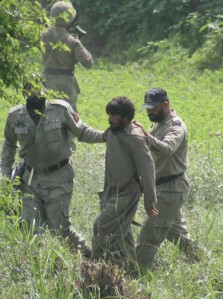
A Taliban militant, part of the group that attacked a police academy near Lahore, being led away by troops. Photo: Rahat Dar

KARACHI, Mar 31 (IPS) – The brazen armed attack on a police academy near Lahore on Monday underlines the danger that the Pakistani state faces from militancy linked to the ‘war on terror’, but with historic roots in the earlier Afghan war of liberation from Soviet occupation, that was converted into a ‘jihad’ against ‘God-less communists’.

The incident is also part of a chain of such attacks that highlight the need for out-of-the-box thinking to a regional, political approach and regional cooperation in this global, border-less conflict.

Eyewitnesses to Monday’s drama said that the gunmen scaled the six-foot high boundary walls of the academy soon after 7 am. They lobbed hand grenades at the 700 or so recruits on parade and ran at them, firing automatic weapons.

Police and paramilitary troops fired aerial bursts in jubilation and shouted ‘Allah-o-Akbar’ (God is great) after they re-gained control of the Academy premises a tense eight hours later.

The final death toll was far lower than the 28 or so initially reported by television channels: eight policemen, one civilian, and four militants who blew themselves up with suicide vests.

Television channels showed heart-rending scenes of distraught relatives at various hospitals where the dead and injured were taken.

The role of the electronic media while covering such incidents has come in for much criticism. In their rush to be first with the news, channels often provide incorrect information – or “lies”, as a press photographer who was at the scene of the Mar 30 drama put it more bluntly.

The al- Qaeda-linked Taliban leader Baitullah Mehsud, based in Waziristan Agency in Pakistan’s north-west tribal areas, claimed responsibility for the latest attack, the second this month in Lahore, capital of Punjab, Pakistan’s most populous and powerful province.

On Mar. 3, some dozen gunmen ambushed the visiting Sri Lankan cricket team in uptown Lahore, injuring several cricketers and killing six policemen and a driver. The gunmen disappeared after the shooting spree and have yet to be apprehended.

On Mar. 27 a suicide bomber killed dozens of worshippers at a crowded mosque near the north-western town of Jamrud on the highway to Afghanistan. Unconfirmed reports suggest that the motive may have been related to money as criminal elements operate freely in the area.

However, the Lahore attacks, taking place in an urban metropolis with dozens of television channels, were far more spectacular and effective, as Asha’ar Rehman, Resident Editor of daily Dawn in Lahore commented.

“A suicide bombing, in the eye of the terrorist perhaps, is too fleeting a moment in the life of a people who have become so used to the occurrence,” said Rehman.

“It is obvious that the terrorist is looking for more than momentary fame. He now wants to stretch the harrowing experience for as long as he possibly can, to the chagrin of onlookers who cannot keep their eyes off the television.”

The attack on the three-storey police school on the outskirts of Lahore a few kilometres from the Wagah checkpoint on Pakistan’s eastern border with India also bore other similarities with the ambush on the cricketers.

Underlining huge security lapses and intelligence failures, both took place in the early morning hours, with well-equipped, well-trained militants attacking supposedly well-protected targets. The Sri Lankan cricketers should have been extended presidential level security while the police school was peopled with – well, policemen, under training though they were.

Their commonalities include the possibility of local support that must have existed in order to facilitate them.

Both attacks drew comparisons to the Nov 2008 attacks in Mumbai, India. Some commentators accused India of being behind them in retaliation for the Pakistani link that emerged in the Mumbai tragedy.

The Mumbai attacks were in turn compared with the suicide attack on Marriott Hotel in Pakistan’s capital Islamabad on Sept 20, 2008. The attack was heavily symbolic given its high-security status and proximity to the corridors of power.

Earlier, militants had eliminated a much more symbolic and high value target – former Prime Minister Benazir Bhutto, as she left an election rally in Rawalpindi on Dec 27, 2007.

Other high-profile attacks, in the recent past, include the suicide car bombing at a police checkpoint in Peshawar that kills 35 and injured about 80 people last September.

In August 2008 twin suicide bombings at the gates of a weapons factory in the town of Wah near Islamabad left 67 dead. Earlier in March 2008, suicide bombers targeted a police headquarters in Lahore, leaving some 24 dead.

But Monday’s attack was so far “the biggest and potentially the most dangerous attack on a state facility in Pakistan,” noted Asha’ar Rehman.

“There were hundreds of trainee policemen inside the compound – trainees among a police force that, according to adviser on interior Rehman Malik, lacks basic training to combat terrorism. They were ill-equipped to stop the advance of a handful of visibly skilled gunmen. It could have been far worse.”

The drama ended with an unexpected twist, again a throwback to Mumbai, when security forces captured some militants alive.

One of them, a bearded man with an expressionless face, was nabbed while heading towards the helipad in the fields behind the Police Academy. He was carrying hand-grenades apparently to attack the helicopters with.

News photographer Rahat Dar told IPS that he was perched along with other media persons on the rooftop of a nearby building watching events unfold at the academy in front of them. “We turned around towards the back when we heard shouts of ‘Got him, got him!’” he said.

Security personnel yanked off the man’s shalwar, baggy trousers to ensure that he was not armed. They also beat him up, prompting Islamabad-based journalist Mariana Baabar to question whether police are actually trained to capture a live terrorist.

“It was the Punjab police in action – doing what comes to them naturally. Obviously, they cannot differentiate between a rare live person who could give them tons of information and an ordinary criminal,” she wrote in a front page comment in daily The News. “Nothing amazing or new except that this was a rare chance to see it live on our screen”.

Police repeatedly kicked the man, apparently having “decided that they would keep kicking him with their boots till he was no more…,” wrote Baabar. “It took an army guy… to stop the angry and out of control police from this brutal kicking. At least someone realised that it was essential to get this suspect alive.”

Identified as an Afghan named Hijratullah, the encircled man presented a pathetic sight as he struggled to cover himself with his shirt.

The other three suspected militants in custody have not yet been identified. They were captured when trying to escape from the premises wearing police uniforms.

Political analysts have long been warning that there are no easy military solutions to the ‘war on terror’. The al- Qaeda and Taliban now appear to have converged with Pakistan’s ‘home-grown’ militancy that American and Saudi dollars cultivated during the Afghan war against Soviet occupation.

Analysts hope that the interactions between global leaders at the high-powered meetings in Europe this week will help initiate a change in the global approach to these issues.

The U.N.-backed conference at the Hague on Mar. 31 to discuss the future of Afghanistan, participated in by about 80 countries including Iran and the United States, is expected to also discuss a regional approach to the issue, says Marjan Lucas of the Dutch Peace Organisation (IKV).

“It is important that America understands what they’ve done to the region and develop partners with civil society and elected representatives rather than the army as they have been doing,” she told IPS in Karachi, having arrived from Lahore the day before the police academy was attacked.

The Hague conference will be followed by the G20 and NATO Summits where U.S. President Barrack Obama is expected to hold bilateral meetings with several world leaders.

What is certain is that there are no easy answers, and that there are likely to be more such links in the terrorist chain before things get any better.

‘From Pakistan with Love: Saneeya Hussain’

‘Celebrating Saneeya’ – feminist, activist, environmentalist, my former editor, and dear friend. Made this 5-min documentary after she died in Brazil in 2005… Saneeya, we will always miss you and be inspired by you and your infectious laughter… See also Saneeya Hussain Trust
http://saneeyahussaintrust.com/

A breath of fresh Kashmiri air

Column for Hardnews, Delhi, Feb 2009

PERSONAL POLITICAL

basharat-peer-t2f-6-w-mural

Basharat Peer at T2F. Photo: Jamal Ashiqain

Beena Sarwar

Basharat Peer’s ‘Curfewed Nights’ brings home the myriad nuances and human-ness of ‘the Kashmir issue’ – the main reason why, we are told, Pakistan and India can’t exist in peace.

Despite the hostilities, it speaks for the changing times that Peer was able to recently visit Pakistan, staying with Saad Haroon, a satirist he had met in New York (got the visa because a Pakistani diplomat liked his book). Friends hooked him up with Sabeen Mahmud who runs The Second Floor, T2F, the internet café-cum-community space in Karachi where you can hang out over music or a board game, browse the bookshelves or imbibe the art work and mural on the brick walls. Despite the short notice, the place was packed – with mostly young people, like Peer, Mahmud, and Haroon themselves. The event provided a rare opportunity for meaningful interaction without the public posturing, ‘national’ positions and one-upmanship that the mainstream media reflects and reinforces, overwhelming the shades of grey.

Waiting for the author, I got engrossed in the first chapter. The first few pages outlining his idyllic boyhood in a village in Anantnag reveal a culture steeped in religion, but gentle and tolerant. “Everything changed in 1990,” he explained, taking his seat in a corner of the room. “That was the turning point. It is the year against which we measure every subsequent moment.”

Ironically, Peer landed in Pakistan on Feb 5, designated ‘Kashmir Day’ by former prime minister Nawaz Sharif. No subsequent government could remove this unnecessary national holiday that costs the exchequer millions of rupees annually. My daughter is happy that it’s a school holiday. Kashmiris remain in ignorant bliss about this magnanimity. “I didn’t even know there was such a day,” admitted Peer. “None of my friends know.”

He dispelled the myth nurtured by the Pakistani establishment that Kashmiris are grateful for the foreign intervention. The foreign fighters injected into the region have no affinity with the Kashmiris. “They have no language in common, they have different worldviews, and their approach to religion is very different. Villagers have an ambiguous approach to foreign militants. They bury their bodies out of respect for the dead, but don’t carry them on their shoulders in processions like they do for the local boys.”

Kashmiris most certainly “would not want a government like some people want Swat to have,” he added (nor would most of us in Pakistan).

Refreshingly honest and thoughtful, Peer is among the 74 per cent of Kashmiris who are under 40. His first visit to Pakistan, he said, has been an eye-opener. “For a long time, Pakistan for me was Imran Khan. It was an abstraction, a collection of images. I couldn’t have imagined it was like this, or that there were so many multiple worlds in Karachi. I had no real sense of what Pakistan was.”

In turn, many of us were stunned by the story he related about the reaction in Kashmir when Gen. Zia got Z.A. Bhutto hanged in 1979. “People were so angry they burnt the houses of 500 Jamat-e-Islami members all over Kashmir valley. They even burnt copies of (JI founder) Maulana Maududi’s book and copies of the Quran. When my grandfather tried to stop them, they said that it was the ‘Jamati Quran’.”

One of the passages he read out was a moving one about reuniting with Kashmiri Pundit friends at a refugee camp. Obviously something he feels strongly about, the issue figures prominently in his book. Keenly observed and vividly related, his writing made me literally ‘see’ Kashmir as never before.

Peer stresses the high premium placed on education in the Valley. “Even the poorest girls in my village go to school. Srinagar’s Lal Chowk is a sea of women from 1 to 3.30 pm, hundreds of women and girls from schools in the area, dominating the most significant public space in Kashmir.”

Some asked if he felt a greater need to prove his loyalty to India as an Indian Muslim? “I am a Kashmiri Muslim, not an Indian Muslim,” he responded. “I have a disputed status… I published this book in India. I’ve worked for several Indian publications, but never felt discriminated against because of religion. I could write about and publish anything. It may not always get the best display, but all reporters crib about that. Yes, there is a problem finding housing in Delhi if you are Muslim, but aren’t housing issues universal? Would a Pathan find it easy to get a house in a Mohajir area?”

Three cups of tea and hope in Pakistan

Three Cups of Tea_Mech.inddToday, March 23, Greg Mortenson will receive Pakistan’s highest civilian award, the Sitara-e-Pakistan (Star of Pakistan) for his work on education, especially for girls, in Pakistan’s northern areas.
His book, Three Cups of Tea, is a must read for anyone interested in the area.
Here’s a note I found on Shahidul Alam’s blog:
Pakistan: Hope amidst the chaos
Salma Hasan Ali

Pakistan: Hope amidst the chaos