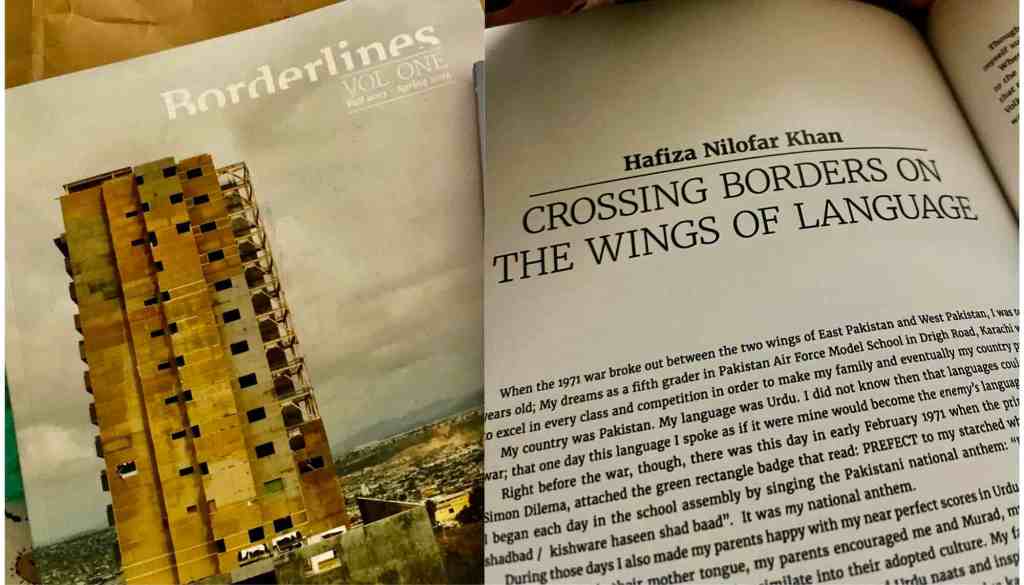
It was only as an adult long after 1971 that I learnt about the internment camps where Bengalis in then West Pakistan had been detained. My source was an essay titled ‘Crossing Borders on the Wings of Language’, by Hafiza Nilofar Khan, in Borderlines, Vol. 1 (2014), an anthology published by Voices Breaking Boundaries, my sister Sehba Sarwar’s nonprofit in Houston (now archived at the University of Houston).
The ten-year-old Hafiza whose father is in the Pakistan Air Force and proud of her prowess in Urdu suddenly finds herself and her family in the situation that Lahore-based historian Ilyas Chatta details in his recently published book Citizens to Traitors: Bengali Internment in Pakistan 1971-1974 (Cambridge University Press, 2025).
It has been a decade since we lost Sabeen Mahmud to a targeted attack in Karachi and since we lost Shayan “Poppy” Afzal Khan to cancer. It is also 20 years since the pioneering environmental journalist Saneeya Hussain died in Brazil. Their peacemongering legacies live on.
Personal Political Beena Sarwar / Sapan News
On 24 April 2015, a valiant crusader for peace, social justice, creativity and human dignity was killed in Karachi. That tragedy ten years ago deprived a mother of her only child, and many of us of a dear friend.
Social entrepreneur Sabeen Mahmud, 40, was driving home with her mother Mahenaz next to her. A motorcyclist approached while they were stopped at a red light, and shot Sabeen at point blank range. She died on the spot.
Sabeen. Photo by Zaheer Alam Kidvai.
Mahenaz at Creative Karachi Festival 2016: Sabeen would hate for any of us to give up. Photo: Beena Sarwar
A poster with Sabeen’s photo at Creative Karachi Festival, 2016, Alliance Francaise. Photo: Beena Sarwar
Pakistan: Countrywide demonstrations for Sabeen, 2015
Protest for Sabeen in Delhi, 2015. File photo
I had known Sabeen since she was a teenager. We were comrades together in several peace initiatives – part of a large, cross-border tribe of ‘peacemongers’ as I call our community.
Some thoughts emerging from a chance encounter with one of Pakistan’s most respected and iconic progressive poets.
Indian and Pakistani writers and a filmmaker at the Faiz Festival, Lahore: (l-r) Dr Saif Mahmood, Atul Tiwari, Dr Arfa Sayeda Zehra, Dr Arvinder Chaman, Nandita Das and Zehra Nigah. Photo by Zarminae Ansari / The Joy of Urdu
“It’s the girls that give me hope,” says the celebrated poet and writer Zehra Nigah.
She leads a quiet life at her home in Karachi, without a mobile phone or email. Yet those who seek her are able to find her. Besides the school and college students who look to her for guidance, there are advertising companies looking for classy jingles. And there are organisers of literary festivals wanting to invite her.
These include Jashn-e-Rekhta, the three-day annual festival that celebrates Urdu — subtly countering the rightwing narrative that Urdu is a ‘Muslim’ language while Hindi is for ‘Hindus’.
When it started in 2015, Rekhta invited several prominent Pakistani poets and writers to participate. Its third edition in 2017 was the first time that there was no Pakistani participation in its sessions – due to the “prevailing atmosphere” in India, the organisers took “a considered decision” to not invite Pakistanis as “participants” but only as “guests”, reported Anita Joshua in the Telegraph, India.
“Some see in this an instance of self-censorship to avoid trouble of the sort that has recently beset Bollywood films starring Pakistani actors,” commented Joshua.
The only Pakistani who accepted the invitation was Kishwar Naheed, then 77, another iconic Pakistani poet, for whom being invited as a ‘guest’ meant that she would at least be able to recite at the ‘mushaira’, the poetry recital session addressed by several poets, as she told me later.
Wrote this piece a couple of weeks ago, on one of Pakistan’s most versatile composers who continues to produce a genre embedded in Southasian traditional music, to get the younger generation to appreciate classical poetry and music — and provide a platform for new talent. A Sapan News syndicated feature also published in other outlets.
Personal Political By Beena Sarwar / Sapan News
Arshad Mahmud in Such Gup, PTV, 1970s. Screenshot.
Will there be singing In dark times? Yes, there will be singing About dark times
— Bertolt Brecht, Germany, 1939
Arshad Mahmud is one of Pakistan’s most prolific and talented composers, the man whose music launched singing sensations like Nayyar Noor and Tina Sani.
He made his debut with the children’s television show Akkar Bakkar, 1972, along with Nayyara Noor and the pioneering puppeteer Farooq Qaiser, produced by Shoaib Hashmi, then an economics professor at Government College (now University) Lahore.
Behind the ustad (teacher) Hashmi’s booming voice, gruff manner and handlebar moustache was a brilliant writer and satirist who went on to write and produce the groundbreaking, now legendary satirical television shows Such Gup and Tal Matol. We would use these as the titles of Shoaib Hashmi’s columns for The Frontier Post later and The News on Sunday that I edited in Lahore, starting in the 1990s. His daughter Mira Hashmi has uploaded many of the videos to her YouTube channel.
Hello friends – I’m still in Boston, waiting for permission to visit India. The WISCOMP Saahas (courage) awards ceremony I wanted to attend on 16 December is over, but I am still like to go and visit my friends and family, and show my Sri Lanka documentary at various places including the Bangalore International Center, the IIC, Delhi, and in Chennai – police in all three cities have given clearance as far as I know.
Sharing the edited version of the WISCOMP awards ceremony below – they had taken it offline to edit out the Afghan and Bangladeshi activists who were kept anonymous. Don’t miss the inspirational speeches by the awardees and thoughtprovoking documentary on the courageous journalist Patricia Mukhim from India’s North-East (I love her singing in it and now I know where her love for plants and nature comes from).
Here is a report about the event in The Wire – I’m delighted they used a photo of featuring the wonderful community of Southasia Peace Action Network (Sapan) Peacemongers who joined my dear friend and colleague, journalist Mandira Nayar on stage after she accepted the award on my behalf from Dr Syeda Hameed, a Sapan founder member and advisor. It was wonderful and moving to see Aekta Kapoor, Ruchira Gupta (also a Saahas awardee), Parshu Narayan, Reema Amin, and the veteran peace activist O.P. Shah from Kolkata come together – thank you WISCOMP for inviting them.
Other wonderful members of our community were present but remained seated, like the inspirational activist Harsh Mander of Carvan-e-Mohabbat, poet and writer Sagari Chhabra, and journalist and activist Rita Manchanda.
Mukta Lall, daughter of the poet Jagannath Azad, was also present but had to leave before my name was called. We’ve been been in communication with for years but never met. It was Mukta ji who provided me with a scan of her father’s Urdu poem that served as Pakistan’s first national anthem – well documented, although there is no official record.
The event in India this afternoon represents a significant moment for Southasian solidarity. It also underscores the challenges in the region, including visa restrictions between Pakistan and India
I feel deeply honoured to be among the wonderful women being conferred the Saahas-e-Azim (Most Fearless) award by WISCOMP in Delhi today – Women in Security, Conflict Management and Peace, celebrating its 25th anniversary.
Sapan founder member Dr Syeda Hameed
It is amazing that three of the awardees are from Pakistan – but sadly unable to be there at the ceremony, thanks to the visa issues between Pakistan and India.
The highest award, the Saahas Shresta (Great Courage), goes to the journalist and activist Patricia Mukhim, Editor of Shillong Times and a Sapan News advisory council member. The jury termed Mukhim a “tireless advocate for communal harmony and gender equality” with “ceaseless positive energy in countering violence”.
Further delighted that our dear mentor Dr Syeda Hameed is a guest of honour conferring the awards, and that our lovely friends Kavita Srivastava and Mandira Nayar will be there to receive the honour on behalf of Saeeda Diep and me.
The large Sapan presence and contingent in this event includes four of the awardees, a guest of honour, and two accepting the awards, as Pragyan Srivastava wrote today for Sapan News
The Pakistanis besides myself are Sapan founder member Saeeda Diep, “peace activist and human rights advocate from Pakistan, championing the rights of religious minorities, especially Hindus through a gender lens” and Mossarat Qadeem, a university professor turned activist, being honoured for her work through her Paiman Trust which “empowers women and radicalised youth in conflict zones to become agents of peace and reconciliation”.
The fourth Saahas-e-Azim awardee is Ruchira Gupta, “globally renowned journalist, filmmaker, and activist, dedicated to eradicating sex trafficking and empowering women”, a Sapan member from India.
Thanks also to our great friends and Sapaners Aekta Kapoor and Sagari Chhabra for the nominations.
The keynote speaker at TCF Boston fundraiser this year was Indian – and it wasn’t ‘bad news’. On the contrary. Check out Shashi Buluswar‘s cricket documentary that I’ve included in the article. Plus a discussion with ‘peacemongers’ hosted by a center in Kolkata the same day.Why can’t our political leaders take a leaf from Mani Shankar Aiyar’s relationship with his old friend Javed Jabbar, a self-proclaimed “chauvinist and narrow-minded Pakistani” — they disagree on almost everything yet are “the closest of friends”.(Note: for more photos, go to the piece published on Sapan News)
“By now you will have got the bad news,” said the keynote speaker after being introduced. “I’m Indian”.
There was laughter and warm applause from the largely Pakistani or Pakistani-origin audience.
Not only was it not ‘bad news’, but the speaker’s support for the cause he was advocating for, beyond borders and boundaries, was even more appreciated because of his Indian origin.
Going by the media – and social media – you’d think we all hate each other. Not true.
Film screenings byAnand Patwardhanin Cambridge MA TODAY and tomorrow. My documentary at Tufts on Wednesday. The sublime musical play ‘Madho’ at Wellesley next weekend. The latest Sapan Alliance newsletter has more events and info about other events, including in Colombo. Scroll below for my conversation with Mayank Chhaya on the Sri Lanka elections, plus pix from ‘Democracy in Debt’ Global Community Screenings – some 40 events in 14 countries across 5 continents – and my notes on recent Sapan News features.
Off-Kendrik started over 16 years ago, “committed to building a broad platform for South Asian theatre groups and the next generation of South Asian Americans through theatre and storytelling”.
PERSONAL POLITICAL By Beena Sarwar
I went to see ‘Madho’ last night with my mother at the Third South Asia Theatre festival, SAATh 2024, in the Boston area. A musical play set in Lahore, it is written and directed by Sarbpreet Singh, an engineer by profession whose passion is music and storytelling.
I meant to share this when it was first published on Sapan News recently, my article co-authored with Dr Serena Hussain and Vishal Sharma, but was caught up with the Colombo screening of my Sri Lanka documentary. Thought I’d post now – the piece is still relevant especially given a recent article in an influential foreign policy magazine debunking the idea of Southasia
Images from various SAARC summits sourced from copyright-free photos. Collage by Pragayan Srivastava
Why the regimes ushered in through the democratic political process need to collaborate for a better future for the peoples of the region
By Dr Serena Hussain, Vishal Sharma and Beena Sarwar
The recent elections in Britain, France, and India are a reminder of the power of the people – and also of the importance of regional cooperation.
Pakistani PM Benazir Bhutto with her Indian counterpart Rajiv Gandhi at 1988 SAARC Summit in Islamabad. Source: Dawn
The Indian elections were the third electoral exercise in South Asia this year, after Bangladesh in January and Pakistan in February. Sri Lanka is also required to hold presidential elections before October.
As part of the democratic political process, elections determine the leadership that will shape not only a nation’s destiny, but also in closely connected regions.
The governments may choose to be isolationist, or follow the will of foreign powers, or cooperate and collaborate with neighbouring nations. Can and will South Asia’s regimes cooperate to promote regional peace, prosperity and progress as they have done in previous decades such as, during the 1950s, 1980s, and 2000s?
Such collaboration is essential for the sake of the peoples of the region.




 Journeys to democracy