Prisoners’ anguish

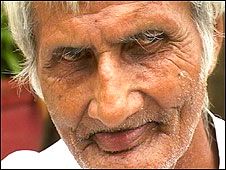
A lifetime lost...Left with no speech, no memory, no family (photo courtesy The News)

A lifetime lost...Left with no speech, no memory, no family (photo courtesy The News)

An 85-year old man acquitted after 38 years in prison has little to live for – he has lost his speech and memory, and is now being cared for by Christian missionaries at a shelter in Malir, Karachi.

See ‘The News‘ editorial 38 years .

The same day as news of Saeed-ul-Haq’s acquittal was published, newspapers reported that a Pakistani had been ‘tortured to death’ in an Indian prison. M. Nawaz Jamil had been a student of class 9 in 1991 when Indian troops arrested him along the Line of Control. He ended up serving far more than the six years he was sentenced for. This is what Indians regularly do to Pakistani prisoners and vice versa.

As I wrote in an article last December, ‘Media falls into old trap’):
Prison conditions and how the police treat prisoners in both countries are no secret. It is not that we treat Indian prisoners well, while they viciously torture Pakistanis. Sometimes a prisoner’s death results not from outright torture but illness arising from neglect — poor living conditions in a hostile environment, extreme temperatures, lack of medical attention, all compounded by lack of contact with loved ones back home.

There have been many instances of Pakistani prisoners dying in Indian prisons and vice versa. But what strikes me is the cruelty with which we treat our own prisoners, as the case of Saeed ul Haq shows. Not to mention all those other deaths in custody that periodically surface.

Dr Sarwar blog; my ‘Media Matters’ chapter in new book on Pakistan India divide

Hello all, it’s been a while since I last posted anything to this list. Have been caught up in a bit of a backlog.

Have uploaded new material, including photos, to the Dr Sarwar website – www.drsarwar.wordpress.com

Please do check it out. Suggestions, comments and inputs welcome

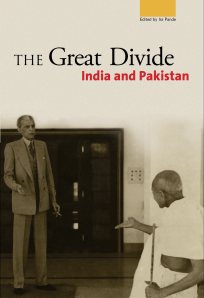
Cover 'The Great Divide'

Cover 'The Great Divide'

Recently received a copy of the India International Center quarterly to which I contributed a chapter (excerpt below), published recently by Harper Collins, India. I dipped into it – loved the chapter by Sonia Jabbar & was happy to see that Mukul Kesavan, one of my favourite writers, also has a chapter, besides other luminaries like Urvashi Butalia, Amit Baruah (former The Hindu correspondent in Islamabad),and Pervez Hoodbhoy plus a short story by Danial Muinuddin.

‘The Great Divide: India and Pakistan’ (Hardback, 360  pages)
Edited by Ira Pande
ISBN: 9788172238360
Cover Price: Indian Rs. 495.00

http://www.harpercollins.co.in/BookDetail.asp?Book_Code=2313

BOOK SUMMARY
At a time when India and Pakistan are both reeling under terror attacks and hysterical talk of an impending war, it is important to take stock of where we have reached, individually and as part of the Indian subcontinent; sixty years after the two nations were carved out as two distinct entities.

This volume of essays by writers from both sides of the border attempts to do just that. As the editor, Ira Pande, says in her introduction, ‘There is a balance here between the ‘hard’ topics (politics, economy, diplomacy, religion et al) and ‘soft’ (music, crafts, language, cricket, cinema) to bring out the full range of our engagement with each other.’

Below: Excerpt from my chapter

‘Media Matters’

Beena Sarwar

(excerpt begins)
Ask anyone what they think the major problems in society are, and chances that the media will figure somewhere in the answer. Ask about possible solutions and the answer again will include the media in some way. So is the media part of the solution or part of the problem? Or is it, as some think, the problem itself? Do journalists simply mirror society – reflect the good and the bad — or do they actually shape perceptions and agendas? Equally crucially, do they act independently or do they ‘manufacture consent’ for their governments and corporate owners? Have the media contributed to rising tensions between South Asia’s nuclear-armed neighbours, or are hostilities between the countries contributing to tensions between their media? Has the media boom brought people closer, or is it driving a greater wedge between them?

The answer is ‘yes’, to all these questions.

The ‘media’ of course are not a monolithic entity. The news media includes print, television, radio and more recently the ‘new media’ – websites and web logs or ‘blogs’ posted on the Internet. The ‘popular’ or ‘entertainment’ media includes film and advertising. Crucial to the role of the media is the continual blurring of the line between the news and entertainment media.

The media boom has on the one hand brought the people of India and Pakistan closer together and contributed to shattering stereotypes. On the other hand, it has done just the opposite, reconfirming prejudices and old suspicions.

The 24/7 news media boom has also spawned a beast that thrives on 30-second sound bites and shrinking attention spans around the world. It is not big on in-depth analysis and prefers speculation. It tends to bypass contextualisation for quick updates. The race to be the first to ‘break’ the news often leads to misreporting and inaccuracy. Peace talks and negotiations which would be more effective away from the media spotlight are routinely sabotaged by leaks and overreactions to those leaks.

Broadcasting belligerent statements by one politician or other is damaging anyway, but worse when these are cross-border taunts and challenges. The media has a duty to report, but giving weight to negative statements and events contributes to the hardening of stances and reinforcing of negative stereotypes. Of course, it also exposes the belligerent nature of those making such statements for all to see.

(excerpt ends)

Arundhati ‘Pakistani’ and right-wingers ‘patriotic’

The FMP panel in Delhi, April 15, 2009

The FMP panel in Delhi, April 15, 2009. Photo: FMP

Panel members Arundhati Roy & Aniruddha Bahal. Photo: B. Sarwar

Panel members Arundhati Roy & Aniruddha Bahal. Photo: B. Sarwar

PERSONAL POLITICAL

Beena Sarwar

“Shouldn’t Arundhati Roy come from Pakistan?” sarcastically asked a Delhi freelance journalist, commenting on the Facebook posting about a panel discussion, ‘Does Media Jingoism Fan India Pakistan Tensions?’ The cynical remark stemmed from his annoyance, shared by many, at Roy’s consistent exposure of India’s ‘warts’.

The panel, organised by the recently formed Forum of Media Professionals (www.fmp.org.in ), included four journalists from India besides the celebrated writer and activist Arundhati Roy as well as four Pakistani journalists and The Hindu’s Islamabad correspondent Nirupama Subramanian.

Delhi is far cleaner and greener since I was last there nearly five years go, thanks to laws (that are actually implemented) banning diesel and making CNG compulsory. On a more intangible level, another kind of pollution remains, reminiscent of a phenomenon we face in Pakistan: right-wing jingoism fuelled by emotional appeals to religion and nationalism.

The jibe about Arundhati Roy, disguised under an urbane sarcasm, is just one aspect of bigoted nationalism. Going by that logic, those in Pakistan who fight for justice — a struggle that necessitates exposing wrongdoings, or ‘washing dirty linen in public’ according to our critics — should represent India. Another aspect of such thinking is evident in the comments back home when I show my documentary ‘Mukhtiar Mai: The Struggle for Justice’, in Pakistan: “Why don’t you make such films about violence against women in India? Women there have these problems too.”

I wonder at this competitiveness that makes us feel self-congratulatory when we can point out how much worse the other is in some way.

Thankfully, not everyone takes this myopic view. In Allahabad, at a crowded meeting of the Pakistan-India People’s Forum for Peace and Democracy (PIPFPD), there was none of this one-upmanship or finger pointing. The audience immediately saw the commonalities of the issues raised in the films I showed, on Pakistan’s flawed and discriminatory Hudood Laws and Mukhtiar Mai. They understood that the phenomenon in Pakistan of Taliban ‘punishing’ women for alleged transgressions is not much different from those who rape, kill or lynch women and couples for the sake of ‘honour’ in India itself or indeed in traditional communities in Pakistan.

The difference is that most of these ‘honour crimes’ are committed by relatives of the women who ‘transgress’, as opposed to the Taliban who are taking it upon themselves to enact these punishments as part of the imposition of their own criminal justice system that flouts the writ of the state.

Another difference is that the family in Haryana who hanged their daughter and the man she eloped with (in their own home) will be charged, tried and probably punished. In Pakistan, the ostensibly Islamic Qisas and Diyat (retribution and blood money) laws imposed by a military dictator in the 1980s allow the murder victim’s family members to ‘forgive’ the perpetrators who are often their own relatives.

As for the Taliban and their sympathisers, none have ever been charged for their criminal transgressions, ranging from blackening women’s faces on billboards, to disrupting public events in that involve women (remember the Gujranwala marathon?), to blowing up schools, killing teachers and dragging women out of their homes and murdering them for alleged ‘immorality’.

At the Allahabad meeting, the tone was set by senior advocate Ravi Kiran Jain in his introduction when he stressed on the need for a stable government in Pakistan, and the desire to remove misunderstandings. His words reminded me of Nirupama Subramanian’s appeal at the panel discussion in Delhi urging Indians to “be sensitive to Pakistan as a country that has problems and show moderation in we respond to these problems.”

Many Indians already understand this, but we don’t hear their voices in the media very often. For instance, Utpala, a women’s rights activist during the discussion in Allahabad talked about the need for Indians and Pakistanis to be allowed to visit each other’s countries. Her own visit to Pakistan many years ago, she said had expanded her ‘angan’ (literally, courtyard). She ended by asking, “How can we in India be happy until there is a pro-people, pro-women government in Pakistan?”

The Delhi panel was disrupted for a minute or so by one man at the back of the auditorium who stood up and shouted anti-Pakistan, pro-war slogans. The organisers threw him out. He turned out to be from the Sri Ram Sene, one of the faces of India’s right-wing ‘Sangh Parivar’, who . Three or four others were outside, whom the organisers had refused to allow entry as they were not signing their names in the register. The SRS, which does not otherwise have much presence in Delhi, later claimed it had sent ‘thirty’ men to disrupt the meeting.

True to form, illustrating the very issues we had been discussing, most media hyped up the disruption which then overshadowed the discussion itself. Pakistani journalists were ‘roughed up’, ‘attacked’, the meeting disrupted for ’15-20 minutes’ and so on. The incident set off a chain reaction across the border, giving right-wing forces in Pakistan the opportunity to condemn the ‘anti-Pakistan feelings in India’. A ‘human rights’ organisation held a demonstration against the ‘attack’. Jamat-e-Islami’s recently elected chief Munawwar Hasan promptly issued a statement saying that it should serve as an eye-opener to those who talk of friendship with India and they should refrain from visiting India (‘ba’az ajana chahiye’).

For such people, obviously the anti-Pakistan slogans raised by one miscreant are paramount over the dozens of people in the IIC auditorium who listened respectfully to the discussion and engaged in a dialogue with the speakers later. The people in Allahabad and at the Delhi Press Club a few days later who came to hear a Pakistani journalist and express their support for a democratic order in Pakistan also don’t count, even if some of them were prepared for a rough time, like Zafar Bakht in Allahabad who had lent his school’s auditorium for the event. “After hearing of the Delhi incident, we rolled up our sleeves and were prepared,” he said later.

In the end, the anti-Pakistan slogans raised by one miscreant hogged the media limelight rather than those who filled the auditorium, heard the speakers respectfully and engaged in dialogue later. This is the nature of the media beast. Who is going to tame it?

India trip, the ‘attack’ and some articles

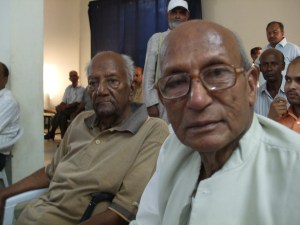
Allahabad Chapter of PIPFPD: Comrade Kameshwar Prashad Agarwal

No disruptions at the Allahabad Chapter of PIPFPD, attended, among others, by Comrade Kameshwar Prashad Agarwal

Hello everyone, have been traveling with limited access to internet, hence the silence.

I was among the journalists at a panel discussion ‘Does media jingoism fan tensions between India and Pakistan?’ organised by Forum of Media Professionals at the India International Centre in New Delhi on April 15. The event got a lot of play because of misreporting.

The Indian media hyped up a minor disruption, reporting that the Pakistani journalists in the panel were ‘attacked’ or ‘roughed up’. The Pakistani media picked up on the photos and subsequently there were condemnations and even demonstrations in Pakistan about the ‘attack’.

To set the record straight, no one was roughed up or attacked. One man did disrupt the meeting – but very briefly, from the back of the auditorium. The organisers had turned away 3-4 men who refused to sign the register – he must have sneaked in. The discussion was half over when he stood up and started shouting anti-Pakistan, pro-war slogans (someone sitting near him said he’d just come in). The organisers pushed him out. TV cameramen and photographers followed.

Most papers and channels used photos and footage of the scuffle outside, rather than focusing on the discussion inside, which continued, despite the noise we could hear outside for a couple of minutes. The interruption lasted for maybe a minute or so. The discussion started at 10 am and continued till 1.30 pm. It turned out that he was from the Sri Ram Sene, the same group that tried to prevent Valentines Day celebrations in India, to whom thousands of people sent ‘pink chaddis’ in response.

The incident demonstrated what we had been talking about, that TV, being a visual medium, focuses on images rather than words. Hence their running after the scuffle rather than focusing on the discussion. This is the nature of the beast. Those keen to tame it might try organizing mass emails, letters and phone calls to demand meaningful change.

Here is Rahimullah Yusufzai’s article on the incident – `The good, the bad and the ugly’, The News, Apr 21, 2009 <http://tinyurl.com/dxtuo3>

Our visit also involved several other interactions with the media. Rahimullah Yusufzai, the veteran reporter from Peshawar was the most sought after for his views on Talibanisation, living as he does in the heart of the storm. Here is the link to a full page ‘idea exchange’ published April 19, a forum that The Indian Express regularly holds: “I don’t think we have reached a stage when the Taliban will take over Pakistan” – <http://tinyurl.com/dzeyc9>

I showed some of my documentaries at a meeting of the Allahabad chapter of the Pakistan-India Peoples Forum for Peace and Democracy (PIPFPD) and at the Delhi Press Club, organised by Youth4Peace. Here are links to a couple of reports on the Press Club screening:

‘In Pakistan, change has to come from within, says journalist’ -Indian Express, Apr 20, 2009 – <http://tinyurl.com/covts7>

`Pak journalist’s short take on women’s rights’, Mail Today, Apr 20, 2009 – <http://tinyurl.com/cmb7ey>

More later