The cross-border solidarity of Amrita Pritam and Fahmida Riaz, the student movement, and peacemongering today

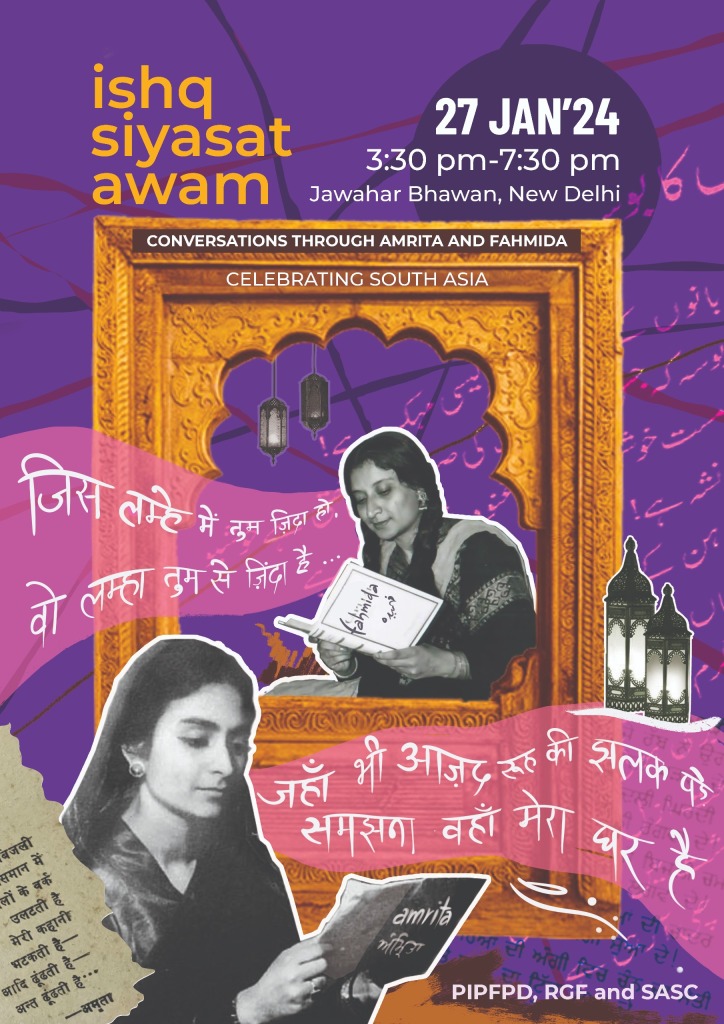
Poster for the event honouring Amrita Pritam and Fahmida Riaz. Courtesy PIPFPD

The latest Southasia Peace Action Network (Sapan) newsletter we put out highlighted a commemoration in Delhi for two iconic feminist poets of Pakistan and India: How the friendship of two cross-border feminist poets symbolises our work; upcoming events, and more

Radical love, epitomised by the late Amrita Pritam and Fahmida Riaz is ‘one of the seeds of the revolutionary thought process’, to quote the Pakistan India People’s Forum for Peace and Democracy (PIPFPD) stalwarts who organised the event – Vijayan MJ, Tapan Bose, and Dr Syeda Hameed. Their consistent work over the decades for peace and justice is truly inspirational, and I feel privileged to know them personally.

I was also privileged to know one of the late poets personally, Fahmida ‘Khala’ (aunt) to me, who was close to my father Dr. M. Sarwar. He led the Democratic Students Federation (DSF), Pakistan’s first student movement while at Dow Medical College in Karachi, 1949-54.

I’ve uploaded archives about the movement here: drsarwar.wordpress.com. Principles of that struggle continue to show the way, like the importance of coming together across divides for a minimum common agenda. For DSF, it was student rights. For Sapan, it’s Southasia Peace. We need it now, for the sake of the people of the region, and beyond. 

The Videos section of the Dr Sarwar blog includes a playlist of video clips from the event held at the Karachi Arts Council in January 2010 to commemorate DSF and the student movement, a few months after my father passed on.

Compered by the actor Rahat Kazmi, the event featured speeches from young activists, students, and academics like Amar Sindhu, Alia Amirali, Ali Cheema, and Varda Nisar, as well as veterans like I.A. Rehman, besides the singer Tina Sani, Taimur Rahman and his band Laal, and Fahmida Riaz.

Fahmida Khala recited her poem ‘Palwashey Muskurao’ (Palvasha, smile), dedicated to daughter of late Afzal Bangash of the Mazdoor Kissan Party (Workers’ and Peasants’ Party), and the followers of other late leftist leaders. They may no longer be on this earth, but their principles and aspirations for human rights and dignity continue to show the way.

Fahmida Riaz reciting her poem ‘Palwashey Muskurao’ (Palvasha, smile), Jan. 2010, Karachi.

(ends)

Pakistan, India and Aman ki Asha: The year that was, and looking ahead

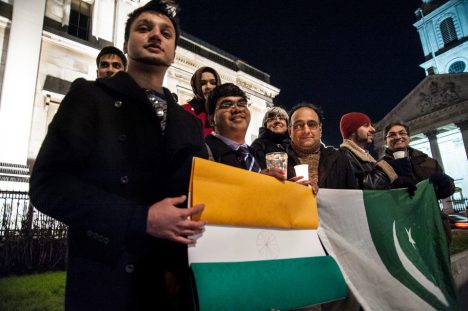
Indo Pak Global Peace Vigil, London. Photo by Ali Mehdi Zaidi

Indo Pak Global Peace Vigil, London. Photo by Ali Mehdi Zaidi

Something I wrote last week for The News year-end special supplement, published Jan 1, 2014. I later remembered many special moments I left out, like the Mumbai and Karachi Press Clubs exchanges, the border security guards allowing violators to return instead of throwing them in prison, the Indian heart patient allowed to disembark without a visa in Pakistan, to name some. There are many others…

For millions of Indians and Pakistanis, Aman ki Asha is just that – a shared ‘hope for peace’ between our two countries. Despite falsehoods circulated by detractors targeting this peace initiative in all kinds of underhand ways since its launch on January 1, 2010, it has stayed the course, and continued to urge both governments to do so. In the process, Aman ki Asha has provided a platform and a way forward for aspirations of peace between India and Pakistan.

India Pakistan Global Peace Vigil

The year 2013 started out with a powerful expression of these aspirations countering rising tensions due to firing and the loss of lives at the Line of Control in Kashmir. In the midst of the cacophony of allegations and counter-allegations arose voices of sanity, coming together for a global vigil for peace between India and Pakistan. Continue reading

Malala and Absurdistan, Mazariland, Cuckooland… We are sorry, Bhooro Bheel. Taliban bhagao, mulk bachao

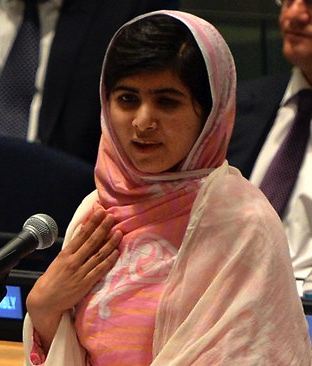
malala-yousafzaiMy two bits on the muddied narrative in Pakistan on Malala Yousafzai, a favourite for the Nobel Peace Prize being announced on Oct 11:  Those who so easily buy conspiracy theories about Malala being a “US agent” or who go against Malala are usually the same people  you will find justifying the murderous, criminal acts of the Taliban (who are fasadis not jihadis, in my mind) in some way, absolving them of responsibility by terming it a response to the US invasion of Afghanistan or the drone attacks. These people conveniently forget that the mindset that attacked Malala is the same as the one that was attacking women NGO workers and teachers and girls’ schools in the western border areas BEFORE 9/11. It’s the same mindset that was target killing Ahmadis and Shias since the 1990s. It was not just the Taliban’s bullets that targeted Malala and all that she stands for – it is this mindset that the United States, Pakistan and Saudi Arabia cultivated and developed in the 1980s in order to counter the Soviets in Afghanistan. Continue reading

Jashne-Faiz April 17, 2011, Karachi: event details

Check out the Citizens for Democracy blog for details about a great all-day event

Sunday, April 17, 2011, 11.30 am-12.30 midnight

Jashne Faiz, CDGK Sports Complex, Karachi

Seminars, theatre, music, art, speakers’ corner, food court, children’s play area, plus plenary session with music concert (inclusing Strings, Laal, Shehzad Roy, Arieb Azhar and others) and resolutions; culminating in mushaira

Don’t forget to pre-register at the CFD website – www.cfdpk.org

Chance encounters of a connected kind

My article published in Dialogue section of The News on Sunday, Sept 26, 2009

Musings

By Beena Sarwar

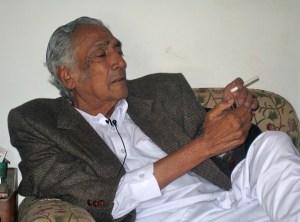
Dr Sarwar, Karachi, Jan 2007. Photo by Anwar Sen Roy

Dr Sarwar, Karachi, Jan 2007. Photo by Anwar Sen Roy

There is something about unexpectedly bumping into unexpected people and making meaningful connections on various levels.

The common thread running through two strings of such encounters I had recently was my late father, Dr M. Sarwar — his being who he was, and his passing on, led to these moments and the associations they evoked.

Continue reading