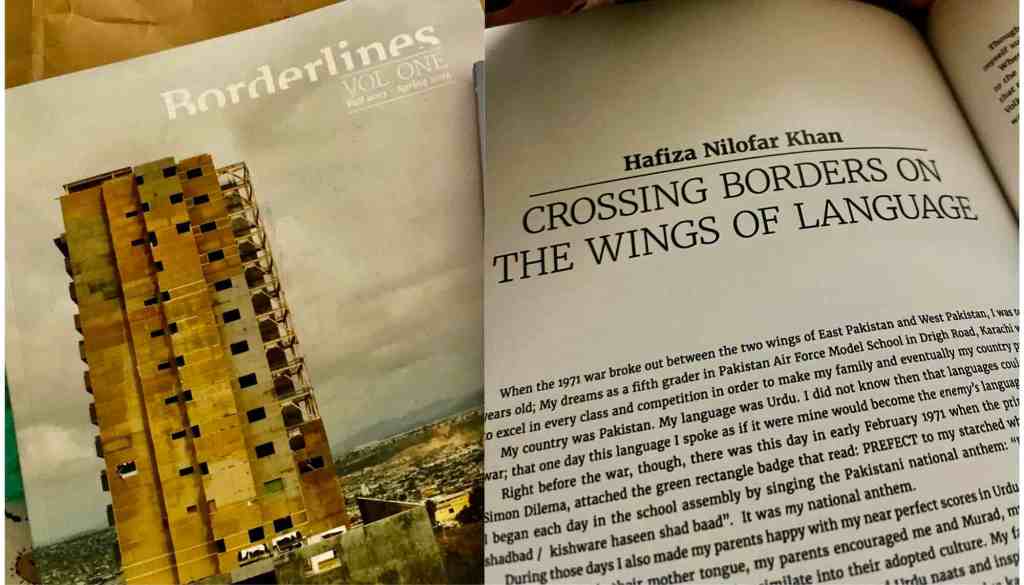
It was only as an adult long after 1971 that I learnt about the internment camps where Bengalis in then West Pakistan had been detained. My source was an essay titled ‘Crossing Borders on the Wings of Language’, by Hafiza Nilofar Khan, in Borderlines, Vol. 1 (2014), an anthology published by Voices Breaking Boundaries, my sister Sehba Sarwar’s nonprofit in Houston (now archived at the University of Houston).
The ten-year-old Hafiza whose father is in the Pakistan Air Force and proud of her prowess in Urdu suddenly finds herself and her family in the situation that Lahore-based historian Ilyas Chatta details in his recently published book Citizens to Traitors: Bengali Internment in Pakistan 1971-1974 (Cambridge University Press, 2025).
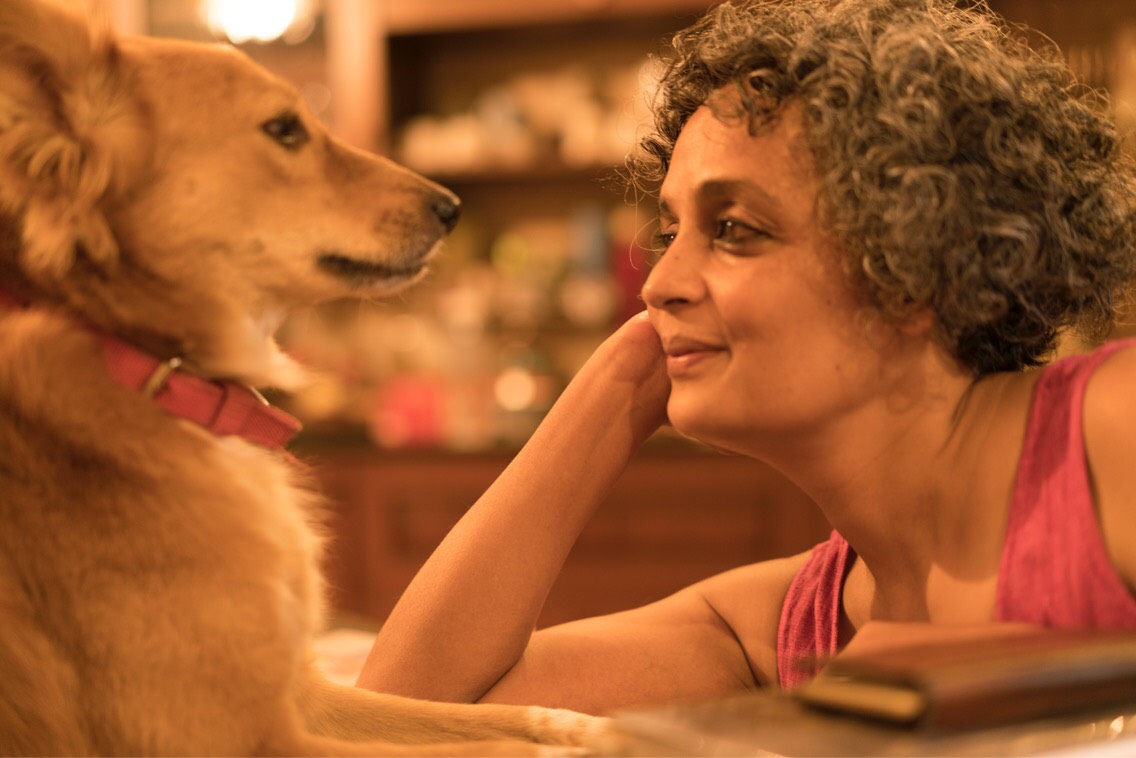
Arundhati Roy with a furry friend. Photo by Shahidul Alam.
Read Arundhati Roy’s letter to Shahidul Alam as part of PEN International’s Day of the Imprisoned Writer, 15 November. Today the Dhaka High Court also finally granted bail to Shahidul Alam, been incarcerated for over 100 days. He has yet to be actually released — the government is appealing the court’s decision.
Every November 15 PEN highlights the cases of five persecuted writers and activists imprisoned, killed, persecuted or otherwise at risk for their work. This year’s campaign focuses on Dawit Isaak imprisoned in Eritrea, Miroslava Breach Velducea killed in Mexico, Oleg Sentsov imprisoned in Russia, Shahidul Alam detained in Bangladesh and Wael Abbas imprisoned in Egypt. Writers David Lagercrantz, Jennifer Clement, Tom Stoppard, Salil Tripathi and Khaled Hosseini are also participating in this year’s campaign. Continue reading →
Harsh Mander: Committed, consistent and soft-spoken. Photo: Beena Sarwar
Cross-border solidarity isn’t exactly a new idea. The rallying cry, “Proletarians of all countries, unite!…” that emerged in 1848 from The Communist Manifesto has resounded around the globe in many forms since it was first articulated.
Meeting Harsh Mander, one of India’s foremost activist-intellectuals and a courageous former civil servant, again revived the idea for me, but this time, beyond workers. I had first met the soft-spoken Mander in Karachi, when I worked for Geo TV. He had been part of a small delegation from India visiting Pakistan in early 2004, a visit aimed at improving understanding between India and Pakistan, organised by the social-cultural group Act Now for Harmony and Democracy (ANHAD).
The Zinn magic. Photo: BJ Bullert, Cambridge MA, 2006
“To be hopeful in bad times is not just foolishly romantic. It is based on the fact that human history is a history not only of a cruelty but also of compassion, sacrifice, courage, kindness”
– Howard Zinn
Howard Zinn’s death on Jan 27 came as a shock to his friends and admirers around the world. The iconic historian, activist, and academic (Professor Emeritus, Boston University) was 87, frail, but in reasonable health. He had a heart attack while swimming, an activity he loved. As Arundhati Roy put it when she called his old friend David Barsamian of Alternative Radio: “Howard lived a glorious life and accomplished so much and to die swimming — what a way to go”.
Howard Zinn, Cambridge, Oct 2006 (photo: BJ Bullert)
David writes that Howard had rented a place with a swimming pool near the ocean for three weeks and “was thrilled to be escaping the dreaded Boston winter.”
A fluent Urdu/Hindi speaker, David sent this note to friends: “A light has gone out. There are new lights to be lit,” adding the following verse from Iqbal’s poetry:
Sitaron se aage jahan aur bhi hain abhi ishq ke imtehan aur bhi (Beyond these stars there are other galaxies The real test of love is yet to come)
In November when he visited Howard David noticed a mug in his kitchen with these words: ‘Sooner or later the American people are going to wake up’ – Emma Goldman, Detroit 26 Nov 1919. “
The book that Jack launched (at HLS)
It was going to be my lead question to him in the interview we were going to do,” wrote David. “I was to have left here on Thurs to join him.” (Howard died on Wednesday).
David sent a link to his radio tribute to Howard adding, “Please listen and of course feel free to distribute. It’s about 30 minutes.” His note ended rousingly: “Onward/Adelante/Howard Zinn Presente!”
We had been in email contact for some time but I met David for the first time at the launch of Eqbal Ahmad’s collected essays published posthumously by Columbia University Press in September 2006. The launch took place subversively at Harvard Law School – subversively because HLS is a rather conservative place where the views of people like Eqbal Ahmad and his friends and comrades – David Barsamian, Howard Zinn, Noam Chomsky to name some – are rarely heard (particularly in the context of the Middle East, Palestine, Israel). But some pockets of resistance exist in those gilded halls. They include John Trumpbour (Jack), Research Director at Labor & Worklife Program, Harvard Law School.
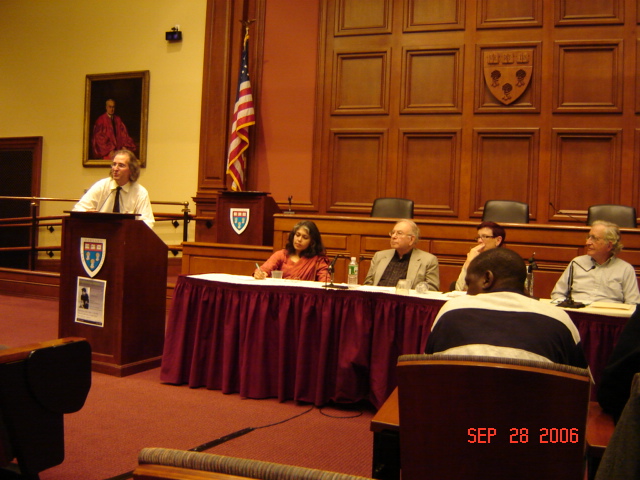
Jack introducing the Eqbal Ahmad book launch and panelists. R-L – Chomsky, Margaret Cerullo, Stuart Schaar & me.
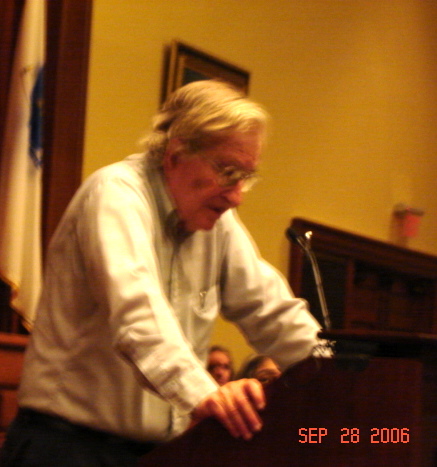
Jack, who organised the launch, invited me to be on the panel (I was then a fellow at the Carr Center for Human Rights Policy, Kennedy School). David flew in from Colorado for the launch. Noam Chomsky, a long-time friend of Eqbal’s, gave the main speech. (I sent my report on the event reproduced at Pakistaniat to Howard – he replied: “That’s a lovely story, with wonderful photos!”)
There was pin drop silence as Chomsky spoke in his characteristic low key way.
Chomsky was of course also an old friend of Howard Zinn’s. In an email responding to my note of condolence he wrote: “It is a sad moment, not just personally, but for wide circles far beyond his family and many friends. A really remarkable person, just as you say, as well as a close personal friend for many years.”
Jack recalls his last meeting with Howard, whom he had invited to teach at a class at the Harvard Trade Union Program in January, just a couple of weeks earlier. “Howard had lost some significant weight in the last year, but he was energetic and engaging as always. He showed a lot of clips from the new history movie he helped make, including appearances by Bob Dylan and Bruce Springsteen.”
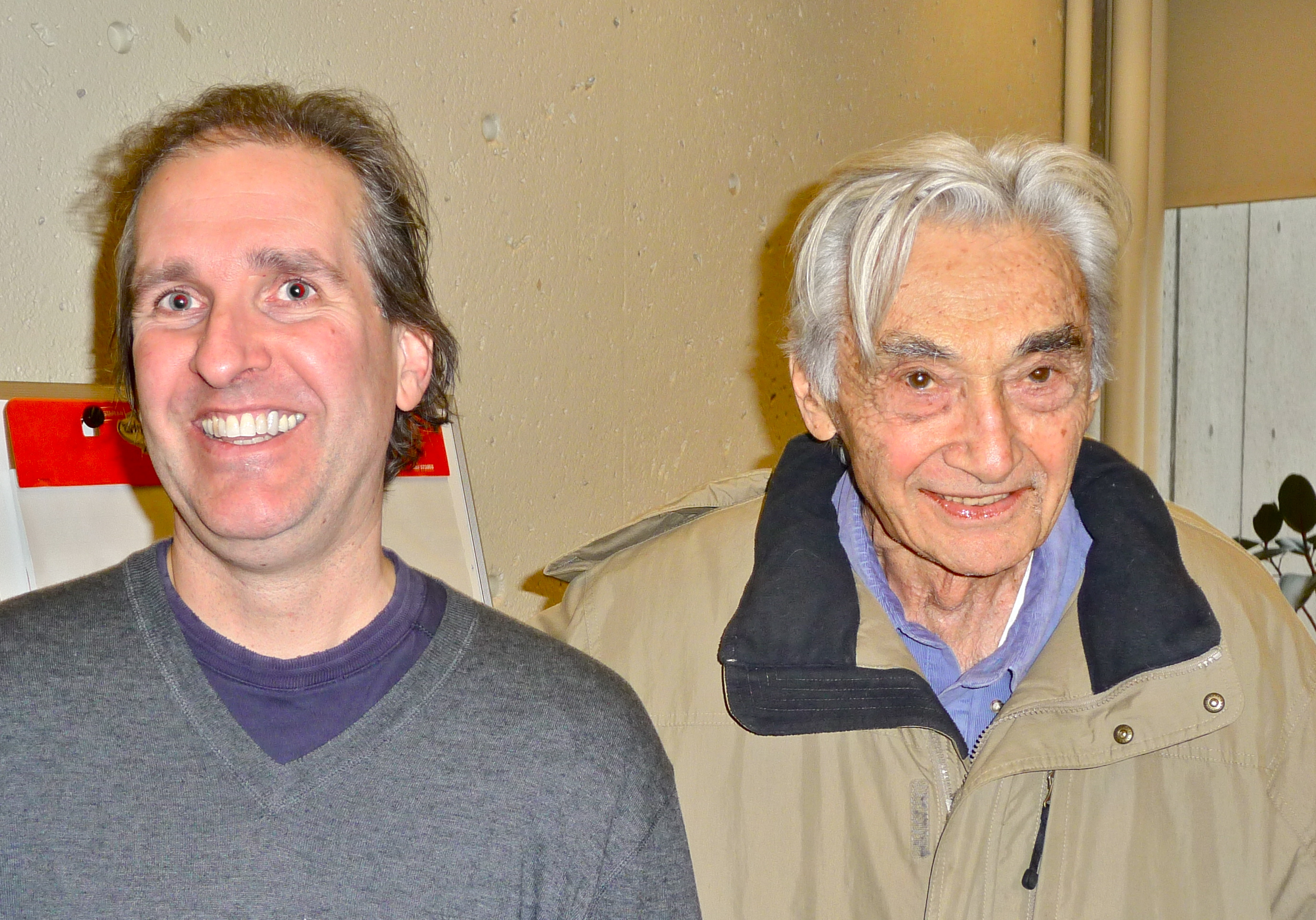
Jack Trumbour and Howard Zinn: photo by Canadian labour leader Nancy Hutchison, taken on Jan 15, after Howard finished teaching the Program.
“Many people know about Howard’s peace activism, but fewer know about his efforts to reach workers and the labor movement,” comments Jack.
“Howard had a lot of issues with serious back pain during the past year, and he had some significant medical attention for this. He indicated that he was doing better, though not great… There have been some fine tributes to Howard. And the bloggers at the nasty right-wing website of David Horowitz have sneered at him, which is to be expected.
“…This is a sad day for us all, but we are hoping Howard’s tireless advocacy for peace might inspire others in 2010 to build a movement that can stop the madness, madness which includes Obama’s support for more global interventions.”
“I would try to be fair to other points of view, but I wanted more than ‘objectivity’; I wanted students to leave my classes not just better informed, but more prepared to relinquish the safety of silence, more prepared to speak up, to act against injustice wherever they saw it. This, of course, was a recipe for trouble” – Howard Zinn in his autobiography, You Can’t Be Neutral on a Moving Train (1994).
Cambridge, Oct 2006: Howard Zinn and B.J. Bullert. Photo: Beena Sarwar)
Jack was indirectly responsible for my own meeting with Howard Zinn. In May 2006, he had connected me with BJ Bullert, a documentary filmmaker in Seattle, WA, a graduate of Boston University (BA, Philosophy) with an MLitt in Politics from Oxford, with a PhD in Communication (University of Washington). She was interested in finding out more about the Tarbela Dam (her father was an engineer there and she had lived in Pakistan as a 13-year old) and issues of displacement (That is another story).
When BJ visited Cambridge in October 2006, we met for the first time since we had started corresponding. Later, when going to meet Howard, her old teacher, she invited me also. I was thrilled, and took along my copy of his inspirational, best selling book ‘A People’s History of the United States’. The book, currently #4 on the NYT non-fiction best-seller list, has sold more than a million copies and “redefined the historical role of working-class people as agents of political change” (as the LA Times obituary put it).
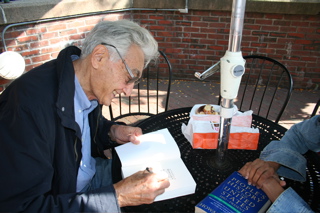
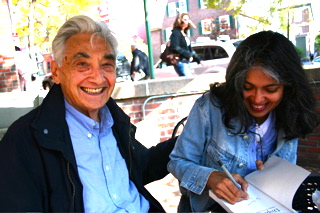
Howard Zinn autographs my copy of People’s History…
... and graciously makes me sign my offering. Photos: BJ Bullert
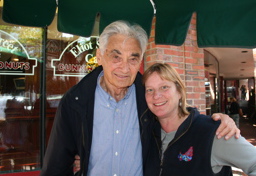
We sat outside in the little courtyard at Dunkin’ Donuts opposite the Kennedy School and talked, and joked. He graciously signed my copy of his book and even more graciously asked me to sign a copy of a book I gave him, ‘Dispatches from a Wounded World, (BlueEar & BookSurge, USA & UK, December 2001, to which I had contributed a chapter, ‘The Hijacking of Pakistan’, pushed by Ethan Casey). We joked, bantered and exchanged ideas. Jack turned up later to join us. Howard then had another appointment and we all went on our own ways. But we kept in touch.
Howard was prompt to endorse the ‘Academics’ Statement Of Support For Dr Ayesha Siddiqa’ in June, 2007, after the Musharraf government attempted to intimidate Ayesha following the publication of her book ‘Military Inc.: Inside Pakistan’s Military Economy’. The establishment pressurised the Islamabad hotel where the launch was scheduled to cancel the event. Ayesha’s phone service was disrupted as she gave interviews and she felt increasingly isolated and physically threatened.
The statement reminded the Musharraf administration “that the whole world is watching. The aspirations of the vast majority of the Pakistani people are inclined towards democracy and freedom of expression. It is obstructing these aspirations that will ‘derail the nation from its path of progress and prosperity’ to use a phrase from the press statement issued after the corps commanders meeting.”
Howard was generous in his appreciation for an oped I wrote for the Boston Globe about Pakistan’s struggles a couple of weeks later, saying it gave him “a clearer picture of what is going on in Pakistan, which of course I cannot get in the media.” (I think he meant the ‘mass media, particularly television, because after all, the Globe is media…).
In December 2007, I emailed BJ, Jack and Howard when David Barsamian visited to Pakistan for the Eqbal Ahmad Distinguished Lectures and needed some contacts. “Somebody ought to make a film about David,” quipped BJ.
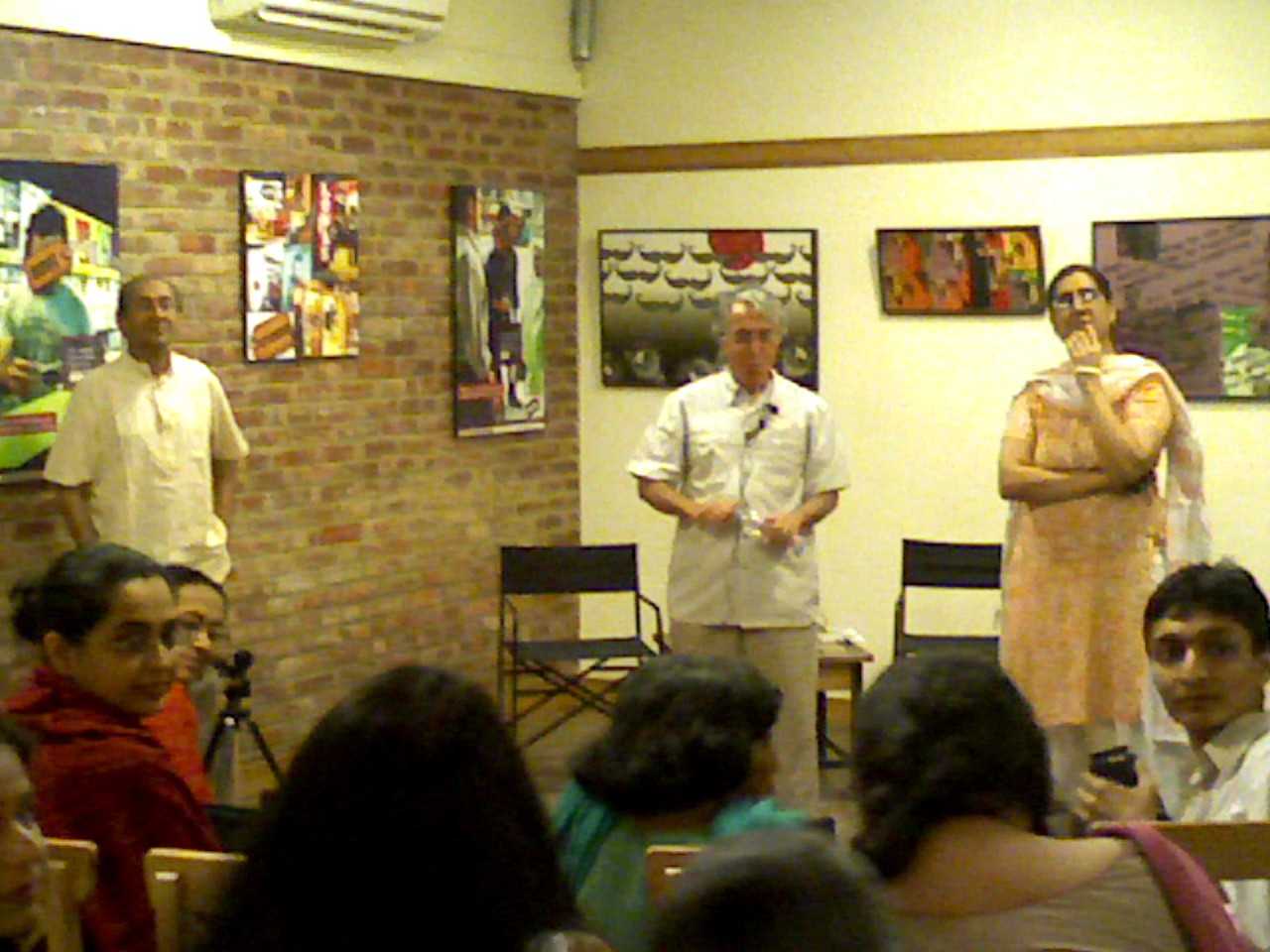
David Barsamian at T2F (1.0) with Sabeen and Zak listening to an audience comment (March 2008). Photo: beena sarwar
Howard replied playfully, “BJ, a film on David Barsamian is a great idea. You will interview me and I will tell the world what a scoundrel he is. But seriously, you should do it! He deserves it, scoundrel that he is.”
In April 2008, the indefatigable e-campaigner Isa Daudpota emailed a Zinn quote to his mailing list, formatted as a poster that he had put up on his office door:
We need Civil Disobedience!
“Civil disobedience is not our problem. Our problem is civil obedience. Our problem is that numbers of people all over the world have obeyed the dictates of the leaders of their government and have gone to war, and millions have been killed because of this obedience. Our problem is that people are obedient all over the world in the face of poverty and starvation and stupidity, and war, and cruelty. Our problem is that people are obedient while the jails are full of petty thieves, and all the while the grand thieves are running and robbing the country. That’s our problem.”
~Howard Zinn
“Well, that’s nice news about the poster! In Islamabad!” exclaimed Howard when I forwarded it to him.
I visited Cambridge soon afterwards. His wife was ill and he tried to stay home as much as possible. But he added cheerily, “Hope you come back and we’ll have another chance to get together.”
I learnt in September from David that she had passed away soon afterwards. In response to my note of condolence Howard replied: “Roz was diagnosed with ovarian cancer in July of 2007, had six very good months, refusing surgery and chemotherapy, then declined and died in May. lt’s hard, but I’m doing okay.”
Married in 1944, they were inseparable until Roz’s death in 2008. She was also an activist, and Howard’s editor. “I never showed my work to anyone except her,” Bob Herbert quoting him as saying, in his obituary for the NYT.
Howard’s energy was amazing. Shattered by his wife’s passing away, himself well over 80 years old, he continued to write, give talks and interviews. He also embraced new ways of getting the word out, as evident with the publication of ‘A People’s History of American Empire’, the comic book version of “The People’s History of the United States” in 2008 that combines cartoons, historical documents and photos, “making the whole thing visual, dynamic, and absolutely captivating,” as one review put it.
The last email I got from him was about yet another exciting project to spread these ideas and awareness, through the documentary, THE PEOPLE SPEAK. He sent an email out to his contacts about the screening of this film, “directed-produced by Chris Moore, Anthony Arnove, myself, with a great cast of readers and performers. That will be Sunday evening, Dec. 13, 8 PM (7 PM Central) on the History Channel.”
A must-read for any Zinn fan is ‘the most dangerous man in America’ Daniel Ellsberg’s riveting tribute. He recounts that he first met Howard Zinn at Faneuil Hall in Boston in early 1971, “where we both spoke against the indictments of Eqbal Ahmad and Phil Berrigan” for “conspiring to kidnap Henry Kissinger”. He recalls how Howard (who had been arrested in D.C.) returned to Boston for a rally and a blockade of the Federal Building, and was the last speaker at a large rally in Boston Common being addressed over loudspeakers.
Ellsberg writes: ‘Twenty-seven years later, I can remember some of what he said. “On May Day in Washington, thousands of us were arrested for disturbing the peace. But there is no peace. We were really arrested because we were disturbing the war.”
At the end, he said: “I want to speak now to some of the members of this audience, the plainclothes policemen among us, the military intelligence agents who are assigned to do surveillance. You are taking the part of secret police, spying on your fellow Americans. You should not be doing what you are doing. You should rethink it, and stop. You do not have to carry out orders that go against the grain of what it means to be an American.”
He paid for his words the following day when he was singled out for manhandling and arrest.
As the legendary activist and author discussed in one of his final interviews, he wants to be remembered for “introducing a different way of thinking about the world,” and as “somebody who gave people a feeling of hope and power that they didn’t have before.”
Howard Zinn, wherever you are, know that there are people here too who will always celebrate your life and work and who mourn your passing away as a world citizen who cared for humanity above all and did indeed give people “a feeling of hope and power”.
Compilation of tributes and articles related to Howard Zinn, including his own works, at the Howard Zinn website.
Post script: Just came across Mahir Ali’s tribute to Zinn in Dawn, Feb 10, 2010: ‘Lessons from a past master‘ – “Every country would be well-served by a radical public intellectual of comparable erudition, commitment, wit and wisdom. Americans should be very proud of Howard Zinn.”
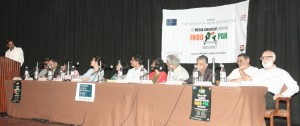
The FMP panel in Delhi, April 15, 2009. Photo: FMP
Panel members Arundhati Roy & Aniruddha Bahal. Photo: B. Sarwar
PERSONAL POLITICAL
Beena Sarwar
“Shouldn’t Arundhati Roy come from Pakistan?” sarcastically asked a Delhi freelance journalist, commenting on the Facebook posting about a panel discussion, ‘Does Media Jingoism Fan India Pakistan Tensions?’ The cynical remark stemmed from his annoyance, shared by many, at Roy’s consistent exposure of India’s ‘warts’.
The panel, organised by the recently formed Forum of Media Professionals (www.fmp.org.in ), included four journalists from India besides the celebrated writer and activist Arundhati Roy as well as four Pakistani journalists and The Hindu’s Islamabad correspondent Nirupama Subramanian.
Delhi is far cleaner and greener since I was last there nearly five years go, thanks to laws (that are actually implemented) banning diesel and making CNG compulsory. On a more intangible level, another kind of pollution remains, reminiscent of a phenomenon we face in Pakistan: right-wing jingoism fuelled by emotional appeals to religion and nationalism.
The jibe about Arundhati Roy, disguised under an urbane sarcasm, is just one aspect of bigoted nationalism. Going by that logic, those in Pakistan who fight for justice — a struggle that necessitates exposing wrongdoings, or ‘washing dirty linen in public’ according to our critics — should represent India. Another aspect of such thinking is evident in the comments back home when I show my documentary ‘Mukhtiar Mai: The Struggle for Justice’, in Pakistan: “Why don’t you make such films about violence against women in India? Women there have these problems too.”
I wonder at this competitiveness that makes us feel self-congratulatory when we can point out how much worse the other is in some way.
Thankfully, not everyone takes this myopic view. In Allahabad, at a crowded meeting of the Pakistan-India People’s Forum for Peace and Democracy (PIPFPD), there was none of this one-upmanship or finger pointing. The audience immediately saw the commonalities of the issues raised in the films I showed, on Pakistan’s flawed and discriminatory Hudood Laws and Mukhtiar Mai. They understood that the phenomenon in Pakistan of Taliban ‘punishing’ women for alleged transgressions is not much different from those who rape, kill or lynch women and couples for the sake of ‘honour’ in India itself or indeed in traditional communities in Pakistan.
The difference is that most of these ‘honour crimes’ are committed by relatives of the women who ‘transgress’, as opposed to the Taliban who are taking it upon themselves to enact these punishments as part of the imposition of their own criminal justice system that flouts the writ of the state.
Another difference is that the family in Haryana who hanged their daughter and the man she eloped with (in their own home) will be charged, tried and probably punished. In Pakistan, the ostensibly Islamic Qisas and Diyat (retribution and blood money) laws imposed by a military dictator in the 1980s allow the murder victim’s family members to ‘forgive’ the perpetrators who are often their own relatives.
As for the Taliban and their sympathisers, none have ever been charged for their criminal transgressions, ranging from blackening women’s faces on billboards, to disrupting public events in that involve women (remember the Gujranwala marathon?), to blowing up schools, killing teachers and dragging women out of their homes and murdering them for alleged ‘immorality’.
At the Allahabad meeting, the tone was set by senior advocate Ravi Kiran Jain in his introduction when he stressed on the need for a stable government in Pakistan, and the desire to remove misunderstandings. His words reminded me of Nirupama Subramanian’s appeal at the panel discussion in Delhi urging Indians to “be sensitive to Pakistan as a country that has problems and show moderation in we respond to these problems.”
Many Indians already understand this, but we don’t hear their voices in the media very often. For instance, Utpala, a women’s rights activist during the discussion in Allahabad talked about the need for Indians and Pakistanis to be allowed to visit each other’s countries. Her own visit to Pakistan many years ago, she said had expanded her ‘angan’ (literally, courtyard). She ended by asking, “How can we in India be happy until there is a pro-people, pro-women government in Pakistan?”
The Delhi panel was disrupted for a minute or so by one man at the back of the auditorium who stood up and shouted anti-Pakistan, pro-war slogans. The organisers threw him out. He turned out to be from the Sri Ram Sene, one of the faces of India’s right-wing ‘Sangh Parivar’, who . Three or four others were outside, whom the organisers had refused to allow entry as they were not signing their names in the register. The SRS, which does not otherwise have much presence in Delhi, later claimed it had sent ‘thirty’ men to disrupt the meeting.
True to form, illustrating the very issues we had been discussing, most media hyped up the disruption which then overshadowed the discussion itself. Pakistani journalists were ‘roughed up’, ‘attacked’, the meeting disrupted for ’15-20 minutes’ and so on. The incident set off a chain reaction across the border, giving right-wing forces in Pakistan the opportunity to condemn the ‘anti-Pakistan feelings in India’. A ‘human rights’ organisation held a demonstration against the ‘attack’. Jamat-e-Islami’s recently elected chief Munawwar Hasan promptly issued a statement saying that it should serve as an eye-opener to those who talk of friendship with India and they should refrain from visiting India (‘ba’az ajana chahiye’).
For such people, obviously the anti-Pakistan slogans raised by one miscreant are paramount over the dozens of people in the IIC auditorium who listened respectfully to the discussion and engaged in a dialogue with the speakers later. The people in Allahabad and at the Delhi Press Club a few days later who came to hear a Pakistani journalist and express their support for a democratic order in Pakistan also don’t count, even if some of them were prepared for a rough time, like Zafar Bakht in Allahabad who had lent his school’s auditorium for the event. “After hearing of the Delhi incident, we rolled up our sleeves and were prepared,” he said later.
In the end, the anti-Pakistan slogans raised by one miscreant hogged the media limelight rather than those who filled the auditorium, heard the speakers respectfully and engaged in dialogue later. This is the nature of the media beast. Who is going to tame it?
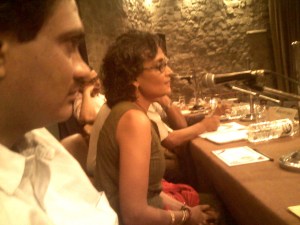
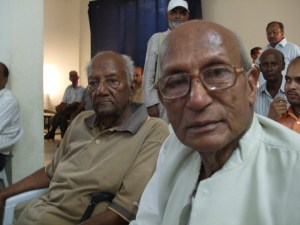
No disruptions at the Allahabad Chapter of PIPFPD, attended, among others, by Comrade Kameshwar Prashad Agarwal
Hello everyone, have been traveling with limited access to internet, hence the silence.
I was among the journalists at a panel discussion ‘Does media jingoism fan tensions between India and Pakistan?’ organised by Forum of Media Professionals at the India International Centre in New Delhi on April 15. The event got a lot of play because of misreporting.
The Indian media hyped up a minor disruption, reporting that the Pakistani journalists in the panel were ‘attacked’ or ‘roughed up’. The Pakistani media picked up on the photos and subsequently there were condemnations and even demonstrations in Pakistan about the ‘attack’.
To set the record straight, no one was roughed up or attacked. One man did disrupt the meeting – but very briefly, from the back of the auditorium. The organisers had turned away 3-4 men who refused to sign the register – he must have sneaked in. The discussion was half over when he stood up and started shouting anti-Pakistan, pro-war slogans (someone sitting near him said he’d just come in). The organisers pushed him out. TV cameramen and photographers followed.
Most papers and channels used photos and footage of the scuffle outside, rather than focusing on the discussion inside, which continued, despite the noise we could hear outside for a couple of minutes. The interruption lasted for maybe a minute or so. The discussion started at 10 am and continued till 1.30 pm. It turned out that he was from the Sri Ram Sene, the same group that tried to prevent Valentines Day celebrations in India, to whom thousands of people sent ‘pink chaddis’ in response.
The incident demonstrated what we had been talking about, that TV, being a visual medium, focuses on images rather than words. Hence their running after the scuffle rather than focusing on the discussion. This is the nature of the beast. Those keen to tame it might try organizing mass emails, letters and phone calls to demand meaningful change.
Here is Rahimullah Yusufzai’s article on the incident – `The good, the bad and the ugly’, The News, Apr 21, 2009 <http://tinyurl.com/dxtuo3>
Our visit also involved several other interactions with the media. Rahimullah Yusufzai, the veteran reporter from Peshawar was the most sought after for his views on Talibanisation, living as he does in the heart of the storm. Here is the link to a full page ‘idea exchange’ published April 19, a forum that The Indian Express regularly holds: “I don’t think we have reached a stage when the Taliban will take over Pakistan” – <http://tinyurl.com/dzeyc9>
I showed some of my documentaries at a meeting of the Allahabad chapter of the Pakistan-India Peoples Forum for Peace and Democracy (PIPFPD) and at the Delhi Press Club, organised by Youth4Peace. Here are links to a couple of reports on the Press Club screening:
‘In Pakistan, change has to come from within, says journalist’ -Indian Express, Apr 20, 2009 – <http://tinyurl.com/covts7>
`Pak journalist’s short take on women’s rights’, Mail Today, Apr 20, 2009 – <http://tinyurl.com/cmb7ey>






 Journeys to democracy