Women’s Action Forum letter to the Chief Justice, Supreme Court of Pakistan

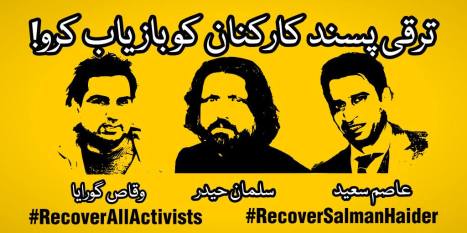
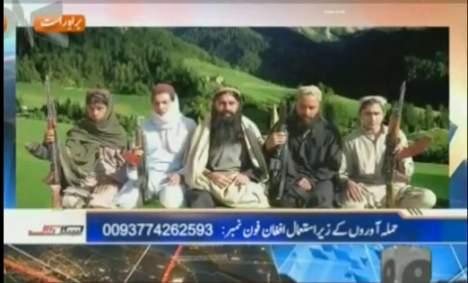
recover-activistsReproducing below the letter sent by the Women’s Action Forum letter to the Chief Justice, Supreme Court of Pakistan about the “disappeared” activists and the deliberate and sustained campaign against them in the media and on social media. This campaign, with its accusations of blasphemy and treason being leveled against the missing activists and those campaigning for their safe recovery poses a danger to those missing, their families and the human rights campaigners.
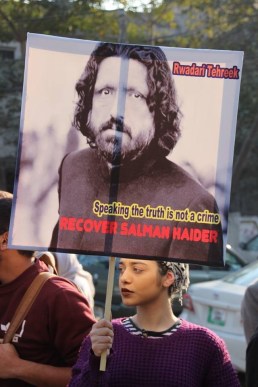
WAF urges that the state, its institutions and agencies be held responsible for the recovery of the missing bloggers/activists and inform what the investigation has yielded, and that the federation be held answerable for non-compliance of SC orders on the issue of enforced disappearances.

Continue reading

Ongoing worldwide protests against “missing” bloggers

lhr-wom

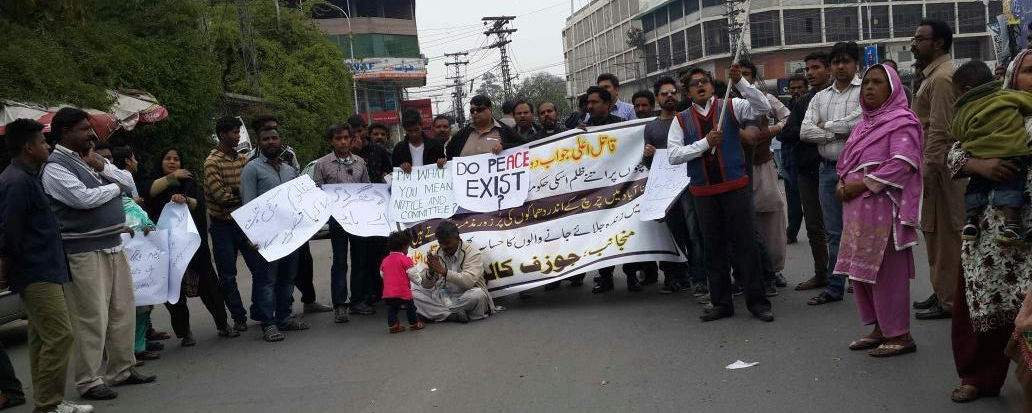
Lahore protest. Photo: Khalid Mahmood

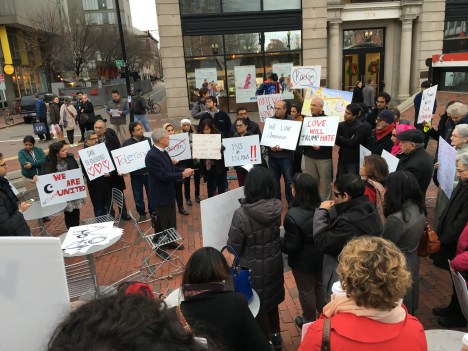
January 15, 2017 marks just over two weeks since the professor, poet and activist Salman Haider was abducted from Islamabad, followed soon after by more such “disappearances”. Human rights activists around the world are demanding that Pakistan produce the missing bloggers and end the climate of fear being created. Disappearing activists is not a new tactic, as Pervez Hoodbhoy reminds us – been happening with alarming regularity in Balochistan. But these abductions happened in Punjab. Meanwhile, the propaganda machinery of the dirty tricks brigade (#DTBPk) is out in full force painting as ‘blasphemers’ and ‘traitors’ the missing bloggers and those supporting them – which in the context of Pakistan is a clear incitement to violence and vigilante action. Below: photographs from some of the protests – Peshawar, Toba Tek Singh, Islamabad, Lahore, Karachi, Dallas TX and London, England.  Continue reading

#StandwithJNU… “But what about Pakistan?”

I wrote this piece a couple of days ago for Scroll.in on why I, as a Pakistani, am bothered about what’s happening in India – and also what people like me have to deal with from hyper-nationalists on both sides of the border. Also see this post from New Pakistan raising the question of whether the applause in Pakistan for political dissent in India means that such dissent is acceptable in Pakistan too – with reference to the young cricket enthusiast Umar Daraz in Pakistan, arrested for raising an Indian flag. Also see this excellent piece by Rubeena Mahato in Nepali Times raising alarm bells about South Asia’s constricted freedoms.
JNU crisis: But what about Pakistan?

JNU crisis: But what about Pakistan?


For the past few days, the row between those who stand for free speech and those who don’t has intensified in India. As a journalist from Pakistan, I stand unequivocally with the students and journalists in India who are being vilified and targeted by hyper-nationalists. In the process, I am getting more than my usual share of nasty comments from Indians – and Pakistanis – on social media. Continue reading

India/Pakistan: ‘Peace is a process, not an event’

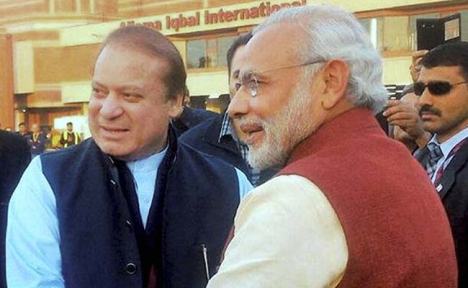
My first monthly column for Himal Southasian (Feb 2016 issue), a Kathmandu-based magazine I’ve been associated with since its launch in 1997. The headline derives from something I remember a Naga woman from India saying at a conference I attended in Colombo, Sri Lanka many years ago. I focus my piece on what links the Pathankot and Bacha Khan University attacks, Modi’s Christmas Day visit to Pakistan and beyond – the issue may have died out from the headlines, but remains relevant. Article below with additional links and photos.vxtvfzk
By Beena Sarwar

If Indian Prime Minister Narendra Modi’s stopover in Lahore to meet his Pakistani counterpart Nawaz Sharif on 25 December last year came as a surprise, the subsequent militant attack in India barely a week later on 2 January did not. Continue reading

In wake of Pakistan university attack, the voices grow louder – stop glorifying the dead

Screen Shot Hamid Mir-Geo TV

Screenshot from Hamid Mir’s Capital Talk, Geo TV, Jan 20, 2016

I wrote this piece on Jan 20, 2016 on the barbaric attack on Bacha Khan University in Charsadda. Published in Scroll.in on Jan 22, 2016.

As Pakistanis look for solutions, a consensus is emerging that people killed in such attacks should not be called ‘martyrs’ or ‘heroes’.

By Beena Sarwar

There is now a numbing familiarity to the kind of news that broke on Wednesday morning from Pakistan.

This time, heavily armed militants in suicide vests scaled the walls of a sprawling university campus near Charsadda, a picturesque town in Khyber Pakhtunkhwa (formerly known as North West Frontier) province near the Afghan border. Gunfire and explosions starting at about 9 am resounded through the dense fog enveloping Bacha Khan University, set idyllically amidst sugar cane fields some 13 km from Charsadda.

The four assailants killed at least 19 students and teachers before themselves being killed by the police and army in a three-hour long gun-battle.

The casualty rate was far lower than the attack on the Army Public School in nearby Peshawar just over a year ago on Dec 16, 2014 in which militants killed some 150 school children and teachers.

The relatively low casualties, pointed out Senator Rubina Khalid of the Pakistan People’s Party, is not a basis for self-congratulation.
Continue reading

A year after Peshawar APS massacre; Islamophobia and yes, Humanity Trumps All

Rev Joe Robinson speaking at a protest in Boston against the APS massacre and Islamophobia. Dec. 21, 2015. Photo: Beena Sarwar

Last Sunday as we geared up to commemorate the Peshawar APS massacre of Dec 16, 2014, when Taliban killed 144 schoolchildren, a bomb blast in Shia-majority Parachinar at the lunda bazar (second-hand market) killed over 22 people, most of them poor.

We talked about that at our gathering that afternoon at Harvard Square where Reverend Joe Robinson and members of the Christ Church in Cambridge joined us in solidarity, as did many others from the local Pakistani and Indian communities. Rabbi Neal Gold of Temple Shir Tikvah couldn’t join us but we read out his letter of support and solidarity to the Islamic Center of Boston.

Many friends joined us from another rally in Providence, R.I., an hour away, attended by some 3-400 people of all faiths, including Muslim, Jewish, Christian and agnostics.

Here’s a link to a piece I wrote for Scroll.in on the issue: #NeverForget: A year after Peshawar school attack, voices rise in solidarity around the world

Continue reading

Despair is not an option. Neither is silence.

Lahore March 15 Church attack protest

March 15: Activists protest in front of the Lahore Press Club in solidarity with Pakistan’s Christian community. Photo: courtesy Sajjad Anwar Mansoori

As I posted my last update about the third monthly Global Vigil of Pakistanis united against terrorism, March 15-16, 2015, to commemorate the Peshawar APS attack of Dec 16, 2014, news came in about the suicide attacks at two churches in Lahore – yet another horrible reminder of what happens when you keep snakes in your backyard and develop a culture of impunity. See my comment on the issue in Huffington Post, right after the Peshawar APS attack. It is a sign of the brutality and rage that engulfs Pakistan that a mob lynched, killed and burnt two men suspected of being co-conspirators in the attacks. Continue reading

Days of Hope and Challenge: Understanding the Middle East and South/Central Asia

Noam Chomsky speaking at the event. Photo: Beena Sarwar

Below, text of my talk at Boston University, April 14, 2011, organised by American Friends Service Committee, that United for Justice with Peace helped publicise, as a fundraiser for AFSC. (I didn’t read out the paper but it was useful to organise my thoughts; Chomsky focused on the Middle East)

Boston, April 14, 2011

Beena Sarwar

Days of Hope and Challenge: Understanding the Middle East and South/Central Asia Continue reading