

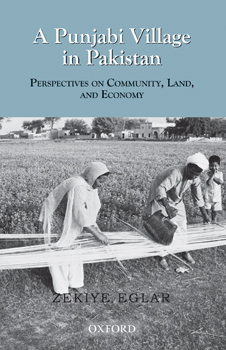
This is a plug for ‘A Punjabi Village in Perspective: PERSPECTIVES ON COMMUNITY, LAND, AND ECONOMY’ by the Russian-Turkish anthropologist Zekiye Eglar. The book, recently published by OUP Pakistan, is a two-volume publication that includes Eglar’s seminal award-winning work completed for her PhD at Columbia University, ‘A Punjabi Village in Pakistan’ (Columbia University Press, 1960, out of print) and her previously unpublished manuscript ‘The Economic Life of a Punjabi Village in Pakistan’ (See the review in Dawn here, and economist Haris Gazdar’s comments here).
My contribution to the book is the Introduction, Conclusion,and Bio-note about Zekiye Eglar, none of which would have been possible without constant inputs and information from the venerable artist Fazal Ahmed Chowdhry, who had helped Eglar with both works. Driven by the need to get the book published in his lifetime, he worked tirelessly with me to complete the current publication, despite his failing health and eyesight. The book contains previously unpublished archival photographs from his personal collection.
When Eglar met Fazal in 1949, he was the newly-appointed Chowdhry of the village of Mohla (near Gujranwala, Punjab) where she conducted her fieldwork and research; he left Pakistan for the USA along with his little nephew Gulli (now a successful businessman in the US and Italy) to join Eglar and help her with her work, and to pursue his dream of becoming an artist (the bio note contains their story as well). He attended art classes at the Museum of Fine Arts in Boston, and set up a summer school in Florence, Italy, for Garland College (now Simmons College, Boston) that he ran for several years. I felt a great sense of personal loss when he passed away just last year, shortly before the OUP book was published, but am happy that he at least knew that the book was in its final stages and would be out soon.
Update: Here is what Haris Gazdar wrote about the publication, review published in The News on Sunday, 11 September 2011:
Rural roots
This is a significant publication, combining the seminal study A Punjabi Village in Pakistan (1960) together with its previously unpublished sequel, The Economic Life of a Punjabi Village, by the Turkish anthropologist Zekiye Eglar
“No two clusters of villages in the Punjab are exactly alike. Yet there is a village way of life, which is best understood through the lives of people in a particular village. So Mohla, the village in which I lived for five years and which is described here, is both unique, and in its own way, typical of the Punjab.”
The genre of village study was once the mainstay of anthropology. When Zekiye Eglar arrived in Pakistan in 1949 most students of the discipline expected to stay in a village for a year, apply the tools of ethnography with great attention to detail and then re-emerge with a magnum opus, having often radically but knowingly reordered their own lives. Eglar, a Muslim woman of Azerbaijani descent, grew up in Ataturk’s Turkey. Her engagement with “her” village in Gujrat went further still, perhaps because unlike most foreign (generally colonial) researchers she self-consciously sought something of herself in the “field”.
But that is not all that is significant about this book and its publication. The fact is that Pakistan lost out on village studies after a promising start. The village study, for all its many problems, demanded acute engagement with a community, and valorized the production of systematic qualitative knowledge which enriched both policy-making and political debate in India.
In Pakistani Punjab we had a handful of pioneers and the precious few who followed in their footsteps. In Sindh, there was even less. More village studies would, obviously enough, not have significantly altered the course of history, but having fewer shoulders to stand on does make the job of engaged social scientists harder.
By taking on the task of completing and reviving Eglar’s work — re-publishing Eglar’s seminal study A Punjabi Village in Pakistan (Columbia University Press, 1960) together with its previously unpublished sequel, The Economic Life of a Punjabi Village — Beena Sarwar and Oxford University Press (OUP), Pakistan have done us all a huge favour.
Interestingly, the project was initiated by Catherine Mary Bateson (daughter of the iconic American anthropologist Margaret Mead who mentored Eglar) along with Fazal Ahmed, formerly the choudhry of the village Eglar studied, who left Pakistan (Ahmed, who became an artist and art teacher in the USA, passed away shortly before the book was published).
One of the central themes of Eglar’s study of a Punjabi village is the institution “vartan bhanji” — reciprocal exchange and the building of social relationships through reciprocal exchanges of cash, food and other items in rural Punjabi society. It is old fashioned these days to speak about moral economy and perhaps hard-nosed cynicism is our zeitgeist.
There are serious critiques of what was once a widely accepted notion of the harmonious Indian village. I, for one, believe that our present-day hard-nosedness is not just cynical but also democratic. Be that as it may, one issue where Eglar’s understanding of relations binding rural society together remains at the cutting edge is her careful consideration of the role of women in ordering social relationships.
We will find her treatment of class and caste overly coloured by the dominant caste-class. But she was certainly not alone among ethnographers of Punjab in not underscoring the institutionalized inequality faced by Kammis and laboring castes. One way of interpreting the relatively benign treatment of caste-class inequality is to wonder if actual conditions were, indeed, less severe then than now.
There is plenty of evidence to suggest this was not the case. Even on this score Eglar and the few early village studies are valuable because they do not deny the existence of a caste-class hierarchy — the zamindar-kammi relationship is everywhere in the books even if it is not explicitly put forth as the central theme. Eglar was a product of her own times and has left much of value for us.
Another professional woman who went to Punjab from the outside and engaged with its society some four decades after Eglar had different concerns. It is a measure of her times that the brutality of bonded labour, much of based on the caste-class hierarchy was far more salient than the softening of harsh edges afforded by reciprocal exchange. I am speaking, of course, about Beena Sarwar, who along with colleagues at the Human Rights Commission of Pakistan (HRCP) and others was among the first journalists to have written openly about bonded labour in the brick kilns of Punjab.
I don’t believe it is at all ironic that it has fallen upon Sarwar, an activist journalist with an eye for social inequality, to pay a tribute to Zekiye Eglar, the anthropologist who documented/analysed a system of reciprocal exchanges. In fact, it is “vartan bhanji” between us and the past generation to whom we are greatly in debt. I certainly hope that OUP will consider other similar projects — the names of Saghir Ahmad and Hamza Alavi spring to mind.
Haris Gazdar is an economist working on social policy and political economy issues at the Collective for Social Science Research, Karachi http://www.researchcollective.org
Filed under: Gender | Tagged: anthropology, garland college, margaret mead, mfa boston, Pakistan, simmons college, zekiye eglar | 5 Comments »




 Journeys to democracy