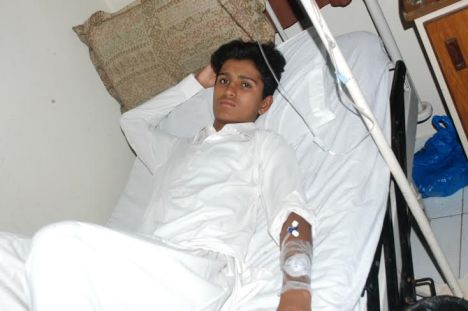
17-yr old Allahdin from Mithi, Tharparkar at hospital in Karachi. Photo: Wahid Khairi
Sharing three appeals for help here from people I trust, for those who would like to get involved or contribute in some way to any of these worthwhile causes:
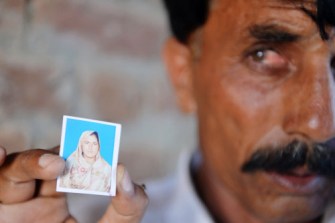
Iqbal holds up a picture of his wife, Farzana Parveen, killed outside the Lahore High Court. Photo: Aamir Qureshi/AFP/Getty Images
On the murder of Farzana Parveen in Pakistan and the two Dalit girls in India – something I wrote last week, published in The News and in The Times of India blog
There is no honour in killing
End the culture of impunity
Beena Sarwar
Last Tuesday, May 27, two crimes that shocked the world took place, one in the morning in Lahore, Pakistan and the other at night in Uttar Pradesh, India. Three young women – two of them just girls, really, were killed in these incidents. A fourth casualty was the unborn child of the five months pregnant woman in Pakistan.Continue reading →
When a court in India ruled in favour of 60-year-old Shah Bano, granting her maintenance (under Section 125 of the Criminal Procedure Code with an upper limit of Rs. 500 a month) from her ex-husband who had divorced her, it was not the first such judgment granting a divorced Muslim woman maintenance under Section 125 like all Indian women. But the orthodox lobby termed the verdict an attack on Islam.
Received the following note via email from Justice Katju in New Delhi, posted below. He has also posted it to his blog.
Uniform Civil Code
The refusal to modernise Muslim law or enact a common civil code has contributed to keeping Muslims backward in India, and has thus done great harm to Muslims
By Justice Markandey Katju
The issue of a uniform civil code has recently been raised. I am fully in support of a uniform civil code.
Article 44 of the Indian Constitution states : “The state shall endeavour to secure for the citizens a uniform civil code throughout the territory of India”. Continue reading →
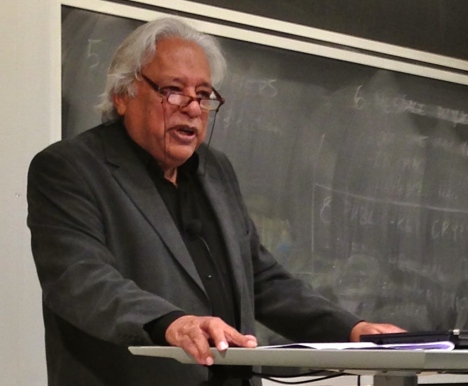
Arif Hasan speaking at the syposium: Architecture with ethics. Photo: Beena Sarwar.
Perween Rehman, photo by Steve Inskeep, NPR
An abbreviated version of my article on the symposium held at MIT to commemorate Perween Rehman and her legacy was published in The News on Sunday last weekend, titled Commitment personified. Below, the full text with additional links and photos:
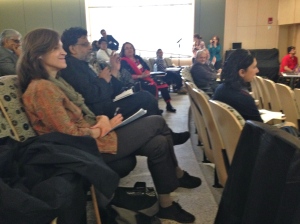
Audience members at the MIT symposium on OPP and Perween Rahman, included Miloon Kothari. Photo: Beena Sarwar.
Speakers at a symposium in the Boston area last week, on “The Orangi Pilot Project and Legacy of Architect Perween Rehman” paid tribute to the late architect and OPP director, as “a woman, architect and social activist”. They also discussed parallels between the issues faced by the urban poor in and elsewhere. Hosted by the Aga Khan Program for Islamic Architecture at the prestigious Massachusetts Institute of Technology (MIT), the symposium featured prominent academics from India, Pakistan and the United States.
The event, spearheaded by graduate students Fizzah Sajjad and Hala B. Malik from Lahore, had been in the planning soon after the murder of Perween Rehman in Karachi on March 13, 2013.Academics from India, Pakistan and the United States presented papers and participated in discussions. Prominent among them were Akbar Zaidi, Kamran Ali Asdar, Balakrishnan Rajagopal, James Wescoat, Anita M. Weiss, Laura A. Ring, Anita Spirn (of the pioneering West Philadelphia Landscape Project, which has many parallels with OPP), and Miloon Kothari, former UN Special Rapporteur on the Right to Housing who is currently at MIT.
Ironically, Perween herself had taken a deliberate decision to not attend such events, reflected the prominent architect Arif Hasan, Chairperson of the Orangi Pilot Project (OPP) and Urban Resource Centre (URC), whose keynote speech kicked off the day-and-a-half long event. Perween Rehman, who graduated in 1981 from the Dawood College of Engineering in Karachi, was among the first batch of students he had taught. The following year, fed up with doing projects for the rich, as she put it, she came to work with the legendary Dr Akhtar Hameed Khan at the Orangi Pilot Project that he had launched in 1980.
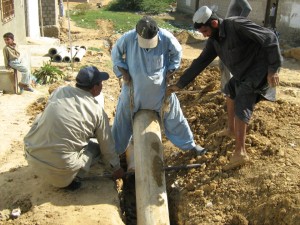
Orangi Pilot Project: Self help and advocacy. Photo: courtesy Arif Hasan.
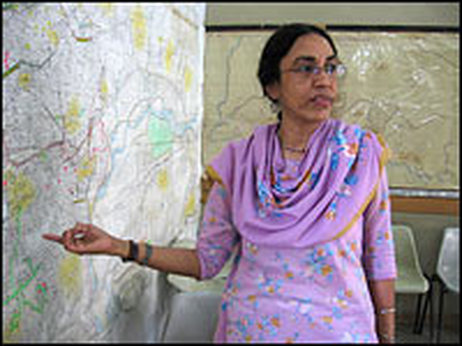
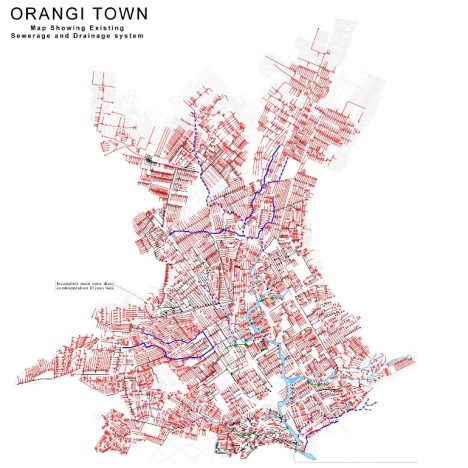
Orangi Township, Karachi. Map: Courtesy OPP.
It was Agha Hasan Abidi of BCCI who had asked Dr Khan, a retired bureaucrat famous for his uplift work at Comilla (in former East Pakistan), to help the people settled in Orangi. Dr Khan said he would not work with any one ethnic group or to do any social work, but agreed to investigate the problems in Orangi. After “roaming around” as Arif Hasan puts it, and talking to the people for several months, Dr Khan became convinced that the area would never become developed unless the people organised themselves and raised the money needed. In 1981, he asked Arif Hasan to develop a sanitation model, and later a housing model. There were psychological, social and economic barriers to be crossed. And there was a need, Arif Hasan suggested to Dr Khan in a note, to hire a young person to head the project and grow with it. However, one after the other, the young men they hired barely lasted beyond a few hours to a week at the job. And one day, Perween serendipitously showed up at Arif Hasan’s office, fed up of doing meaningless projects. She wanted to do something that would actually help people. She had done her homework and asked her former teacher about the various options she had investigated. He suggested that she go meet Dr Khan. She did, and he hired her. Unlike the others before her, she stayed on, “very serious in those early days”.
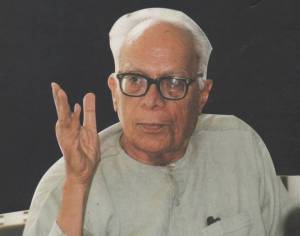
Dr Akhtar Hameed Khan: the guru who showed the way. File photo.
She learnt on the job, supervising the mapping and surveying of OPP, that students not much younger than herself carried out. This cost a fraction of the amount that an international agency had quoted, said Arif Hasan.
Rehman’s second major learning was to start a research institute. She “learnt by doing, observing and association”. In 1987, she was made director of the research and training institute, much to the resentment of the conservative lobby who considered her as a young “girl” – “but she stuck it out”. In time, she became close to various social organisations and activists, winning over many detractors who became her protectors and friends.
Her third major learning, said Arif Hasan, was through Khuda ki Basti, the housing project that the bureaucrat Tasneem Siddiqui started (see his interview in The News on Sunday on katchi abadis). To Perween Rehman’s credit goes the removal of the old complicated system of registering land and other legalities, and the establishment of a one-window operation open in the evenings that people could avail of.
She also initiated the OPP-RTI (Research and Training Institute), which manages projects like low-cost sanitation, secure housing support, education, water supply, and women’s savings, and training programmes. One of its greatest contributions has been mapping and documenting numerous settlements in Karachi.
Over 70 per cent of katchi abadis in Karachi are now regularised, thanks largely to the advocacy work of Perween Rehman and the OPP. Her greatest achievement, reflected Arif Hasan, was to make OPP “a people’s project”, and to “bring people closer together”. She refused to deal with the ‘big’ bureaucrats, preferring to focus on those working at that ground level. That in itself was a major shift in how advocacy was done. It led to changes in the laws, and changed perceptions towards informal settlements. “Laws are important”, as Arif Hasan put it, pointing out that it took 11 years to frame the Sindh Katchi Abadis Act, which in turn, became part of the Karachi Development Plan.
Panel discussion after Arif Hasan’s talk – Rajagopalan Balakrishnan: Universal parallels, anti-poor bias. Photo: Beena Sarwar
There is a strong anti-poor bias, not just in Karachi and Pakistan but all over South Asia, and indeed, the world, observed Balakrishnan Rajagopal, Associate Professor of Law and Development and founding Director of the Program on Human Rights and Justice at MIT.
Around the world, the poor are being pushed into smaller settlements, he said in his thought-provoking talk on various kinds of violence, including those that are structural and institutional, weighed against the poor. Transport is geared towards the much-touted vision of the ‘world class city’, rather than connecting the poor. Indeed, slogans like “world class” or “slum-free city” are “dangerous ideologies that sanction violence on the vulnerable at the policy level”. Re-locating people to make room for ‘development projects’ causes an increase in poverty levels as incomes decrease. Children pay a heavy price as their schooling is interrupted. Meanwhile, as literacy levels are rising, people are becoming more aware of their political rights.
Ironically, the more assertive they become, the more conflict is generated — the police tend to be heavy-handed when it comes to dealing with protests by the poor. Another common phenomenon, from Mexico and Brazil to South Asia, is the personal risk taken by those who work with the poor. The violence against defenders of equities, rights and the poor needs to be explicitly recognised, suggested Balakrishnan.
Over-commercialisation and commodification are giving rise to a certain kind of consumerism, and the consolidation of a trans-nationalist capitalist class. Exploitation of natural resources pushes rural dwellers to the cities, where they are forced into slums, making them vulnerable to disease and other issues related to urban poverty. Arif Hasan has suggested that architects and town planners develop a code of ethics and take oath like doctors do, to refuse projects that displace the poor or are environmentally or ecologically unfriendly.
Given the neo-liberal agenda that is being pushed globally, the suggestion is unlikely to receive a sympathetic hearing among his colleagues (“Arif Bhai, hum bazaar mein baiThey haiN,” as one of them put it). Still, it is certainly an idea worth pushing for.
Updated version of my PERSONAL POLITICAL column published in The News op-ed and TOI blogs on Friday
Beena Sarwar
Shahid Afridi’s googly lobbed at women’s cricket in Pakistan in an interview, dismissing women as just good cooks, went viral on social media over the past few days.
Ostensibly very different, both stem from the same patriarchal mind-set that sees women as inferior to men, justifying itself by invoking religion or cultural traditions.Continue reading →
BOSTON, United States, Mar 8 2014 (IPS) – On one of her many visits to Pakistan recently, Sarah Peck, director of the US-Pakistan Women’s Council, spent some time talking to young women medical students in Pakistan. She was struck by their passion and commitment — and by the hurdles they face.
The US-Pakistan Women’s Council is working with expatriate Pakistani doctors to find ways to encourage women qualifying as doctors in Pakistan to practice medicine.
Women outnumber male students in medical colleges across Pakistan, forming up to 85 percent of the student body in private universities and 65 percent in the public sector.Continue reading →
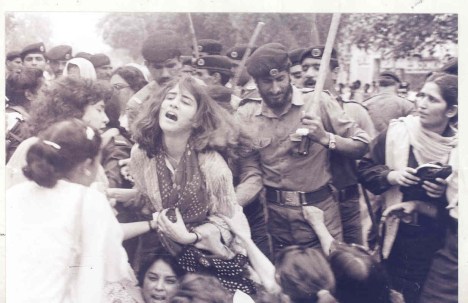
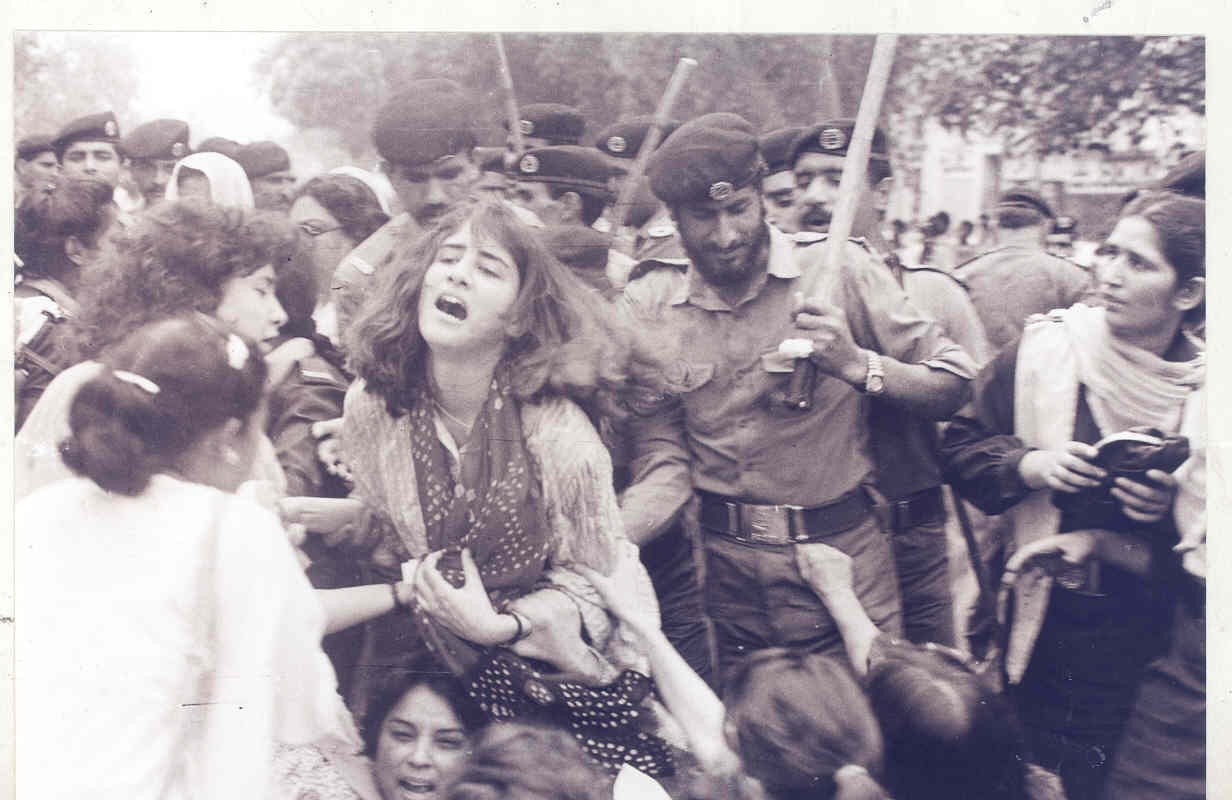
Lahore, Feb 12, 1983: Police lathi charge demonstrators. Photo: Rahat Ali Dar
The News published a slightly toned down version of my article, The Feb 12 pledge. Un-edited text below, followed by a postscript linking this struggle to Malala. More photos at this link.
Renewing the Feb 12 pledge
By Beena Sarwar
Every February 12 we commemorate Pakistan Women’s Day in honour of those who gathered at Lahore’s Regal Chowk on that day in 1983, defying the military order against public gatherings, to protest Gen. Zia’s ‘Law of Evidence’ that upheld the testimony of a male as equal to that of two females in a court of law. The police attacked the demonstrators with batons and arrested several, including the venerated poet Habib Jalib whom Chief Minister Punjab Shahbaz Sharif is fond of quoting.Continue reading →
Guest post:Zohra Yusuf, my first editor at The Star Weekend 1981-82, outlines the birth of the women’s movement in Pakistan
Lahore, Feb 12, 1983: Police brutality on the women’s demonstration against the ‘Law of Evidence’ catapulted the nascent women’s movement into the limelight. Photo: Rahat Ali Dar
“My years with WAF”
By Zohra Yusuf | Article written for a souvenir on WAF’s 25th anniversary, Oct 2006
Certain memories are etched on the mind. The birth of Women’s Action Forum is, for me, surely among them. It was on an afternoon in September 1981 that Aban Marker (Shirkatgah) called. She told me about the distressed call she had just received from Najma Sadeque (another SG founding member) regarding the case of Fehmida-Allah Bux. Pakistan’s first sentence of death by stoning and public whipping handed down to a couple under the Zina Ordinance of 1979. We had all read about the sentence and in our individual capacities felt deeply disturbed. After a bit of discussion, we decided to call a meeting of all women’s organizations at Aban’s place. The rest, as they say, is history.Continue reading →
That girl, the one without the name. The one just like us. The one whose battered body stood for all the anonymous women in this country whose rapes and deaths are a footnote in the left-hand column of the newspaper.
Sometimes, when we talk about the history of women in India, we speak in shorthand. The Mathura rape case. The Vishaka guidelines. The Bhanwari Devi case, the Suryanelli affair, the Soni Sori allegations, the business at Kunan Pushpora. Each of these, the names of women and places, mapping a geography of pain; unspeakable damage inflicted on women’s bodies, on the map of India, where you can, if you want, create a constantly updating map of violence against women.
For some, amnesia becomes a way of self-defence: there is only so much darkness you can swallow. They turn away from all the places that have become shorthand for violence beyond measure…
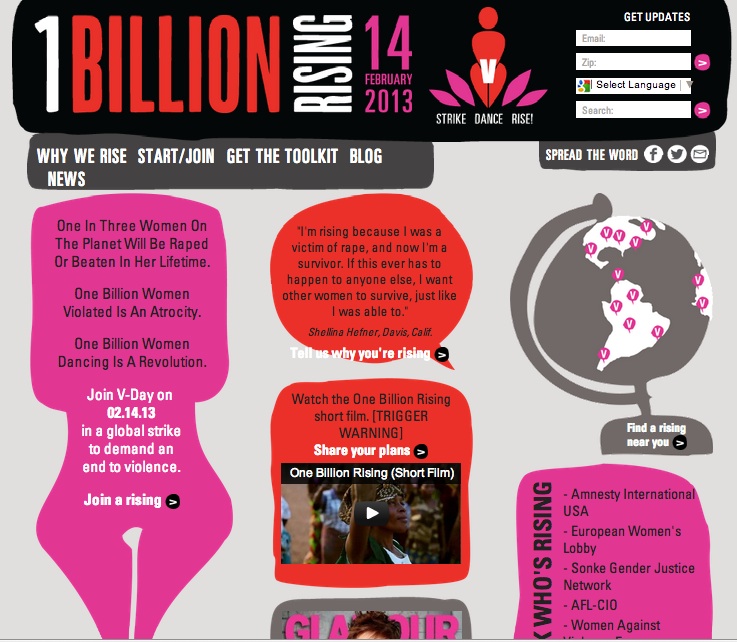
Join V-Day on 02.14.13 in a global strike to demand an end to violence.
Feb 14, 2013 is the 15th Anniversary of V-Day, the non-profit that began using The Vagina Monologues the ground-breaking play by Eve Ensler to raise awareness and money to end violence against women.Continue reading →








 Journeys to democracy