12-year old Ateeq from Lahore, currently in the Juvenile Jail in Hoshiarpur, India
Here is an update from Asad Jamal in Lahore on Feb 26: Release orders were passed for the 12 years old Pakistani boy in Indian Juvenile (Hoshiarpur) Prison after Asma Jahangir appeared in the Juvenile Court in Amritsar today. Now the Pakistan authorities have to complete procedural matters and bring the boy back home. Asma Jahangir met the boy in Amritsar and found him traumatised. She had taken video film of the boy’s father as well some clothes for him. Local lawyers/activists arranged and distributed sweets after the court order. Continue reading →
A Pakistani and an Indian begin an email exchange, attempting to share their thoughts honestly, without fear and hostility, exploring what divides our countries, and seeking ways to bridge the divide
By Dilip D’Souza and Beena Sarwar
February 16 2010
Dear Beena,
I started writing this before Pune. When I heard about those 11 more senseless deaths, I decided to rewrite it. I want to start by saying how difficult horrors like this make it to remain committed to the idea of peace, of speaking the language of reason. Here’s the bottom line: most Indians believe that this latest attack, like previous attacks, was conceived in Pakistan. Continue reading →
Pioneering sports journalist and statistician Gul Hameed Bhatti remembered
By Beena Sarwar
Karachi, Feb 12: There was laughter and some tears as friends, relatives and admirers gathered at an informal reference for the late veteran sports journalist and former Sports Editor The News, and former Editor The News Karachi Gul Hameed Bhatti, at The Second Floor community space near Defence Library.
Prominent speakers highlighted Bhatti’s thorough decency and honesty, selflessness, professionalism, his pioneering role in establishing cricket statistics in Pakistan and on a more personal level, his sense of fun, his love for music, cinema, food and off-colour jokes, his unreserved support of his journalist wife’s career and dedication to their children Kamil and Sara. Continue reading →
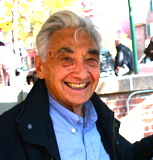
The Zinn magic. Photo: BJ Bullert, Cambridge MA, 2006
“To be hopeful in bad times is not just foolishly romantic. It is based on the fact that human history is a history not only of a cruelty but also of compassion, sacrifice, courage, kindness”
– Howard Zinn
Howard Zinn’s death on Jan 27 came as a shock to his friends and admirers around the world. The iconic historian, activist, and academic (Professor Emeritus, Boston University) was 87, frail, but in reasonable health. He had a heart attack while swimming, an activity he loved. As Arundhati Roy put it when she called his old friend David Barsamian of Alternative Radio: “Howard lived a glorious life and accomplished so much and to die swimming — what a way to go”.
Howard Zinn, Cambridge, Oct 2006 (photo: BJ Bullert)
David writes that Howard had rented a place with a swimming pool near the ocean for three weeks and “was thrilled to be escaping the dreaded Boston winter.”
A fluent Urdu/Hindi speaker, David sent this note to friends: “A light has gone out. There are new lights to be lit,” adding the following verse from Iqbal’s poetry:
Sitaron se aage jahan aur bhi hain abhi ishq ke imtehan aur bhi (Beyond these stars there are other galaxies The real test of love is yet to come)
In November when he visited Howard David noticed a mug in his kitchen with these words: ‘Sooner or later the American people are going to wake up’ – Emma Goldman, Detroit 26 Nov 1919. “
The book that Jack launched (at HLS)
It was going to be my lead question to him in the interview we were going to do,” wrote David. “I was to have left here on Thurs to join him.” (Howard died on Wednesday).
David sent a link to his radio tribute to Howard adding, “Please listen and of course feel free to distribute. It’s about 30 minutes.” His note ended rousingly: “Onward/Adelante/Howard Zinn Presente!”
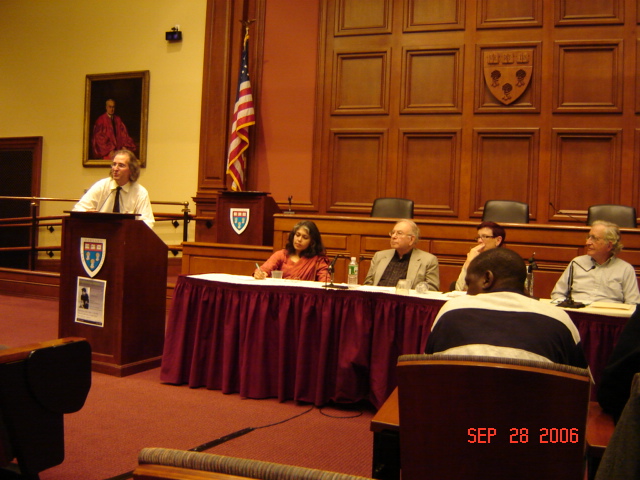
We had been in email contact for some time but I met David for the first time at the launch of Eqbal Ahmad’s collected essays published posthumously by Columbia University Press in September 2006. The launch took place subversively at Harvard Law School – subversively because HLS is a rather conservative place where the views of people like Eqbal Ahmad and his friends and comrades – David Barsamian, Howard Zinn, Noam Chomsky to name some – are rarely heard (particularly in the context of the Middle East, Palestine, Israel). But some pockets of resistance exist in those gilded halls. They include John Trumpbour (Jack), Research Director at Labor & Worklife Program, Harvard Law School.
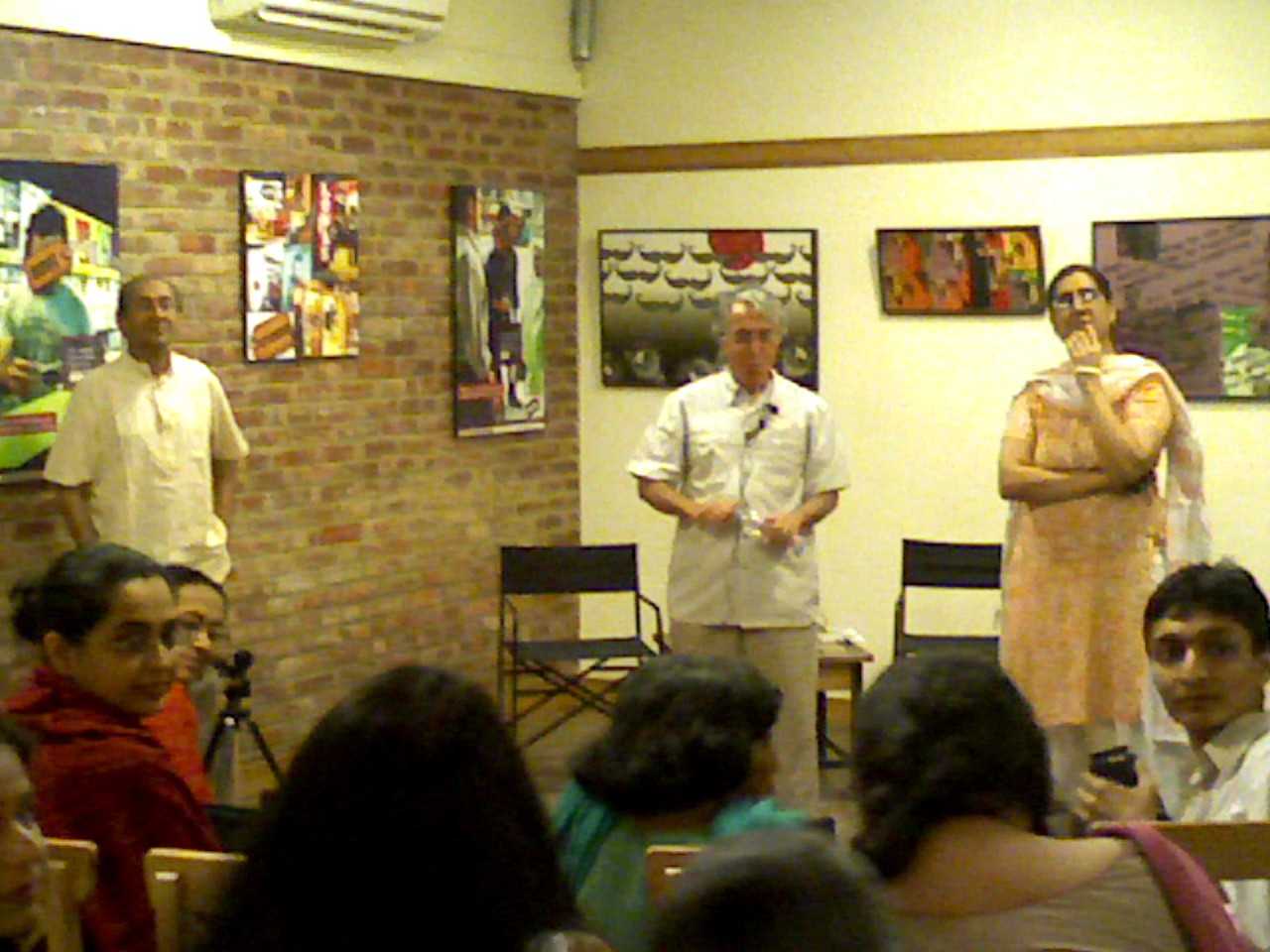
Jack introducing the Eqbal Ahmad book launch and panelists. R-L – Chomsky, Margaret Cerullo, Stuart Schaar & me.
Jack, who organised the launch, invited me to be on the panel (I was then a fellow at the Carr Center for Human Rights Policy, Kennedy School). David flew in from Colorado for the launch. Noam Chomsky, a long-time friend of Eqbal’s, gave the main speech. (I sent my report on the event reproduced at Pakistaniat to Howard – he replied: “That’s a lovely story, with wonderful photos!”)
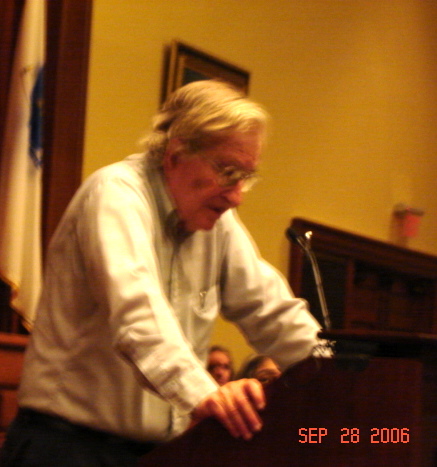
There was pin drop silence as Chomsky spoke in his characteristic low key way.
Chomsky was of course also an old friend of Howard Zinn’s. In an email responding to my note of condolence he wrote: “It is a sad moment, not just personally, but for wide circles far beyond his family and many friends. A really remarkable person, just as you say, as well as a close personal friend for many years.”
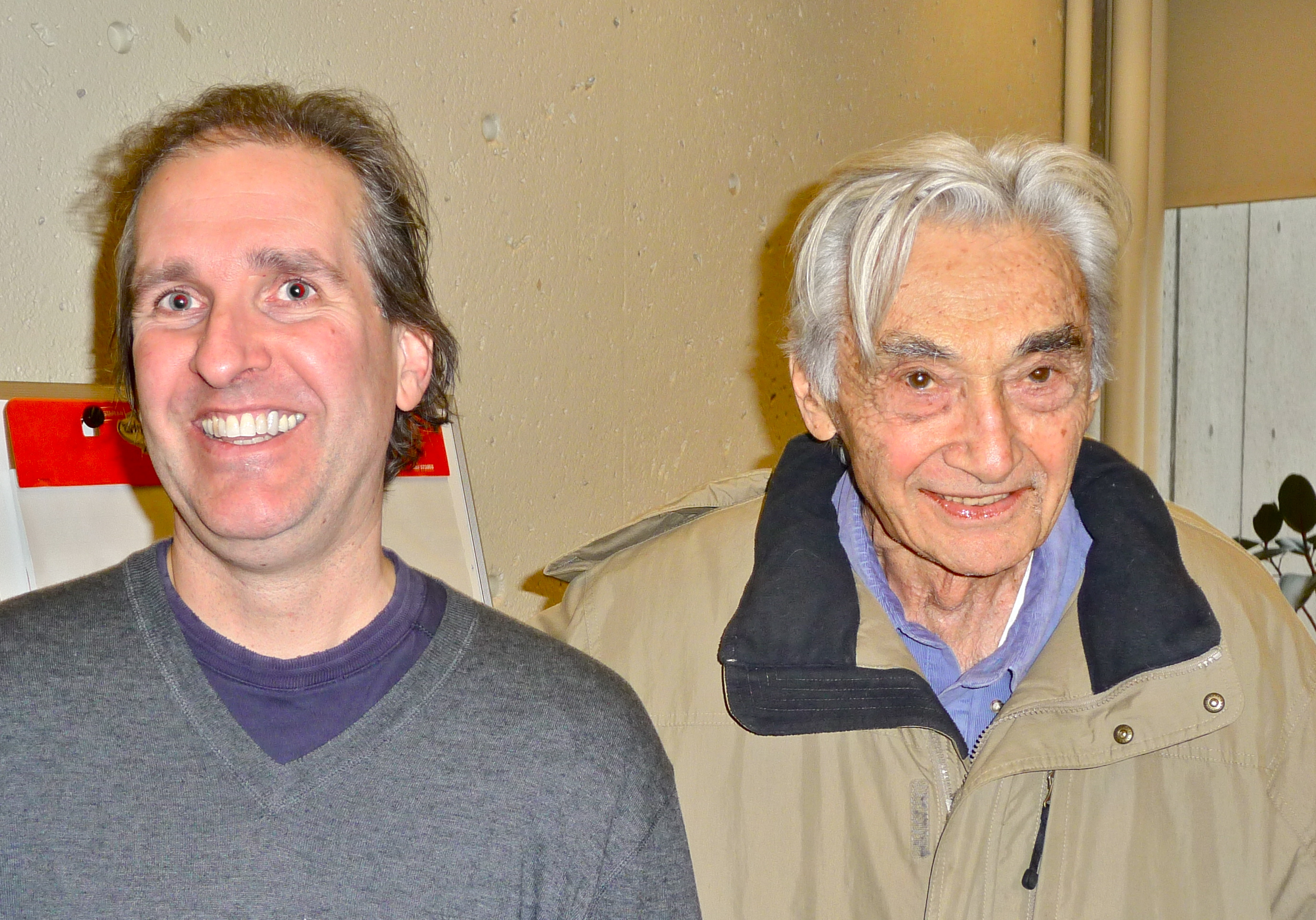
Jack recalls his last meeting with Howard, whom he had invited to teach at a class at the Harvard Trade Union Program in January, just a couple of weeks earlier. “Howard had lost some significant weight in the last year, but he was energetic and engaging as always. He showed a lot of clips from the new history movie he helped make, including appearances by Bob Dylan and Bruce Springsteen.”
Jack Trumbour and Howard Zinn: photo by Canadian labour leader Nancy Hutchison, taken on Jan 15, after Howard finished teaching the Program.
“Many people know about Howard’s peace activism, but fewer know about his efforts to reach workers and the labor movement,” comments Jack.
“Howard had a lot of issues with serious back pain during the past year, and he had some significant medical attention for this. He indicated that he was doing better, though not great… There have been some fine tributes to Howard. And the bloggers at the nasty right-wing website of David Horowitz have sneered at him, which is to be expected.
“…This is a sad day for us all, but we are hoping Howard’s tireless advocacy for peace might inspire others in 2010 to build a movement that can stop the madness, madness which includes Obama’s support for more global interventions.”
“I would try to be fair to other points of view, but I wanted more than ‘objectivity’; I wanted students to leave my classes not just better informed, but more prepared to relinquish the safety of silence, more prepared to speak up, to act against injustice wherever they saw it. This, of course, was a recipe for trouble” – Howard Zinn in his autobiography, You Can’t Be Neutral on a Moving Train (1994).
Cambridge, Oct 2006: Howard Zinn and B.J. Bullert. Photo: Beena Sarwar)
Jack was indirectly responsible for my own meeting with Howard Zinn. In May 2006, he had connected me with BJ Bullert, a documentary filmmaker in Seattle, WA, a graduate of Boston University (BA, Philosophy) with an MLitt in Politics from Oxford, with a PhD in Communication (University of Washington). She was interested in finding out more about the Tarbela Dam (her father was an engineer there and she had lived in Pakistan as a 13-year old) and issues of displacement (That is another story).
When BJ visited Cambridge in October 2006, we met for the first time since we had started corresponding. Later, when going to meet Howard, her old teacher, she invited me also. I was thrilled, and took along my copy of his inspirational, best selling book ‘A People’s History of the United States’. The book, currently #4 on the NYT non-fiction best-seller list, has sold more than a million copies and “redefined the historical role of working-class people as agents of political change” (as the LA Times obituary put it).
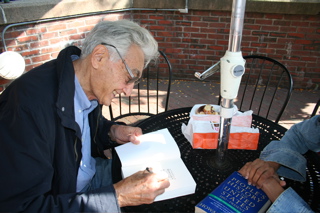
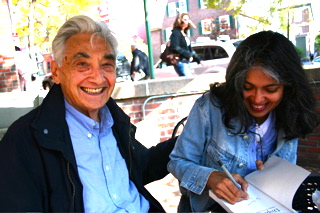
Howard Zinn autographs my copy of People’s History…
... and graciously makes me sign my offering. Photos: BJ Bullert
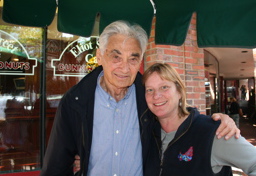
We sat outside in the little courtyard at Dunkin’ Donuts opposite the Kennedy School and talked, and joked. He graciously signed my copy of his book and even more graciously asked me to sign a copy of a book I gave him, ‘Dispatches from a Wounded World, (BlueEar & BookSurge, USA & UK, December 2001, to which I had contributed a chapter, ‘The Hijacking of Pakistan’, pushed by Ethan Casey). We joked, bantered and exchanged ideas. Jack turned up later to join us. Howard then had another appointment and we all went on our own ways. But we kept in touch.
Howard was prompt to endorse the ‘Academics’ Statement Of Support For Dr Ayesha Siddiqa’ in June, 2007, after the Musharraf government attempted to intimidate Ayesha following the publication of her book ‘Military Inc.: Inside Pakistan’s Military Economy’. The establishment pressurised the Islamabad hotel where the launch was scheduled to cancel the event. Ayesha’s phone service was disrupted as she gave interviews and she felt increasingly isolated and physically threatened.
The statement reminded the Musharraf administration “that the whole world is watching. The aspirations of the vast majority of the Pakistani people are inclined towards democracy and freedom of expression. It is obstructing these aspirations that will ‘derail the nation from its path of progress and prosperity’ to use a phrase from the press statement issued after the corps commanders meeting.”
Howard was generous in his appreciation for an oped I wrote for the Boston Globe about Pakistan’s struggles a couple of weeks later, saying it gave him “a clearer picture of what is going on in Pakistan, which of course I cannot get in the media.” (I think he meant the ‘mass media, particularly television, because after all, the Globe is media…).
In December 2007, I emailed BJ, Jack and Howard when David Barsamian visited to Pakistan for the Eqbal Ahmad Distinguished Lectures and needed some contacts. “Somebody ought to make a film about David,” quipped BJ.
David Barsamian at T2F (1.0) with Sabeen and Zak listening to an audience comment (March 2008). Photo: beena sarwar
Howard replied playfully, “BJ, a film on David Barsamian is a great idea. You will interview me and I will tell the world what a scoundrel he is. But seriously, you should do it! He deserves it, scoundrel that he is.”
In April 2008, the indefatigable e-campaigner Isa Daudpota emailed a Zinn quote to his mailing list, formatted as a poster that he had put up on his office door:
We need Civil Disobedience!
“Civil disobedience is not our problem. Our problem is civil obedience. Our problem is that numbers of people all over the world have obeyed the dictates of the leaders of their government and have gone to war, and millions have been killed because of this obedience. Our problem is that people are obedient all over the world in the face of poverty and starvation and stupidity, and war, and cruelty. Our problem is that people are obedient while the jails are full of petty thieves, and all the while the grand thieves are running and robbing the country. That’s our problem.”
~Howard Zinn
“Well, that’s nice news about the poster! In Islamabad!” exclaimed Howard when I forwarded it to him.
I visited Cambridge soon afterwards. His wife was ill and he tried to stay home as much as possible. But he added cheerily, “Hope you come back and we’ll have another chance to get together.”
I learnt in September from David that she had passed away soon afterwards. In response to my note of condolence Howard replied: “Roz was diagnosed with ovarian cancer in July of 2007, had six very good months, refusing surgery and chemotherapy, then declined and died in May. lt’s hard, but I’m doing okay.”
Married in 1944, they were inseparable until Roz’s death in 2008. She was also an activist, and Howard’s editor. “I never showed my work to anyone except her,” Bob Herbert quoting him as saying, in his obituary for the NYT.
Howard’s energy was amazing. Shattered by his wife’s passing away, himself well over 80 years old, he continued to write, give talks and interviews. He also embraced new ways of getting the word out, as evident with the publication of ‘A People’s History of American Empire’, the comic book version of “The People’s History of the United States” in 2008 that combines cartoons, historical documents and photos, “making the whole thing visual, dynamic, and absolutely captivating,” as one review put it.
The last email I got from him was about yet another exciting project to spread these ideas and awareness, through the documentary, THE PEOPLE SPEAK. He sent an email out to his contacts about the screening of this film, “directed-produced by Chris Moore, Anthony Arnove, myself, with a great cast of readers and performers. That will be Sunday evening, Dec. 13, 8 PM (7 PM Central) on the History Channel.”
A must-read for any Zinn fan is ‘the most dangerous man in America’ Daniel Ellsberg’s riveting tribute. He recounts that he first met Howard Zinn at Faneuil Hall in Boston in early 1971, “where we both spoke against the indictments of Eqbal Ahmad and Phil Berrigan” for “conspiring to kidnap Henry Kissinger”. He recalls how Howard (who had been arrested in D.C.) returned to Boston for a rally and a blockade of the Federal Building, and was the last speaker at a large rally in Boston Common being addressed over loudspeakers.
Ellsberg writes: ‘Twenty-seven years later, I can remember some of what he said. “On May Day in Washington, thousands of us were arrested for disturbing the peace. But there is no peace. We were really arrested because we were disturbing the war.”
At the end, he said: “I want to speak now to some of the members of this audience, the plainclothes policemen among us, the military intelligence agents who are assigned to do surveillance. You are taking the part of secret police, spying on your fellow Americans. You should not be doing what you are doing. You should rethink it, and stop. You do not have to carry out orders that go against the grain of what it means to be an American.”
He paid for his words the following day when he was singled out for manhandling and arrest.
As the legendary activist and author discussed in one of his final interviews, he wants to be remembered for “introducing a different way of thinking about the world,” and as “somebody who gave people a feeling of hope and power that they didn’t have before.”
Howard Zinn, wherever you are, know that there are people here too who will always celebrate your life and work and who mourn your passing away as a world citizen who cared for humanity above all and did indeed give people “a feeling of hope and power”.
Compilation of tributes and articles related to Howard Zinn, including his own works, at the Howard Zinn website.
Post script: Just came across Mahir Ali’s tribute to Zinn in Dawn, Feb 10, 2010: ‘Lessons from a past master‘ – “Every country would be well-served by a radical public intellectual of comparable erudition, commitment, wit and wisdom. Americans should be very proud of Howard Zinn.”
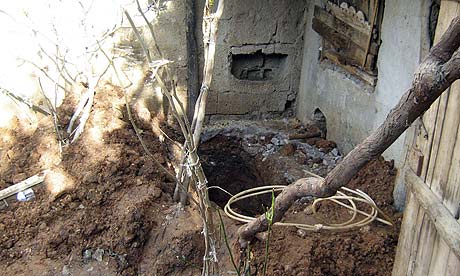
The hole where a 16-year-old girl was buried alive by her relatives in Adiyaman, southeastern Turkey Photograph: HO/REUTERS (courtesy: The Guardian - report below)
Recently there was a report about the horrific murder of a Turkish girl, whose family buried her alivebecause she was talking to a boy. Turkey’s shame… but she’s not alone. Such incidents take place regularly in conservative, patriarchal societies that face all kinds of conflict in this day and age, among communities that have distorted notions of ‘honour’. ‘Honour killings’ take place in Muslim-majority Pakistan but similar stories also emerge from Hindu-majority India, where such murders take place among those belonging to the Hindu or Sikh faiths (often when the girl or boy involved belongs to a ‘lower’ caste), not just Muslims. I believe the issues are related to power and patriarchy. Religion is just a tool in that game, as are notions of ‘honour’. As I wrote when a similar case emerged in Pakistan (four women buried alive in Balochistan for wanting to marry of their own choice), there is no honour in killing. Below: text of the report that appeared in The Guardian, by Robert Tait in Istanbul, Feb 4, 2010:
PERSONAL POLITICAL article written on Jan 26, 2010, published in The News on SundayFootloose page Feb 7, as ‘Wild, pure magic of malhars’
Photo by MAHA SARWAR SHAHID, age 13
Beena Sarwar
Out on a fishing boat under a clear blue early morning sky to go dolphin watching, the violence, squabbles and tensions that mark daily life fade into irrelevance – including the recent tensions arising from the Indian Premier League’s refusal to bid for Pakistani cricketers.
We cruise the sparkling azure waters of the Arabian Sea parallel to the lengthy sand spit (imaginatively called ‘Sandspit’) along the Karachi coast. About five kilometres out to sea, we can still clearly see the recreational ‘huts’ that dot Sandspit beach. As we pass another fishing boat, the crews exchange greetings – just as highway truckers and bus drivers do.Continue reading →
Gul Hameed Bhatti as I will always remember him (photo courtesy GHB Facebook page)
Feb 5, 2010: Sad day. Woke up this morning to the news that Gul Hameed Bhatti had passed away last night. I knew he was not keeping well, but didn’t know how ill he was — dedicated journalist, sports editor, friend, equal rights upholder, and fine human being. Went to the funeral this afternoon and it brought back so many memories – the last time I was there was probably when his wife Razia Bhatti, founder editor of Newsline, died in 1996. I had known them both since 1981, when I was an intern at The Star evening paper, now also sadly no more. Razia was then editor of monthly Herald, down the corridor.
Gul, last we spoke was when I called you about a story I was doing on the Pakistan Women’s Swimming Team for IPS, several months ago. Your own reports provided great material on the issue of course, like this 2008 story in The News on Sunday Sports page. My story got delayed several months because my father was very ill and subsequently passed away. I was relieved for him when his suffering was over, and Gul, I am relieved your suffering is over and that you are with your beloved Razia where ever you are, together again. Continue reading →
This post is based on a note I began compiling over a week ago, sent to my yahoogroup the other day, which includes links to some articles on corruption and politics and a somewhat related note on Bindiya Rana, the Khwaja Sira (hijra) who features in Ragni Kidvai’s film ‘Bindiya Chamke Gi’…
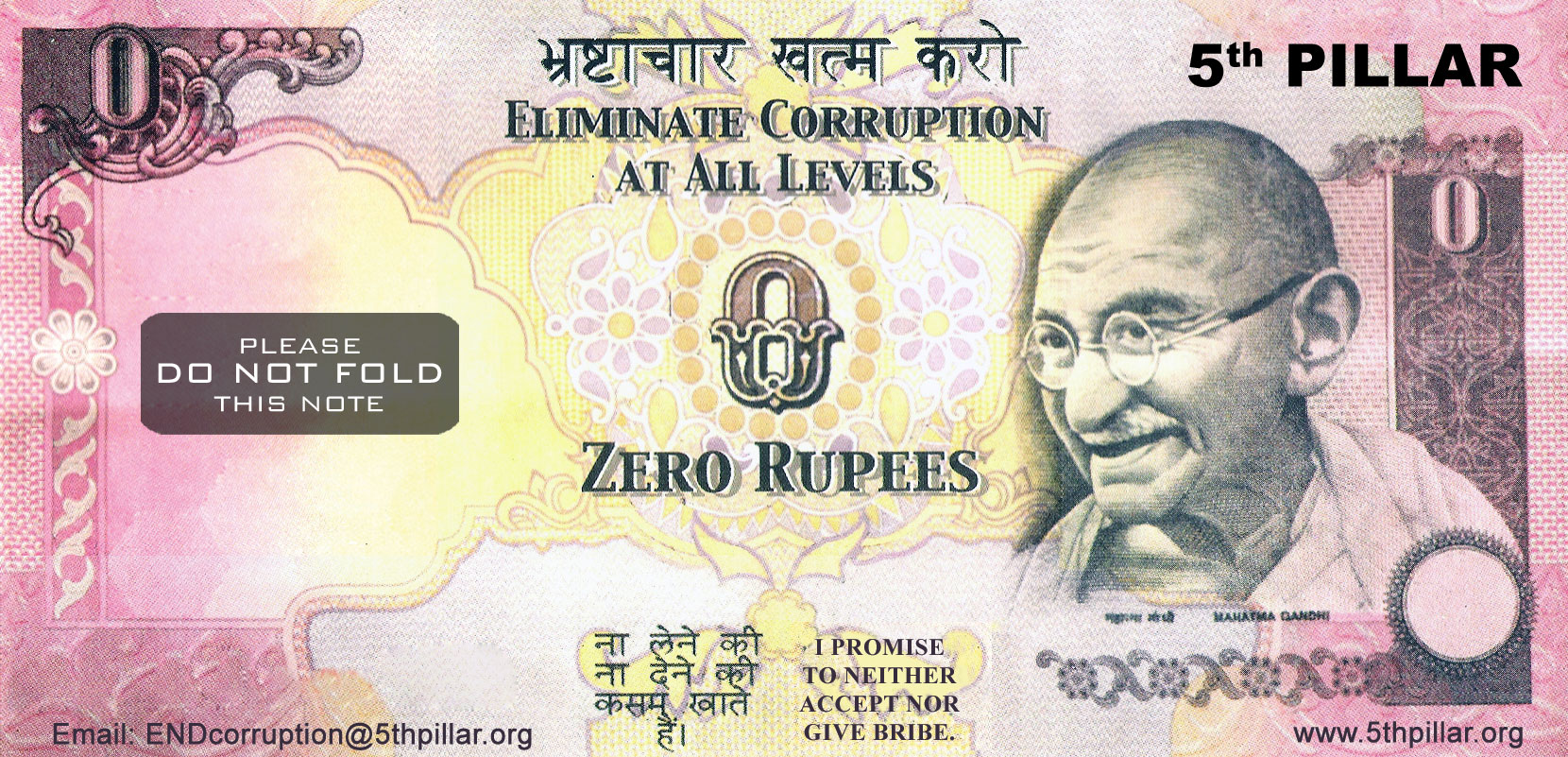
‘Paying Zero for Public Services’: An Indian NGO called 5th Pillar gives the public a powerful ally, an imaginative way to combat petty corruption:a zero rupee note (“eruption against corruption”! – love it). Why can’t we do this in Pakistan? (thanks Omar Ali)
Speaking of corruption: “The NRO judgment cannot be all about the evil in Asif Zardari. It must be seen on its own. It is a reminder of the time when the military’s illegal acts against Nawab Akbar Bugti were being tolerated because the latter was an unsavoury person” – ‘Flaws in the judgment‘ by Asma Jahangir Continue reading →







 Journeys to democracy
