

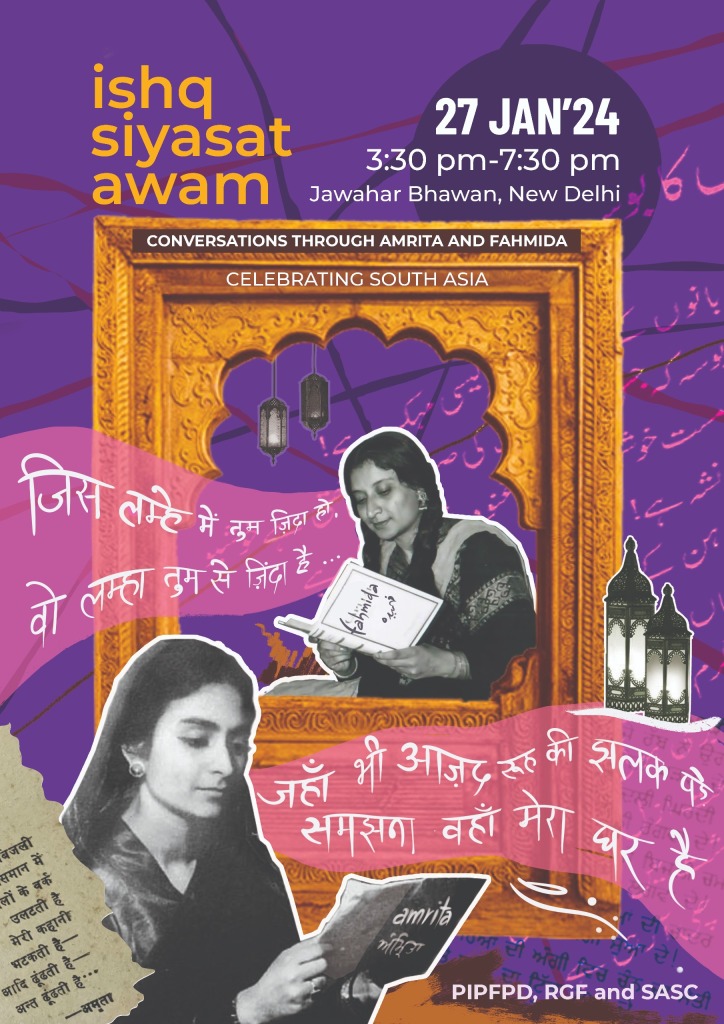
The latest Southasia Peace Action Network (Sapan) newsletter we put out highlighted a commemoration in Delhi for two iconic feminist poets of Pakistan and India: How the friendship of two cross-border feminist poets symbolises our work; upcoming events, and more
Radical love, epitomised by the late Amrita Pritam and Fahmida Riaz is ‘one of the seeds of the revolutionary thought process’, to quote the Pakistan India People’s Forum for Peace and Democracy (PIPFPD) stalwarts who organised the event – Vijayan MJ, Tapan Bose, and Dr Syeda Hameed. Their consistent work over the decades for peace and justice is truly inspirational, and I feel privileged to know them personally.
I was also privileged to know one of the late poets personally, Fahmida ‘Khala’ (aunt) to me, who was close to my father Dr. M. Sarwar. He led the Democratic Students Federation (DSF), Pakistan’s first student movement while at Dow Medical College in Karachi, 1949-54.
I’ve uploaded archives about the movement here: drsarwar.wordpress.com. Principles of that struggle continue to show the way, like the importance of coming together across divides for a minimum common agenda. For DSF, it was student rights. For Sapan, it’s Southasia Peace. We need it now, for the sake of the people of the region, and beyond.
The Videos section of the Dr Sarwar blog includes a playlist of video clips from the event held at the Karachi Arts Council in January 2010 to commemorate DSF and the student movement, a few months after my father passed on.
Compered by the actor Rahat Kazmi, the event featured speeches from young activists, students, and academics like Amar Sindhu, Alia Amirali, Ali Cheema, and Varda Nisar, as well as veterans like I.A. Rehman, besides the singer Tina Sani, Taimur Rahman and his band Laal, and Fahmida Riaz.
Fahmida Khala recited her poem ‘Palwashey Muskurao’ (Palvasha, smile), dedicated to daughter of late Afzal Bangash of the Mazdoor Kissan Party (Workers’ and Peasants’ Party), and the followers of other late leftist leaders. They may no longer be on this earth, but their principles and aspirations for human rights and dignity continue to show the way.
(ends)
Filed under: Art and activism, Dr M Sarwar, Pakistan-India, Progressive politics, Resistance | Tagged: Activism, Afzal Bangash, Ali Cheema, Alia Amirali, Amar Sindhu, Amrita Pritam, and Varda Nisar, democracy, Dr M Sarwar, Dr Syeda Hameed, DSF, Fahmida Riaz, I.A. Rehman, India, Laal, Mazdoor Kissan Party, Pakistan, PIPFPD, poetry, Punjabi poetry, Sapan, sapan news, south asia peace, southasia peace action network, Taimur Rahman, Tapan Bose, Tina Sani, Urdu poetry, Vijayan MJ, Workers’ and Peasants’ Party | Leave a comment »



 Journeys to democracy