Three ‘9/11’s…

9/11: Anis Mansoori of FM 103 in his live talk show today brought up the  significance of two 9/11s – Sept 11, 1948, when Mohammad Ali Jinnah breathed his last, and Sept 11, 2001 when two planes crashed into New York’s Twin Towers, catalysing a spiral of violence from which we have yet to emerge. My comment was that if successive Pakistani governments had not discarded Jinnah’s vision and headed down the ‘jihadi’ path at the behest of America in its fight against the USSR in Afghanistan, perhaps the second ‘9/11’ would not have happened.

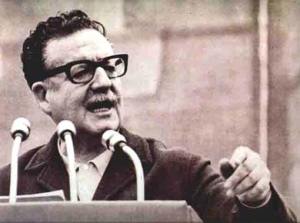
Another 9/11 to remember: Allende ousted

Another 9/11 to remember: Allende ousted

And Mohsin Sayeed reminds me about another 9/11, in 1973 – the US-backed military coup in Chile, that removed the world’s first elected Marxist government. “I don’t see why we need to stand by and watch a country go Communist due to the irresponsibility of its people,” said Henry Kissinger about the coup.

The deposed Dr Salvadore Allende was killed and Gen. Pinochet  unleashed a reign of terror and massacred between 32,000 to 80,000 people…

Target killing of doctors; my article of 2002; Dr Sarwar on censoring Jinnah, 1991

A press release from PMA condemning the ongoing target killing of doctors in Pakistan reminded me of a piece I had written in 2002, published in the Indian Express – googled the key words and found it. Ah, Internet.

There are also new uploads in the ‘Writings’ section of the blog Dr Sarwar blog – including ‘Censoring the Quaid’, a piece Dr M. Sarwar wrote in 1991 for his fortnightly column ‘Karachi calling’ in The Frontier Post, Lahore. Particularly relevant given the Jaswant Singh and Jinnah controversy.

In its press release of August 21, 2009, the Pakistan Medical Association, Karachi strongly condemns yet another murder of Dr.Sajjad Arain in Hyderabad, killed on his way to work at Civil Hospital, Hyderabad. A similar incident had also occurred a couple of days before in Quetta when Dr.Iqbal Zaidi was killed by unidentified miscreants. “By now this easy phenomena of killing doctors has become a routine, and right to life of those who are providing soles to humanity irrespective of sex, colors, religion or beliefs, is sadly no more available to them in the country,” says PMA, demanding the immediate arrest of culprits. If stern action is not taken with in 24 hrs the doctors community will be forced to stage country wide protest by calling total shut down of health services in the country.  http://health.groups.yahoo.com/group/pakistanmedicalassociation

Below, my article in Indian Express, April 2002: http://www.indianexpress.com/storyOld.php?storyId=1097

Targeted doctors ask what about us as Gen fights US war against terror

Apr 19, 2002

Beena Sarwar

For some days now, Karachi has thankfully not woken up to the news of yet another medical doctor shot dead in cold blood. But as an editorial in The News (April 16) cautions, ‘The current let-up in the assassinations does not mean that the issue should be allowed to quietly die down, or overshadowed by the controversial referendum. The question of who is behind the killings and why still begs to be answered, and must be answered sooner rather than later.’

Over the last decade, almost 90 doctors, mostly Shi’ite, have been assassinated, causing widespread fear and insecurity, and leading to a veritable exodus not just of medical practitioners but also their relatives in other professions. Dr Tipu Sultan, Karachi President of the nation-wide Pakistan Medical Association (PMA), knows of at least 28 doctors who left Karachi in one week in March.

Obviously, whoever is behind these murders wants to make an impact: a doctor killed demands media attention, and creates far-reaching ripples, given each doctor’s contact with hundreds of patients and their families; their very public dealing makes them vulnerable.

Assassins turn up at a targeted doctor’s clinic, and ask for him by name to identify him, as in the case of Dr Rashid Mehdi, 39 on February 12. He was shot dead, leaving behind a young wife, also a doctor, a little son, and a five-day-old daughter.

The pattern includes armed motorcyclists intercepting a doctor’s car and shooting him at point blank, as in the case of Kidney Centre nephrologist Dr Alay Safdar Zaidi, killed on his way to work on March 4. Dr Zaidi had returned to Pakistan a year and a half ago, leaving a thriving practice in the States to come back and make a difference here.

His daughter, aged six, and son, only three, are now among the dozens of other children whose fathers were similarly assassinated, despite not being affiliated with any religious or political party or even holding aggressively Shia views.

In one instance, the assailants used a car to force a doctor’s car to a stop. Dr Jafar Naqvi of the philanthropically run Kidney Centre was saved by his driver’s reflexes.

Dr Naqvi, saved by taking refuge in a private house, is now virtually confined to his own house, with round-the-clock police protection.

Most victims are Shi’ite, but they include some Sunnis too, like Dr Fayyaz Karim, 44, shot on Feb 4 as he left a mosque after offering his prayers. His wife, Dr Farahnaz Karim, says bitterly that it’s commendable that the Government is helping Americans wipe out terrorism. ‘‘But what of the terrorists in our midst who are killing our own countrymen?’’

The killings have forced an organised response from doctors, with the PMA calling several strikes (including a six-hour country-wide hunger strike) during which doctors at hospitals and clinics across the country provide only emergency cover. ‘‘This is not the answer,’’ concedes Dr Asghar Mirza, editor of the PMA’s Urdu journal Nabs. ‘‘But how else do we express our rage and fear?’’

When the PMA met the Sindh Governor last month, police officials suggested a ban on motorcycle pillion riding, and arms training and protection to threatened doctors. ‘‘This is not the answer either,’’ says prominent psychiatrist Dr Haroon Ahmed. ‘‘They are trying to use us to push through their own agenda.’’ He argues, like others, that administrative steps alone are not the answer.

‘‘The Government must restore civil and political liberties so that alternative opinions are given space, and tolerance and respect promoted,’’ demanded the Pakistan Peace Coalition (PPC) at a nation-wide protest on April 5 against violence in the name of religion. ‘‘This will likely provide a necessary challenge to extremism, as well as temper the urge for many frustrated elements to resort to reactionary violence.’’

Political parties in Karachi, including major players like the Pakistan People’s Party (PPP) and the Muttahida Qaumi Movement (MQM), joined the protest on the invitation of the Joint Action Committee for Peace Karachi (JAC), an umbrella group for activist groups, and also a PPC member. A March 20 meeting agreed that ‘‘The killings of doctors, lawyers, judges and other sections of society are aimed at instigating fear and retaliation’’ and that the root cause of the problem must be addressed. This includes ‘‘the forces of reaction and regression’’, including the intelligence agencies, which have gained strength since Pakistan’s involvement in the Afghan war.

The point is reiterated by PPC: ‘‘It is time that the intelligence agencies start protecting citizens from extremist violence rather than harass citizens and activists for their political activities and agitation. The revamping and reorientation of the intelligences agencies is yet another promise that the Government has made and is failing to keep.’’

Meanwhile, ‘‘it is individuals and groups who are fighting for their basic rights that are being targeted by the state, often under the anti-terrorist legislation’’.

Gen Musharraf’s actions against religious extremists since 9/11 are criticised as tokenism. ‘‘Some have been arrested, but why have cases not been registered against them?’’ questions PPP Central Information Secretary Taj Haider. ‘‘Because the Pakistan army’s and the agencies’ role in the matter will be exposed. This permanent axis is dangerous for democracy in Pakistan.’’

Even the police privately acknowledge this axis. ‘‘These extremists have been very useful to the Government, which might need their services again,’’ says an official, speaking on condition of anonymity.

He acknowledges that at least some elements of the powerful Inter-Services Intelligence (ISI) still protect the militants they nurtured, trained and armed over the years.

It is significant that while the doctors’ killings are labeled as sectarian because those targeted mostly belong to a particular sect, there is no sectarianism or religious intolerance at the grassroots level.

‘‘The incidents of apparently religiously-motivated violence, like the attack on the Islamabad church or the murder of Daniel Pearl, are planned and executed by individual miscreants with no popular support or public sanction,’’ says The News editorial.

‘Except for one incident in Rahim Yar Khan (instigated by economic reasons), Hindus in Pakistan have not been attacked in retaliation for the carnage of Muslims in Gujarat, as opposed to 1992, when the razing of the Babri Masjid was countered by attacks on Hindu temples in Pakistan (then too, the nexus of vested interests like property developers and ‘‘religious’’ leaders had teamed up to reap the benefits).

Religious parties have never gained more than 3 per cent of the assembly seats in Pakistan, unlike in next door India, where a religious party has actually been voted in, with disastrous results for an avowedly secular polity.’

Former mayor of Karachi and MQM leader Farooq Sattar argues against calling these killings sectarian: ‘‘Let’s not play into the hands of vested interests by calling them that.’’

Dr Sattar urges the easing of regional tensions as a step towards resolving national problems. ‘‘Sixty per cent of India’s trade is with Islamic countries, as compared to only 5 per cent of Pakistan’s, the remaining 95 per cent of our trade is with Western countries.’’

‘‘These issues (violence in the name of religion) are not Pakistan’s alone, they also exist in India and Bangladesh, all of South Asia,’’ argues Sabihudin Ghausi, the outspoken President of the Karachi Press Club and a senior economic reporter.

‘‘We can’t remain isolated from the region, we have to have ties with India, with Bangladesh, and the other South Asian countries.’’

(Beena Sarwar is a senior journalist working with The News)

Simply repealing 295-C will not stop the rot

Since it was introduced by Gen. Zia, the ‘blasphemy law’ 295-C has been used to settle scores, including financial rivalries, as umpteen fact-finding missions have recorded (included several I have participated in), much as the Zina laws have been used for revenge.

Now, simply repealing 295-C will not stop the rot. That must be done, but along with it we have to demand strict enforcement of law and order.

Those who incite violence and murder (eg mullahs who used loudspeakers) must be held culpable as well, charged, tried and punished in accordance with the law.

Ditto those who desecrate a holy book or symbol, no matter of what religion.

Below, links to some reports that provide a perspective on the issue:

PAKISTANI CHRISTIANS-THE VICTIMS OF HALF LAW IN GOJRA, by Brigadier Samson Simon Sharaf (Retired), Aug 5, 2009

http://chowk.com/ilogs/73055/47736

An Eyewitness Account from Gojra – Faris Kasim.  August 7, 2009

http://www.chowk.com/articles/an-eyewitness-account-from-gojra-faris-kasim.htm

Edited version in The News Op-Ed, Aug 8, 2009

http://www.thenews.com.pk/daily_detail.asp?id=191978

HRCP press releases, Aug 4 & Aug 1
http://hrcpblog.wordpress.com/2009/08/06/gojra-admin-knew-about-pre-planned-attacks-hrcp/

http://hrcpblog.wordpress.com/2009/08/06/hrcp-press-release-on-gojra-and-korian-incident/

Lethal Law, Newsline Sept 2001
http://www.newsline.com.pk/NewsSept2001/newsbeat.htm

Zardari: two articles and a comment

Meant to do this earlier but didn’t get around to it – two interesting articles about Zardari and a comment

July 12, 2009 ‘The advent of Asif Zardari’ by Kunwar Idris http://tinyurl.com/ksbydc

Shaheryar Azhar posted this to his group The Forum with the comment: “A very good article. This moderator to the dismay of some forum members has not focused on the ‘governance’ issue in Pakistan ever since the departure of the Musharraf government. This, of course, was by design.

“We must first decisively emerge victorious in our civil war – as long as Zardari’s government is doing a credible job on this front they deserve our full support. There will, however, come a time when we will shift our complete focus on ‘governance’, ‘corruption, ‘efficiency’ etc.-type make-or-break issues. Here we must acknowledge that what is different from the 90’s is not just more maturity being shown by the politicians or the existence of the Charter of Democracy or the working coalitions in all the four provinces or much greater consensus amongst politicians of consequence on key national issues – all of which individually and collectively is the big and surprise story of 2008 and 2009 but the existence of two empowered institutions, which were conspicuously missing then – independent judiciary and media. So rest assured, there will be time (soon inshalla) when our focus will shift laser-like to the bread-and-butter issues.

“There is one big caveat: as always military dictatorship, including military manipulation from the background will always be fought against. In Pakistan what is true is the following: Corrupt democracy anytime over any kind of military dictatorship.”

A follow up article at – http://tinyurl.com/m6zuva

July 15, 2009, ‘Meeting the president’, by Sayed Naseer Ahmad, Dawn:

“Never before had a head of state invited so many retired bureaucrats and asked them to speak their mind on national issues. The mere fact that several dozen retired bureaucrats, who could no longer influence decision-making, were invited to the presidency for a frank discussion showed that the incumbent valued good counsel.

“…Zardari said he thought that the militants and extremists had emerged on the national scene not because the civil bureaucracy was weak. In fact, they had been deliberately created and nurtured with the help of the international community as an instrument of policy in the 1980s. He then went on to advise the former bureaucrats to be “truthful to ourselves and make a candid admission of the realities”.”

PAKISTAN/INDIA: Citizens Push for Peace

By Beena Sarwar

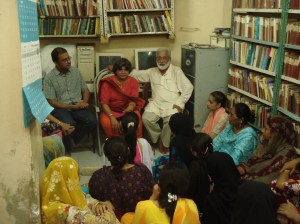
India's Kavita Srivastava meets Pakistan's Rajasthani women. Also pictured Haris Gazdar (left) and Karamat Ali. Photo: YPC

India’s Kavita Srivastava meets Pakistan’s Rajasthani women. Also pictured Haris Gazdar (left) and Karamat Ali. Photo: YPC

KARACHI, Jul 8 (IPS) – The months following last year’s Mumbai terror attacks have seen a renewed sense of urgency among peace activists in Pakistan and India. Citizens are pushing their governments to resume the composite dialogue process between the two nuclear-rival nations.

India suspended the process after the Mumbai attacks, accusing Islamabad of not doing “enough” to contain terrorism. But activists argue that terrorism is not Pakistan’s problem alone.

“Both countries are going through a critical phase,” says Jatin Desai, a veteran Mumbai-based journalist.

A frequent visitor to Pakistan, he was in the country with two other Indians, meeting community-based organisations, political leaders and media persons in Karachi, Lahore and Hyderabad to take the push for peace to the people. His proposal to ‘twin’ the press clubs of Karachi and Mumbai was positively received.

“After the Mumbai terror attacks, Mumbai residents sent a clear message – No to war, No to violence, No to terror,” said Desai. “Thousands joined hands for a hundred kilometre long ‘human chain for peace’ on Dec. 10, 2008, to say this and urge a resumption of the peace process.”

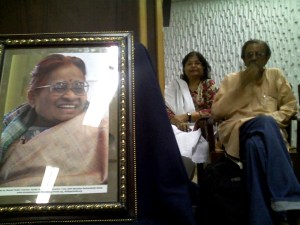
Zahida Hina and Jatin Desai at the seminar for Nirmala Didi. Photo: beena sarwar

Zahida Hina and Jatin Desai at the seminar for Nirmala Didi. Photo: beena sarwar

He was speaking at a seminar in Karachi to underline the need for peace in South Asia and to honour Nirmala Deshpande, a prominent peace lobbyist, who passed away in May 2008.

A majority of participants in the seminar were women from low income localities whose husbands work as daily wage labourers. Mumtaz, a young woman suckling her toddler, told IPS that this was the second such event she had attended.

“I understand what it’s about,” she said. “They want peace between India and Pakistan. We should live in peace with our neighbours. Maybe then our lot will improve. We all want that.”

Breakthroughs between India and Pakistan are routinely subverted by violence like the Mumbai attacks.

The security establishments and military machines also have vested interests in keeping tensions simmering.

“There will be no peace until the arms race ends,” said Mohammad Ali Shah of the Pakistan Fisherfolk Forum, representing a community severely impacted by the hostilities, with whom the Indian delegates spent an evening.

“There are currently over 500 Indian fishermen in Pakistani prisons, and over 150 Pakistani fishermen in Indian prisons,” Shah told IPS. “Fishermen on both sides caught violating the maritime borders are treated as prisoners of war.”

A consular access agreement of May 2008 – aimed at facilitating early release of prisoners – requires both sides to exchange updated lists of each other’s nationals in their custody every Jan. 1 and Jul. 1.

Pakistan handed over its list to the Indian government. “But India defaulted both times this year, and has been unable, for unspecified reasons, to provide Pakistan with a list of Pakistani prisoners in Indian jails,” reported The Hindu on Jul. 2.

The lists in any case are incomplete, with many prisoners unaccounted for.

Jaipur-based Kavita Srivastava of India’s People’s Union for Civil Liberties (PUCL), on her maiden visit to Pakistan, wanted information about five Indian prisoners incarcerated in Pakistani prisons since 1991.

“Only two are in touch with their families, we don’t even know if the other three are alive,” she told IPS. “When they heard that I got my visa, their families walked for a whole day to meet me. With tears in their eyes they begged me to bring any information I could.”

She was unable to ascertain their whereabouts but left with a promise from the provincial minister for prisons that “next time” she would be allowed to visit the prisons and verify for herself.

“Such visits are important to increase contacts. After all, we are one region. We should be able to meet,” Shakeel Silawat of the Youth Progressive Council told IPS, after arranging a visit for Srivastava with girls and women from his community. Silawats are Rajasthanis who often have families on both sides of the border.

“If there was dual citizenship for Indians and Pakistanis, believe me, many would take it,” asserts award-winning social activist Sandeep Pandey from Lucknow.

Pandey participated in the 2005 peace march from Delhi to Multan in the south of Pakistan’s Punjab province. The marchers had also received enthusiastic welcomes from Pakistani villagers along the way.

Karamat Ali from the Pakistan Peace Coalition which organised the visit said that the Indians left with “a sense of the urgency for peace with India which appears to be greater among Pakistanis”.

“They realise that they need to push the Indian government to change its attitude towards the elected government of Pakistan, go beyond pressurising the Pakistani government to ‘take action’, in order to break the grip of the establishment here,” he told IPS.

Such visits may not yield immediate results, but the fact that the governments allow them to take place is in itself a step, if not forward, then at least not backwards. And in the context of India and Pakistan, that can only be seen as positive.

(END/2009)

http://www.ipsnews.net/news.asp?idnews=47575

`Pakistan: Chaos unto Order?’ and ‘syllabus of hate’

1. `Pakistan: Chaos unto Order?’ by Haris Gazdar in EPW (Economic & Political Weekly, June 6, 2009 vol XLIV no 23).

Extract: The Pakistani military finally appears to have embraced the war against jihadi militancy as its own. If so, an
important shift in perception and policy has taken place. Past experience, however, demands caution before coming to any hasty conclusions.
Comment by Shaheryar Azhar in the Forum: “this is an excellent article – cuts through the fog of confusion. Those who have denied it can perhaps now understand what the big deal was about the ‘deal’ bravely made by both parties –
PPP and General Musharraf, which is what put into motion where we are now. Million dollar question remains whether overtime there will remain the political will that will be crucially required on a sustained basis within the military, politicians and the general public to fight this to the bitter end?”

PakTeaHouse link: http://tinyurl.com/gazdar-epw

2. `Awaiting changes to a syllabus of hate’ by Nirupama Subramanian, Islamabad correspondent for The Hindu, June 09, 2009

Extract: In April, the federal Cabinet put off approving the draft indefinitely, …until the Education Ministry makes the policy “more comprehensive, covering every aspect of education sector which needs improvement along with an
implementable work plan.” But no urgency is visible in the Ministry to get cracking on this task. Another concern is that the Education Minister is not known for his progressive views, especially on gender issues.

http://tinyurl.com/syll-hate

Beating Back the Taliban

My column for HardNews, written May 24, 2009

PERSONAL POLITICAL

Beena Sarwar

“Is the threat of Talibanisation real or has it been hyped up by the media?” asked an Australian journalist friend calling a week before the Pakistan army began its belated operation against the militants in Swat region. With no independent reporting from the area, there’s only the army’s word about the situation. If rag-tag Taliban barely 4,000 strong are being trounced it is hardly surprising – they face the world’s fifth largest standing army.

A quarter have reportedly been killed in the operation. Many are deserting, shaving off their beards and melting back into the local population. Not all are hard core militants. Some joined the Taliban for money, were forced, or driven to avenge the casualties caused by American drone attacks. However, some still cause fear according to reports coming from refugee camps that house an estimated 20 per cent of the over two million persons internally displaced (IDPs in development jargon) since the fighting began. The rest are living with friends, family or strangers, some of whom house up to 4,000 people on their lands.

For the first time since 1971, a ‘war narrative’ is being developed by the media, government, army and politicians (many of whom until recently justified the Taliban’s actions; during Kargil, they denied the Pakistan army’s involvement). Now there are images ‘war hero funerals’ of army ‘shaheeds’ (martyrs) – not all from Pakistan’s dominant religion (Muslim) or ethnic group (Punjabi).

Even before the army action, wild bearded turbaned hordes were unlikely to take over Pakistan. This is not Afghanistan where decades of war destroyed all the systems and institutions. Nor is it Iran, where a huge urban-rural divide helped the mullahs to take over. Even conservative Pakistanis are uncomfortable with the Taliban’s brand of Islam – public beheadings, corpse mutilations and floggings. There is wide adherence to Sufi values and anger at the Taliban’s attacks on sufi shrines.

Pakistan has a 5,50,000 strong standing army (struggling to re-orient itself against its former allies the jihadis, countering its historic conditioning against India), a bureaucracy geared to maintaining the status quo, and an elected Parliament. Regular interruptions to the political process have made them somewhat dysfunctional but the only cure is to continue the process, break the pattern according to which no elected government in Pakistan has completed its tenure (not counting the one formed after the 2002 elections that took place during military rule without the participation of the political leadership).

I started writing this while my father was hospitalised  in the Sindh Institute of Urology and Transplantation (SIUT), a clean and well-equipped facility that treats rich and poor free of charge in this bustling megapolis of over 16 million. I described to my Australian friend the street scene I saw. The three-storey sandstone building is surrounded by decrepit British era and modern apartment blocks. Some ancient neem trees raise leafy green heads, sanctuaries for noisy crows in this concrete jungle. In the evenings, families including women and children, and groups of young men, bring roadside eateries to life.

For all the efforts homogenise Pakistani society, it remains diverse. That afternoon, a couple walked past the pushcart fruit, juice vendors and parked motorcycles, the woman in a brown burqa, the man in conventional shalwar kameez. Two young girls in colourful shalwar kameez, dupattas draped casually over their shoulders, walked the opposite direction. Another woman went alone, a black chaddar over her blue shalwar kurta. Several men lounged on the footpath, some squatting on their haunches, smoking, chatting, drinking tea.

Elsewhere, air-conditioned malls are full of young girls and women, some with girlfriends or dates, others with families or alone. Their attire ranges from burqas and headscarves over shalwar kurtas, to short shirts and jeans, to  high-slit tunics over calf-length trousers (‘capris’). Many are window shoppers escaping oppressive heat compounded by power breakdowns. Not all can afford the designer labels on display, but exposure to different lifestyles has changed old aspirations (not necessarily in a positive way).

Meanwhile, whether or not the Taliban are beaten back, a greater threat emanates from state systems that encourage conservative thinking — discriminatory laws against religious minorities and women, the encouragement of violence against religious minorities and women, vigilante justice, and anti-India, pro-jehadi values

http://tinyurl.com/pp-taliban

Doc’s blog; Madrassas vs Pvt schools; Hoodbhoy on Pk; Cost of war and more

Condolences: Lourdes Joseph, longtime activist and office secretary of the Human Rights Commission of Pakistan (HRCP) passed away today in Dubai of a heart attack. Funeral on June 10, 4 pm, at St Anthony’s Church in Karachi; burial at ‘gora qabristan’ 5 pm.

1. New blog – www.drsarwar.wordpress.com – with photos and remembrances, including by I.A. Rehman, Salima Hashmi, Dr Badar Siddiqui, S.M. Naseem, Ali Jafari, Mohsin Tejani and others

2. The Madrasa Myth op-ed co-authored by Tahir Andrabi, Jishnu Das, C. Christine Fair, and Asim Ijaz Khwaja, published June 3, 2009 –  http://www.foreignpolicy.com

Extract: `Rather than focusing on madrasas and public schools, the donor community should take note of a striking change in the Pakistani educational landscape: the emergence of mainstream and affordable private schools.’

Note from Tahir Andrabi (Professor of Economics, Pomona College, Claremont, CA):
“Trying to inject some sense in the mainstream of the Washington policy debate on Pakistan. Would like for once to having facts as a basis for conversation on Pakistan”. (The other Pakistani co-author Asim Ijaz Khwaja teaches at Harvard Kennedy School). http://tinyurl.com/lxlbrs

3. `Whither Pakistan? A five-year forecast’ by Pervez Hoodbhoy in the Bulletin of Atomic Scientists, 3 June 2009. Article Highlights
• U.S. government officials and media outlets have exaggerated how close Pakistan is to collapse.
• That said, the speed of Pakistan’s societal decline has surprised many inside in the country who have long warned of the effects of religious extremism.
• The first step toward calming the situation–Pakistan’s political leadership and army must squarely face the extremist threat, something they’ve finally begun to do.
http://tinyurl.com/Pk-PH-5yr

4. The Women of Swat and `Mullah Radio’, Tuesday, 02 June 2009,
From a group of NWFP women, report published in http://khyberwatch.com
Extract: “Islam started as soon as we fled from Malakand. People outside Swat think we had Islam and Shariat. There is no Islam in Swat. The Taliban have finished it.’ -woman from Mingawera, Swat, in a Sawabai camp
Full report at – http://tinyurl.com/lrnvo4

5. HRCP report on the situation of the internally displaced, plus the Commission’s conclusions and recommendations at:  http://hrcpblog.wordpress.com
`A tragedy of errors and Cover-ups – The IDPs and outcome of military actions in FATA and Malakand Division’
The cost of the insurgency in the Malakand Division has been increased manifold by the shortsightedness and indecisiveness of the non-representative institutions and their policy of appeasing the militants and cohorting with them. While the ongoing military operation had become unavoidable, it was not adopted as a measure of the last resort. Further, the plight of the internally displaced people has been aggravated by lack of planning and coordination by the agencies concerned, and the methods of evacuation of towns/villages and the arrangements for the stranded people have left much to be desired….

Based on reports by HRCP activists in Malakand Division and other parts of NWFP/Pakhtunkhwa, visits to camps by its activists and senior board members, and talks with many displaced people and several Nazims and public figures
Direct link to report – http://tinyurl.com/mpy7et

6. From Isa Daudpota: Bill Moyers sits down with award-winning investigative journalist Jeremy Scahill to examine the human and financial costs of America’s wars.
http://www.pbs.org/moyers/journal/06052009/watch.html
Plus a new website he suggests checking out: www.whowhatwhy.com

Some articles re ‘Talibanisation’, veiling, flogging

Two of my articles on `talibanisation’ and violence against women published April 12, 2009 that I didn’t get round to sharing here, reminded by Nadeem Farooq Paracha’s spot on article ‘Slap him or Slap yourself’ (Dawn, May 17, 2009) – http://tinyurl.com/pxrfjz

1. `Ongoing struggle’, in Special Report, ‘The News on Sunday’ about how Talibanisation is splitting our South Asian identity and leading to the existing schizophrenia and changing dress codes…

Extract: The trend (to veil) is also visible at the lower socio-economic level. Some years ago, Sughra, who cleans homes for a living, began wearing a burqa when going to work, motivated by weekly religious meetings. She feels it is “better”, both because it is ordained by religion and because it helps her to avoid the male gaze. Her cousin Ameena, a cook, shrugs off the suggestion to wear a burqa. Although deeply religious– she says her prayers regularly and fasts during Ramzan — she does not see the need to alter how she dresses, which is perfectly modest by any standards. “If a man harasses me, I beat him with his own shoe,” she says.

Complete article at  http://tinyurl.com/dmg4om

2. Op-ed in Dawn for which they changed original title “`Wicked’ NGOs and that flogging thing” to the more mundane `Swat flogging & public outrage’. They also changed the word `bottom’ to `back’ which doesn’t at all mean the same thing. `Buttocks’ would have worked but I guess that’s the prevailing `sensibility’.

Extract: The first casualty of war may be the truth but the first casualty of any `religious militancy’ is women’s rights…. The Taliban’s treatment of women, including their ban on female education while in power in Afghanistan (please note, before the American drone attacks) takes Zia’s obsession with controlling women’s morality and public behaviour further…. One reason for the Pakistani state’s apparent paralysis is that the armed forces and large sections of the population think of this as America’s war, compared to the previous Afghan war with its religious trappings. In fact, that was less `our war’ than the current one, which threatens the very existence of the Pakistani state. http://tinyurl.com/ccelax

A slightly longer, revised version was published in ‘The Hindu’ on April 14 – Vigilantes, the state and that flogging thing’ – The first casualty of war may be truth but the first casualty of any ‘religious militancy’ is women’s rights – http://tinyurl.com/qjs8da

Some other articles published at that time that I liked:

The high cost of surrender, Irfan Husain, Dawn 11 Apr, 2009 http://tinyurl.com/dxfmv8

Are we in denial about terrorism? Shafqat Mahmood, The News, April 10, 2009 http://tinyurl.com/cveryg

A state adrift, by Cyril Almeida, Dawn, 10 Apr, 2009 http://tinyurl.com/d9eoy8

A catalyst for change? By Zubeida Mustafa, 08 Apr, 2009 – WHY did civil society in Pakistan vociferously protest the flogging of a 17-year old girl in a public square in Swat and not when many other atrocities were committed against women in recent times? http://tinyurl.com/czofco

Swat aid appeals; Pk can defy odds; ‘WoT’ Myths; Binayak Sen; Ashram in Sindh

A lot going on but huge backlog (on the personal front, the ‘Old Fighter’ as his friend Eric Rahim called him still in hospital, fighting on). In this post:

1. Appeals for aid for thousands of Pakistanis displaced by the fighting in the
Swat region (I so dislike using ‘IDP’, the dehumanising but convenient acronym
used for internal refugees) & I.A. Rehman on the disaster brewing & Independent report (scroll below for details)

2. Pakistan Can Defy the Odds: How to Rescue a Failing State by Hassan Abbas – download the PDF document at
http://ispu.org/reports/articledetailpb-76.html
(outlines issues related to the Taliban, a vibrant civil society movement for
the rule of law, an independent judiciary, and the supremacy of the
constitution; a strong ‘independent’ (for the most part) media; writers,
artists, poets, and intellectuals standing up to religious bigotry; the results
of the 2008 elections in which religious political parties were trounced, and
American-Pakistani relations)

3. `A cobweb of myths’ – Prominent linguist and writer Dr Tariq Rahman
de-constructs myth, the realisation of which is essential if our children are to
have a better future – “that we have created our own Frankensteins and not
foreign countries; that most of the militants are our people and not foreigners
(though some are); that foreign countries may help militants but are not
powerful enough to keep them alive for ever; that we made mistakes in the past
of which we are reaping the harvest”
Dawn, May 14, 2009: http://tinyurl.com/p2fo95

4. The campaign to free Dr Binayak Sen – Chattisgarh paediatrician, health care
worker and democracy activist (general secretary of the People’s Union for Civil
Liberties, PUCL) has been imprisoned for two years without trial, without bail,
for allegedly helping Naxalite insurgents – see
Daily South Asian – http://tinyurl.com/padqzk
Countercurrents – http://tinyurl.com/rcqpf7
Indian Express – http://tinyurl.com/r7dpeq

5. Some good news in the middle of the bad – Report on a 100-year-old Ashram in Tharparkar, where hundreds of animals, children and jobless people find solace, by Shahid Husain in ‘The News on Sunday’, Kolachi section, May 10, 2009:
http://tinyurl.com/ov4j4u

OVER TO the burning issue of the military operation in Swat and the internally
displaced persons

‘Malakand priorities’ – Veteran journalist and human rights activist I.A. Rehman warns that with the expected fallout of the military operation in Malakand Division having exceeded official estimates, the whole effort at overcoming terrorism and militancy could miscarry.
Dawn, May 14, 2009 –http://tinyurl.com/par5b2

See also Truthout – <http://www.truthout.org/050909A>
Half a Million Flee Swat Valley as Pakistan Faces Months of Fighting
by Andrew Buncombe, The Independent, Saturday 09 May 2009

BELOW: Localised appeals for aid – besides Edhi – http://www.edhifoundation.com

From Fauzia Minallah <funkor.childart@gmail.com>
Summer Clothes for women and children (Please ensure that the shirts are not
be sleeveless ).  Toys will bring back smiles on Children’s faces.
Please drop them at 2 C, Naval Housing F 11/1 Islamabad –
Contact: Naila Zahid 0300 555 4303

From Dr Samrina Hashmi <samrina_hashmi@yahoo.com>
Pakistan Medical Association (PMA), Karachi – accepting Cash,Medicines, Flour, Powdered Milk, Biscuits,Water
Medical Camp for IDPs at Itehad Town, Karachi, Sunday May 17 2009.
Bus will leave from PMA House (Aga Khan 111 Road,Sadder, Karachi) at 9am sharp; Doctors, nurses ,paramedics invited. Need Antibiotics,plaster {Gypsona 4″,6″}, Paracetamols, anti-diarreals, anti-malarials 
Contact:
Amir Peter +92-21-2251159
Rehan   +92-333-2367020   

From Mohsin Sayeed <mohsinqs@hotmail.com>
Voice of the Civil Society-VOTCS donation camp at Carlton Hotel May 15-17, 10:00 a.m-5:00 p.m). Contact: hadiakhan@gmail.com
Collecting cash (esp for tents), dry food, hygenic items (soap etc), beddings &
candies for children, plus basic medicines (Pain Killers, Cough syrups,
Bandages, Antibiotic oral medicines and for external use e.g. Furecin
powder)

From Pakistan Peace and Solidarity Council <pscpak@gmail.com>
PPSC is providing food, drinking water and assist the displaced people in
registration in Shergarh, Takht Bhai, Mardan and Jalala.  

Dr. Nisar Ali Shah,  (Karachi)  Ph# +92-333-7157215

Mr. Pasha (Peshawar)   Ph# +92-300-9363403

Mr. Jamshed Khan  (Mardan)    Ph# +92-345-9386739

Mr. Hassan Zaman (Punjab)      Ph# +92-300-7192515 & +92-61-6014154

Dr. Muhammad Hafiz Ur Rehman (Islamabad)  Ph# +92-334-5038705

Web: http://www.pscpak.org

That’s it for now