India, Pakistan: Build on goodwill, not hate

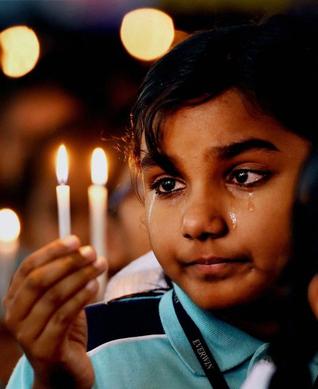
A student in Chennai prays for those killed in Peshawar. Schools across India held a two-minute silence on Wednesday. Photo: R. Senthil Kumar/ PTI

A student in Chennai prays for those killed in Peshawar. Schools across India held a two-minute silence on Wednesday. Photo: R. Senthil Kumar/ PTI 

I wrote this for The News on Sunday’s Jan 11, 2015 issue:

Build on goodwill, not hate

In the wake of escalation of tensions between India and Pakistan, people on both sides of the border continue to express solidarity through peace initiatives

In an unprecedented and heart-warming gesture from India to Pakistan, Indian Prime Minister Modi requested schools in his country to observe a two-minute silence to commemorate the children and teachers killed in the horrific attack on the Army Public School in Peshawar on Dec 16, 2014.

In another unprecedented, spontaneous show of solidarity, Indians began tweeting with the hashtag #IndiaWithPakistan, started by Indian columnist Tehseen Poonawala who tweets from the handle @tehseenp.

The hashtag peaked with over 63,000 tweets on Tuesday, the day of the tragedy. By Friday, the number of tweets containing this tag had crossed the one million with about 600 tweets per minute hash-tagged #IndiaWithPakistan (“IndiaWithPakistan hashtag crosses 1 million on Twitter”, TNN, Dec 20, 2014).

These developments spawned hope that relations between the two countries would improve.

However, India sent a very different signal by refusing to grant visas to 24 prominent Pakistanis invited to a seminar in Delhi on “Understanding Pakistan”, organised by the Pakistan-India People’s Forum for Peace and Democracy (PIPFPD) on December 19-21. Formed in 1994, PIPFPD is the oldest and largest people-to-people group between India and Pakistan that both governments have typically given visas to, leaving a door open even during hostilities.

Soon afterwards, there was a massive knee-jerk reaction in India, officially and in the mainstream media, to a lower court in Pakistan on December 26 announcing bail to Zaki ur Rehman Lakhvi, accused of the November 2008 Mumbai attacks.

The Indian media reacted furiously and with a sense of betrayal to news of the bail, without bothering to notice that this was a court order that the Pakistan government was contesting (Lakhvi is still in prison).

Meanwhile, the hashtag #PakWithIndiaNoToLakhviBail, started by Pakistani lawyer Ahmed Shaikh who tweets at @MohdAhmedShaikh, began trending on twitter in solidarity with the Indians’ sense of betrayal. By the afternoon, there were over 9,000 tweets hash-tagged #PakWithIndiaNoToLakhviBail, according to the data analytics company Frrole.

Indians and Pakistanis continued to express solidarity for each other’s hurt and to connect not just through Aman ki Asha but also initiatives like the peace video selfies (‘velfies’) of the ‘Dear Neigbour Movement’ and the Indo-Pak Peace Calendar launched by the cross-border youth organization Aaghaz-e-Dosti.

But events on the ground continue to test the goodwill. By the end of December, several incidents of cross-border firing were reported along the disputed border that divides Kashmir.

With heavy fog obscuring visibility and no independent observers allowed near the conflict zone, it is hard to tell what really happened. What is clear is that each side blames the other for ‘unprovoked’ firing and the killing of their soldiers and civilians, and that both sides have suffered casualties.

What’s also clear is that escalation of tensions and ‘tit for tat’ firing are causing massive sufferings to the people of the border areas. They also have the potential for long term repercussions as they “provide a greater space to extremist, hawkish and fanatic elements, whilst empowering war mongers on both sides,” to quote Kashmiri analyst and columnist Raja Muzaffar.

These tensions, as he notes, “have the potential to drag the whole region into a new war, destroying hopes of long term peace and economic stability”.

The only information available on what is happening at the border is what the security establishments on either side choose to tell their respective sides. Since we know how trustworthy they are, it makes sense to question the official narratives and obtain more information before jumping to conclusions.

Another case in point is the Pakistani fishing boat said to be carrying explosives that entered Indian waters on the night of December 31 that the Indian Coast Guard intercepted. Initial media reports in India said that the boat was a fishing vessel from Keti Bunder in Pakistan, and there were reportedly four men on board who blew it up when intercepted.

Sceptical of this narrative, Mumbai-based journalist Jatin Desai wrote to friends at the Pakistan Fisherfolk Forum (PFF) asking them to find out whether any fishing boat from Keti Bunder was hijacked or reported missing.

PFF President Muhammad Ali Shah responded within hours, terming the “terror boat” incident as “drama and false information”. He explained that an empty fishing boat from Jati district, Thatta – that is, without crew — had been separated from another boat due to strong winds. The Indian Coast Guard had burnt the empty boat at sea, said Shah. It was this empty boat that had been labelled as a “terrorist boat”.

Indian journalist Praveen Swami also questioned the official narrative in the Indian Express, writing that rather than being terrorists, those on board “might have been small-time liquor and diesel smugglers, ferrying bootleg cargo from the port of Gwadar to other fishing boats which were to have carried it into Karachi’s Keti Bandar harbor”.

He raised the question of “use of disproportionate force since the fishing boat did not have an engine capable of outrunning Indian interceptors”  and the possibility of the incident having occurred “in international waters, some distance from the thousands of Indian and Pakistani fishing boats in the area” since local fishermen said they had not seen the fire on December 31. (“Doubts mount over India’s claims of destroying ‘terror boat’ from Pakistan”).

India’s hyper-nationalist right wing promptly dubbed him as a traitor, held demonstrations against him and burnt his effigy (in Pakistan he would have been in danger for his life). Ironically, Pakistan has in the past denied Swami a visa.

The more commentary in the media, the worse the situation seems to be. In reality, the people in both countries have the same concerns and issues: to earn a decent living, educated their children, and feed, clothe and house their families. Lack of rule of law, gender and caste violence and militancy are common concerns.

Both countries need to capitalise on the goodwill that exists for each other rather than building on hate. The latter only feeds the agenda of those who have a vested interest in perpetuating hostilities. And I am confident that that is not what the people of the region need or want.

(ends)

India, Pakistan: Moving on the right track

May 25, , Puri beach, Odisha: Sand artist Sudarshan Pattnaik's image of India’s Prime Minister-designate Narendra Modi and the Pakistan Prime Minister Nawaz Sharif made in sand, with the message ” Peace gets a chance’.

May 25, , Puri beach, Odisha: Sand artist Sudarshan Pattnaik’s image of India’s Prime Minister-designate Narendra Modi and the Pakistan Prime Minister Nawaz Sharif made in sand, with the message ” Peace gets a chance’.

I don’t have any great expectations from Pakistani Prime Minister Nawaz Sharif’s upcoming visit to Delhi for PM designate Modi’s inauguration but it’s good that he’s going (despite all the pressures) and that contact is being initiated. Hopefully this contact will lead to steps being taken to implement agreements that have already been signed (re: trade, travel) that are in limbo. In that spirit, a re-plug for the Aman ki Asha petition against visa restrictions. Please sign and share if you haven’t already. Also, a very positive step ahead of the Modi-Sharif meeting is that, as a goodwill gesture, Pakistan has ordered the release of over 150 Indian prisoners, mostly fishermen, from Pakistani prisons. And for the first time, they are also releasing fishing boats. This is the first time in years that any side has decided to release fishing boats – kudos to Pakistan for taking the lead in this direction.

PIPFPD welcomes fishermen’s release, participation of Sharif in Modi’s swearing in ceremony

Modi’s invitation to Nawaz Sharif – a welcome move: Justice Markandey Katju Continue reading

Urgent appeal for potable water in monsoon-affected areas of coastal Sindh

Appeal from A Ercelan, Pakistan Labour Trust

People in monsoon affected areas of coastal Sindh urgently need potable water.

Their dire condition is the direct result of decades of deprivation of fresh water, drainage of upstream pollution, and destruction of mangroves — with consequent depletion and degradation of ground water reserves specially through sea water intrusion. State policies of which many if not all of us are beneficiaries.

Please help by donating for Musaffa (brand name for water-filter bags developed by the Pakistan Council of Scientific and Industrial Research (PCSIR)). Musaffa bags contain mostly sand with some silver as the active steriliser, which kills e-coli about an hour after immersion.

Direct purchase of Musaffa bags for delivery to Pakistan Fisherfolk Forum (PPF) would be appreciated. You can collect money and go to Musaffa supplier directly, or have a PPF representative pick up the contribution and deliver a sale invoice from Musaffa supplier. An a/c payee check is preferred to cash. Pakistan Labour Trust

(PLT) has donated Rs 50,000 to deliver Musaffa filter bags to the Pakistan Fisherfolk Forum. The Musaffa supplier has made an additional donation of about half this amount through a discount.

Please join this PLT-PFF effort to provide at least 1000 families in emergency need of potable drinking water.

Contacts:

Faiz Saheb at +92-21-4534356 (off Amir Khusro Road, Karachi) to purchase.

Pakistan Fisherfolk Forum M Ali Shah +92-21-5090543 in Ibrahim Hyderi, Karachi).

PAKISTAN/INDIA: Citizens Push for Peace

By Beena Sarwar

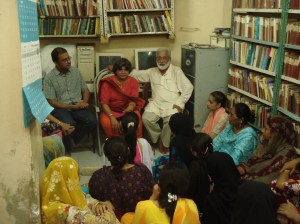
India's Kavita Srivastava meets Pakistan's Rajasthani women. Also pictured Haris Gazdar (left) and Karamat Ali. Photo: YPC

India’s Kavita Srivastava meets Pakistan’s Rajasthani women. Also pictured Haris Gazdar (left) and Karamat Ali. Photo: YPC

KARACHI, Jul 8 (IPS) – The months following last year’s Mumbai terror attacks have seen a renewed sense of urgency among peace activists in Pakistan and India. Citizens are pushing their governments to resume the composite dialogue process between the two nuclear-rival nations.

India suspended the process after the Mumbai attacks, accusing Islamabad of not doing “enough” to contain terrorism. But activists argue that terrorism is not Pakistan’s problem alone.

“Both countries are going through a critical phase,” says Jatin Desai, a veteran Mumbai-based journalist.

A frequent visitor to Pakistan, he was in the country with two other Indians, meeting community-based organisations, political leaders and media persons in Karachi, Lahore and Hyderabad to take the push for peace to the people. His proposal to ‘twin’ the press clubs of Karachi and Mumbai was positively received.

“After the Mumbai terror attacks, Mumbai residents sent a clear message – No to war, No to violence, No to terror,” said Desai. “Thousands joined hands for a hundred kilometre long ‘human chain for peace’ on Dec. 10, 2008, to say this and urge a resumption of the peace process.”

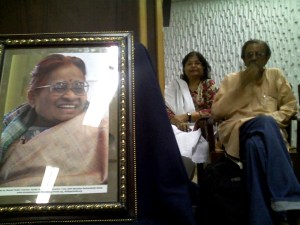
Zahida Hina and Jatin Desai at the seminar for Nirmala Didi. Photo: beena sarwar

Zahida Hina and Jatin Desai at the seminar for Nirmala Didi. Photo: beena sarwar

He was speaking at a seminar in Karachi to underline the need for peace in South Asia and to honour Nirmala Deshpande, a prominent peace lobbyist, who passed away in May 2008.

A majority of participants in the seminar were women from low income localities whose husbands work as daily wage labourers. Mumtaz, a young woman suckling her toddler, told IPS that this was the second such event she had attended.

“I understand what it’s about,” she said. “They want peace between India and Pakistan. We should live in peace with our neighbours. Maybe then our lot will improve. We all want that.”

Breakthroughs between India and Pakistan are routinely subverted by violence like the Mumbai attacks.

The security establishments and military machines also have vested interests in keeping tensions simmering.

“There will be no peace until the arms race ends,” said Mohammad Ali Shah of the Pakistan Fisherfolk Forum, representing a community severely impacted by the hostilities, with whom the Indian delegates spent an evening.

“There are currently over 500 Indian fishermen in Pakistani prisons, and over 150 Pakistani fishermen in Indian prisons,” Shah told IPS. “Fishermen on both sides caught violating the maritime borders are treated as prisoners of war.”

A consular access agreement of May 2008 – aimed at facilitating early release of prisoners – requires both sides to exchange updated lists of each other’s nationals in their custody every Jan. 1 and Jul. 1.

Pakistan handed over its list to the Indian government. “But India defaulted both times this year, and has been unable, for unspecified reasons, to provide Pakistan with a list of Pakistani prisoners in Indian jails,” reported The Hindu on Jul. 2.

The lists in any case are incomplete, with many prisoners unaccounted for.

Jaipur-based Kavita Srivastava of India’s People’s Union for Civil Liberties (PUCL), on her maiden visit to Pakistan, wanted information about five Indian prisoners incarcerated in Pakistani prisons since 1991.

“Only two are in touch with their families, we don’t even know if the other three are alive,” she told IPS. “When they heard that I got my visa, their families walked for a whole day to meet me. With tears in their eyes they begged me to bring any information I could.”

She was unable to ascertain their whereabouts but left with a promise from the provincial minister for prisons that “next time” she would be allowed to visit the prisons and verify for herself.

“Such visits are important to increase contacts. After all, we are one region. We should be able to meet,” Shakeel Silawat of the Youth Progressive Council told IPS, after arranging a visit for Srivastava with girls and women from his community. Silawats are Rajasthanis who often have families on both sides of the border.

“If there was dual citizenship for Indians and Pakistanis, believe me, many would take it,” asserts award-winning social activist Sandeep Pandey from Lucknow.

Pandey participated in the 2005 peace march from Delhi to Multan in the south of Pakistan’s Punjab province. The marchers had also received enthusiastic welcomes from Pakistani villagers along the way.

Karamat Ali from the Pakistan Peace Coalition which organised the visit said that the Indians left with “a sense of the urgency for peace with India which appears to be greater among Pakistanis”.

“They realise that they need to push the Indian government to change its attitude towards the elected government of Pakistan, go beyond pressurising the Pakistani government to ‘take action’, in order to break the grip of the establishment here,” he told IPS.

Such visits may not yield immediate results, but the fact that the governments allow them to take place is in itself a step, if not forward, then at least not backwards. And in the context of India and Pakistan, that can only be seen as positive.

(END/2009)

http://www.ipsnews.net/news.asp?idnews=47575