Conversations 12: A grounding for reconciliation

I forgot to upload the last few Conversations published in The News on Sunday, Aman ki Asha page in Political Economy. The entire archives are also up at the Aman ki Asha website

A grounding for reconciliation

Dilip D’Souza and Beena Sarwar continue their email discussion, questioning state versions of history and politics

May 20, 2010

Dear Beena,

So here you go – on my wife’s birthday I am taking a couple of hours off to write this to you. Please send whatever brownie points I’m eligible for to various powers that be in our countries.

Facetiousness aside, I’m once more in the hills as I write, this time in the south. Such a clean, quiet, beautiful spot. So peaceful, in fact, given our discussions for several weeks now, I cannot help wondering if such peace is the exception in our part of the world, rather than the rule; and if so, will that ever change? Is it meant only for an incredibly lucky few? Continue reading

Conversations 10: The trust deficit

May 6 2010

Dear Beena,

I am heartened too by our PMs meeting in Thimphu. But let me say that I also have hope from such events as your Aman ki Asha seminar, where there’s discussion between folks from both sides who have less political pressures on them than ministers.

Still, while I don’t mean to second-guess what happened at the seminar, I wonder about the urge to build a “consensus” in discussions like these. Is that always necessary or useful, what do you think? I wonder if we end up watering down our own emotions and concerns in the search for consensus, and thus leave them essentially un-addressed. If that’s at all true, it’s not a good prescription for peace. Continue reading

Kashmir solution ‘a hair’s breadth away’ – Kasuri at Aman ki Asha seminar

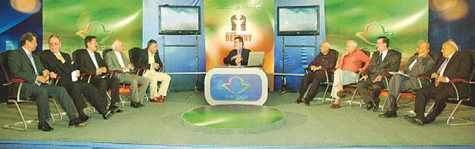
Aman ki Asha panel on 'A Common Destiny', April 23, 2010, Lahore

Back in Karachi after an eventful visit to Lahore for the Aman ki Asha ‘A Common Destiny’ conference that started on April 22, with a closed door discussion between distinguished Indians and Pakistanis deliberating on issues of strategic importance and the need for peace between the two countries. They agreed on this joint statement at the end of the day.

The following day, at a televised panel discussion, conducted by Iftikhar Ahmad of Geo TV,  former foreign minister Khursheed Kasuri elaborated on something he has hinted at before – that Pakistan and India had been a hair’s breadth away from a settlement on Kashmir. What stymied the agreement was instability within Pakistan and Musharraf’s ouster of the Chief Justice which led to a nation-wide movement. Following the panel discussion, he talked in more detail to some of the journalists present, including the Times of India’s senior editor Ranjan Roy, and Babar Dogar of The News. Their detailed stories, merged and published the following day with a joint byline, are available at this link. In brief: Continue reading

Aman ki Asha Press release: Dialogue on ‘A Common Destiny’

LAHORE, Apr 22: Prominent academics, writers and analysts from India and Pakistan met today at a closed-door seminar titled “A Common Destiny”, the first of Aman ki Asha’s series of discussions on issues of strategic importance.

Delegates at the first of Aman ki Asha’s series of discussions on issues of strategic importance to India and Pakistan, titled “A Common Destiny”, agreed on the need for peace between the two countries, and the importance of a sustained dialogue to resolve bilateral issues including Jammu & Kashmir, terrorism, water-sharing, trade and investment. Continue reading

Conversations 8: Clap with both hands

Dilip and my ongoing weekly email exchange (archives at the Aman ki Asha website, published in The News on Sunday Political Economy section, Aman ki Asha page on April 18, 2010:

April 15 2009

Dear Beena,

Rejuvenated by a few days tramping in the hills, I return to our fray, if that’s the word. Continue reading

Conversations 7: Frankly my dear, let’s give a dam(n)

I’m really behind on my postings. Below, Dilip & my Conversations (7th installment), published in The News on Sunday’s Aman ki Asha page in the Political Economy Section on April 4, 2010

April 1 2010

Hi Beena,

OK, so perhaps we are agreed that we should find a way to take forward the idea of a joint war memorial and/or peace parks on the borders. We should ask about your view that a serving soldier cannot openly support such an idea. I cannot imagine that doing so would be equated to refusing to serve and being called a conscientious objector. Perhaps we can write a letter to senior officers in both our countries, suggesting such memorials, and see where it goes. I’ll draft one and let’s discuss it. Continue reading

CONVERSATIONS-4: It’s about time

Published in The News on Sunday Aman ki Asha page, Political Economy section, on March 14, 2010

Conversations 4: It’s about time

Dilip D’Souza and Beena Sarwar continue their correspondence, attempting to share thoughts honestly, without fear and hostility, exploring what divides our countries, and seeking ways to bridge the divide

March 11, 2010

Dear Beena,

Again, so much to address! But since I asked what annoys you about Indians, and since you answered so frankly, let me make that the theme for this installment of our exchange, and in two ways.

First, your beef is with “the hard-nosed nationalism and sense of superiority of many Indians, the refusal to introspect and see flaws within their own society.” Personally, I’m bothered too by this reluctance to see flaws, by the sense of almost manifest destiny and even entitlement that a lot of us Indians nurse. Continue reading

HAITI: How and why Pakistanis can help

Excerpts from appeal and joint statement by Todd Shea and Ethan Casey at the Alive and Well in Pakistan blog, addressed to Pakistani-Americans:

The aftermath of the October 8, 2005 earthquake was Pakistan’s finest moment. The nation’s citizens, government, military, and expatriates stepped up together and contributed money, material, time, professional skills and other resources to alleviate the suffering of the survivors of the devastating quake that killed more than 80,000 people.

The 7.0 earthquake that struck Haiti on January 12 has devastated that small, desperately poor country at least as much as the 2005 earthquake devastated Pakistan. Pakistan has resources that Haiti lacks – like a competent, patriotic army and an affluent expatriate community. Continue reading

India and Pakistan: Bridging the gap

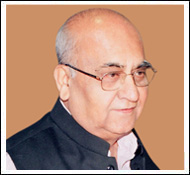
RK Mishra

RK Mishra Memorial Lecture by Maj Gen Mahmud Ali Durrani

Excerpts below, complete text at http://tinyurl.com/md-mishra – thanks to Renuka Mishra whom I met in Kabul. See also ‘Ex-NSA for ‘candid talks’ between Indo-Pak security agencies’, Iftikhar Gilani’s report on the event in Daily Times, Sept 6, 2009.

Pakistan’s National Security Adviser till January 2009, former Ambassador to the USA, active in peace initiatives between India and Pakistan (he’s known as “General Shanti” in India, author of several books and studies – was closely associated with the well known Indian journalist, thinker, and parliamentarian RK Mishra who passed away earlier this year. He delivered the first RK Mishra Memorial Lecture in Delhi on Sept 8, 2009 –

India and Pakistan:  Bridging the gap

'General Shanti' at IIC, New Delhi

'General Shanti' at IIC, New Delhi

In his talk, Gen. Durrani suggested, among other things, opening up the visa regime between our two countries; allowing broadcast of TV programs from one country to the other; setting up a joint “lndo-Pak  “Arid Agriculture Research Centre”; including agriculture as a major component of the composite dialogue; cooperating in areas like water, coal, wind and solar energy; and supporting “any solution which is acceptable to the majority of the Kashmiris. The bottom line – Kashmir for the Kashmiris.”

Continue reading

Deconstructing `We, the Mothers of Lashkar-e-Tayyaba’

Ham Ma’en Lashkar-e-Taiba Ki (`We, the Mothers of Lashkar-e-Tayyaba’), a series of Lashkar-e-Tayyaba propaganda publications – very appropriate to post ahead of the whole commercial mother’s day hype.

“…the Lashkar-e-Taiba uses mothers’ grief to create an emotionally charged arena that, it hopes, will both justify its mission and help increase volunteers for its mission” writes Farhat Haq in her analysis, published in Economic & Political Weekly, India – See http://snurl.com/hlil7 for the link

C.M. Naim in Outlook weekly, India, gives a detailed commentary on the three volumes have(they all “have the same garish cover, showing a large pink rose, blood dripping from it, superimposed on a landscape of mountains and pine trees”), published between November 1998 and October 2003. See – http://snurl.com/hliu5