Indian Supreme Court judges appeal to Pakistan for prisoner’s release, quote Faiz, Shakespeare

March 14, 2011, New Delhi: “The quality of mercy is not strained” and  “Qafas udaas hai yaaron” – Indian Supreme Court judges quote Shakespeare and Faiz in appealing to the Pakistani authorities to release an Indian prisoner detained for 27 years, applaud “humanitarian spirit on both sides”. Judgement below (thank you Jatin Desai for sending the judgment so fast)

REPORTABLE

IN THE SUPREME COURT OF INDIA
CRIMINAL ORIGINAL JURISDICTION

WRIT PETITION (CRIMINAL) NO. 16 OF 2008

Gopal Dass Thru. Brother Anand Vir    ..       Petitioner

-versus-

Union of India and anr.        ..  Respondents

J U D G M E N T Continue reading

‘In the political tug of war it’s the poor and helpless that hurt the most’

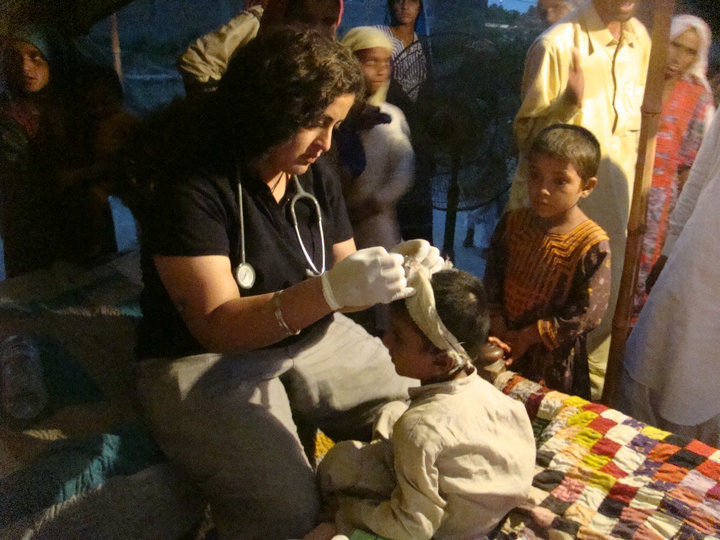
Geet Chainani conducting a medical camp in a village near Dadu, Sindh

“I, an American, a New Yorker used to the harsh winter and snowy weather yet, I am freezing in Pakistan. My heart goes out to those suffering the cold winter without shelter, blankets, clothing. May God provide you with his soldiers to keep fighting for the injustices meted out to you. May we all be able to look beyond the differences and reach out a helping hand.” – Geet Chainani, Dec 15, 2010

My article on an Indian-American doctor who comes to Pakistan in search of her Sindhi roots… and finds a sense of peace working for flood-affected women and children, published in Aman ki Asha, March 2, 2011 (as another Indian put it – “not Akhand Bharat, but Akhand Insaniyat”) Continue reading

Personal Political: Dear Abhijeet, please come to Pakistan

Yes, we do have theatre in Pakistan. Sania Saeed in 'Mein Adakara Banoongi'. Many other listings at http://www.danka.com.pk/

My monthly column Personal Political in The News on Sunday (Political Economy section, as ‘Going beyond ‘nothing’ in Pakistan’) and in Hard News, New Delhi

Good music too: Zeb and Haniya. See their interview at http://bit.ly/zebhania

Oct 24, 2010 Personal Political

Going beyond ‘nothing in Pakistan’

Beena Sarwar

“There is nothing in Pakistan,” said the Indian playback singer with finality. “They have no auditoriums, no facilities, there is nothing there. Everything is here (in India).”

Another example of the misconceptions about Pakistan, I thought, waiting to respond. The playback singer, Abhijeet Bhattacharya, and I were participating in a talk show for NewsX TV in New Delhi. Participating from a hired studio in Karachi, I could hear, but not see, the others.

When I tried to reply to this comment, the Indians couldn’t hear me, although I could still hear them through my earpiece connected to a phone line. I was no longer on air. NewsX had booked a live uplink from Pakistan for 20 minutes, which was over. Symbolic? Continue reading

India and Pakistan are stronger together

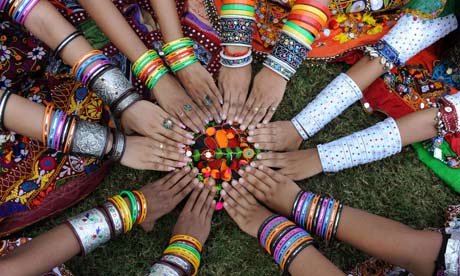
Indian dancers from the Rang Rasia Group traditionally touch their master's turban before the rehearsing Garba in Ahmedabad. Photograph: Sam Panthaky/AFP/Getty Images

My article in The Guardian recently prior to our talk at The Guardian Foundation:

India and Pakistan are stronger together

Loosening cultural, travel and trade restrictions is a vital first step to rediscovering our two countries’ shared heritage

India and Pakistan may be neighbours but it’s surprising how little they really know about each other. Their rich common heritage is easily forgotten amid mutual baiting and negative stereotyping, and it’s difficult to imagine them ever being truly at peace until these obstacles have been overcome.

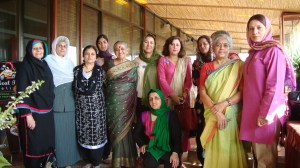
“I’m really surprised to see so many women … I thought you would be all covered in burqas,” said a journalist at the Indian Women’s Press Club when the Pakistani contingent arrived last April on a visit organised by Aman ki Asha (a joint initiative for peace by the Times of India and Pakistan’s Jang media group). >

DEVELOPMENT-SOUTH ASIA: Women’s Peace Offensive

Analysis by Beena Sarwar

A collective aspiration for peace brings together women from India, Pakistan and Afghanistan. Photo:Roshan Sirran

A collective aspiration for peace brings together women from India, Pakistan and Afghanistan. Photo:Roshan Sirran

KABUL, Oct 18 (IPS) – ‘Give peace a chance’ may just be another cliché for many, but for women who have suffered the ravages of war, endless strife and other forms of conflict, joining hands to find meaningful solutions to their collective aspiration lends it a whole new meaning.

Within the South Asian region, Pakistan, India and Afghanistan have for decades been torn by internal and external conflicts that have cried out for, but have not quite found, a lasting resolution.

“We waited for a long time to see what the men would do for peace,” Zahira Khattak, a member of the think-tank formed by Pakistan’s Awami National Party (ANP), told IPS.

Continue reading

Arundhati ‘Pakistani’ and right-wingers ‘patriotic’

The FMP panel in Delhi, April 15, 2009

The FMP panel in Delhi, April 15, 2009. Photo: FMP

Panel members Arundhati Roy & Aniruddha Bahal. Photo: B. Sarwar

Panel members Arundhati Roy & Aniruddha Bahal. Photo: B. Sarwar

PERSONAL POLITICAL

Beena Sarwar

“Shouldn’t Arundhati Roy come from Pakistan?” sarcastically asked a Delhi freelance journalist, commenting on the Facebook posting about a panel discussion, ‘Does Media Jingoism Fan India Pakistan Tensions?’ The cynical remark stemmed from his annoyance, shared by many, at Roy’s consistent exposure of India’s ‘warts’.

The panel, organised by the recently formed Forum of Media Professionals (www.fmp.org.in ), included four journalists from India besides the celebrated writer and activist Arundhati Roy as well as four Pakistani journalists and The Hindu’s Islamabad correspondent Nirupama Subramanian.

Delhi is far cleaner and greener since I was last there nearly five years go, thanks to laws (that are actually implemented) banning diesel and making CNG compulsory. On a more intangible level, another kind of pollution remains, reminiscent of a phenomenon we face in Pakistan: right-wing jingoism fuelled by emotional appeals to religion and nationalism.

The jibe about Arundhati Roy, disguised under an urbane sarcasm, is just one aspect of bigoted nationalism. Going by that logic, those in Pakistan who fight for justice — a struggle that necessitates exposing wrongdoings, or ‘washing dirty linen in public’ according to our critics — should represent India. Another aspect of such thinking is evident in the comments back home when I show my documentary ‘Mukhtiar Mai: The Struggle for Justice’, in Pakistan: “Why don’t you make such films about violence against women in India? Women there have these problems too.”

I wonder at this competitiveness that makes us feel self-congratulatory when we can point out how much worse the other is in some way.

Thankfully, not everyone takes this myopic view. In Allahabad, at a crowded meeting of the Pakistan-India People’s Forum for Peace and Democracy (PIPFPD), there was none of this one-upmanship or finger pointing. The audience immediately saw the commonalities of the issues raised in the films I showed, on Pakistan’s flawed and discriminatory Hudood Laws and Mukhtiar Mai. They understood that the phenomenon in Pakistan of Taliban ‘punishing’ women for alleged transgressions is not much different from those who rape, kill or lynch women and couples for the sake of ‘honour’ in India itself or indeed in traditional communities in Pakistan.

The difference is that most of these ‘honour crimes’ are committed by relatives of the women who ‘transgress’, as opposed to the Taliban who are taking it upon themselves to enact these punishments as part of the imposition of their own criminal justice system that flouts the writ of the state.

Another difference is that the family in Haryana who hanged their daughter and the man she eloped with (in their own home) will be charged, tried and probably punished. In Pakistan, the ostensibly Islamic Qisas and Diyat (retribution and blood money) laws imposed by a military dictator in the 1980s allow the murder victim’s family members to ‘forgive’ the perpetrators who are often their own relatives.

As for the Taliban and their sympathisers, none have ever been charged for their criminal transgressions, ranging from blackening women’s faces on billboards, to disrupting public events in that involve women (remember the Gujranwala marathon?), to blowing up schools, killing teachers and dragging women out of their homes and murdering them for alleged ‘immorality’.

At the Allahabad meeting, the tone was set by senior advocate Ravi Kiran Jain in his introduction when he stressed on the need for a stable government in Pakistan, and the desire to remove misunderstandings. His words reminded me of Nirupama Subramanian’s appeal at the panel discussion in Delhi urging Indians to “be sensitive to Pakistan as a country that has problems and show moderation in we respond to these problems.”

Many Indians already understand this, but we don’t hear their voices in the media very often. For instance, Utpala, a women’s rights activist during the discussion in Allahabad talked about the need for Indians and Pakistanis to be allowed to visit each other’s countries. Her own visit to Pakistan many years ago, she said had expanded her ‘angan’ (literally, courtyard). She ended by asking, “How can we in India be happy until there is a pro-people, pro-women government in Pakistan?”

The Delhi panel was disrupted for a minute or so by one man at the back of the auditorium who stood up and shouted anti-Pakistan, pro-war slogans. The organisers threw him out. He turned out to be from the Sri Ram Sene, one of the faces of India’s right-wing ‘Sangh Parivar’, who . Three or four others were outside, whom the organisers had refused to allow entry as they were not signing their names in the register. The SRS, which does not otherwise have much presence in Delhi, later claimed it had sent ‘thirty’ men to disrupt the meeting.

True to form, illustrating the very issues we had been discussing, most media hyped up the disruption which then overshadowed the discussion itself. Pakistani journalists were ‘roughed up’, ‘attacked’, the meeting disrupted for ’15-20 minutes’ and so on. The incident set off a chain reaction across the border, giving right-wing forces in Pakistan the opportunity to condemn the ‘anti-Pakistan feelings in India’. A ‘human rights’ organisation held a demonstration against the ‘attack’. Jamat-e-Islami’s recently elected chief Munawwar Hasan promptly issued a statement saying that it should serve as an eye-opener to those who talk of friendship with India and they should refrain from visiting India (‘ba’az ajana chahiye’).

For such people, obviously the anti-Pakistan slogans raised by one miscreant are paramount over the dozens of people in the IIC auditorium who listened respectfully to the discussion and engaged in a dialogue with the speakers later. The people in Allahabad and at the Delhi Press Club a few days later who came to hear a Pakistani journalist and express their support for a democratic order in Pakistan also don’t count, even if some of them were prepared for a rough time, like Zafar Bakht in Allahabad who had lent his school’s auditorium for the event. “After hearing of the Delhi incident, we rolled up our sleeves and were prepared,” he said later.

In the end, the anti-Pakistan slogans raised by one miscreant hogged the media limelight rather than those who filled the auditorium, heard the speakers respectfully and engaged in dialogue later. This is the nature of the media beast. Who is going to tame it?

More on women – and Rahman Baba

Sangota Girls Public School, Swat, destroyed by militants. Photo by Kamran Arif

Sangota Girls Public School, Swat, destroyed by militants. Photo by Kamran Arif

Forgot to include the following in my posting focusing on women

AMMU JOSEPH’s article ‘Our freedom is at stake’ is linked to the issues Kalpana Sharma identified in her article on the attacks women in India are facing, which as I wrote, looks like an Indian version of the Vice & Virtue dept of the Taliban that we are facing here in Pakistan. Ammu’s Bangalore Mirror article of Feb 12 (but still very relevant) at

http://tinyurl.com/clhdzy

And now to RAHMAN BABA: As the political confrontation heats up in Pakistan ahead of the lawyers’ long march, joined by the Sharifs who were disqualified from politics recently, before all this reaches a stage where it overtakes all other discourse (which it already seems to have, to an extent), wanted to post a few items related to the disturbing attack on Rahman Baba’s shrine near Peshawar on March 5. The attack caused widespread outrage and practically every paper took it up. The incident took place just two days after the March 3 attack on the Sri Lankan cricketers in Lahore that led to a knee-jerk reaction among many Pakistanis blaming India for the attack.

Countering the culture of blame-counter blame, Siddharth Varadarajan, Associate Editor The Hindu, wrote on March 4 that finding ways to “encourage Pakistani cooperation and, more generally, to stabilise that country, are the most important challenges facing Indian diplomacy”. See his article ‘Lahore attack shows urgency of joint action on terror’ – Forget the conspiracies, the threat to Pakistan and India is the same – http://tinyurl.com/au8xhy

I thought he was spot on, on the whole and had a comment to add to his statement that “Cricket is the most visible icon of secular Pakistan, and perhaps the only competitor militant Islam faces in its struggle to tame the wayward Pakistani mind.”

I wrote: “There is another, even more deep-rooted competitor militant Islam faces – the widespread adherence to Sufi Islam and values, superstition, taweez dhaga (tying threads, getting amulets) etc. I fear (hope hope hope I am wrong) a major attack on any urs (birthday celebrations of Sufi saints) taking place at any of the major shrines any time soon…”

The following day, militants bombed the shrine of the 17th century Sufi poet Rahman Baba. An AP report in the Independent commented that the attack highlighted “the gulf between hard-line Muslims and many in the region who follow a traditional, mystical brand of Islam… A professor at Peshawar University told a local TV station that in many Pashtun homes, Baba’s poems are kept alongside the Islamic holy book, the Quran.” http://tinyurl.com/b45yo5

The caretaker of the shrine said he had got a letter three days before the attack warning against the perpetration of this “shrine culture” and objecting to the fact that women were coming to pray at the shrine. Militants used remote control bombs that destroyed the outer wall of the Mausoleum and partially damaged the building one month ahead of Baba’s urs, scheduled for April 5.

According to Pashtun Post <www.pashtunpost.com/>, Yousaf Ali Dilsoz, President of Rahman Baba Adabi Jirga says that Rahman Baba is the icon of Pashtuns spirituality and their love for peace and tolerance. “Saidu Baba, a revered saint from Swat valley, is known to have said that if the Pashtuns were ever asked to pray on a book other than the Koran, they would undoubtedly go for Rahman Baba’s work.”

Pashtun Post contains translations of some of Baba’s verses – http://tinyurl.com/c6neqy

Some excerpts:

Sow flowers so your surroundings become a garden
Don’t sow thorns; for they will prick your feet

If you shoot arrows at others,
Know that the same arrow will come back to hit you.

Humans are all one body,
Whoever tortures another, wounds himself.

(ends)

Focus on women – Pakistan, India, Afghanistan, a docu on Swat and more

Still from my film 'Mukhtiar Mai: The struggle for justice'

Still from my film 'Mukhtiar Mai: The struggle for justice'

A collection of articles published around March 8, including mine for IPS and The News, plus articles by Kalpana Sharma, Cassandra Balchin, Zofeen Ebrahim, Ayesha Khan (study on Lady Health Workers in Pakistan), link to a documentary on a Swat schoolgirl and more. Another post pending on issues around the attack on Rahman Baba’s shrine near Peshawar, will compile and post soon.

‘A new political context for Juliet’ – my article for The News on Sunday, about women speaking out all over the country, attempting to exercise their rights to personal autonomy – in a post-colonial age that harks back to medieval times when women were considered family property

Women Defy Militancy, Patriarchy – story for IPS outlining the twin threats of militancy and patriarchy that women face in Pakistan
http://www.ipsnews.net/news.asp?idnews=46024

In both articles, I refer to a documentary ‘Class Dismissed in Swat Valley’ (NYT) that focuses on Malala, an 11-year-old Pakistani girl on the last day before the Taliban close down her school. A must see – very moving and informative – profiling the great courage of ordinary people under adversity
http://tinyurl.com/avq4c9

I learnt of this film through an article that Shabbir Imam in Peshawar forwarded from the Anchorage Daily News by Shehla Anjum, a Pakistan-born writer based in Alaska, ‘Taliban wages war against girls’ education in Pakistan’. The writer followed up the story in the documentary by contacting Malala and her father.
http://tinyurl.com/dmxtld

The IPS website – http://www.ipsnews.net – contains a link to the other articles around Women’s Day –
http://www.ipsnews.net/new_focus/women/index.asp
This link includes other articles worth looking up, from Palestine and Afghanistan, and ZOFEEN EBRAHIM’S article about child marriage in Pakistan
http://www.ipsnews.net/news.asp?idnews=46022

KALPANA SHARMA in her column `The Other Half’ in The Hindu, Sunday Magazine, March 8, 2008, writes about the attacks women in India are facing – a chilling account of what looks like an Indian version of the Vice & Virtue dept of the Taliban that we are facing here in Pakistan…
http://tinyurl.com/bql9vg

CASSANDRA BALCHIN – a three-part series on the challenges faced by Muslim women around the globe and the debates within the Muslim world to deal with these challenges, the demand for equality within the family, and more, in Open Democracy – http://www.opendemocracy.net – I’ve shortened the three URLs for easy reference here:
Home truths in the Muslim family – The global pressure to reform Muslim family law is mounting
http://tinyurl.com/bxhf8v

Musawah: there cannot be justice without equality – Muslim scholars and activists from 48 countries launch a global initiative for justice with equality between men and women
http://tinyurl.com/akg2q8

Musawah: solidarity in diversity – a global initiative to reform Muslim Family Law finds solidarity in diversity and a growing convergence around human rights values.
http://tinyurl.com/bbvvhd

AYESHA KHAN’s recent study on LHWs and Women’s Empowerment in Pakistan can be accessed through the Collective for Social Science Research website
The study is at this link: http://tinyurl.com/cssr-lhv